Paperback, 480 pga, Pub June 4th 2019 by Other Press (NY) (first published January 1st 2012), Orig Title: Bortom varje rimligt tvivel, ISBN13: 9781590519196, Series: Sophia Weber #2
This legal thriller bursts out of the gate from the first pages, easily capturing the attention of anyone who has ever been, or known, a teenaged girl. At the same time it underlines and validates the well-deserved success of Swedish novelist Malin Persson Giolito, who won Best Swedish Crime Novel of the Year for her English-language debut Quicksand.
Persson Giolito has not so much captured the crime thriller genre as reinvented it for a sophisticated and cosmopolitan audience. We may never have set foot in Scandinavia but we certainly know their crime writers. Quicksand was optioned and produced as a Netflix Original Series, and debuted worldwide in April 2019.
This story is presented as a case of possible wrongful imprisonment; as each new fact is uncovered, our vision blurs and we are not sure if we have corrupt law enforcement, a scam trial, evil parents, or #MeToo run amok. The victim is fifteen and a model student. A doctor is in jail for her murder. A female lawyer in mid-career is asked to look into the case by her old professor, as a favor. Reluctantly, this lawyer begins to investigate the old case, now fifteen years past, and sees the possibility of retrial or release.
The story has resonance, the subject is personally interesting to everyone, and Persson Giolito’s writing is sharp and insightful. She adds short propulsive chapters of character development to bind us to the characters. We see marriage with the boredom left in, and then later, the exquisite and intimate tenderness. We enjoy the sight of a woman exhausted by the mental and emotional toil of lawyering take a 3-ton sailboat out on a northern ocean by herself in March for a week. We recognize the misplaced pride of the old professor who may have sabotaged his protégé’s case because he wanted the recognition due her.
This novel is just being published in time for summer reading this year and I urge you not to pass this one by when you are developing your summer reading list. It is definitely an immersive rain day read at the beach, but will keep anyone occupied for what it tells us about the psyche of young girls, the legal system in Sweden, and the state of criminal forensics in Europe. Apparently everyone looks to England for “the latest equipment” and to America for discoveries in the field: the TV show CSI makes the actors look authoritative beyond all reason.
The final third of this novel is reason to read through to the end. It is utterly without formula and gripping for that. I don’t think anyone will predict how this legal case might turn out. Americans may have a view of Sweden as famously liberal sexually, but what struck me beyond the fact that fifteen is considered the “age of consent,” is how similar our wealthy classes appear to be in terms of social development. In other words, a teenager is a teenager is a teenager, with all the teenaged angst fairly shared around the world.
Women will feel a bond with Persson Giolito after reading this novel. She is, after all, a professional woman making her way in what used to be called “a man’s world.” Male supremacy has not ended yet, but there are chinks in the wall. Persson Giolito has her main character make casual comment about the backlash that plagues a professional woman making any kind of public statement that could conceivably be the subject of controversy; she describes the now all-too-familiar online and media trolling that is difficult to survive, emotionally, personally, professionally.
The backlash often comes in the form of sexual attack. When I examine my own thinking, I have to admit the most outrageous swear word still taboo is the C word, only recently publicly breached and used in mixed company, but still not normalized. When we get mad, we get sexual. Persson Giolito also makes reference to the court of public opinion: how bad information about a person may be introduced into the public sphere through social media and is almost impossible to combat. This is partly why this book feels so contemporary, and cosmopolitan. Women and men must deal with this new world now.
Persson Giolito is now a full-time writer based in Brussels. In an earlier incarnation she worked as a lawyer for the biggest law firm in Scandinavia and as an official for the European Commission. She is a writer of enormous gifts, and her invention looks like the real deal. Her perceptions are invariably enlightening. Her description of winter sailing made me want to pound my chest Tarzan-style. Women are just getting better and braver and that is a good thing.
Tweet
Showing posts with label summer reads. Show all posts
Monday, June 3, 2019
Saturday, June 30, 2018
To End a Presidency by Laurence Tribe & Joshua Matz
Hardcover, 304 pgs, Pub May 15th 2018 by Basic Books, ISBN13: 9781541644885
America is an advanced democracy. It is imperative we the citizenry recognize our responsibilities and make use of our rights. “Impeachment is neither a magic wand nor a doomsday device.” It won’t fix the problems that brought a failed real estate magnate and showman to power. Moreover, calling for impeachment may have deleterious consequences which serve to rally the tyrant’s support.
The best thing about this book for me is that it lowered my blood pressure. I am not going to deny I have been distressed for…more than a year now, and severely low in the past couple months. This book reminded me that there are smart, educated people thinking about how best to deal with a liar whose proclivities border on fascism. Impeachment, these authors argue, may not be the best way to address this threat.
The authors stress that loose talk of impeachment may become as desensitizing as crying wolf when even the public begins to mistrust the options for curbing bad behaviors in a sitting president. Our elected officials must think strategically about what they are planning to achieve especially when they do not control enough seats to initiate impeachment hearings. Hot air is not helpful in educating the public in a time of crisis because it inflames the citizenry’s baser instincts.
We must work together if we are going to govern. The authors quote Lincoln at a time our country was more divided than now:
This book is worthwhile. Time to take a deep breath and think before you speak.
Tweet
America is an advanced democracy. It is imperative we the citizenry recognize our responsibilities and make use of our rights. “Impeachment is neither a magic wand nor a doomsday device.” It won’t fix the problems that brought a failed real estate magnate and showman to power. Moreover, calling for impeachment may have deleterious consequences which serve to rally the tyrant’s support.
The best thing about this book for me is that it lowered my blood pressure. I am not going to deny I have been distressed for…more than a year now, and severely low in the past couple months. This book reminded me that there are smart, educated people thinking about how best to deal with a liar whose proclivities border on fascism. Impeachment, these authors argue, may not be the best way to address this threat.
“When our democracy is threatened from within, we must save it ourselves…We must draw together in defense of a constitutional system that binds our destinies and protects our freedoms.”Calls for impeachment have been increasing over the past decades, but this pair of authors thinks that is a sign of the divisiveness of our politics rather than realistic means of addressing things we don’t like about the other party’s president. We reached a new low when, even before the last presidential election in 2016, promises were made by each side to impeach the winner.
The authors stress that loose talk of impeachment may become as desensitizing as crying wolf when even the public begins to mistrust the options for curbing bad behaviors in a sitting president. Our elected officials must think strategically about what they are planning to achieve especially when they do not control enough seats to initiate impeachment hearings. Hot air is not helpful in educating the public in a time of crisis because it inflames the citizenry’s baser instincts.
We must work together if we are going to govern. The authors quote Lincoln at a time our country was more divided than now:
“We are not enemies, but friends. We must not be enemies.”Yes, exactly. We clearly have not seen the existential threats coming down the road or we would be a lot more circumspect about calling hatred down on fellow citizens. Good grief. If we can’t work together despite living in the most resource-rich and abundant country on earth, we’re gonna lose it. But the people that made us this angry will all be dead and we and our children will have to deal with the problems that come. If everybody’s happy with that, let’s prepare well.
“In our experience, one of the main obstacles to an even-keeled analysis of impeachment under Trump is the fear and fury that he inspires in many of his political opponents.”Don’t be a part of the problem. Educate yourself. It turns out that the most reliable way to deal with a pedant ideologue is to sideline them…in our case, by voting him and his supporters out. Not easy. But neither are any of the alternatives. This state of affairs was a long time developing into toxicity. It may take some time to rid ourselves of it.
This book is worthwhile. Time to take a deep breath and think before you speak.
Tweet
Tuesday, June 12, 2018
Warlight by Michael Ondaatje
Hardcover, 304 pgs, Pub May 8th 2018 by Knopf Publishing Group, ISBN13: 9780525521198
What a beautiful book this is, and how it reminds us how many people go before us, unsung, unremarked, unremembered. A teenaged boy and his slightly older sister find themselves attending separate but proximate boarding schools rather suddenly one year while their parents have taken off for Singapore. The schools are not happy matches and the kids meet up and decide to run away. They return home where a curious bachelor holds fort in their absence. The teens begin a whole new type of education.
The central mysteries in the novel unfold gradually, some we are never privy to. One cannot but thrill to the fascinating similarity between this story and John LeCarré's The Spy Who Came In From the Cold, about an impressionable boy and an incorrigible teacher.
The boy and his sister find their way among an oddball group of scammers and outsiders, none of whom want the wider world to know what they are doing. When the teens find their mother's trunk--the one she packed for Singapore-- hidden in the basement, much confusion and uncertainty ensues.
I listened to the audio, beautifully produced by Penguin Random House and read by Steve West. Audio is a wonderful way to enjoy this title, though truthfully, the Alfred A. Knopf hardcover is small, beautifully printed, and self-sufficient. This is a great choice for summer reading, as it is short, terrifically atmospheric, and full of mystery. The action is not so fast the reader doesn't have time to think while reading.
Tweet
What a beautiful book this is, and how it reminds us how many people go before us, unsung, unremarked, unremembered. A teenaged boy and his slightly older sister find themselves attending separate but proximate boarding schools rather suddenly one year while their parents have taken off for Singapore. The schools are not happy matches and the kids meet up and decide to run away. They return home where a curious bachelor holds fort in their absence. The teens begin a whole new type of education.
The central mysteries in the novel unfold gradually, some we are never privy to. One cannot but thrill to the fascinating similarity between this story and John LeCarré's The Spy Who Came In From the Cold, about an impressionable boy and an incorrigible teacher.
The boy and his sister find their way among an oddball group of scammers and outsiders, none of whom want the wider world to know what they are doing. When the teens find their mother's trunk--the one she packed for Singapore-- hidden in the basement, much confusion and uncertainty ensues.
I listened to the audio, beautifully produced by Penguin Random House and read by Steve West. Audio is a wonderful way to enjoy this title, though truthfully, the Alfred A. Knopf hardcover is small, beautifully printed, and self-sufficient. This is a great choice for summer reading, as it is short, terrifically atmospheric, and full of mystery. The action is not so fast the reader doesn't have time to think while reading.
Tweet
Labels:
adolescence,
British,
Canada,
family,
fiction,
Knopf,
PRH Audio,
spies,
summer reads,
war
Wednesday, May 9, 2018
God Save Texas by Lawrence Wright
Hardcover, 352 pgs, Pub Apr 17th 2018 by Knopf Publishing Group, ISBN13: 9780525520108
This is a fast and fabulous, smart and funny read…the kind that reads so effortlessly because the author has a lifetime of writing experience. There is a big-hearted generosity in Wright’s view of Texas, though he doesn’t hesitate to point out personalities or policies that diminish what he believes the state could be. Wright lived many years in Austin, the big blue liberal heart of Texas, a city that attracted so many people to what the city once was that it no longer resembles that attractive mixed-race, mixed-income diversity so rich with possibility.
Having read Wright’s big books on Carter’s peace talks at Camp David, and his exhaustive study of Christian Science, I was unprepared for the deep vein of “will you look at that” humor that richly marbles this piece. It is an utter delight to have Wright use his insider status as a resident to call out especially egregious instances of Texas bullshit.
The book is a memoir, really—the memoir of a natural raconteur from a state where cracking jokes about serious issues is an art form. But before page ten Wright makes clear his assessment of the state:
Music and art are sprinkled throughout this biography, obviously an important part of Wright’s attraction to the state. Each chapter sports woodcuts by David Dantz describing the chapter’s subject and Dantz’s endpapers illustrate the arc of the book. The art, like the prose, is rich with humor and attitude. Music is a part of Wright’s own biography and so he writes particularly well about the scene and historical influences. It’s rounded, this book, and interesting and fun and full of reasons to like Texas, despite its particularly awful politicians.
Texas was a reliably blue state until the 1990s. Houston is the only major city in America without zoning laws. AM Texas radio hosts Alex Jones. Ted Cruz makes jokes about Machine Gun Bacon on Youtube but as usual when Cruz is trying to be funny, it’s an epic fail. Dallas had been a city fostering extremism until Kennedy died there. After that humiliation, Dallas became more open and tolerant, more progressive…and developed more churches per capita than any city in the nation. Wright thinks Dallas has the ability to transform suffering into social change. I say we shouldn’t be blamed for being a little suspicious of all that supposed holiness. Evangelicals have shownwhat they are thinking where they are standing.
In the last chapters, Wright is open about searching for his final resting place. He is only seventy years old, but he is calling it for Texas. I really like that about him. He can conceive of life and death, Democrat and Republican, north and south in one sentence. He can love Texas and laugh at it, too. He has written a truly wonderful, un-put-down-able book about thebiggest second-biggest state in the union.
I'm from Texas.
Tweet
This is a fast and fabulous, smart and funny read…the kind that reads so effortlessly because the author has a lifetime of writing experience. There is a big-hearted generosity in Wright’s view of Texas, though he doesn’t hesitate to point out personalities or policies that diminish what he believes the state could be. Wright lived many years in Austin, the big blue liberal heart of Texas, a city that attracted so many people to what the city once was that it no longer resembles that attractive mixed-race, mixed-income diversity so rich with possibility.
Having read Wright’s big books on Carter’s peace talks at Camp David, and his exhaustive study of Christian Science, I was unprepared for the deep vein of “will you look at that” humor that richly marbles this piece. It is an utter delight to have Wright use his insider status as a resident to call out especially egregious instances of Texas bullshit.
The book is a memoir, really—the memoir of a natural raconteur from a state where cracking jokes about serious issues is an art form. But before page ten Wright makes clear his assessment of the state:
"Texas has nurtured an immature political culture that has some terrible damage to the state and to the nation. Because Texas is a part of almost everything in modern America—the South, the West. the Plains, Hispanic and immigrant communities, the border, the divide between rural areas and the cities—what happens here tends to disproportionately affect the rest of the nation. Illinois and New Jersey may be more corrupt, Kansas and Louisiana more dysfunctional, but they don’t bear the responsibility of being the future."Wright is so skilled now at writing big books that he manages to give us lots of detail and information even in this more relaxed telling, all the while being really funny. He is clear-eyed about why Texas can be a big fail and yet he clearly loves the place.
"To strike it rich is still the Texas dream...Texans are always talking about how much they loved the state, but I wondered where was the evidence of that love."Wright admits he considered leaving during the oil boom/bust in the 1980s when the state never seemed to live up to its obligations. He dreamed sometimes of decamping to liberal California, where he could flog his screenwriting skills...and make more money. He thinks that a country that can hold together two such immensely powerful and opposing forces as California and Texas has got to be something worthwhile and important. I used to think so, too, but feel less confident now. Sometimes I want to saw off those pieces of the country that claim to want so much freedom, and seal the borders. No trade. We’ll see then who comes out on top.
Music and art are sprinkled throughout this biography, obviously an important part of Wright’s attraction to the state. Each chapter sports woodcuts by David Dantz describing the chapter’s subject and Dantz’s endpapers illustrate the arc of the book. The art, like the prose, is rich with humor and attitude. Music is a part of Wright’s own biography and so he writes particularly well about the scene and historical influences. It’s rounded, this book, and interesting and fun and full of reasons to like Texas, despite its particularly awful politicians.
Texas was a reliably blue state until the 1990s. Houston is the only major city in America without zoning laws. AM Texas radio hosts Alex Jones. Ted Cruz makes jokes about Machine Gun Bacon on Youtube but as usual when Cruz is trying to be funny, it’s an epic fail. Dallas had been a city fostering extremism until Kennedy died there. After that humiliation, Dallas became more open and tolerant, more progressive…and developed more churches per capita than any city in the nation. Wright thinks Dallas has the ability to transform suffering into social change. I say we shouldn’t be blamed for being a little suspicious of all that supposed holiness. Evangelicals have shown
In the last chapters, Wright is open about searching for his final resting place. He is only seventy years old, but he is calling it for Texas. I really like that about him. He can conceive of life and death, Democrat and Republican, north and south in one sentence. He can love Texas and laugh at it, too. He has written a truly wonderful, un-put-down-able book about the
I'm from Texas.
Tweet
Friday, August 4, 2017
The Fall Guy by James Lasdun
Hardcover, 256 pgs Pub Oct 18th 2016 W. W. Norton & Company ISBN13: 9780393292329
Ever since I read It’s Beginning to Hurt, a collection of stories by James Lasdun, I have eagerly picked up any writing of his I could find. He comes from a long line of self-aware male novelists who point to themselves, the human condition with its male inadequacies, and laugh with us, e.g., Julian Barnes, Ian McEwan, Graham Swift, and further back, Kingsley Amis and P.G. Wodehouse. That Lasdun is not as broad as these last two, matters not at all for what it is he perceives and is able to convey.
Lasdun may be one of the most underrated novelists of whom I am aware. A new novel of his should be an event, and widely heralded. Instead I came upon this novel published last year in a library display. All my other reading had to wait until I had a chance to see what he was doing in this extraordinarily chilling horror novel in which the unspooling of mystery is embedded in the comfort the characters enjoy.
There is a threesome: a wealthy banker, his beautiful wife, and a talented cousin. There are some stressors: the banker has been laid off, the wife has an artist’s eye but not an artist’s income, and the talented cousin lost his last investment in a restaurant of which he was chef. However, it is summer, and the three escape city heat to enjoy the cool of the summer house in the Catskills, time to refuel one’s energies for the stretch ahead.
The vacation idyll has a butterfly garden, a pool house, privacy hedges, large airy rooms, and a fully stocked kitchen. The chef shops for local produce using the banker’s seemingly inexhaustible supply of funds to prepare gorgeous meals of diverse and exciting courses, accompanied by wines from an extensive cellar that the banker enjoys replenishing in his free time. Everything is lovely until, suddenly, one character in the piece appears in town outside of the role assigned them…
On one foray to the tiny shops in town servicing the vacationers, the chef sees the wife driving to an apparently secret assignation. Lasdun cleverly constructs this novel so that whatever happens after, our sympathies are at war with our understanding. Tiny, shocking revelations mentioned almost as afterthought set alarm bells clanging, turning around hours of conclusions we have already made from the details Lasdun gives us.
This is a deeply disturbing novel, perhaps the more so because we are lulled into believing that none of these likable and ordinary-seeming characters can harbor dark secrets. But, we discover, one of the three is indeed twisted, and even when we get an inkling of the truth, we are not willing to completely believe the evidence of our eyes. After all, Lasdun did leave out something crucial when we were first constructing our own narrative.
Tell me the following passage, which comes late in the story, isn’t calculated to give you chills. Can we even trust the author?
You can buy this book here:
Tweet
Ever since I read It’s Beginning to Hurt, a collection of stories by James Lasdun, I have eagerly picked up any writing of his I could find. He comes from a long line of self-aware male novelists who point to themselves, the human condition with its male inadequacies, and laugh with us, e.g., Julian Barnes, Ian McEwan, Graham Swift, and further back, Kingsley Amis and P.G. Wodehouse. That Lasdun is not as broad as these last two, matters not at all for what it is he perceives and is able to convey.
Lasdun may be one of the most underrated novelists of whom I am aware. A new novel of his should be an event, and widely heralded. Instead I came upon this novel published last year in a library display. All my other reading had to wait until I had a chance to see what he was doing in this extraordinarily chilling horror novel in which the unspooling of mystery is embedded in the comfort the characters enjoy.
There is a threesome: a wealthy banker, his beautiful wife, and a talented cousin. There are some stressors: the banker has been laid off, the wife has an artist’s eye but not an artist’s income, and the talented cousin lost his last investment in a restaurant of which he was chef. However, it is summer, and the three escape city heat to enjoy the cool of the summer house in the Catskills, time to refuel one’s energies for the stretch ahead.
The vacation idyll has a butterfly garden, a pool house, privacy hedges, large airy rooms, and a fully stocked kitchen. The chef shops for local produce using the banker’s seemingly inexhaustible supply of funds to prepare gorgeous meals of diverse and exciting courses, accompanied by wines from an extensive cellar that the banker enjoys replenishing in his free time. Everything is lovely until, suddenly, one character in the piece appears in town outside of the role assigned them…
On one foray to the tiny shops in town servicing the vacationers, the chef sees the wife driving to an apparently secret assignation. Lasdun cleverly constructs this novel so that whatever happens after, our sympathies are at war with our understanding. Tiny, shocking revelations mentioned almost as afterthought set alarm bells clanging, turning around hours of conclusions we have already made from the details Lasdun gives us.
This is a deeply disturbing novel, perhaps the more so because we are lulled into believing that none of these likable and ordinary-seeming characters can harbor dark secrets. But, we discover, one of the three is indeed twisted, and even when we get an inkling of the truth, we are not willing to completely believe the evidence of our eyes. After all, Lasdun did leave out something crucial when we were first constructing our own narrative.
Tell me the following passage, which comes late in the story, isn’t calculated to give you chills. Can we even trust the author?
“It was still raining when he went to bed. The pines stood dripping behind the guesthouse, dark and immense. Glittering strings ran from the unguttered octagonal eaves. He opened the door and slid the suitcase out from under the bed, half expecting, as he always did, the things inside to have rearranged themselves, so bristlingly volatile had they become in his imagination. They lay exactly as he had left them.”Loved it. To me this is a perfect summer read—drifting in and out of consciousness by the water—one instinctively feels something is wrong, but a stray sentence jolts us awake, sending heart rate pounding. Terrific little psychological thriller.
You can buy this book here:
Tweet
Monday, May 22, 2017
My Life with Bob by Pamela Paul
Hardcover, 256 pages Pub May 2nd 2017 by Henry Holt and Co. ISBN13: 9781627796316
Coming out at this time of year, Pamela Paul’s memoir is reminiscent of a commencement speech, albeit book-length and one just as interesting for the parents as for the graduates. It is a blast to listen to an obsessive reader share her thoughts on books, her travels and travails. Bob is her lifelong companion and record, her Book of Books, the place she can note what she has read. It gives date of completion, and, because Paul tried to read books about the countries or cities she visits or lives, we deduce a sense of location. It is her book of memories then, a record of where she has been.
Paul was the single daughter born into a family of seven sons. Despite the expected in-house torture and rough-housing, her psyche remained remarkably intact, though her parent’s divorce may have had more effect than discussed here. She did emerge as a reader, an introvert, and from a young age wanted to write. In this book she has boldly decided to write about what she’s read in the context of her life, and astonishingly, it is interesting. We enjoy retracing her faltering steps as a burgeoning adult, in which she recalls with uncommon accuracy the embarrassed and confused feelings of a teen.
France plays a large role in Paul’s life. Although her American Field Service (AFS) experience in a small town in suburban France was not as she imagined, it set the table for her next visit and the one after that. Eventually she found a family in France that became a second home, a family that subsequently attended her weddings and met her children. This kind of close long-term relationship defines Paul, I think. We all have trajectories, but not all of us cultivate the path as we go so that it becomes personal, the impact felt on both sides.
Paul’s decision after college to go directly to Thailand without the usual scramble for underpaid work at home was prescient but daring. She’d not get another chance to see that part of the world with any depth, though the China portion of the trip gave me the screaming heebies. It sounded perfectly horrendous, completely uncomfortable, filled with sickness and incomprehension. The China trip was her father’s idea, and it never became hers. The unmitigated disaster of that trip reminds us that we have to own our journey, start to finish, for us to manage it with any kind of finesse.
There was a marriage that lasted a year. The utter heartbreak Paul experienced does not lacerate us: from the moment she begins to speak of her first husband we are suspicious. She is much too happy much too soon. Love is one thing. Blindness is another. In my mind I modify Thoreau to read: beware all enterprises that require giving up a large, rent-controlled flat in New York City...
I loved reading about Paul’s poor dating experiences after that. She was inoculated against irrational exuberance after her divorce, but she still wanted intimacy. She manages to share with us chortle-inducing instances of “okay, I’ve had enough of that” with some of the men she met later. My favorite might be the time a boyfriend convinces her that he’d been to the Grand Canyon before and so can show her “the best way to see it.” Har-dee-har-har. This memoir is a great example of smart and funny, gifting us many moments of remembering our own worst histories and reinforcing for younger women coming along that our judgment may be the only thing separating us from a much worse time of it.
Pamela Paul is now books editor of The New York Times and no longer has to struggle to find the coin to buy a new book. She is the best kind of editor for all of us because she is has read widely and acknowledges the draw of genre fiction while communicating her admiration for the range of new nonfiction that helps us cope with our history and our future. She is also an interested and informed consumer of Children’s lit and Young Adult titles, which aids me immeasurably since these are not my specialty and therefore necessitate me seeking assistance from a trusted source.
Access to all there is out there comes with its own set of stresses, but Paul has extended her reach by asking some of the best writers in the country to read and review titles in the NYT Book Review, and to talk about their selections on the Book Review Podcast, available each week from iTunes as an automatic download. Her guests and her own considered opinions help to narrow the field for us.
This is a great vacation read, not at all strenuous, yet it is involving. Imagine the unlikeliness of the concept: an introverted reader and editor writes a book about her life…reading…and it is interesting! Totes amazeballs. It occurs to me that Goodreads is one big Bob. I’m so glad Paul put the effort in to share with us: big mistakes don’t have to be the end of the world. It depends what happens after that. See what I mean about commencement?
You can buy this book here:
Tweet
Coming out at this time of year, Pamela Paul’s memoir is reminiscent of a commencement speech, albeit book-length and one just as interesting for the parents as for the graduates. It is a blast to listen to an obsessive reader share her thoughts on books, her travels and travails. Bob is her lifelong companion and record, her Book of Books, the place she can note what she has read. It gives date of completion, and, because Paul tried to read books about the countries or cities she visits or lives, we deduce a sense of location. It is her book of memories then, a record of where she has been.
Paul was the single daughter born into a family of seven sons. Despite the expected in-house torture and rough-housing, her psyche remained remarkably intact, though her parent’s divorce may have had more effect than discussed here. She did emerge as a reader, an introvert, and from a young age wanted to write. In this book she has boldly decided to write about what she’s read in the context of her life, and astonishingly, it is interesting. We enjoy retracing her faltering steps as a burgeoning adult, in which she recalls with uncommon accuracy the embarrassed and confused feelings of a teen.
France plays a large role in Paul’s life. Although her American Field Service (AFS) experience in a small town in suburban France was not as she imagined, it set the table for her next visit and the one after that. Eventually she found a family in France that became a second home, a family that subsequently attended her weddings and met her children. This kind of close long-term relationship defines Paul, I think. We all have trajectories, but not all of us cultivate the path as we go so that it becomes personal, the impact felt on both sides.
Paul’s decision after college to go directly to Thailand without the usual scramble for underpaid work at home was prescient but daring. She’d not get another chance to see that part of the world with any depth, though the China portion of the trip gave me the screaming heebies. It sounded perfectly horrendous, completely uncomfortable, filled with sickness and incomprehension. The China trip was her father’s idea, and it never became hers. The unmitigated disaster of that trip reminds us that we have to own our journey, start to finish, for us to manage it with any kind of finesse.
There was a marriage that lasted a year. The utter heartbreak Paul experienced does not lacerate us: from the moment she begins to speak of her first husband we are suspicious. She is much too happy much too soon. Love is one thing. Blindness is another. In my mind I modify Thoreau to read: beware all enterprises that require giving up a large, rent-controlled flat in New York City...
"…the minute a subject veered from the fictional world, the private world, the secluded, just-us-on-top-of-the-mountain world, into the greater, grittier territory below, the nonfictional world, my husband and I had serious differences…Even when we each happily read those same books about the perfidy of man, we read them in opposite ways…this kind of book contested my essentially optimistic view of the world rather than overturned it…whereas for him, the world really was that bleak, and the books proved it."Here you have, folks, a political difference so profound it can break nations in two. Ayn Rand’s work became Paul’s personal standard for judging viewpoints. Paul admits--she who practically worships books--that she threw one of Ayn Rand’s books in the trash after reading it, so that no one else would be polluted by its ideas. I laughed. I did the same thing, though I contemplated burning it before I did. In my tiny garage-turned-apartment in New Mexico, I wrestled with Rand’s horrifying vision of a society of go-getters and decided that to burn her book would invest it with too much significance.
I loved reading about Paul’s poor dating experiences after that. She was inoculated against irrational exuberance after her divorce, but she still wanted intimacy. She manages to share with us chortle-inducing instances of “okay, I’ve had enough of that” with some of the men she met later. My favorite might be the time a boyfriend convinces her that he’d been to the Grand Canyon before and so can show her “the best way to see it.” Har-dee-har-har. This memoir is a great example of smart and funny, gifting us many moments of remembering our own worst histories and reinforcing for younger women coming along that our judgment may be the only thing separating us from a much worse time of it.
Pamela Paul is now books editor of The New York Times and no longer has to struggle to find the coin to buy a new book. She is the best kind of editor for all of us because she is has read widely and acknowledges the draw of genre fiction while communicating her admiration for the range of new nonfiction that helps us cope with our history and our future. She is also an interested and informed consumer of Children’s lit and Young Adult titles, which aids me immeasurably since these are not my specialty and therefore necessitate me seeking assistance from a trusted source.
Access to all there is out there comes with its own set of stresses, but Paul has extended her reach by asking some of the best writers in the country to read and review titles in the NYT Book Review, and to talk about their selections on the Book Review Podcast, available each week from iTunes as an automatic download. Her guests and her own considered opinions help to narrow the field for us.
This is a great vacation read, not at all strenuous, yet it is involving. Imagine the unlikeliness of the concept: an introverted reader and editor writes a book about her life…reading…and it is interesting! Totes amazeballs. It occurs to me that Goodreads is one big Bob. I’m so glad Paul put the effort in to share with us: big mistakes don’t have to be the end of the world. It depends what happens after that. See what I mean about commencement?
You can buy this book here:
Tweet
Labels:
adventure,
Asia,
decision-making,
Europe,
family,
France,
HH,
language,
literature,
memoir,
nonfiction,
summer reads,
travel
Tuesday, August 30, 2016
Hot Milk by Deborah Levy
Long-listed for the 2016 Man Booker Prize, this novel comes after a long history of successful poetry, novels, and screenplays by Levy, so we are primed to find it praiseworthy. And it is, but she very nearly tips us into the deep, endlessly cycling the trauma of caring for someone apparently suffering a psychosomatic illness. To make it thrilling, Levy throws in parallels to Europe’s debt crisis and America’s pushy Big Pharma colonization. If you take the cover story as what Levy was trying to convey, you miss the beauty of her satire and the humor in her (wo)man-made disaster.
Sofia Irina is a half-British half-Greek anthropologist, trained to look for cultural memory which links the past to our present attitudes and actions. She quit working on her Ph.D. ostensibly to care for her mother, who is unable to walk. No explanation can be found for the mother’s malady so mother and daughter travel to Spain in hopes a specialist there may be able to elicit a cure.
The Doctor they have contracted with in Spain is a traditionalist who eschews Big Pharma, represented by a handsome gnat of a young man who seeks to discredit the Doctor’s carefully staged proofs that the illness Sophia’s mother suffers are in her head. The Doctor has a sexy Sunny vodka-swilling daughter who works with him and represents Spain’s youthful disdain for the old ways. It goes on like this, each character representing something larger than themselves, culminating in Levy's masterpiece: a luscious blond German autocrat attractive to both sexes who manages to import old fabrics from China and export them again at a markup after she adds her skillful embroidery.
An early scene which derailed a fine reviewer was the one where Sophia, delighted to find herself by the beach in sunny Spain, swims far out only to be stung by the swarms of medusa jelly-fish that have become a menace due to overfishing. (The birthplace of Medusa is Greece.) She runs back to shore to be treated for the painful stings, only to realize late that her bikini halter has broken and she is topless, jiggling insanely as she stomps about with the pain.
Besides the enormous fun we have with Levy’s impersonation of financial crises, there are other themes Levy raises about an adult daughter caring for her mother in illness. Again and again in the course of the novel, we are pointed to the notion that some people would never consider doing things that are not to their own advantage. This notion is first explicitly stated when Sophia visits her estranged and happily remarried father to ask for financial assistance or, at the very least, moral support for her efforts to care for his first wife. What some might consider his debt or obligation, he refuses to honor. His new young wife snorts with derision that he would consider doing anything not to his advantage.
Women—wives, mothers, daughters, sisters—often do things not strictly in their best interests. They do it out of love, usually, or say they do. But when one is the head of one’s own household, one is responsible for oneself—to oneself—to manage, to persist, to succeed. How one succeeds is not always by putting oneself first. [I might point out that people who put themselves first in every instance are the most unbearable and uncivilized bores, to say nothing of the possibility of culpability in a large societal context.]
There is more in this novel: forbidden love and lustful sex, fabulous deep white cotton sheets from Berlin, blue embroidery thread that spells out a mistaken and potentially lethal message, a pregnant white cat and a chained dog who howls whether or not he is leashed. I don’t want to take all the fun out of this novel by speculating on possible meanings of these for readers. Keep your eyes and mind open for the delights this novel offers and try not to be frustrated with the air of post-adolescent confusion. The claustrophobia of a strictly line-by-line reading might lead one to underestimate what Levy was attempting. If the stage is set for a close (re)reading, I think you will find yourself instead enjoying Levy's facility with keeping many balls in the air at one time, once again earning our respect.
I was helped in understanding this novel by many reviewers at the online site Goodreads, including one in particular, whose great insights pushed me to examine my initial lackluster evaluation more closely.
You can buy this book here:
Tweet
Sofia Irina is a half-British half-Greek anthropologist, trained to look for cultural memory which links the past to our present attitudes and actions. She quit working on her Ph.D. ostensibly to care for her mother, who is unable to walk. No explanation can be found for the mother’s malady so mother and daughter travel to Spain in hopes a specialist there may be able to elicit a cure.
The Doctor they have contracted with in Spain is a traditionalist who eschews Big Pharma, represented by a handsome gnat of a young man who seeks to discredit the Doctor’s carefully staged proofs that the illness Sophia’s mother suffers are in her head. The Doctor has a sexy Sunny vodka-swilling daughter who works with him and represents Spain’s youthful disdain for the old ways. It goes on like this, each character representing something larger than themselves, culminating in Levy's masterpiece: a luscious blond German autocrat attractive to both sexes who manages to import old fabrics from China and export them again at a markup after she adds her skillful embroidery.
An early scene which derailed a fine reviewer was the one where Sophia, delighted to find herself by the beach in sunny Spain, swims far out only to be stung by the swarms of medusa jelly-fish that have become a menace due to overfishing. (The birthplace of Medusa is Greece.) She runs back to shore to be treated for the painful stings, only to realize late that her bikini halter has broken and she is topless, jiggling insanely as she stomps about with the pain.
Besides the enormous fun we have with Levy’s impersonation of financial crises, there are other themes Levy raises about an adult daughter caring for her mother in illness. Again and again in the course of the novel, we are pointed to the notion that some people would never consider doing things that are not to their own advantage. This notion is first explicitly stated when Sophia visits her estranged and happily remarried father to ask for financial assistance or, at the very least, moral support for her efforts to care for his first wife. What some might consider his debt or obligation, he refuses to honor. His new young wife snorts with derision that he would consider doing anything not to his advantage.
Women—wives, mothers, daughters, sisters—often do things not strictly in their best interests. They do it out of love, usually, or say they do. But when one is the head of one’s own household, one is responsible for oneself—to oneself—to manage, to persist, to succeed. How one succeeds is not always by putting oneself first. [I might point out that people who put themselves first in every instance are the most unbearable and uncivilized bores, to say nothing of the possibility of culpability in a large societal context.]
There is more in this novel: forbidden love and lustful sex, fabulous deep white cotton sheets from Berlin, blue embroidery thread that spells out a mistaken and potentially lethal message, a pregnant white cat and a chained dog who howls whether or not he is leashed. I don’t want to take all the fun out of this novel by speculating on possible meanings of these for readers. Keep your eyes and mind open for the delights this novel offers and try not to be frustrated with the air of post-adolescent confusion. The claustrophobia of a strictly line-by-line reading might lead one to underestimate what Levy was attempting. If the stage is set for a close (re)reading, I think you will find yourself instead enjoying Levy's facility with keeping many balls in the air at one time, once again earning our respect.
I was helped in understanding this novel by many reviewers at the online site Goodreads, including one in particular, whose great insights pushed me to examine my initial lackluster evaluation more closely.
You can buy this book here:
Tweet
Wednesday, June 3, 2015
Losing Faith by Adam Mitzner
Legal thrillers are not a genre of fiction I read a lot of simply because good ones are so thin on the ground. I do remember picking up Scott Turow’s great thriller Presumed Innocent and being rapt. To this day it sets a standard against which other writers are judged. I should also state for the record that I am no legal scholar. The morass of legal considerations which might keep a confessed criminal from punishment make me anxious.
Adam Mitzner’s third novel is a curious thing. There seemed to be a large hole in the logic of the case he brought to our attention, which I realized later was supposed to create suspicion in the reader’s mind about the facts laid out by the author. Unfortunately, I was instead confused as to how we got here in the first place: it seemed Judge Nichols was well and truly screwed no matter what she did…and then she was murdered.
The successful head of a large New York law firm, Aaron Littman, involves himself sexually with a married federal court judge, Faith Nichols, who happens to be on the short list for the Supreme Court. Six months after they begin their liaison, she is the presiding judge over a case Aaron is arguing. Neither party recuses themselves. Aaron loses the case & his client goes to jail. The relationship ends.
When Faith is murdered, evidence of the relationship comes to light and Aaron is in the frame for the deed. The bulk of the novel revolves around Aaron’s trial.
Mitzner seems to present correctly the technical bits about objections and evidence but I wasn't sure he got the motivations of the characters right. One could argue that a legal thriller is really a psychological drama and the thoughts and motivations of the characters are at least as important as physical evidence, which as we all know, can be ambiguous, tampered with, lost, or destroyed.
I think by now all of us can imagine a powerful man, say the head of a large New York law firm, with a zipper problem. It is harder to imagine the flip side of that: a Supreme Court nominee willing to risk her career and her future for a relationship that could go nowhere. And Aaron’s associate Rachel did not have enough motivation to perjure herself under oath, to my mind. Love, sure. Gratitude, maybe. Promise? Hope? Nah. Maybe a man could do it, like Aaron’s mentor Rosenthal, for instance.
Anyway, it is an interesting set of circumstances that Mitzner provides and it is a good book to take to the beach. It is involving enough to keep you guessing and working out what the characters (and the author) could have done differently.
You can buy this book here:
Tweet
Adam Mitzner’s third novel is a curious thing. There seemed to be a large hole in the logic of the case he brought to our attention, which I realized later was supposed to create suspicion in the reader’s mind about the facts laid out by the author. Unfortunately, I was instead confused as to how we got here in the first place: it seemed Judge Nichols was well and truly screwed no matter what she did…and then she was murdered.
The successful head of a large New York law firm, Aaron Littman, involves himself sexually with a married federal court judge, Faith Nichols, who happens to be on the short list for the Supreme Court. Six months after they begin their liaison, she is the presiding judge over a case Aaron is arguing. Neither party recuses themselves. Aaron loses the case & his client goes to jail. The relationship ends.
When Faith is murdered, evidence of the relationship comes to light and Aaron is in the frame for the deed. The bulk of the novel revolves around Aaron’s trial.
Mitzner seems to present correctly the technical bits about objections and evidence but I wasn't sure he got the motivations of the characters right. One could argue that a legal thriller is really a psychological drama and the thoughts and motivations of the characters are at least as important as physical evidence, which as we all know, can be ambiguous, tampered with, lost, or destroyed.
I think by now all of us can imagine a powerful man, say the head of a large New York law firm, with a zipper problem. It is harder to imagine the flip side of that: a Supreme Court nominee willing to risk her career and her future for a relationship that could go nowhere. And Aaron’s associate Rachel did not have enough motivation to perjure herself under oath, to my mind. Love, sure. Gratitude, maybe. Promise? Hope? Nah. Maybe a man could do it, like Aaron’s mentor Rosenthal, for instance.
Anyway, it is an interesting set of circumstances that Mitzner provides and it is a good book to take to the beach. It is involving enough to keep you guessing and working out what the characters (and the author) could have done differently.
You can buy this book here:
Labels:
crime,
fiction,
Gallery Books,
legal,
mystery,
S+S,
summer reads,
thriller
Wednesday, April 15, 2015
Into the Savage Country by Shannon Burke
This old-fashioned western set in the Bighorn Range of the 1820s takes us back to the days when reading a novel was pure entertainment. With this third novel, Shannon Burke exhibits once again his deep curiosity about the world and how it works, and his magnificent talent in writing fiction that makes us notice. His versatility of subject matter is extreme: his first two novels were set in modern-day big city-scapes rather than 19th Century landscapes, though his great talent for making morally ambiguous characters facing difficult choices was as suitable then as it is now.
Burke’s second novel Black Flies featured a rookie paramedic on an ambulance crew that serviced New York City’s Harlem district, Station 18. Reviewed here by Liesl Schillinger in the New York Times, it is described as a reading experience not unlike war reporting. It is a deeply felt, visual, and psychological portrait of a young man learning in the school of hard streets and hard blows.
Now Burke’s third novel is also a psychological novel, though set in big sky country rather than the fast lanes of New York City. The young man narrating, William Wyeth, came from a good family who thought humility important in forming character, and he left home angry and eager to flog what he suspected were his natural gifts in the wide world west of the Mississippi, in unsettled lands. From the first pages when we sink into the muddy streets of a frontier-town St. Louis, we are more than a century away from fifty states and a United States that resembles our own.
The real riches in this novel come from thrilling acts of stupidity and the resulting heroism among the team of men who banded together as trappers. We come to know the men, their faults and their skills, and miss them as they meet their end with a crazy bravery that many of us will never know. Two of the men among the band are artists of a sort: one pens a record of the years together and the other sketches with charcoal the scenes they encounter. Another man is so contrary and full of vinegar that the men consider killing him to keep themselves from aggravation. In the end every man is needed for what they bring, good and bad, and it is Burke’s skill that brings this realization home to us.
This wonderful novel brings with it the scent of cold, fresh air and the color of rocks in the streambed of a fast-moving creek surrounded by tall evergreens shading snow. The work is hard, and though the financial gains aren’t usually great, the pleasure that the men take in working outdoors in a constantly changing landscape is payment in part. Indians of various tribes feature in the story, and the tale wouldn’t be the same without their shifting loyalties to the white intruders on their land.
A strong female character, Alene Chevalier, is the heartthrob that balances the male egos-gone-wild, and she doesn’t seem out of place in this romantic view of the western edge of civilization. All in all, this novel has just about everything one would want for a hot summer weekend or a snowbound winter day. The writing is assured, the story ample, and the author capable of involving us in adventures of long ago. Bravo, Burke!
A final note: this would also make a great teen title that teachers could add to a syllabus reading list or summer reads. It is beautifully and engagingly written and so instructive in observation about personalities that mesh or grate. And of course, it fills the mind with images of Indians and the differences in their lifestyles and culture.
You can buy this book here:
Tweet
Burke’s second novel Black Flies featured a rookie paramedic on an ambulance crew that serviced New York City’s Harlem district, Station 18. Reviewed here by Liesl Schillinger in the New York Times, it is described as a reading experience not unlike war reporting. It is a deeply felt, visual, and psychological portrait of a young man learning in the school of hard streets and hard blows.
Now Burke’s third novel is also a psychological novel, though set in big sky country rather than the fast lanes of New York City. The young man narrating, William Wyeth, came from a good family who thought humility important in forming character, and he left home angry and eager to flog what he suspected were his natural gifts in the wide world west of the Mississippi, in unsettled lands. From the first pages when we sink into the muddy streets of a frontier-town St. Louis, we are more than a century away from fifty states and a United States that resembles our own.
The real riches in this novel come from thrilling acts of stupidity and the resulting heroism among the team of men who banded together as trappers. We come to know the men, their faults and their skills, and miss them as they meet their end with a crazy bravery that many of us will never know. Two of the men among the band are artists of a sort: one pens a record of the years together and the other sketches with charcoal the scenes they encounter. Another man is so contrary and full of vinegar that the men consider killing him to keep themselves from aggravation. In the end every man is needed for what they bring, good and bad, and it is Burke’s skill that brings this realization home to us.
This wonderful novel brings with it the scent of cold, fresh air and the color of rocks in the streambed of a fast-moving creek surrounded by tall evergreens shading snow. The work is hard, and though the financial gains aren’t usually great, the pleasure that the men take in working outdoors in a constantly changing landscape is payment in part. Indians of various tribes feature in the story, and the tale wouldn’t be the same without their shifting loyalties to the white intruders on their land.
A strong female character, Alene Chevalier, is the heartthrob that balances the male egos-gone-wild, and she doesn’t seem out of place in this romantic view of the western edge of civilization. All in all, this novel has just about everything one would want for a hot summer weekend or a snowbound winter day. The writing is assured, the story ample, and the author capable of involving us in adventures of long ago. Bravo, Burke!
A final note: this would also make a great teen title that teachers could add to a syllabus reading list or summer reads. It is beautifully and engagingly written and so instructive in observation about personalities that mesh or grate. And of course, it fills the mind with images of Indians and the differences in their lifestyles and culture.
You can buy this book here:
Labels:
adventure,
exploration,
fiction,
Pantheon,
summer reads,
teen,
western
Thursday, April 9, 2015
My Struggle Volume 3 by Karl Ove Knausgaard
The third book in the Knausgaard saga explores Karl Ove’s boyhood. The family moves to the largest island in southern Norway, Tromøy, where Karl Ove's father teaches Norwegian in high school and his mother works with families experiencing trauma. Finally we learn why Karl Ove was so terrified of his father. The older brother Yngve now becomes the shadowy enigma we only glimpse but cannot see. Yngve is the essence of the older brother—a little dismissive of his younger sibling, but generally supportive and friendly enough. I yearn to see more of him, but suspect Karl Ove’s penchant for self-revelation did not extend to his brother.
This is a remarkable piece of work. The more I read the more I want to read. Fiction or nonfiction? Of course it is both. In a series this long and detailed one could only have used elements of both. In order to ring true it must have recognizable motivations and actions, yet the detail feels new rather than remembered. I found myself mesmerized by the thirteen-year-old Karl Ove. The scene in which he takes “the prettiest girl” he’s met to the forest by bicycle to kiss is positively painful—and classic.
The difference between the personalities of Karl Ove’s parents is spelled out in a paragraph about driving styles:
This revealing paragraph shows us two critical portraitures and Knausgaard’s run-on style which impels the reader forward. We know immediately the difference in the two personalities, and Karl Ove’s as well. On the day Karl Ove was reprimanded for embarrassing another boy, Edmund, for not being able to read, Karl Ove tells us “I both understood and I didn’t” why his family was mean to him and kind to Edmund, whom they hardly knew. He was learning two sets of behaviors and being confused by which to adopt. By including this incident in his record we know that it became clearer to him at some later point.
There is no mention of Knausgaard’s overall direction with this third of the six books, though in the very last pages Karl Ove comes across a photograph in a history book of a naked woman starving to death. The next page of the history book contains images of a mass grave with many strewn, emaciated corpses. Immediately readers' minds go to the Holocaust with no further prompting. The juxtaposition of the sunny warmth of impending summer and the stark brutality of the images jerks us from our reverie and places Karl Ove's boyhood in a larger context. The years are passing but there are a few holes in the picture of a forty-year old life. We’ve now had the beginning and the end, but early adulthood and a first marriage are still missing.
Is it literature? I think so. We have already “gone somewhere” though each volume leads only to another at this point. A person with contradiction and depth is given life in these pages. The detail is lush and ample and oh-so-readable, the story instructs us, and the context haunts us. I look forward to seeing what Knausgaard wants us to understand with his linked volumes, but he has already given us something very special indeed.
My Struggle Volume 1
My Struggle Volume 2
My Struggle Volume 4
You can buy this book here:
Tweet
This is a remarkable piece of work. The more I read the more I want to read. Fiction or nonfiction? Of course it is both. In a series this long and detailed one could only have used elements of both. In order to ring true it must have recognizable motivations and actions, yet the detail feels new rather than remembered. I found myself mesmerized by the thirteen-year-old Karl Ove. The scene in which he takes “the prettiest girl” he’s met to the forest by bicycle to kiss is positively painful—and classic.
The difference between the personalities of Karl Ove’s parents is spelled out in a paragraph about driving styles:
”Speed and anger went hand in hand. Mom drove carefully, was considerate, never minded if the car in front was slow, she was patient and followed. That was how she was at home as well. She never got angry, always had time to help, didn’t mind if things got broken, accidents happened, she liked to chat with us, she was interested in what we said, she often served food that was not absolutely necessary, such as waffles, buns, cocoa, and bread fresh out of the oven, while Dad on the other hand tried to purge our lives of anything that had no direct relevance to the situation in which we found ourselves: we ate food because it was a necessity, and the time we spent eating had no value in itself; when we watched TV we watched TV and were not allowed to talk or do anything else; when we were in the garden we had to stay on the flagstones, they had been laid for precisely that purpose, while the lawn, big and inviting though it was, was not for walking, running, or lying on...Dad always drove too fast.”
This revealing paragraph shows us two critical portraitures and Knausgaard’s run-on style which impels the reader forward. We know immediately the difference in the two personalities, and Karl Ove’s as well. On the day Karl Ove was reprimanded for embarrassing another boy, Edmund, for not being able to read, Karl Ove tells us “I both understood and I didn’t” why his family was mean to him and kind to Edmund, whom they hardly knew. He was learning two sets of behaviors and being confused by which to adopt. By including this incident in his record we know that it became clearer to him at some later point.
There is no mention of Knausgaard’s overall direction with this third of the six books, though in the very last pages Karl Ove comes across a photograph in a history book of a naked woman starving to death. The next page of the history book contains images of a mass grave with many strewn, emaciated corpses. Immediately readers' minds go to the Holocaust with no further prompting. The juxtaposition of the sunny warmth of impending summer and the stark brutality of the images jerks us from our reverie and places Karl Ove's boyhood in a larger context. The years are passing but there are a few holes in the picture of a forty-year old life. We’ve now had the beginning and the end, but early adulthood and a first marriage are still missing.
Is it literature? I think so. We have already “gone somewhere” though each volume leads only to another at this point. A person with contradiction and depth is given life in these pages. The detail is lush and ample and oh-so-readable, the story instructs us, and the context haunts us. I look forward to seeing what Knausgaard wants us to understand with his linked volumes, but he has already given us something very special indeed.
My Struggle Volume 1
My Struggle Volume 2
My Struggle Volume 4
You can buy this book here:
Sunday, June 22, 2014
I am Pilgrim by Terry Hayes
British-born Terry Hayes’ filmography runs to nearly twenty films. Perhaps best known in the U.S. for Mad Max Beyond the Thunderdome, he was also script writer and producer of Dead Calm, the horror/thriller that featured a couple alone on a yacht on the Great Barrier Reef when murderers come calling. Now, Hayes' debut novel is an espionage wunderkind that was originally published in 2013 in England by Bantam and Transworld Press and came out this summer in the U.S. Re-released in hardcover this year by Atria and in audio by Simon & Schuster, it is making a huge splash in the summer reading market.
I just finished two nonfiction spy histories: Ben MacIntyre’s new A Spy Among Friends about spies in Britain and Kai Bird’s The Good Spy about American spies. I thought I was done with spies for awhile, so imagine my surprise to discover Hayes writes about espionage as well. But Hayes’ operative, code-named Pilgrim, is run straight from the White House (!) by The Whisperer, an old White House insider who appears to be dying, maybe from throat cancer. (?)
Hayes luxuriates in the ability to tell detailed backstories about all his characters, for a novel has the potential to have far more of everything than a screenplay. Like many mysteries and thrillers, this novel has the de rigueur two threads: A young white lesbian is killed in New York City and a terrorist gets mujahideen training in Afghanistan. What is absolutely gob-smacking is how the two threads actually come together in Turkey.
The proof that a U.S. billionaire was murdered in Turkey has the most
Perhaps I am a little risqué for some folks, but I would suggest this story is a young adult title. The level of detail of actions and motivations would make it exciting reading for teens. There is some gun violence, but bodily harm is mostly done to Pilgrim himself. Since Pilgrim is describing it, it’s more interesting than fearsome. The good guy Pilgrim does some bad things, but his heart is in the right place. Even the bad guy, undeniably evil, has reasons for what he does. There is one person, however, that is bad through and through. That is the killer of the young woman in New York.
The story solves both crimes, but one killer escapes to kill another day, which must be why this book is called Pilgrim #1 on Goodreads. The first book of a series, it is sure to garner a large and enthusiastic audience. I listened to this on Simon & Schuster audio, read very capably by Christopher Ragland, and was provided with the audiobook by Simon & Schuster in exchange for an honest review.
Thriller readers everywhere are sure to be entranced with this finely constructed mystery and I immediately recommended the title to members of my family who enjoy thrillers.
You can buy this book here:
Labels:
adventure,
Atria,
audio,
debut novel,
fiction,
foreign affairs,
Middle East,
S+S,
series,
spies,
summer reads,
suspense,
teen,
thriller
Friday, June 20, 2014
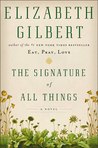
The Signature of All Things by Elizabeth Gilbert
I loved this huge story. Sometime last month I came across a years-old video interview of Gilbert by the author ZZ Packer. Gilbert’s responses were so natural and open, it reminded me how much I admired her bestselling memoir, Eat, Pray, Love. I remember thinking of that book that I would never have revealed as much of myself as she had, but she is still doing it! She just blurts out what she thinks and instead of liking her less, we like her more. It helps that she has a commodious, first-class mind; I find her absolutely irresistible.Books about early world-wide plant-seekers have always been a favorite of mine. Gilbert recreates the awesome wonder of the major botanical gardens and gives us the deeply imagined personality of Henry Whittaker, the Englishman who built a plant empire at White Acre in Pennsylvania. We are treated also to his daughter, Alma, who comes to take over the business and become a scientist and businesswoman in her own right.
Along the way, we come across all that life can throw at one: the joy of discovery, the humiliations in love, the pain of communication, the heartbreak of misunderstanding, the excitement of finding purpose and direction. Gilbert held me rapt as she added layer upon layer of gloss to the story until the whole had a three-dimensional depth and distance of a lovingly created terrarium featuring a world long past. I was a child again, and I willingly succumbed to her vision.
The book wasn’t without its moments of humor or depth of purpose. Gilbert raises something that seems to me momentous in our understanding of the world. She points out that struggle is the necessary impetus to change and to growth in the world and for individuals. It is the part of life we often like least but is the most necessary for our survival. Those who turn toward the challenge may often better manage the change that comes than those who deny or fear “the great changes that life brings.”
Once again Gilbert has shown her skill in creating an easily-read story which carries with it great truths. I am delighted she was able to turn her attention to fiction, since despite her work on nonfiction in the past, she claims her interest has always been to write fiction. I can’t wait to see what she will come up with next. By the way, this is the perfect summer read: big, engrossing, fabulous.
You can buy this book here:
Tuesday, January 14, 2014
At the Shores by Thomas Rogers

The northern state border of Indiana doesn’t nestle in the arms of Lake Michigan but kisses its bottom curve. And what a kiss it is. “High dune, grass covered, tree crowned” shoreline stretches for miles along the wave-torn lake and it is here that the story of Jerry Engels, adolescent, unfolds.
This coming-of-age story was first published by Simon & Schuster in 1980, but a few years ago it was revived by Other Press and now has just been re-released by Open Road Media in ebook format. Thomas Rogers died at age 79 in 2007.
It is 1950s Midwest. Jerry Engels is White, Protestant, and the son of a Standard Oil executive. His girlfriend, Rosalind, is an heiress and outclasses him a little. Since his early days Jerry enjoyed the company and caresses of his sister, his mother, and his classmates and always felt girls were more interesting and intriguing than boys. An unreflective young man, he has many friends, and his body and urges develop faster than his restraint.
I always felt there was a class of men who operated primarily on orders from their genitals and this book gives us a good example. The time, style, and world created here are reminiscent of John Updike—when White men ruled the world and their desires were the most important thing in it.
Rogers captures something fast in this novel, in both senses of the word. There is something edgy, forward, illicit in the dreams and actions of young Jerry, as well as something lasting and built into our culture: the unconscious privilege of a White man well born. I will not deny a certain impatience with the circuitous, faulty, and deafening logic of a young man ruled by his hormones. But it is as clear a picture of teenaged confusion and angst as we may find without the further complications wiser eyes may bring to a summer idyll. My parents would have said Jerry wasn’t busy enough.
Any joy I felt came from Rogers’ pitch-perfect description of the lake and its beauty, back when summer vacations were just that. Rogers is at his most eloquent when describing the Lake Michigan shoreline—the clarity of the water, the softness and heat of the sand, the nature of the waves, the intensity of the changing skies.
”Pale blue in the calm mornings, cloud darkened in the afternoons, wind roughened and white-capped during storms, the lake was always awaiting him…the sandbars below developed unexpected pockets…through the clear water…against the fine sand on the [sunlit] bottom…[where] only minnows and silver perch and a turtle [could be seen].This might just be the perfect summer read. Imagine discovering this on the shelves of some summer house cooling in the dark shade of fragrant pines. It might cause one to break out the watercolors.
You can buy this book here:
Friday, July 19, 2013
The Boys in the Boat by Daniel James Brown
"When you get the rhythm in an eight, it's pure pleasure to be in it. It's not hard work when the rhythm comes--that "swing" as they call it. I've heard men shriek out with delight when that swing came in an eight; it's a thing they'll never forget as long as they live."
--George Yeoman Pocock
If I told you one of the most propulsive reads you will experience this year is the non-fiction story of eight rowers and one coxswain training to attend the 1936 Olympics in Berlin, you may not believe me. But you’d need to back up your opinion by reading this book first, and you will thank me for it. Daniel James Brown has done something extraordinary here. We may already know the outcome of that Olympic race, but the pacing is exceptional. Brown juxtaposes descriptions of crew training in Seattle with national races against the IV League in Poughkeepsie; we see developments in a militarizing Germany paired with college competitions in depression-era United States; individual portraits of the “boys” (now dead) are placed alongside cameos of their coaches; he shares details of the early lives of a single oarsman, Joe Rantz, with details of his wife's parallel experiences.
The 1936 Olympics in Berlin was the stuff of legend, when Jesse Owens swept four gold medals in field and track, but a Washington crew team won that summer also, against great odds. How that victory took place and how a group of great athletes became great competitors is something Daniel James Brown spent five years trying to articulate. Quotes from George Pocock, crafter of cedar shells, head each chapter, sharing his experience watching individual oarsmen become a team.
At various times I have heard sports like baseball or golf, and now crew, described as “the thinking man’s game.” I like to imagine that any sport, particularly a team sport, is best performed when one is thinking. Surely strategies and tactics are involved. But when a team sport is performed fast and in key, there is something organic in its growth and peak performance that transcends “thinking.”
For one thing, there is the sustained coordinated rhythm of many bodies performing as one, starting from zero and demanding as much as two hundred heartbeats per minute in a sprint, erasing the individual and coalescing into something much bigger than each individual effort could achieve. This particular crew overcame the usual and expected race-day catastrophes to deliver the sweetest win they or their coaches had ever experienced. It is a story at the time and on the level of the historic Seabiscuit victory: speaking of the horse, the race, and the book by Hillenbrand.
One of the things about a great book is the energy one derives from having encountered it. Great teachers generate interest in a subject and Brown did that in this book. Even if you have no knowledge or interest in rowing before you begin, you will be fascinated by the end. In addition, Brown tells us some things about the Third Reich and Leni Reifenstahl’s photography for Hitler and of the 1936 Olympics that makes me want to revisit that film record. Reifenstahl had taken pictures (after the event) of the rowing crews from inside their boats, among other things, and when the film Olympia came out two years later, it cemented her reputation as a great filmmaker. Of course she is best known for creating the great propaganda film, Triumph of the Will . She used camera angles and techniques that had never been done before and were extraordinarily successful in supporting the political machine that was Germany in the 1930s.
A film version of The Boys in the Boat is scheduled, reputedly with Kenneth Branagh directing, which is sure to capture further interest in this remarkable story. A radio interview with Daniel James Brown is available to download from San Francisco radio station KLLC (radioalice). In it Daniel James Brown shares a little of his narrative non-fiction technique of keeping readers dangling at critical moments and turning instead to talk of parallel events to keep the tension high. He does it better than almost anyone—writers take note!
I believe I can guarantee this title—either you or someone close to you will find this a riveting summer read. I am pleased to be able to offer a giveaway of this title through August 15, 2013-- just enough time for you to receive it and read it before summer ends. So all of you unsure whether nonfiction is your “thing,” put aside your reservations, add your name to the list, and see if this story doesn’t float your boat. Viking Penguin shared this book with me in exchange for an honest review.
Giveaway completed 8/15/13
---------------
PBS special on the Boys in the Boat posted August 2016
You can buy this book here:
Tweet
Labels:
adventure,
giveaway,
nonfiction,
sports,
summer reads
Tuesday, July 16, 2013
2013 Summer Reads--It's not too late!

It is mid-July and if you haven't yet found your great summer read, or already finished one, you might find this list helpful to finish out the summer.
You have to read the hugely absorbing multi-generational tale of Texas The Son by Philipp Meyer. Meyer's novelistic skill is widely admired, but this is one of those books you will remember always and will come to define your understanding of southwest history in the nineteenth century. Told in the voices of three people, we see the "sides" to the long argument that is our history. Big in scope, this book gives us the time and space to begin to tease out life lessons and philosophies about the arc of human endeavor and development in the United States.
For a quick, easy fiction read filled with joie de vivre, I have to reprise a book I reviewed earlier in the season Cinammon and Gunpowder by Eli Brown. This is summer reading at the giddiest heights of fantasy. A cook, a pirate, a boat, and a conscience...the summer they all sailed together is now recorded for posterity. For the fun of it, buy this one.
A nonfiction must-read is The Boys in the Boat by Daniel James Brown. A nine-man rowing crew from Washington State wins the gold in the 1936 Berlin Olympics against all odds. The author interleaves happenings in Berlin with training in Seattle and races in Poughkeepsie in such a way that the action never stops and our interest never flags.
The book the too many tomatoes cookbook by Brian Yarvin comes just at the right time in summer when we anticipate a bumper crop of heirloom tomatoes and yearn for that deep tomato taste. Rather than bore yourself with the same old thing, try some of the fast, easy, and absolutely delicious choices Yarvin has discovered from around the world. You may find a new favorite or two--I did!
Finally, for those folks that simply don't have the opportunity to get away this summer, take a trip with Ian Mortimer in The Time Traveler's Guide to Elizabethan England. "The past is a foreign country..." [L.P.Hartley] and nobody does it better than Ian Mortimer. He takes you right in to imagine where you might stay overnight (and where you will pee), to how you might clean up without water after walking through muddy streets. The inns, the characters you will meet and what you will talk about, what you will do at night and eat for breakfast are all here and utterly fascinating. Take a walk through Elizabethan England. You won't want to live there, but a visit is bliss.
You can buy this book here:
the too many tomatoes cookbook by Brian Yarvin
"OK, 'rice and tomatoes'--it couldn't be simpler. But simple dishes are often the hardest, aren't they?"
We are not always so lucky to have a bumper crop of tomatoes (they used to be easier to grow when I was only harvesting :/) but if you love fresh tomatoes, you need this book. Farmstand aficionados, vegans, vegetarians, and meat-lovers will all find something here to favorite. Brian Yarvin gives simple, delicious, and diverse recipes using tomatoes for those days when our heat-addled or work-dead brains come to a halt at spaghetti.
I cook a lot. But even I have days when the juices are not flowing and I have used up the repertoire stored in my hard drive. I just need a little inspiration to make something wonderful and Yarvin’s book is so handy to remind me of things I love. He adds a little something I hadn’t thought to use, tells order of ingredients, and length of sauté (things I am sure I never knew), and I have come up with truly splendid cuisine from this small book. Besides, I love his stories, like the one of looking for canned tomatoes in Italy, or judging a chili cook-off in Texas.
I immediately discovered a new favorite, “Sicilian Vegetable Stew (Caponata)” served atop Parmesan Couscous, which is not the same as “French Vegetable Stew (Ratatouille)”, another classic. His vegetable lasagna won over hardened meat-eaters, and was a dream dish on my table. And he tells us how to make our own frozen pizzas for those days we simply will not spend another dime (more like ten dollars) or another minute eating out.
There are many delicious choices here for quick dinners, as well as dinners as aromatic and fragrant as an Italian don’s Spaghetti Sauce. They smell so good you don’t ever want the simmering to end. Yarvin doesn’t stop at the Mediterranean, however, but shares Central African, Romanian, Albanian, Chinese and Japanese (!) specialties featuring tomatoes as well as American favorites from all parts of the country. His stories interspersed among the recipes give one a chance to savor his particular brand of travel writing.
With heirloom tomatoes making a comeback and farmer’s markets getting up to speed for the season, you may want to pick up a copy of this cookbook which is sure to become one of your favorites. There are enough ways to vary your tomato dishes that you will never again say you have “too many tomatoes.”
Brian Yarvin is a travel writer, photographer, and cook. His recipes are simple to follow, and often might be one-dish meals.
You can buy this book here:
The Son by Philipp Meyer
Hardcover, 576 pages Pub May 28th 2013 by Ecco (first published September 1st 2012) ISBN13: 9780062120397
This is a big summer blockbuster of a novel—a huge book that can keep one occupied for days. The world looks a little different after a session with it—we feel wonder and regret in equal shares: wonder at human diversity and commonality evident at the same time; regret at our inability to comprehend this and share our bounty until it is too late.
Three generations of Texans represented by Eli, Peter, and Jeanne struggle through Comanche raids and the discovery of oil from the mid-nineteenth through the twentieth centuries. Eli is the "son" about whom the others revolve, and his life is the most finely described and keenly felt. But the time and distance we readers enjoy as the generations play out is what brings the book to fruition: life lessons and realizations about the human condition result.
Comparisons have been made of Philipp Meyer with Cormac McCarthy and I can see why: the country is that same hard, brutal, violent landscape that McCarthy paints so memorably. Meyer has his own style, however. Sentences are longer and in this novel the timeline is far longer. We see great expanses of the nineteenth and twentieth centuries through the eyes and voices of three generations. Meyer shifts point of view and time frequently, and he writes in the voice of a woman—an unusual woman that often thinks like a man, it could be argued—but that is something I don’t recall McCarthy attempting.
The threads come together at the end, and we see who sired whom, and which family is still standing. What is remarkable as the story unfolds, is how the large scope of the story smooths out the individual agonies and gives us instead a kind of justice—what we like to call divine justice—but it is really no more than human history to date. If it went on a little longer, perhaps, the wheel would have turned once again. There may be some in the future who have actually learned from our past, but judging from the folks that survive in this book, the hope is a faint one.
Philipp Meyer is a remarkable writer. You really do not want to miss this big, absorbing saga. Meyer has written another novel, American Rust, which was likewise memorable, about living in the Rust Belt in Pennsylvania. These are, for the most part, books about men. But that is fine—he does this with great skill. I think I will always have Meyer on my list of must-reads.
You can buy this book here:
Tweet
This is a big summer blockbuster of a novel—a huge book that can keep one occupied for days. The world looks a little different after a session with it—we feel wonder and regret in equal shares: wonder at human diversity and commonality evident at the same time; regret at our inability to comprehend this and share our bounty until it is too late.
Three generations of Texans represented by Eli, Peter, and Jeanne struggle through Comanche raids and the discovery of oil from the mid-nineteenth through the twentieth centuries. Eli is the "son" about whom the others revolve, and his life is the most finely described and keenly felt. But the time and distance we readers enjoy as the generations play out is what brings the book to fruition: life lessons and realizations about the human condition result.
Comparisons have been made of Philipp Meyer with Cormac McCarthy and I can see why: the country is that same hard, brutal, violent landscape that McCarthy paints so memorably. Meyer has his own style, however. Sentences are longer and in this novel the timeline is far longer. We see great expanses of the nineteenth and twentieth centuries through the eyes and voices of three generations. Meyer shifts point of view and time frequently, and he writes in the voice of a woman—an unusual woman that often thinks like a man, it could be argued—but that is something I don’t recall McCarthy attempting.
The threads come together at the end, and we see who sired whom, and which family is still standing. What is remarkable as the story unfolds, is how the large scope of the story smooths out the individual agonies and gives us instead a kind of justice—what we like to call divine justice—but it is really no more than human history to date. If it went on a little longer, perhaps, the wheel would have turned once again. There may be some in the future who have actually learned from our past, but judging from the folks that survive in this book, the hope is a faint one.
Jeanne : "But the slackening. By five she and her brothers were throwing loops. By ten she was at the branding fire. Her grandchildren were not good at anything and did not have much interest in anything either. She wondered if the Colonel would even recognize them as his descendants, felt briefly defensive for them, but of course it was true. Something was happening to the human race.
That is what all old people think, she decided…
When the first men arrived, she told them, there were mammoths, giant buffalo, giant horses, saber-toothed tigers, and giant bears. The American cheetah—the only animal on earth that could outrun a pronghorn antelope.
Her grandsons … went inside to watch television."
Jeanne: "Of course you wanted your children to have it better than you had. But at what point was it not better at all? People needed something to worry about or they would destroy themselves, and she thought of her grandchildren and all the grandchildren yet to come."
Eli: "That I’d done wrong was plain. I was not thick enough to believe I might have saved the ponies from Ranald Mackenzie’s troopers, but you could never say for certain. A single man can make a difference."
Eli: "Toshaway had been right: you had to love others more than you loved your own body, otherwise you would be destroyed, whether from the inside or out, it didn’t matter. You could butcher and pillage, but as long as you did it for people you loved, it never mattered…there is a myth about the West, that it was founded and ruled by loners, while the truth is just the opposite; the loner is a mental weakling, and was seen as such, and treated with suspicion. You did not live long without someone watching your back and there were very few people, white or Indian, who did not see a stranger in the night and invite him to join the campfire."
Peter: "To listen to the three of them talk about the death of Dutch Hollis, you might have thought there had been some accident, a lightning strike, flash flood, the hand of God. Not my son’s. Had to do it, acted on instinct, the sheriff just nodding away, sipping our whiskey, my father refilling his glass.
Considered interrupting them to note that the entire history of humanity is marked by a single inexorable movement—from animal instinct toward rational thought, from inborn behavior toward acquired knowledge. A half-grown panther abandoned in the wilderness will grow up to be a perfectly normal panther. But a half-grown child similarly abandoned will grow up into an unrecognizable savage, unfit for normal society. Yet there are those who insist the opposite: that we are creatures of instinct, like wolves."
Philipp Meyer is a remarkable writer. You really do not want to miss this big, absorbing saga. Meyer has written another novel, American Rust, which was likewise memorable, about living in the Rust Belt in Pennsylvania. These are, for the most part, books about men. But that is fine—he does this with great skill. I think I will always have Meyer on my list of must-reads.
You can buy this book here:
Tweet
Monday, July 15, 2013
The Time Traveler's Guide to Elizabethan England by Ian Mortimer
On the pro side, world-wide exploration was in its infancy, and it must have been thrilling to discover new products coming in from overseas, changing the way people thought about their own culture. People were reading—even women—and while much of what was available to them were religious tracts, there began to be something more as the period (1550-1600) wore on. Mortimer gives us statistics on how many books were being published and the results are startling.
My greatest interest in the period had been language: there are so many words no longer in use which seem to capture something unique in the lives of people at the time that I find them fascinating. Mortimer is likewise taken, for he spends some time explaining words, even words we use now for their meanings might well have changed since the sixteenth century. Just the list of tradesmen and merchants brings on a long period of daydreaming: tucker, tailor, baker, victualer, cutler, draper, cooper, currier, glover, hatter, hosier, cordwainer, costermonger, needlemaker, ostler, scrivener…the list goes on.
Mortimer tells us “you won’t find the answers to [how to behave at table or how to tell the time] in traditional history books” so he attempts to address those gaps in our knowledge about everyday life. One of things I liked most about this non-traditional history was Mortimer directly addressing his readers: in the section on religion, he explains how Queen Elizabeth established a Protestant state and outlawed Catholicism. There was a long period of debate and discussion in the parliament before each infringement on the rights of Catholics to practice is enacted. The punishments for those found violating the strictures is profound and ugly, and Mortimer does not allow us to turn away. At the end of the chapter he exclaims in a one-sentence paragraph, “For the love of God.”
Nearing the end of the book, Mortimer indulges us with a discussion of the theatre—who was writing, who was acting, who was watching. In other books (Imagine by Jonah Lehrer), it is suggested that Shakespeare reached the height of skill and brilliance that he did because he had competitors for the affections of theatre-goers. Mortimer tells of the other great playwrights of the time and their successes, pushing Shakespeare to craft the most daring and innovative scripts for the greatest stage actors. He suggests that part of the thrill of watching a Shakespearean drama was the mirror-like action that reflected the lives of watchers…something that was new. Passion plays, or morality plays common at the time had morphed into theatre that showed human endeavor and failings and did not just teach but explained.
No, perhaps I do not want to live there, but I am better prepared now for a visit. This is a great read for high school or college students because Mortimer does not neglect details and reminds us to think in a wholistic way about the life Shakespeare must have led. Mortimer anticipates questions we generate as we read and answers them thoroughly. It is a wonderful, absorbing history and if you don’t come out with a few new deliciously barbed and pointed swear words, I’ll be surprised.
You can buy this book here:
Monday, June 3, 2013
Cinnamon and Gunpowder by Eli Brown
Hardcover, 318 pgs, Pub June 4th 2013 by Farrar, Straus and Giroux, ISBN13: 9780374123666
Eli Brown’s infectious romp of a novel has a thoroughly modern sensibility dressed in the garb of yore. It is the early 1800’s and Owen Wedgwood is chef to Lord Ramsey, one of the chief shareholders of the Pendleton Trading Company in England which trades opium for tea, silk, and spices in Asia. Enter Hannah Mabbot, pirate extraordinaire, defender of the underdog, and avenger of the exploited.
This is escapist fun of the best sort, effortlessly inventive, reminiscent of childhood summers, yet with truths adults will recognize and may take to heart. Once, Mabbot must throw overboard the treasure she has looted from Pendleton ships in order to speed her progress away from danger:
And, on the pain one feels when a close friend or lover dies:
And on the sanctity of eating the flesh of animals:
And finally, we have a love story. It has a prudish man’s restraint, told in the voice of Wedgwood, who denies for ever-so-long his interest in Mabbot and in being at sea with pirates. But lord knows how we all love conquering the inhibitions of prudish men—and how much more satisfying and telling it is for the woman to be the instigator. If men are permanently “on” for sex, their sexual proclivities have less value, as it were. ‘Barky holes of trees’ as John Barth (The Sot-Weed Factor) has written, would do as well. Women, more discriminating perhaps, may tell us more by their choices.
A fine choice for a summer read. This book deserves to be widely enjoyed for the sheer fun it offers. It is something apart from the usual, and one must always take note of derring-do.
You can buy this book here:
Tweet
Eli Brown’s infectious romp of a novel has a thoroughly modern sensibility dressed in the garb of yore. It is the early 1800’s and Owen Wedgwood is chef to Lord Ramsey, one of the chief shareholders of the Pendleton Trading Company in England which trades opium for tea, silk, and spices in Asia. Enter Hannah Mabbot, pirate extraordinaire, defender of the underdog, and avenger of the exploited.
”Then entered a pillar of menace, a woman in an olive long-coat. Her red hair hung loose over her shoulders. She sauntered to the middle of the room, her coat opening to reveal jade-handled pistols. Using a chair as a stepping stool she walked upon the dining table to Lord Ramsey’s plate and stood there, looking down, as is she had just conquered Kilimanjaro. Her boots added inches to her already long frame…There…was the Shark of the Indian Ocean, Mad Hannah Mabbot, Back-from-the-dead Red…”Hannah kills Lord Ramsey for his greed and sins against humanity, and takes Owen captive on her pirate ship, charging him with concocting a gourmet meal for her once a week on pain of his life.
"Except that we are at sea I would believe that I had been abducted by a traveling circus."Author Brown’s delicious confection reminds us what we loved about stories of old, and adds that sine qua non of righteous vengeance to sustain our sensibilities. It may be that readers are especially susceptible to feats of culinary desperation because we are too busy reading to shop, so finding Wedgwood creating real cuisine from weevily flour and rancid lard is positively inspiring. Some sea captains for large sailing vessels in my family surprised me with the news that those aboard ship rarely partake in the (obvious to me) fresh seafood surrounding them, as they are not fishermen but sailors, but one of the Japanese sailors aboard the Flying Rose, Mabbot’s pirate ship, always has a line dragging from the aft rail, saving Wedgwood more than once in his search for a main course.
This is escapist fun of the best sort, effortlessly inventive, reminiscent of childhood summers, yet with truths adults will recognize and may take to heart. Once, Mabbot must throw overboard the treasure she has looted from Pendleton ships in order to speed her progress away from danger:
”The men will be bitter for having lost their silver, though it saved their lives. It is a complicated thing. With money in their pockets they become lazy and contrary. Heavy and slow, as does the Rose itself…A small part of me is glad to be rid of it. When my men are hungry, with death upon their heels, they work hard and never complain and enjoy their own company. They sing every night.”
And, on the pain one feels when a close friend or lover dies:
”I’ve had this pain. To tell you it will go away would be a lie. It will never go away. But, if you live long enough, it will cease to torture and will instead flavor you. As we rely on the bitterness of strong tea to wake us, this too will become something you can use.”
And on the sanctity of eating the flesh of animals:
”I thought I would take pleasure in skinning that watchful rabbit, but now that it was still, it engendered in me a tenderness for all fragile flesh. I sharpened a knife until it shone, then skinned and cleaned the rabbit, trying to make each cut a gesture of respect. Loathe to waste any part of the animal, I set brains and hide aside for tanning…As I progressed deeper into the body I felt a mystery revealing itself to me and began to pray, not with words but with simple cooking, a prayer not for the soul of the rabbit exactly but for the generous blending of its life and Mabbot’s. She had fed and loved it and now its flesh would become hers and mine, and in this way I understood that all beings lived only to feed each other as even the lion lays down for the worm. In the striations of the rabbit’s muscle I saw eons of breath and death.”
And finally, we have a love story. It has a prudish man’s restraint, told in the voice of Wedgwood, who denies for ever-so-long his interest in Mabbot and in being at sea with pirates. But lord knows how we all love conquering the inhibitions of prudish men—and how much more satisfying and telling it is for the woman to be the instigator. If men are permanently “on” for sex, their sexual proclivities have less value, as it were. ‘Barky holes of trees’ as John Barth (The Sot-Weed Factor) has written, would do as well. Women, more discriminating perhaps, may tell us more by their choices.
A fine choice for a summer read. This book deserves to be widely enjoyed for the sheer fun it offers. It is something apart from the usual, and one must always take note of derring-do.
You can buy this book here:
Tweet
Saturday, September 8, 2012
A Month in the Country by J.L. Carr
It hardly seems possible this was first written in 1978. It has the feel of a much older book, for Carr has entered the past and settled in there as though it were his. This belongs to that class of novels that wear their truths lightly: nearly every page describes a look, a feeling, a moment that we recognize no matter that the characters precede us by one hundred years.
Shortly after WWI, a returned soldier comes to an old church in the north of England with the intention of uncovering an old mural concealed beneath lime wash centuries before. It is slow work, and it is summer. He is not well paid. There is something to be said for penury. When one has little, one has no shield to wield off experience. When one is hungry, nearly everything tastes good.
J.L. Carr says, in his introduction that his original intention was to write a rural idyll and “I wanted its narrator to look back regretfully across forty or fifty years but, recalling a time irrecoverably lost, still feel a tug at the heart.” (Intro, xxi) The mural, the quiet, steady effort of the work, the townspeople, the vicar and the vicar’s wife, the weather: all these were “lying about in memory and employ[ed]… to suit one’s ends.”
Though slight in size (just over one hundred pages from start to finish), this novel carries with it the stories of all time. It carries it’s knowledge lightly, carelessly even, and will make this book relevant and enjoyable reading for years to come. Thank goodness for The New York Review of Books. They are saving classic literature from oblivion.
You can buy this book here:
Tweet
Shortly after WWI, a returned soldier comes to an old church in the north of England with the intention of uncovering an old mural concealed beneath lime wash centuries before. It is slow work, and it is summer. He is not well paid. There is something to be said for penury. When one has little, one has no shield to wield off experience. When one is hungry, nearly everything tastes good.
J.L. Carr says, in his introduction that his original intention was to write a rural idyll and “I wanted its narrator to look back regretfully across forty or fifty years but, recalling a time irrecoverably lost, still feel a tug at the heart.” (Intro, xxi) The mural, the quiet, steady effort of the work, the townspeople, the vicar and the vicar’s wife, the weather: all these were “lying about in memory and employ[ed]… to suit one’s ends.”
Though slight in size (just over one hundred pages from start to finish), this novel carries with it the stories of all time. It carries it’s knowledge lightly, carelessly even, and will make this book relevant and enjoyable reading for years to come. Thank goodness for The New York Review of Books. They are saving classic literature from oblivion.
You can buy this book here:
Labels:
British,
classic,
fiction,
historical novel,
NYRB,
summer reads,
WWI
Subscribe to:
Posts (Atom)