Showing posts with label Grove. Show all posts

Thursday, September 13, 2018

Snap by Belinda Bauer

Hardcover, 352 pgs, Pub July 3rd 2018 by Atlantic Monthly Press (first published May 17th 2018), ISBN13: 9780802127747), URL https://groveatlantic.com/book/snap/, Lit Awards: Man Booker Prize Nominee for Longlist (2018)

There are many wonderful novels long-listed for this year’s Man Booker Prize, but I wouldn’t be sad if the award went to Belinda Bauer for her latest crime novel. Crime is a new category for the Man Booker along with graphic novels, of which Sabrina made the list.

In this novel, Bauer manages to sneak up behind us and deliver a perfectly horrible crime that resounds in the minds of young married couples. And she unveils DCI Marvel, a man with the DNA of every crusty and flawed investigator who works on instinct. I immediately thought of Reginald Hill’s Dalziel, surely a man after Marvel's own heart.

Bauer has exquisite instincts and timing as a crime writer. Even if this book hadn’t been chosen to represent her work, some of her earlier books would have done as well. But this novel is fuller, somehow, with the figure of Marvel and the hopelessly earnest Reynolds, who manages to get everything wrong all the time.


A pregnant woman seeking a call box on the motorway leaves her three children in her stranded vehicle and sets off on foot. After more than an hour, the children are wondering what could have become of her. She’d said it was too dangerous to follow her, but that is what the kids did, only to find an empty call box, the phone off the hook.

Bauer has always had the uncanny ability to put us in the mind of a child, and here she has three to work with. The police release the children to the father who finds himself overwhelmed with his new responsibilities.

Writing an excellent crime thriller is certainly as hard as writing any other wonderful piece of literature, and it seems to me that Bauer has succeeded admirably here. A Goodreads group I follow, The Mookse & the Gripes, posts a discussion in which there is hardly a voice crediting Bauer with creating something unique and complex. I disagree.

Bauer makes her skill look easy, but I’ve read hundreds of crime novels and finding new ways to present a terrifying mystery without boring people who read hundreds of crime novels is not an easy job. It has something to do with characterizations, recognizing what it is in ordinary humans that brings out our capacity for murder, and a sufficiently complex mystery. In this solve, readers are invited to decipher a unique code, and agonize how this story is going to end without someone new getting done.

I listened to this terrific story, marvelously read by Andrew Wincott and available on hoopla®, produced by Dreamscape Media, LLC.


Thursday, October 19, 2017

Miss Burma by Charmaine Craig

Hardcover, 355 pages Pub May 2nd 2017 by Grove Press ISBN13: 9780802126450 Literary Awards: National Book Award Nominee for Fiction (2017); Man Booker Prize Long List (2017)

This deeply impactful novel, contrary to what the title might suggest, is not merely beautifully written and proportioned; it is weighted with historical, cultural, philosophical, and political insights from an area of the world well hidden from the sight and understanding of the majority of Americans. The novel is so dense with authentic-seeming detail that it demands the kind of close attention few novels warrant.

In a L.A. Times interview, Charmaine Craig tells us this novel is based on her mother Louisa’s story. Craig could not have done a better job of memorializing her mother’s memory, and it was heartbreaking to hear her recount meeting the popular Burmese politician Aung San Suu Kyi a few years ago and being recognized as her mother’s child.

Craig spent nearly a decade writing this novel, using some of the time researching and reading declassified CIA documents to see how her mother’s first husband was murdered in the process of peace talks with the Burmese leadership, apparently with the help of some double-dealing by the CIA. Her mother, a one-time beauty queen, became a leader of Karen rebels in the mountainous eastern region of Burma. While at first Craig did not want the book to be political, it is clearly a political document, and extremely informative for that. It puts the political wrangling in Burma, particularly now in this time of Burma’s opening to the West and the Rohingya persecution, in historical and global perspective.

Books of such regional particularity are rare things in English; that Craig attempts to share with us the tumultuous experience of her parents and grandparents growing up in such a consequential time and in such a distant clime is a rare gift. What makes this spectacular novel well worthy of its place on the 2017 Man Booker Prize long list is not the accuracy of its history, but how Craig’s characters navigate and philosophize their roles in their own fictional histories. Deeply meaningful statements on the human condition are sprinkled throughout the book, observations and philosophies articulated by one or another character facing a great challenge.

The predominant religion of Burma is Buddhist, though many Karens are animist or Christian. Craig spent some time explaining the following phrase:
“It is better to be in a position of having to ask for charity than to be in the position of never having to ask.”
This sounds very close to a lesson I’d once heard from Thich Nhat Hanh, the Buddhist monk from Vietnam, who said that having less than one needed offered an opportunity for developing and expressing compassion. Craig explains that having to ask for something develops one’s spiritual muscle.

In another circumstance, Craig draws a lesson from a Jewish rabbi when one of her characters is appealing for advice:
“One of man’s injunctions is to strive to live joyously. In the face of these terrible wars abroad, when our very peace is threatened, we must find a way to rejoice in our circumstances. We must find a way to do more than endure.”
What a remarkable and completely freeing and true thing to say. At the end of the novel, several characters look upon their lives and recognize this necessity to strive…to find greatness in the midst of failure. The lessons are applied, and it is grace-giving and forgiving and loving, despite all.

Individuals engaged in a civil war lasting generations are concerned with the state of their souls:
"I’ve been trying to figure out all these years—in defending our rights with this revolution—is whether or not we have the right to kill…It seems clear enough that violence, murder even of the murderous, is a surrender of a kind. But do we have the right to stand by and watch people be made slaves…"
I love that Craig asks these big, earthshaking questions because the answers are the things that may save us. The questions show us we are worthy to be saved. We will all come across these questions in the course of a life and to have a story big enough, consequential enough, to introduce them without pedantry is a tremendous gift.

Craig mentioned in her interview that she worked as an actress for a time until the stereotyping in Hollywood became too much of an obstacle to great work. I can tell her from this side of the screen the failures of imagination by casting directors and producers are agonizingly apparent. But I wish I could encourage her to “be the change you seek” and to write for the screen if she can. I would tell her the country is hungry for diversity of color and experience and she is likely to be very successful, if that is where her heart lies.

I feel so grateful for this big dense book of history and imagination. Craig is enormously talented and I wish her every success. The book is also available in audio, read by the author, produced by Blackstone Audio. The author has a disconcertingly American voice when one might expect something accented, even British. However, were Craig to publish the book she says in the interview that she wrote first--the one about her mother and herself growing up--that American accent would make all kinds of sense. Sounds like a good sequel, doesn't it?

However one consumes this book, I highly recommend it.


You can buy this book here: Shop Indie Bookstores

Tuesday, January 10, 2017

The Refugees by Viet Thanh Nguyen

Hardcover, 224 pages Expected publication: February 7th 2017 by Grove Press ISBN13: 9780802126399

This is such an exciting time in American literature that we can enjoy the gorgeous language and careful craftsmanship of really very fine short stories and novels in English in the American tradition but from traditionally silent participants in our nation’s pageant: immigrants and people of color. These voices began speaking up some time ago, but if you looked at the award lists until recently, people of color weren’t often on them. That has changed, and right now, before cultures become indistinguishable from one another in the wealth churn, the special character and individual voice of different groups is our bounty to reap.

Nguyen just wows me with his capture of the immigrant experience from so many different directions in this collection of stories. Not only is his language clear and expressive and to the point, his stories are rounded and fulfilling. They tell us something, like dispatches from a new world.

A story called “The War Years” is not actually about the war we usually think of. We’re in L.A., in Little Saigon, in a grocery store where we breathe in the smell of dried cuttlefish and star anise in the crowded aisles. Father (Ba), mother (Ma), and Long (do I need to say?), a thirteen-year-old for whom school, even summer school, felt like a vacation, worked at the store every day, even Sundays after Mass.

Ma is the real deal: waking everyone up in the mornings, keeping house, making meals, counting cash. She owns seven pastel outfits, and with makeup and a squirt of scent (gardenia), she is ready to man the cash register. We hear the scratch of her nylons as she rubs one ankle against the other. She knows the margins on every item in the store, even the 50-lb bags of rice in the loft above kitchenware.

Mrs. Hao visits the store regularly to ask for contributions to “fight the Communists,” but Ma thinks that fight is over. She follows Mrs. Hao home one day to confront her and discovers a fight that is all too real.

The story is so richly told, its depths just keep churning up new insights. And yet it is not alone. “The Transplant” introduces us to Arthur Arellano, a man with several overlapping and reflexive problems—problems which influence each other. Despite “transplant” bringing to mind “immigrant,” in this story the word has a more literal meaning.

The characters in all these stories have complex problems, complex attachments, complex lives. In “Someone Else Besides You,” a thirty-three-year-old man lives with his father after his own divorce, but his widower father, despite his own proclivities for mistresses, is constantly urging his son to pursue the former wife. See what I mean? Complex.

One story, “The Americans,” depicts a twenty-six-year-old woman who has been teaching English in Vietnam for two years already, living in a town that also hosts a nonprofit engaged in demining. She invites her parents to visit, to meet her boyfriend, to see her housing, her life. The email inviting them is addressed to Mom and Dad, but James Carver, recently retired as a commercial airline pilot, knows it is mostly meant for her mother, who dreams about Vietnam's “bucolic” countryside. “He knew next to nothing about Vietnam except what it looked like at forty thousand feet.”

Nguyen conveys the silent, withheld anger and confusion that men can often exhibit: an inarticulateness that keeps them angry without them even knowing exactly why. James was so proud when his son graduated from Air Force Academy, but he marks his own decline from that moment: he felt he was growing stupider rather than wiser as he aged. That was just the moment that the torch passed, and it is a new world, not his own. If he could but speak his fears, he’d find he was not alone: the world could still be his, he’d just be sharing it.

His daughter Claire is just like daughters anywhere, thinking they know more than they do, speaking and acting so carelessly, so casually hurtful.
“Although she empathized with vast masses of people she had never met, total strangers who regarded her as a stranger and would kill her without hesitation given the chance, she did not extend any such feeling to him.”
Being a parent is tough stuff. One has to have the hide of a rhinoceros.

The technical skill manifest in this story is breathtaking. We are never explicitly told the man is black, married to a Japanese woman while stationed on Okinawa. Their children have grown up loved by their parents, but confused about their identities and disparaged by their schoolmates. James has endured a lifetime of confusion, including his job flying a bomber jet. Unspoken, unresolved resentment is the minefield.

Nguyen’s stories are feasts of insight, generously shared. We’re lucky folk, to have such a talent writing for us. The Sympathizer, Nguyen’s Pulitzer-winning novel out last year, was a big novel is every sense. He shows us here he can write engaging, enduring short fiction, and his nonfiction, Nothing Ever Dies: Vietnam and the Memory of War, has likewise garnered critical attention. Nguyen is the Aerol Arnold Chair of English and Professor of American Studies and Ethnicity at the University of Southern California. He has received residencies, fellowships, honors, awards, and grants from a wide range of admiring and grateful organizations.


You can buy this book here: Shop Indie Bookstores

Friday, October 21, 2016

The Angel of History by Rabih Alameddine

This novel contains so much naked yearning, sadness, despair, and exhausted hilarity—poking fun at man’s powerlessness in the hands of Satan and Death accompanied by Angels—that we could be forgiven for imagining it a memoir. Alameddine has given us something rich upon which to sup, slowly, for there is much to assimilate. A poor Arab son of a whore (literally, as it turns out) is intellectually realized by nuns and priests in Beirut, schooling paid for by an absent father.

The boy and his schoolmates discover his gayness early, and the rest of his life is nary a denial, only acceptance, and once he found his circle, a verbally rich and figuratively celebratory consummation. Consumption is the other half of the story, the harvesting of lives, the dropping away of the circle. Alameddine does not shrink from the most revealing descriptions of life, love, and death in the life of a "little brown gay" man, just giving us pieces sometimes, as though he can’t remember clearly. He probably can’t, which is how we get the feeling that this is something remembered rather than merely invented.

This is not an easy read, there is so much thoughtful erudition here. Our eyes take in more than our brains can process. References to earlier works are everywhere apparent, some boldly proclaimed—Mikhail Bulgakov, Goethe, the Bible, the Quran—others we see faint outlines of in the swirl of colors and language that comprise invention, memory, and forgetting. This is a novel unlike any other, for that little brown gay Arab has given us something we have not seen before, all beauty and crescendo and wit and the most unbearable sense of loss. This is a revealing, naked novel that expresses a longing for acceptance, despair of a kindly world, and a stunning reversal—that hoarse, defiant shout, drenched in a kind of mad joy, into the void.

The novel opens with Satan having a conversation with Death. Shortly we learn that the man they came to discuss, Jacob, has signed himself into a mental hospital…to check his despair. The man, the little brown gay Arab, had lost many friends to AIDS in the scourge. He wants both to forget and to remember. It is not just his life he must remember, but all of it. All of his history, starting with his Yemeni blood. Satan tells us “forgetting is as integral to memory as death is to life.” It is not immediately obvious why we need to know this, and we are not sure we understand it anyway. We will forget it, and remember it again and again.
"Yemen is one of my favorite places, [said Death]...That nation has refreshed and rejuvenated me for centuries."
Love between partners is a momentous thing, not easily found and not easily lost. It lasts forever, some believe, or its vestiges linger forever. It leaves a mark. One is not supposed to lose one’s partner to death in mid-life. It is cruel. It is unnatural. This is the place where Jacob finds himself, struggling through a life filled with losses since childhood. Now in adulthood, he should be expert at it. And there is some resilience there that we poke and prod with interest. How will Jacob respond to his challenges?
”As it was in the beginning, said Satan, lying on my bed, so shall it be in the end, so shall it be first, last, midst, and without end, basically you’re screwed, Jacob, you know, the supremacy of Western civilization is based entirely on the ability to kill people from a distance….You can never win, Jacob.”
Death, on the other hand, promises peace, lethe, forgetfulness, and silence. “Peace on demand, instant gratification.” Which will our confused and suffering Jacob choose? His answer is foreshadowed throughout the novel and has something to do with his covering angels. Despair is normal, despite Jacob’s need for a psych ward. Despair is what we get, sometimes. Forgetting and remembering…you can’t have one without the other.
One early memory is Jacob envying his older cousin, a schoolgirl who faced life silently, in a beige school uniform. Jacob tells us “My Halloween costume that years [was] a headscarf with two pink pigtails sprouting out of it…”

An interview with Rabih Alameddine gives some notion of his carefully hidden depths. This link has the conversation recorded in a noisy cafe. I prefer it, though there is also a written transcript. It is a messy, imperfect thing, this interview, but Alameddine is just so irrepressibly himself.


You can buy this book here: Shop Indie Bookstores

Wednesday, May 11, 2016

The Sympathizer by Viet Thanh Nguyen

Hardcover, 371 pages Published April 7th 2015 by Grove Press (first published April 2nd 2015) ISBN13: 9780802123459

“War, what is it good for? Absolutely nothin’!”
—from “War” by Norman Whitfield and Barrett Strong, Motown, 1969

Nguyen uses the trope of a spy to articulate the experience of “the immigrant” or “the other” in American society. But that’s not all. Nguyen wades into the nature of rebellion, revolt, war, governance, literature, novel-writing, self-examination and -actualization, the duality of human nature, and our essential aloneness. Despite the anguished cry of our unnamed narrator, our “Captain”, at the end of the novel, what Nguyen has given us is not nothing. As the novel draws to a close we in fact wonder if the narrator isn’t talking about the author himself in the process of “writing what he knows” in a novel: the “confession” our Captain gives to his interrogators is the long, discursive narrative this author has crafted from imagination and experience straddling two countries with [sometimes violent] overlapping histories, forcing upon him some truths which cumulatively might seem like 295 pages of “nothing.” The hilarity of his despair might have seemed the author’s alone, but his skill is such that we readers know exactly what he means.
”The absurd often has its seed in a truth.”
Nguyen is uniquely positioned to see into the essential differences and similarities in the Vietnamese and American experience, and as a writer he cannot not write about it. Our boon is that the author is so exquisitely talented in uncovering and expressing our essential humanity, something which should give us all pause. Humanness is an imperfect, often anguished state, Nguyen seems to be saying, but it can also be very funny. In order to appreciate the joke, however, we have some self-examination to do.
”Life’s a suicide mission.”
Captain is writing his “confession” to Man, his lifelong friend and now a commissar in the Viet government after the “fall” of Saigon—a loss of innocence in every regard. Captain lives in the United States, and has returned to Vietnam to make sure his other lifelong friend, Bon, doesn’t die in an ill-conceived attempt to destabilize the new Vietnamese government. Bon is a former Phoenix operative with endless Vietcong kills to his name. The Captain’s boyhood friendship with Man and Bon was sealed when the boys cut their palms and shook hands, mixing blood. Thereafter, the gesture for hello or goodbye revealed the stigmata of their friendship. What are they fighting for again?
”Not to own the means of production can lead to a premature death, but not to own the means of representation is also a kind of death.”
Don’t worry: this novel is not heavy on political theory. You will just want to move slowly through Nguyen’s world. He is telling us something that we need to hear, like why film roles for Vietnamese actors are filled by Filipinos, Koreans, or Japanese actors. The Captain became involved in the making of a film about the Vietnam war in order to give strength and credibility to the portrayal of the Vietnamese people but he was disrespected, uncredited—literally blown off the set—and he never did manage the optics on perceptions of Vietnamese. Nyugen's recounting of the shooting of The Hamlet in the Philippines was such a magisterial set piece (and yet its visualizations link everything in the novel) that it will be resurrected endlessly whenever mention of this book comes up.

A debut novel so packed with insights into the human experience—how we justify our choices and how we try to spin outcomes—doesn’t lead us to expect that Nguyen would write with such verve, perspicacity and humor. Everything is illuminated in this novel, down to the very nub of the author’s own perceptions about women. It was perhaps too long a book (not every word counted), but because the book is a debut, the author had no reason to expect he’d get another chance to write all he has learned. This novel is a spectacular overload filled with all kind of fancy pyrotechnics that recall America's most revered writers.

In an interview with Angela Chen, writing for The Guardian, Nguyen tells us he did not pander in this novel to Western ideas of immigrants. This is true, but he did use a Western instrument—the novel—to illuminate for Westerners the Eastern, the immigrant experience. And he wields it better than most Westerners. What sweet success it must have seemed when he was acknowledged with the Pulitzer Prize, awarded April 2016.


You can buy this book here: Shop Indie Bookstores

Tuesday, October 27, 2015

Scary Vampire Stories from Simon & Schuster - HAPPY HALLOWEEN

Oh, boy, you’re in for a treat. Simon & Schuster has published a book of scary stories from our most popular fiction writers that will put you in the mood to sit around all weekend, munching through the candy meant for trick-or-treaters, and terrifying yourself enough to turn off the TV and keep your eyes peeled until the daylight brings friends to save you.

The collection starts off with Scott Smith’s “Up in Old Vermont” about a thirty-three year old waitress at a small town diner in Vermont looking to make a new life out of her broken dreams. Invited to do light housework and some cooking for an old couple she calls The Hobbits, Ally moves to the woods…far into the woods.

Sherrilyn Kenyon has a six-pager, “The Neighbors” that revives preteen terrors and parents who will not listen. In “On the Dark Side of Sunlight Basin,” Michael Kortya treats us to winter in Montana/Wyoming, where an experienced hunting guide has a Californian loser in tow, looking for a kill…Charlaine Harris gives us a couple of middle-schoolers, Susan and Taylor, a dead schoolmate, and a terrifyingly-composed teacher in “Mrs. Fondevant:” “Susan read more about vampire lore than a girl her age, of any age, should ever read.”

Kelley Armstrong takes on the vampire-doubters in “We are All Monsters Here.” Dan Chaon and Lynda Barry collaborate on a short story that is truly gut-wrenching: two single mothers living across yards of broad country meadow from one another have some weird psycho-sexual predator thing going on for each other’s children.

Rio Youers was a new name for me, but this British-Canadian writer recreates the strangely shallow cosmopolitan view prevalent in today’s plane-hopping culture. In “Separator,” an ambitious Canadian land developer hopes to cash in on a typhoon-devastated landscape in the Philippines while paying insufficient attention to the myths surrounding the customs of the country. Very creepy.

Those of you familiar with the work of John Ajvide Lindqvist will be delighted to find a story translated for you here, called “What Kept You So Long?” One is uneasy from the first sentences.

This terrific collection is edited by Christopher Golden, the American author of Horror, Fantasy, and Suspense novels for teens and adults. Someone managed to get these busy authors to pony up for a volume of uncommon perception about our fears, showcasing individuals’ talents and giving us a lasting opportunity to scare ourselves silly. Big. Bold. Vampiric.


You can buy this book here: Shop Indie Bookstores

Wednesday, September 2, 2015

Rubbernecker by Belinda Bauer

Belinda Bauer is now among my favorite mystery writers. I just love the way her mind works. I read her debut novel, Blacklands, (published in 2009) and was immediately captured by her assured style. She slipped under my radar until this year, when I saw hers among a listing of new books being published in the U.S. this summer by Grove Atlantic.

A young medical student discovers something unusual while dissecting a corpse cadaver and cannot let it rest. The simple story line cannot convey the host of associations and emotions, suspicions and satisfactions readers feel as Bauer leads us through events we are quite sure will turn out deadly.

This novel is classic in a timeless way. It is slim, pared to its essentials. With a phrase, a pause, and brilliant character development Bauer leads us finally to a conclusion that is wholly unexpected. I adore the way she handles the police investigation at the end. No histrionics, but a good policeman does the legwork and surprises himself with what he finds. This is good writing.

While I was reading, I was reminded in a very good way of Louise Welsh, the Scottish mystery writer, and Brigitte Aubert, the French mystery writer. Bauer has Welsh’s offbeat sly humor and Aubert’s daring: Aubert’s novel Death from the Woods featured a quadriplegic who solves a murder case. Bauer treats us to a paralyzed coma patient trying to telegraph his knowledge of a murder. It is masterfully suspenseful…and misleading.

The central character in this novel has Asperger’s Syndrome, and his differentness is handled so well that we teeter back and forth in our support for him. Brilliantly done, Belinda Bauer!


You can buy this book here: Shop Indie Bookstores

Tuesday, August 18, 2015

Icarus by Deon Meyer


Deon Meyer is South Africa’s preeminent mystery/thriller writer and something of a wonder. His books have a richness and specificity that bring South Africa (and crimes committed there) vividly to life. This installment of the Benny Greissel series braids several strands of mystery into a single blood-red cord of baling twine from the wine country of Stellenbosch.

Meyer often posts on his website photos of the locales, restaurants, buildings he uses in his novels, and he did in the case of Icarus as well. The site of the action is South Africa’s western Cape near Cape Town.


A large storm in December reveals the body of an internet entrepreneur buried in the sand of Blouberg Strand. Ernst Richter ran Alibi.com, a South African-based website based on the success of AshleyMadison.com, a company promising discretion when arranging infidelities. The manner of his death ties him firmly to the wine country in Stellenbosch, but in the weeks leading to the Christmas holidays, we are turned in many directions, often away from the truth.


Meyer often has several threads working at once in his novels, and this book is no exception. Deliciously, Meyer shares the personalities of the police and how their prejudices, weaknesses, and particular skills influence an investigation. Benny Griessel struggles with alcohol addiction and falls off the wagon when a colleague dies tragically. The description of his ever-present desire and of his failure is agonizingly real.

Griessel’s colleague, Jamie Keyter, will do just about anything to be in the limelight of newspaper reporting, even if it means selling his team down the river. Another colleague, Vaughn Cupido, falls hard for someone he questions during the murder investigation.

While the murder investigation plays itself out, we are treated to a plausible explanation of the unreasonably high subscription numbers of Alibi.com (and by association the AshleyMadison.com), and a realistic scenario for the sites’ growth and financial requirements. Finally, we also get a fascinating short history of wine production in South Africa.

Meyer keeps readers off-balance throughout the novel with rapid and abrupt shifts between strands: the quiet droning of a man relating his family’s genealogy; the drunken stumbling of Benny Griessel on the edge of losing everything; the start-stop of an investigation where so many have things they wish to hide.

If you haven’t already enjoyed Deon Meyer’s oeuvre, feel free to start here. It is often years between novels, and to discover a new Meyer book is an event. Add Meyer to your list and get a whole different outlook. This book will be published October 6, 2015 by Grove Atlantic, but I am telling you about it now because it is being offered as a giveaway currently on Goodreads. I definitely recommend you sign up.


You can buy this book here: Shop Indie Bookstores

Monday, July 27, 2015

The Master and Margarita by Mikhail Bulgakov

This novel is considered by many to be Bulgakov’s masterpiece. The translation copyrighted by Mirra Ginsburg in 1995 is quite modern enough for today’s readers to get a sense of the arc of Bulgakov’s life (1891-1940), for it is there, thinly disguised. Bulgakov trained & worked as a doctor in provincial towns, but since childhood was enraptured with literature--with words. And words were the cause of his joy and anguish, for his whole life he was never allowed to publish or produce anything without severe rancor from government censors.

Bulgakov saw war. He was sent to the front by the Red Cross just out of medical school in 1913, when he was twenty-two years old. He was badly injured, twice, and suffered such pain that, after a stint as a provincial doctor after the war, he became a morphine addict for a two-year period. The horror of that addiction is recalled in his short fictional monograph, Morphine, which is also immortalized in the BBC 2012 TV series A Young Doctor’s Notebook now playing on Netflix, starring Daniel Radcliffe of Harry Potter fame and John Hamm, who starred in Mad Men.

What would Bulgakov think now, that so long after this death his work is exciting audiences around the world? He would be pleased, though sorry it took so long, I’m sure. He was writing for those suffering through the reign of Stalin, writing to bring them joy and to urge perseverance. It never happened. Many of his works were unable to be published, and he was reduced to writing screenplays or librettos for opera. Even these came under attack.

His work on The Master and Margarita commenced in 1928, but because of the vitriolic reaction to his work, he burned the work in the 1930s in despair. As a medical man, he became aware he had an inherited kidney disease (his uncle had died of it), and began rewriting his great novel, knowing he would never see its publication.

Bulgakov’s parents and grandparents were Christian. His father was a clergyman. The Master and Margarita is a novel imbued with a Christian mentality and perspective. The scenes that riveted me the most were those in which Bulgakov imagines the sentencing of Jesus by Pontius Pilate. Pilate had a migraine, and couldn’t focus on his task: to sentence four men to death, and to reprieve one. What enormous arrogance, intellect, empathy, and knowledge of humanity it takes to imagine a scene two thousand years earlier, if it took place at all. All is shrouded in myth, and we feel that, palpably, in this novel filled with humor and tragedy.

Bulgakov’s great gift was to see clearly, and to speak truth to power. This work is a humorous fiction, but no less searing for that. Dante wrote about man’s weaknesses and Bulgakov parallels him in another century. It is said this work is modeled on Goethe’s Faust. The devil seduces Moscovites and plays on the delights of human desire, and then strips it all away in the most caustic way possible.

The novel references important events or experiences in Bulgakov’s life and can be read as a philosophy, an allegory, a stinging indictment of the Soviet state, or simply as a humorous play on words. Gogol’s Dead Souls is named explicitly, as is Dostoyevsky. Bulgakov wrote contemporaneously with another playwright whose work also couldn’t be published, the Jewish writer Isaac Babel. Soviet intelligentsia in the 1920s and 1930s must have kept the censors very busy and made the public very canny. It was a fantastically fruitful environment for satire. At one point in this novel, terrorized artists make casual reference to “they are coming to arrest us” as they sit at the dining room table finishing breakfast. One man replies, “Ah…well, well…” When a Mauser appears from under the goon’s coat, it sets off a scene of comedic slapstick, ending with a Browning in the hands of a demon cat.

Pontius Pilate returns at the end of the novel and we are treated to Bulgakov imagining Pilate’s discomfiture over the death and disappearance of Christ. The Master is a writer who wrote a novel on the imagined meeting of Pontius Pilate and Jesus Christ. He is confined to a mental institution where he meets a poet imprisoned there for imagining he’d heard just such a story.

Margarita is a lusty, outspoken woman married to a man who was “young, handsome, good, honest, and [who] adored his wife.” But Margarita loves the Master and tries to find him when he disappears, but cannot. “She often cried bitterly and long in secret. She did not know if she loved a living man or a dead one.” She blamed herself for allowing the Master to write about Pontius Pilate.

One of the most remarkable things about the story is how period Moscow comes so vibrantly to life. There is so much intellect, passion, love, and yes, absurdity in the prejudices and manners exposed. Bulgakov names a character with a patronymic matching his given name, Archibald Archibaldovich; shares the mores of drinking houses and artists’ clubs; stages a grand ball; exposes apartment-house living and lust: the uncle of a murdered man tries to secure his nephew's Moscow apartment before handling the details of his funeral. It is a marvelous parade of woe and fury.

We cannot mourn Bulgakov. We can only read him. His work is the result of the pressures in his life. But he does need to be celebrated for the great humanist that he was. Ah, humankind!


You can buy this book here: Shop Indie Bookstores

Wednesday, April 29, 2015

H is for Hawk by Helen Macdonald


"The archeology of grief is not ordered."
Helen Macdonald’s book-length nonfiction is so many things at once: a eulogy, an elegy, a biography, a memoir, a training manual, a journey. It is a conversation about death, and community. It is so filled with passion and pain that one reads, breath bated, to see which will crush the other. This book is only partly about a hawk, despite the title. It records the author’s journey of a few years, starting with the unexpected death of her father, through the purchase and training of a hawk, to a new place of understanding about what and who humans are and what we need to live well.

The author looks closely at the life and writings of another vulnerable person, T.H. White, to express sorrow and a kind of sympathy with his derangements. She learns the origins of his extraordinary flights of fancy in literature, tracing over the sores of his upbringing until we see clearly the agonies of his confused psychopathy. White was a hawker, but a hawker one might quote to show how not to train a hawk. Macdonald loathed his book The Goshawk as a child. When she gets her own hawk after the death of her father, she reads it again. This time she discovers White’s pain--seeing, feeling, tracing it until it is as clear as her own.

Macdonald shares one of the best descriptions of bereavement that I have ever encountered (italics are hers):
"Here’s a word. Bereavement. Or, Bereaved. Bereft. It’s from the Old English bereafian, meaning 'to deprive of, take away, seize, rob.' Robbed. Seized. It happens to everyone. But you feel it alone. Shocking loss isn’t to be shared, no matter how hard you try. 'Imagine,' I said, back then, to some friends, in an earnest attempt to explain, 'imagine your whole family is in a room. Yes, all of them, All the people you love. So then what happens is someone comes into the room and punches you all in the stomach. Each one of you. Really hard. So you’re all on the floor. Right? So the thing is, you all share the same kind of pain, exactly the same, but you’re too busy experiencing total agony to feel anything other than completely alone. That’s what it’s like.' I finished my little speech in triumph, convinced that I’d hit upon the perfect way to explain how it felt. I was puzzled by the pitying, horrified faces, because it didn’t strike me at all that an example that put my friends’ families in rooms and had them beaten might carry the tang of total lunacy…

...I’d dreamed of hawks again. I started dreaming of hawks all the time. Here’s another word: raptor, meaning 'bird of prey'. From the Latin raptor, meaning 'robber,' from rapere, meaning 'seize.' Rob. Seize."
Hawks apparently have a shamanic tradition of being able to cross borders that humans cannot and "were seen as messengers between this world and the next."

The author trains a bird of prey, a hawk called Mabel. Mabel is a predator; she is all about death, violent death. The wildness of the bird seeps into the author’s consciousness, and her perceptions become acute. Macdonald is recovering from a loss, and her bond with the reptilian raptor Mabel underscores her warm-blooded need for love and her bond with the human community. This book is the author working through grief and terror and want and coming out naked and vulnerable on the other side.

The language Macdonald employs in this memoir is as extraordinary and ingenious as her laying out such diverse topics as death, hawking, T.H. White, and history as interlocking pieces. She holds us rapt as she defines her grief. The words she chooses make us hypersensitive to differences in shade, angle, meaning: "Goshawks in the air are a complicated grey colour. Not slate grey, nor pigeon grey. But a kind of raincloud grey…" Or this: "I was…grey, loose-spun wool on an aching set of bones." Or this: "I felt like I was holding the bastard offspring of a flaming torch and an assault rifle." Her meanings are exquisitely clear.

Macdonald was born a hawker. We are all born with something innate but dormant until awakened by opportunity. Fortunately Macdonald was able to find and exercise her passion because she liked to read. It reminds me of teachers we may have had that spark an interest in something that feels as natural to us as breathing, and as necessary. Macdonald discusses six books that formed her consciousness about nature, makes us realize once again that a seed spilled on tilled ground can yield the most amazing things. It breaks my heart a little to think that every child probably has some thing in them that would burst into flame with the right tinder. Not all of us find it, early or ever.


You can buy this book here: Shop Indie Bookstores
Monday, March 2, 2015

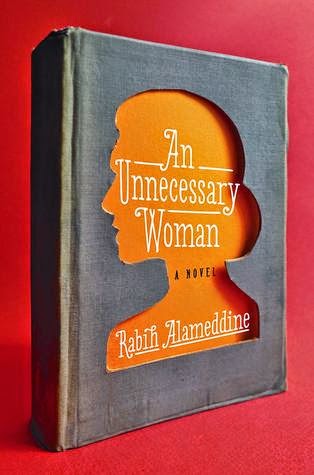
An Unnecessary Woman by Rabih Alameddine


Just before I began this book I learned that Rabih is a man’s name, a Middle-Eastern man’s name. It means, alternatively, “spring,” or “winner.” I wondered what kind of Middle Eastern man felt he could write a book about the internal life of an aging widow. And now I know. It would be a man who reads.

This is a book about loneliness and connection. Aaliya, a name meaning “the exalted one,” is a translator. That is, she spends her time translating into Arabic books written in English or French. Some of the books she translates are translations of translations. Her entire life since her early divorce from an impotent husband has been consumed with this endeavor, one book a year, sharing the work of literature’s greats. She stacks her translations in cartons in the reading room of her apartment in Beirut. She is seventy-two years old.

Not long into listening to the voice from the head of this old woman I began to feel this was the indispensable book: a book I needed to read again and again, to study, to enjoy as refreshment, as instruction, as revelation, sentences changing shade and emphasis depending on the angle of the sun, on the time of year, on the colors in the room in which I sat. Too many sentences needed remarking upon, too many references needed thorough investigation to let it go with only one reading. This was the woman, who by dint of translating the “greats,” had honed her instinct for the critical moment, the real thing, the human condition.

This book about a desperate woman living alone, growing old and infirm in a city riven by dissention and war, is ultimately redemptive, optimistic. It feels like a blessing, a balm. It feels like the sun on a cool day, or a cool breeze when the temperature rockets. It is literature.
”There are two types of people in this world: people who want to be desired, and people who want to be desired so much that they pretend they don’t.”

I want to read everything by Rabih Alameddine.

Rabin Alameddine is interviewed by Dwyer Murphy in Guernica.


You can buy this book here: Shop Indie Bookstores

Tuesday, July 10, 2012

Summer Reads from Four Bloggers


Porter Square Books

Interior of the Porter Square Bookstore


When: June 21, 2012
Where: Cambridge, MA
Porter Square Books


[Courtesy of http://portersquarebooks.com/]

Four bloggers shared their best recommendations for summer reads with us:

I went first, and explained that although I read fiction and nonfiction, I chose fiction for this summer. You can click the book titles listed below to see why we chose each title.


Moonlight Downs by Adrian Hyland


If Jack's in Love by Stephen Wetta


It's Beginning to Hurt: Stories by James Lasdun


Revival by Scott Alarik


Tahleen reviews young adult books and she had a mix of great titles that she'd picked from the past several years.

One Crazy Summer by Rita Williams-Garcia


The True Meaning of Smekday by Adam Rex


Where Things Come Back by John Corey Whaley


Paper Towns by John Green


Gail reads a mix of genres: fantasy, young adult, romance, science fiction and she has chosen the best of her blog for your delectation this summer.


Marie, the Boston Bibliophile, chose some of the books in the past months that have rocked her worldview.

Pure by Andrew Miller

Second Person Singular by Sayed Kashua


Absolution by Patrick Flanery


Sorry to be getting this list out late to you, but think of it this way: summer is in full swing. If you missed on your choices so far, take a look at ours and begin again. You won't be sorry.

You can buy these books here: Shop Indie Bookstores