Showing posts with label Copper Canyon Press. Show all posts

Friday, September 14, 2018

Night Sky with Exit Wounds by Ocean Vuong

Paperback, 89 pgs, Pub April 5th 2016 by Copper Canyon Press, ISBN 155659495X, Lit Awards: T.S. Eliot Prize for Poetry (2018), Forward Prize for Best First Collection (2017), Thom Gunn Award for Gay Poetry (2017), Goodreads Choice Award Nominee for Poetry (2016)

Published in 2016, this is Ocean Vuong’s first full collection. We will never know how a boy emerges, so young, with a talent so great. A poem chosen at random lights deep, protected nodes in our brain and attaches to our viscera. We recognize his work as surely as we appreciate a painting, or a piece of music. He appears a conduit, not a creator.

One of the poems in this collection has a title referencing a Mark Rothko painting. Glancing at it, we know immediately why he pairs it with these words.
Untitled (Blue, Green, and Brown, 1952)

The TV said the planes have hit the buildings.
& I said Yes because you asked me
to stay. Maybe we pray on our knees because god
only listens when we're this close
to the devil. There is so much I want to tell you.
How my greatest accolade was to walk
across the Brooklyn Bridge
& not think of flight. How we live like water: wetting
a new tongue with no telling
what we've been through. They say the sky is blue
but I know it's black seen through too much distance.
You will always remember what you were doing
when it hurts the most. There is so much
I need to tell you--but I only earned
one life & I took nothing. Nothing. Like a pair of teeth
at the end. The TV kept saying The planes...
The planes...
& I stood waiting in the room
made of broken mockingbirds. Their wings throbbing
into four blurred walls. & you were there.
You were the window.
Rothko's Blue, Green, and Brown, 1952
It was the phrase How we live like water: wetting a new tongue with no telling what we've been through. That phrase stopped me.

In an interview with The Guardian, Vuong says “life is always more complicated than the headlines allow; poetry comes in when the news is not enough.” Vuong won awards for this collection, and gained recognition. He now is an associate professor in the MFA program at the University of Massachusetts Amherst and writing a novel.

In an interview with Lit Hub Vuong explains
“I’m writing a novel composed of woven inter-genre fragments. To me, a book made entirely out of unbridged fractures feels most faithful to the physical and psychological displacement I experience as a human being. I’m interested in a novel that consciously rejects the notion that something has to be whole in order to tell a complete story. I also want to interrogate the arbitrary measurements of a “successful” literary work, particularly as it relates to canonical Western values. For example, we traditionally privilege congruency and balance in fiction, we want our themes linked, our conflicts “resolved,” and our plots “ironed out.” But when one arrives at the page through colonized, plundered, and erased histories and diasporas, to write a smooth and cohesive novel is to ultimately write a lie.”
 Vuong brings with him the possibility of a vision that is articulate enough to share, brave enough to bolster. It's a kind of blessing, a grace note we don't really deserve, his voice.

Vuong’s poetry is available as an ebook from many libraries. He is what we call a ‘literary light.’


Tuesday, January 12, 2016

Sanctificum by Chris Abani

Paperback, 96 pages Published April 1st 2010 by Copper Canyon Press

This is my favorite among Abani’s published poetry collections and I think it might be because it is completely accessible. One doesn’t have to know anything about Chris Abani to understand the language and heartache and courage. “Om” appears first and has seven parts on five pages. I reprint a piece from each part:
"I never told anyone that every sliver of orange I ate
was preceded by words from high mass.
Per omnia saecula saeculorum.
Spit out pit. Amen.
Juice. Amen. Flesh."
and
"The dog’s black tongue was more terrifying than its teeth."
and
"Sorrow lodged like a splintered bullet next to the heart."
and
"Sand, where there is no water, can ablute,
washing grain by grain even the hardest stone of sin."
and
"The way a photograph cannot remember the living."
and
"Sanctificum."

A section of the collection is entitled 'God's Country," perhaps a nod to Percival Everett, whose novel of the same name is a must read for fans of American literature. Abani's "God's Country" ends
"When we say love we mean, I want.
When we say sorry we mean, forgive me.
There is little room for anyone else.
But Bean, she loves me.
How else can she keep forgiving me?"
Abani can talk about sadness, about places that are sad, without being sad:
A LETTER TO ROBERT PINSKY

This is wood, enchanted wood.
Still the fire scorches and we say wood
still the pain burns from the club
and then we say wood
still the planks dovetail and we caress
the smooth and the rough
sensuous, delectable, and yet sorrowful
and then we say wood.
My favorite poem is too long to quote, twelve sections on ten pages, called “Pilgrimage.” It talks of words and their meanings, faith and its lack, history and hope, fear and courage, love and rage. Well, I will quote just a little because it speaks to the sadness without being sad:
"Some may call me a pessimist, but I am not.
There is nothing gained from loss.
I drink tea in the shade and believe in poetry.
I am a zealot for optimism."
In "Histories" Abani has a short poem
DEAR YUSEF KOMUNYAKAA

Your poem "Ode to the Drum"
pulled me back from many night terrors.
May I roll it around my lips and not kill it
for its exquisite touch.
May I find a way to beat a song back
into these tired lines, these words.
Amen."
At the end of one of his TED talks, Abani reads Komunyakaa's "Ode to the Drum" "in a way Komunyakka would be proud to hear it read."

In a short poem near the end called “Dew,” Abani writes
"My desire is struggling up the mountain.
My fear is a shower of pebbles.
Your son is trying to be a good man, Mum.
Your son is going to be all right.
There are no names for red."
That is not the poem in its entirety, and it does not end there. But that phrase that appears again and again in Abani’s work is perplexing to me. I don’t know what he means, “there are no names for red.”

The real strength in Abani’s work is his willingness to see and not be ruined by the seeing. He has enough reserves to still give succor to those of us stumbling along beside him. "I have always envied the stigmata," he tells us of those wounds that will not heal…"I want to put my fingers in the wounds and swirl them around." And so he does.

This book was published in 2010 by Copper Canyon Press.

Other works by Chris Abani include:
Becoming Abigail (2006)
Hands Washing Water (2006)
Virgin of Flames (2007)
Song for Night (2007)
There Are No Names for Red (2010)
The Secret History of Las Vegas (2014)
The Face: Cartography of the Void (2014)


You can buy this book here: Shop Indie Bookstores

Hands Washing Water by Chris Abani

Paperback, 90 pages Published October 1st 2006 by Copper Canyon Press

”We are lucky to live now, I mean, look how far we’ve come.”—from “Foucault’s Funk”

Chris Abani, when asked by Walter Mosley in 2010, said he was a novelist first because he thought in stories. He works on poetry and novels concurrently, using one to break the logjams of the other. He works constantly.

The poems in this collection are food, a kind of fruit we have never tasted before, good in our mouth but unfamiliar on our tongue. We try something new in every poem, moving from Paris to the Caribbean, from California to New Zealand. Africa is there, and New York, Harare, Egypt, and Antwerp. At the pyramids

"Rabab tells me: We know how to build graves
here. I nod. I know. It is the same all over Africa."
One extraordinary twelve-part poem, “Buffalo Women,” imagines the correspondence between a white woman and a recently emancipated slave who is fighting in the Civil War. The agony of their separation and the possibility of no return is everywhere evident.
"Remember the bird of paradise you planted?
Well it has spread in the garden, so that it looks as though
a gaggle of tropical birds have gone beserk...
...I am enclose some rags to stanch your blood
and a long piece of sheet to swaddle yourself."
In “A Warrior’s Pride,” we learn to sharpen a broadsword till it cleaves a single blade of grass. Soot, ash, water, stone.
”Grandfather says:
Heed this! A severed head cannot be put back
This is a warrior’s wisdom.”

In Auckland, Abani feels at home. He has a face that is often mistaken for another nationality. Sometimes mistaken for a Maori (“It can be dangerous”), he says
"All of me meets here, an alchemy of parts--
the Pacific of residence, the Atlantic of birth,
the English of heritage, and a culture, like mine,
old enough to have words for birthing the earth."

My favorites in the collection are “Low-Down Dirty Blues,” written for Walter Mosley, and “Harare” which has a refrain in each stanza “This is kwela.” Kwela is a distinctive pennywhistle-based jazzy urban street music from South Africa (according to Wikipedia) that has influenced Western music, notably Paul Simon’s album “Graceland”. Another favorite in this collection is
UNFINISHED SYMPHONY

The light this morning is an aria,
I turn back to the stirring of the coffee.
A way to ground this time
between the hush and the turning. Outside
a hummingbird is spreading rumors
among flowers. Even now.
Even after all the wounds have healed,
I scratch around a phantom scab, avoiding
what lies beneath. When I open the window,
rosemary and thyme spill in.
Later I will loam in the herb garden,
crumbling the dirt, whispering dirges,
spicing the plants with sharpness. For now,
there is Percival’s painted fire
and the coffee. Sometimes
it is enough.
In the TED talk below, Abani told us about seeding the names of the dead, singing melancholic dirges while planting. When it comes time to harvest, joyful songs commemorate the village’s newborns. The other reference in this poem is to the paintings of novelist Percival Everett.

>

This collection, first published in 2006 by Copper Canyon Press, is now available as an ebook by that publisher. The Notes at the end of this collection give the reader a frame of reference for each poem, except for the title poem, which has no notes.

Other work by Chris Abani:
Becoming Abigail (2006)
Hands Washing Water (2006)
Virgin of Flames (2007)
Song for Night (2007)
There Are No Names for Red (2010)
Sanctificum (2010)
The Secret History of Las Vegas (2014)
The Face: Cartography of the Void (2014)


You can buy this book here: Shop Indie Bookstores

Monday, June 22, 2015

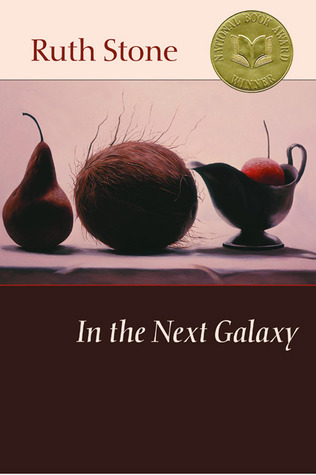
In the Next Galaxy by Ruth Stone

The author was a very old woman in 2002 when this book came out. She was born in Virginia in 1915, before the U.S. involvement in World War I. She won the National Book Award for Poetry in 2002 for this book or perhaps for her body of work. She'd already won many other major awards in the past.

At some point during the production of this book Stone lost her sight and her daughter Abigail did the corrections and proofreading, reading to her.

Stone's Wikipedia entry records a conversation she had with the journalist and novelist Elizabeth Gilbert in which Stone relates the experience of "catching a poem:"
"As [Stone] was growing up in rural Virginia, she would be out, working in the fields and she would feel and hear a poem coming at her from over the landscape. It was like a thunderous train of air and it would come barrelling down at her over the landscape. And when she felt it coming...cause it would shake the earth under her feet, she knew she had only one thing to do at that point. That was to, in her words, "run like hell" to the house as she would be chased by this poem.

The whole deal was that she had to get to a piece of paper fast enough so that when it thundered through her, she could collect it and grab it on the page. Other times she wouldn't be fast enough, so she would be running and running, and she wouldn't get to the house, and the poem would barrel through her and she would miss it, and it would "continue on across the landscape looking for another poet".

And then there were these times, there were moments where she would almost miss it. She is running to the house and is looking for the paper and the poem passes through her. She grabs a pencil just as it's going through her and she would reach out with her other hand and she would catch it. She would catch the poem by its tail and she would pull it backwards into her body as she was transcribing on the page. In those instances, the poem would come up on the page perfect and intact, but backwards, from the last word to the first."

If you would like to hear Gilbert relate this conversation, please listen to Gilbert's TED talk in which she talks about where creativity comes from.

And here is one of Stone's poems from this book:
Seed

Corn is universal,
so like a Roman senator.
Its truths are silk tassels.
True its ears are sometimes
rotten, impure.
But it aspires in vast acres,
to conspire with every pollinator
and to bear for the future
in its yellow hair.

And what are your aspirations,
oh my dears,
who will wear into tatters
like the dry sheaves
left standing, stuttering
in November's wind;
my Indian corn, my maize,
my seeds for a ruined world.
Oh my daughters.


Ruth Stone published thirteen books of poetry. She died in 2011.


You can buy this book here: Shop Indie Bookstores