Showing posts with label quirky. Show all posts

Monday, August 28, 2017

Days Without End by Sebastian Barry

Hardcover, 259 pages Pub Jan 24th 2017 by Viking (first pub October 20th 2016) ISBN13: 9780525427360 Literary Awards Man Booker Prize Nominee for Longlist (2017), Costa Book Award for Novel (2016), Walter Scott Prize (2017), Costa Book of the Year (2016)

Has an Irishman written the Great American Novel? The question is not theoretical; Sebastian Barry’s latest novel is the fourth time he has been longlisted for the Man Booker Prize. It is his seventh, but it doesn't have the density of a novel. It is Barry’s long experience writing for the theatre—thirteen plays already—that lends excitement to this work. After the years of excellent effort, suddenly Thomas McNulty springs full-grown from Barry’s well-tilled field. The success of this gem of a novel set in 1850’s America is all about preparedness and inspiration.

The novel is not long but is fluent and unstrained; it makes big statements about human existence, war, love, about what we want, and what we get. It is remarkable how squarely Barry lands in the middle of the American debate so clamorous around us now, about race, diversity, sexuality, what we fight for and who fights for us—questions we’ve never satisfactorily answered.

Barry gives us humor in a horribly violent world, surprising and delighting us with his deadpan delivery. His diverse cast of characters are reliant on one another, all viewed through the eyes of an Irishman who’d suffered such terrible deprivations as a child that man’s cruelty nevermore surprised him. What did surprise him was that we could find a way to love, to happiness, despite our sorrows.

In the early pages Thomas McNulty meets John Cole under a hedge in a rainstorm. John Cole is a few years older, but both the orphaned boys are wild things, having ‘growed' in the school of hard knocks. Uncanny judges of character, they almost instantly decide they stand a better chance together in the rough-and-tumble than alone and set off on a series of adventures. The pace of the novel is swift. When I go back to find a memorable passage, I am shocked at how quickly events unfolded, and how quickly I am deeply involved.

The language is one of the novel's wonders. Barry doesn’t try to hide his brogue, but uses it: a stranger in a strange land. That distance and perspective allows Thomas to make comment upon what is commonly observed
"Everything bad gets shot in America, says John Cole, and everything good too."
and
"I know I can rely on the kindness of folk along the way. The ones that don’t try to rob me will feed me. That how it is in America."
The novel constantly surprises: when the boys answer the ad hung awry on a saloon door in a broken-down Kansas town, “Clean Boys Wanted,” we prepare for the worst. Within pages we are jolly and laughing, then agonized and pained, then back again, our emotions rocketing despite the tamped-down telling of the historical backward gaze. Our initial sense of extreme danger never really leaves us, but serves to prepare us for the Indian wars, those pitiful, personal slaughters, and the Civil War, which comes soon enough.

The most remarkable bits of this novel, the sense of a shared humanity within a wide diversity, seemed so natural and obvious and wonderful we wanted to crawl under that umbrella and shelter there. These fierce fighting men fought for each other rather than for an ideal. Their early lives were so precarious they’d formed alliances across race, religion, national origin when they were treated fair. “Don’t tell me a Irish is an example of civilised humanity…you‘re talking to two when you talk to one Irishman.”

And then there is the notion of time, if it is perceived at all by youth: “Time was not something then we thought of as an item that possessed an ending…” By the end of the novel, the characters do indeed perceive time: “I am doing that now as I write these words in Tennessee. I am thinking of the days without end of my life. And it is not like that now.” We have been changed, too, because we also perceive time, and sorrow and pain and those things that constitute joy. We have lived his life, and ours, too.

Barry gets so much right about the America he describes: the sun coming up earlier and earlier as one travels east, the desert-but-not-desert plains land, the generosity and occasional cooperation between the Indian tribes and the army come to dispatch them, the crazy deep thoughtless racism. But what made me catch my breath with wonder was the naturalness of the union between Thomas Thomasina McNulty and John Cole and the fierceness of the love these two army men had for an orphaned, laughing, high-spirited, bright star of an Indian girl they called Winona.

Barry understands absolutely that our diversity makes us stronger, better men. Leave the pinched and hateful exclusion of differentness to sectarian tribes, fighting for the old days. We know what the old days were like. We can do better. I haven’t read all the Man Booker longlist yet but most, and this is at the top of my list. It is a treasure.

I had access to the Viking Penguin hardcopy of this novel--I'm still surprised at how small it is, given the expansive nature of the story--but I also had the audio from Hoopla. I needed both: the pace of the novel is swift, and may cause us to read faster than we ought. Barry writes poetically, which by rights should slow us down. The Blackstone Audio production, though read quickly by Aidan Kelly, allows us to catch things we will have missed in print and vice versa. At several stages in this novel, crises impel us forward. As we rush to see what happens, we may miss the beauty. Don't miss the beauty. Books like these are so very rare.


You can buy this book here: Shop Indie Bookstores

Saturday, April 1, 2017

Is It Evil Not To Be Sure? by Lena Dunham

Kindle Edition, 54 pages Pub May 12th 2016 by Lenny ASIN B01FMWFG9A

Lena Dunham is still the woman you met in the first season of Girls. These journal entries were made in 2006 when she was in college at Oberlin in Ohio. Many times the entries are not even complete sentences; they are mostly markers for absurd situations or behaviors. All that Lena Dunham is now is evident in those sentence fragments: her lacerating humor, her lack of modesty, her clear intelligence, and her fierce refusal to put makeup on the human condition.

She is offering these fragments to the world in order to show other young women and men that from which inspiration flows. They are fragments that capture a zeitgeist, a moment in the life of a college student…the time the unsexy boy wrapped his arm around you in the car, or the lover with the meaty thighs, or the time your girlfriend carried you over the snowy field on her back. Dunham is the same person…never sure how she is going to get all the people out of her apartment, sleeping everyday from 4 p.m. to 7 p.m., so inventive in her imagination one is ever off-balance in her company.

2006 was the year Dunham began making short videos around the theme of sexual enlightenment, extracurricular to her school work. One could say none, or all, of the ideas recorded in her journal that year surfaced in her art. She records awkward moments, moments of pleasure and of pain, moments of humiliation. Moments she can use to see a situation, a person, a scene. Theoretically, one could use these scraps to spark an idea, or to remember a character you’d like to describe more fully.

It’s interesting, but it is probably not for the lay person. It’s really for creatives. The audio for this is read by the author, produced by Penguin Random House. It worked well for me. I understand the written journal is available as an ebook only.

You can buy this book here: Shop Indie Bookstores

Wednesday, July 29, 2015

Blanche Passes Go by Barbara Neely

Neely writes genre fiction that is quite unlike any other out there: crime without the cops, mystery without a clue, and the romance of a strong, opinionated woman. It is beautiful and flawed and very real. Neely has an agenda, yes she does, but it’s revelatory to hear her concerns. She talks it all out on the page, so we get the picture from where she’s standing. She is fun but thoughtful; playful, but looks straight in the eye of some edgy situations. I mean, maybe you’ve thought about what to do when your neighbor is being beaten by her husband inside her house, loud enough for all the world to hear. Day after day. Well, Blanche comes up with a solution that worked pretty well and it didn’t involve a weapon of mass destruction or murder. Blanche constantly surprises us.

This mystery novel, #4 of the Blanche White series, brings Blanche down to North Carolina from Boston. Her sister’s son and daughter who are in her care, Malik and Taifa, are children no longer and are off for summer work in Vermont and Maine. Blanche is going to help her best friend, Ardell, with her catering business during the bicentennial celebrations in Farleigh, her hometown. Blanche had left behind in her hometown both a former lover, now married, and her rapist, so the pleasure of her homecoming was mitigated somewhat by what she might uncover hidden in her psyche. Besides, her Mom was as armored against intimacy as always, and never seemed to listen, even though she was getting older and needed more assistance than ever to keep everything in working order.

Nothing about this novel was ordinary. Almost every page expressed some real truth or revelation. Neely must have decided at some point she might be polite in company but she was going to write what she thought people ought to know. Thank god for it. Thank god for her. You don’t have to adhere to her beliefs, but by golly, she’s going to tell you what she thinks. She might even give some of us the words to articulate our own defense for a course of action we wanted to take but for one reason or another, felt unable. She makes a lot of sense. Blanche is an example to us.

As a mystery, the novel works very well. The denouement is guaranteed to blow you out of the water. As we begin, we imagine this novel might just be another opportunity to spend time with Blanche and hear her wisecracks on everything from real food to what men like. Nothing wrong with that! But Neely is too sophisticated and wise to just give us what we think we want: she’s gonna surprise us with something we can learn from, delighting us at the same time she is instructing us.

Blanche makes mistakes--really big, life-and-death mistakes--in this novel, all the while sounding like she has things pretty much under control. But we all have done that, haven’t we? Just as we think we’ve learned a few lessons and can dish it out, life and people surprise us. Neely makes us think. She teaches us how to think.

As the train from Boston to North Carolina makes it way south, Blanche slips into patios, anticipating her homecoming. It feels perfectly natural, though we know Blanche of Boston looking after teens is less lenient with herself. We want to relax, too, and hear the real Blanche fooling with Ardell, or romancing her new love interest, Thelvin.

The following quote is classic Neely:
”When the children were small and using up every moment when she wasn’t working for money, she’d soothed herself with a one-day-they’ll be grown fantasy. Now that they were practically grown, instead of trying to convince them to be careful of strangers, pick up their toys, and eat their okra. She was urging them to use condoms, to avoid hard drugs, and to become their very best selves. Different topics, more stressful topics. Who started that bullshit about parenting getting easier as the children got older? What parenting lost in intensity it picked up in worriation.
Or this:
”[Blanche] made up her own spiritual practice, including reverence for her Ancestors and the planet, and seeking energy from trees and healing from the sea. Some things she’d learned from African, Afro-Caribbean, Native American, and Asian ways of having a spiritual life, but she always added her personal twist. Until she’d come up with her own rituals she’d been hungry for ways to demonstrate her belief that there was more to life than she could see—ways that didn’t require her being a member of the Christian or the Muslim or any other religion that had played a part in African slavery. She also had no time for any religions that said she needed a priest or priestess to act as a go-between or worshipped a god called He. She was her own priest and goddess.”

The Blanche White series has four books. Each of them is special in its own way. Originally published in the 1990s by Penguin Books, they are now published in eBook format by Brash Books and can be bought wherever books are sold. Neely’s voice is extraordinary and outside the usual genre categorizations. The Blanche books are a little mystery, a little crime, a little romance, a little social commentary, and altogether unique. As a special treat, we are given a recipe for Blanche's Muscat Sauce from Blanche's Gig from Hell at the end.

My earlier review of Blanche Cleans Up has links to video of Neely talking about her work.


You can buy this book here: Shop Indie Bookstores

Thursday, June 11, 2015

The Ask by Sam Lipsyte

It’s a war out there. And this book is about war crimes. The kind that happen when failed painters take jobs as development agents for the arts departments of mediocre universities, sucking up to successful wealth-creators to ask them to support the drug habits of university arts brats who produce drek. But the tap of money from wealthy donors was running dry, and our failed painter Milo Burke was now a failed development agent.

Milo’s last big “ask” was to Mr. Ramadathan who had mortgaged his electronics store so that his son could “craft affecting screenplays about an emotionally distant, workaholic immigrant’s quest for the American dream.” It had meant a trip to Mr. Ramadathan’s dusty showroom in an outer borough where only used video game consoles and an old floor fan were on display.

I adored this beginning to Lipsyte’s deeply funny and intentional novel, highlighting as it does a reality of sorts behind the absurd “asks” of college development offices, and the wildly improbable and inappropriate demands of many university students in today’s America.

Lipsyte’s narrator, Milo Burke, is hovering close to the edge of despair. Despite his confusion and frustration over the strange things people do and say and how we live, Milo is not a cynical man. He loves his wife and son, and wants nothing more than to be able to provide for them. He worries about being a good dad to Bernie, his lumberjack-mouthed preschooler with a foreskin fixation.

A neighbor Milo liked “could pull off the role of loving and attentive parent with a lit cigarette in his mouth..or in his stubby fingers, which he’d hold with such care away from his daughter’s braids when she charged over to collapse on his lap and file howling grievance against her brother’s style of playhouse play… He was a throwback papa…horseshit of course, but it warmed the cheap parts of me.” That man died with his entire family, “wiped out by a beverage truck on the Brooklyn-Queens Expressway” one day, leaving Milo musing that man never had to worry about being a shitty father, leaving debts because of his cancer from cigarette smoking. But Milo still had to worry about being a shitty father because he was alive. Poor confused Milo was envious of a dead man, an unrepentant cigarette smoker.

Antihero Milo hits up his own mother for a decent-sized contribution, whether to his rent fund or his college-fund, we are unsure.
Mother: "How much?"
Milo: "Ten thousand."
Mother: "Absolutely not...the system’s rigged for white men and you still can’t tap in..."
Milo: "Okay, you wrinkled old spidercunt, have it your way."

I have to say, literature that gives me great swear words is always a draw. Shakespeare did it, Lipsyte does it.

Milo doesn’t believe in cockamamie conspiracy theories, nor those that say happiness might have something to do with acceptance and love. It’s all part of the trick, the scam to get us to believe that our rage and resentment is our own problem--something we might need to deal with because we look f—ing ridiculous blaming anything outside of ourselves for not seizing every opportunity to find true sources of happiness and love and fulfillment in the wealthiest, if not the greatest, country on earth. A war within; a war without.

Lipsyte keeps the metaphor about war working when he introduces a story about a home invasion featuring Milo and his college buddies, one of whom is his next big “ask,” the interweb magnate Purdy. But Purdy, like all big potential donors, has an “ask” of his own before he concedes to any kind of “give.”

Purdy’s illegitimate son Don is an actual soldier, returned from Iraq...without his legs. He has two new ones, made of titanium, but generally speaking, he did not come off the better for that exchange. He is still angry. He is angry because of the insipid American culture he sees around him, his sacrifice made flesh. Don manages his rage another way from what we know Milo will do. He had different training.

I came on this book because I had a long car trip coming up; I flipped through the mostly ghastly offerings at my local audio library and came across this title. Sam Lipsyte’s name rang a distant bell but I couldn’t remember why. I looked him up on Goodreads to make sure I wasn’t going to get a romance (you know, like “The Proposal”) and saw a very queer video interview that made me sure I was going to borrow this book. I present it to you here:


Mark Savras is an author and the man behind the blog The Elegant Variation. That blog never really changed very much while I listed it on my own blog for a year or so-—hoping, perhaps, to catch reflected glory. A Milo move, I think now. I watched this darn video clip a couple of times to make sure I didn’t misinterpret what I thought I saw. Savras was really out to lunch, wasn’t he? A little like our boy Milo?
Milo, looking at his hands: “I stared at my own hands: soft, expressive things, gifted even, like specially bred, lovingly shaved gerbils.”

I listened to this Macmillan Audiobook brilliantly read by the author. I am quite sure Lipsyte is the only one who could have read this with the attitude and emphases it needed to reflect the true confusion and pathos of our antihero, Milo. I saw an Audiofile review complaining the listener had to “pay attention every moment” which seems a queer kind of criticism to me. The audio won a Listen Up Award and a Publisher’s Weekly Award. It is available for Whispersync on Audible.com and I would recommend that choice: you will want to go back and see his jokes in print—he is very funny. And check out that Isaac Babel reference. I plan to.


You can buy this book here: Shop Indie Bookstores

Tuesday, October 7, 2014

Inherent Vice by Thomas Pynchon

Inherent ViceWhy Inherent Vice and why now? ‘Inherent’ is used as it is in legal documents, and Pynchon is making the point that powerful or wealthy actors in our society have an inherent advantage which they may use to good or ill, i.e., police, FBI, property developers, ARPAnet operators all have outsized power that needs monitoring, formally and/or informally. And perhaps, in the tendency within each of us to look after our own interests and feather our own beds, we all harbor the "inherent vice" Pynchon speaks of.

The New York Times recently announced that Paul Thomas Anderson has a film adaptation of the novel being released in December 2014. The IMDB website has already listed it as 8.6 in a scale of 10. Knowing Pynchon's particular fascination with film, you can bet this was raked over carefully.

It's 1969. Larry ‘Doc’ Sportello, private eye, is navigating a world of cops and zombies in L.A. Nixon is President. Reagan is Governor. Doc is stoned much of the time. He buys into nothing, and the paranoia that comes with being blitzed actually serves him well: we can allow ourselves to operate with half a brain and get on with the joy as long as we retain a healthy skepticism about who is managing our lives around us and offering us goodies. Sportello keeps reminding us to “focus in and pay attention” to weird “inexpressible imbalances in the laws of karma.”

Though I began this crime genre novel smirking over Pynchon’s descriptions of sex, drugs, and rock&roll (!) in L.A. (!) in the sexy sixties (!), gradually I became aware (like awakening from a pot-induced lethargy) that Pynchon actually has a point here. “like…far out, man, you’re actually making sense to me.” But mostly, it was just groovy hanging out with this cool dude.

He drops his truths into paragraphs thick with love beads and leis: “Over the years business had obliged him to visit a stately L.A. home or two, and he soon noticed how little sense of what was hip the very well fixed were able to exhibit, and that, roughly proportional to wealth accumulated, the condition only grew worse.” We all know there is a unfettered beauty to having nothing--no matter the storm has taken my roof, the better to see the stars—so we begin to trust this dopehead with more important observations…like what to eat. Check out the “Shoot the Pier, basically avocados, sprouts, jalapenos, pickled artichoke hearts, Monterey jack cheese, and Green Goddess dressing on a sourdough loaf that had first been sliced lengthwise, spread with garlic butter and toasted.”

Doc is in his late twenties, and has ample experience already with the way cops operate. He doesn’t like them because in his experience they lie and find ways around doing the right thing for the folks they were hired “to serve and protect.” They have powerful inducements to serve and protect their own ass, which they often do. But even the folks out to neutralize our dopehead protagonist seem to like him as he pursues for his former “old lady” Shasta the people that threaten her new bf, a millionaire real estate tycoon who has seen the errors of his ways. Several people turn up dead, and others warn “You don’t want to be fucking with this, Doc.”

The names will send one back: Bambi, Jade, Spotted Dick, Golden Fang, and Coy. We get lyrics, too, entire soundtracks that play in our heads as we squint against the smoke in the air. My favorite is “one of the few known attempts at black surf music”:

”Who’s that strollin down the street,
Hi-heel flip-flops on her feet,
Always got a great big smile,
Never gets popped by Juv-en-ile—
Who is it? [Minor-seventh guitar fill]
Soul Gidget!

Who never worries about her karma?
Who be that signifyin on your mama?
Out there looking so bad and big,
Like Sandra Dee in some Afro wig—
Who is it?
Soul Gidget!

And what about this jewel of a set-piece:
”Back at his place, Doc found Scott and Denis in the kitchen investigating the icebox, having just climbed in the alley window after Denis, a bit earlier, down at his own place, had fallen asleep as he often did with a lit joint in his mouth, only this time the joint, instead of dropping onto this chest and burning him and waking him up at least partway, had rolled someplace else among the bedsheets, where soon it began to smolder. After a while Denis woke, got up, and wandered into the bathroom, thought he would take a shower, sort of got into doing that. At some point the bed burst into flame, burning eventually up through the ceiling, directly above which was his neighbor Chico’s water bed, luckily for Chico without him on it, which being plastic melted from the heat, releasing nearly a ton of water through the hole that had by now burned in the ceiling, putting out the fire in Denis’ bedroom while turning the floor into a sort of wading pool. Denis came drifting back from the bathroom, and not able right away to account for what he found, plus getting the fire department, who had now arrived, confused with the police, went running down the alley to Scott Oof’s beach place, where he tried to describe what he thought had happened, basically deliberate sabotage by the Boards, who had never stopped plotting against him.”

The plot, such as it is, is studded with dazzling gems that threaten to distract one from Doc’s inexorable forward slide towards finding out who is actually screwing who: “…the patriots running [Coy] were being run themselves by another level of power altogether, which seemed to feel entitled to fuck with the lives of all who weren’t as good or bright as they were, which meant everybody.” Doc, to his everlasting credit, began to worry who he was helping and who he was hurting in the course of his meandering investigations. Even his buddy Sparky helping him out by following the action on the ARPAnet led to soul-searching. Too much information. About everybody. There must be a reason Pynchon decides to make dentists the money-grubbing felonious brains behind the importation of heroin, but I guess we’ll never know for sure.

And now for one of my favorite passages: Pynchon describes a phenomenon we may not have experienced before, but one which we will recognize forever after with a burst of delight and wonder.
”In the little apartment complexes the wind entered narrowing to whistle through the stairwells and ramps and catwalks, and the leaves of the palm trees outside rattled together with a liquid sound, so that from inside, in the darkened rooms, in louvered light, it sounded like a rainstorm, the wind raging in the concrete geometry, the palms beating together like the rush of a tropical downpour, enough to get you to open the door and look outside, and of course there’d only be the same hot cloudless depth of day, no rain in sight.”

As I sought the source of the Nixon quote (which sounds as tone-deaf as the man actually was) “There are always the whiners and complainers who’ll say, this is fascism. Well, fellow Americans, if it’s Fascism for Freedom? I…can…dig it!” I came across a review which places this novel in the context of Pynchon’s other works. I said in an earlier review (of Bleeding Edge) that Pynchon is remarkably consistent, and the above reviewer tends to agree. Trust, but verify. Stay vigilant. Watch yourself. “ …stay focused and stay active and [do] not take what those powerful around you say at face value.”[The Closed Circuit Game: A Hippie Noir, by Salvatore Ruggiero]


You can buy this book here: Shop Indie Bookstores

Thursday, June 26, 2014

Carnival by Rawi Hage

“Everything ends with a flight, I thought…”
O strange and wondrous story of an ordinary man “conceived on the circus trail by a traveler who owned a camel and a mother who swung from the ropes.” This story of a circus performer-turned-taxi driver is perhaps not as strange as Hage’s last novel which featured a cockroach. Suffice it to say, Hage wants to take us out of our comfort zone so that we really look at what his characters are experiencing, thinking, and saying.

The sympathetic and unnamed narrator, friend of society’s underclasses, both invokes and evokes Bohumil Hrabal’s Too Loud a Solitude, as he was gifted a large library which fills his small apartment to overflowing. He spends his free time reorganizing the volumes according to a personal and impressionistic system.
“Dead protagonists take priority over triumphant, happy-ending characters but are surpassed by books with open-endings books that don’t have moral conclusions. Novels with open endings I consider to be of a higher rank; hence they are located before novels with happy endings, which I often call religious or “resurrection” endings…As for historical novels, they are organized based on the name of the winner of the first battle that appears in the book. For instance, War and Peace will be filed in the N section, N in reference to Napolean, of course...and here, if you look above the toilet…all libraries must submit to a certain order…“

Our narrator is called “Fly.” When asked if it refers to the insect or the action, he answers “I’m not sure.” But I think I might know. Once his mother, in a state of mental distress, came in from the circus outside and saw her son shivering and naked, cold and wet from a storm.
“She called me some other name. And she laughed when she saw me naked and stared at me. Flying man, she kept on saying, flying man, let me please you. And she drew me close to her bosom and kissed my neck and her hand swept across my skin and touched me and held my erection and stroked me until I came. There you go she said now you can leave and march towards your desert and your stone.”
Fly is a taxi driver in a city that sounds like New Orleans to me; there is a week-long annual Carnival that involves much of the city. He alternately calls his taxi his boat, his plane, his ride, his car. He “flies” to pick up fares or to get home. Or to escape.
“There are two kinds of taxi drivers: the Spiders and the Flies. Spiders are those drivers who wait at taxi stands for the dispatcher‘s call or for customers to walk off the streets and into their hungry cars….Flies are wanderers, operators who drive alone and around to pick up the wavers and the whistlers on the edges of sidewalks and streets…I am a wanderer.”

Fly masturbates on a carpet that his true father had left him. One suspects it is a prayer rug, but it suits Fly to lie on it and fantasize endlessly, his mind filled with dreams of “gladiators, sailors, or women in need of rescue.” Fly does occasionally share his seed with women, but he prefers to be alone, perhaps to concentrate on his imaginary world rather than working to please another.

---SPOILER AHEAD----
Violence has a central role in this narrative. Violence is part of our worlds, though it is visited more upon some than others. Fly himself is violent, though he seems to use it more as a means of communication rather than from psychopathy. Taxi drivers begin to turn up dead, killed in gruesome ways. The litany of the dead recalls Roberto Bolaño’s 2666 in which he lists endlessly the names of Mexican girls killed in the desert over a period of years.

The victims in this novel are male immigrants on the night shift. We are set up to imagine the killers of the taxi drivers to be the work of two feral boys who grew up rough and live under an overpass by a river. Fly knows the boys, and tries to help them but finds his efforts too little too late. One of the boys’ mother is a drug addict, the nominal “father” a pimp. “I don’t judge those who can’t dream…” Fly says.

Other people are murdered: a psychiatrist, an industrialist, a college professor. The boys admit to these murders, though the mystery of the taxi drivers remains unsolved. By the end, nearly everyone close to Fly is dead or disappeared. He flies.
----END OF SPOILER----

Every review I have looked at picks out different authors or works of literature of which this book is reminiscent: Calvino, Kafka, Wallace, O’Toole are a few, but I suspect there are many more. Hage is aligning his story of a neglected underclass of misfits with the vast body of literature, and placing his group in that hallowed hall. Why shouldn’t it be there? he seems to be asking. Their lives are as interesting and telling as any other. Their lives are our responsibility.

In a remarkably difficult but revealing interview with CBC Radio 1's Q host Jian Ghomeshi, we learn a little about the Lebanese Canadian author Rawi Hage. Hage, born in Lebanon, lived in the United States for a few years before moving to Montreal. He thinks of himself as integrated but he has that “outsider” vision allows him to zero in on cultural touchstones and problems.
“There is a war out there, and believe me, Fly, it was never really between Jews, Muslims, Hindus, Crusaders, and Confucius. The final battle is between those who love, respect, and liberate the body and those who hate it, Fly…”
Thus the masturbation, and the library--feeding the body and the brain. But real food is another story.
“Communists and Muslims are not the enemies to fear in this land, Fly. It is the food consumption that will eventually blow up in everyone’s face.”

Hage is a very interesting man and author. I think he could have helped us out by making his story more user-friendly; I had to work hard to get somewhere with this and I’m still I’m not sure I got all that he meant. I do think Hage is doing something unique…he has his own style and his own subjects. I hope I have the opportunity to see his earlier work.


You can buy this book here: Shop Indie Bookstores

Friday, January 17, 2014

The Serialist by David Gordon

Here’s something I haven’t done before: read two books by the same author one after another. I’d never heard of David Gordon until I came across a very funny essay by him in the NY Times Magazine one Sunday this January. In the essay he explains that his debut novel was mostly ignored in the U.S. but was widely admired in Japan, where he won three literary prizes and sold the film rights. Gordon, bewildered and mute in a country where he didn't speak the language, was hosted in Tokyo when the film came out and ushered about by adoring fans.

Gordon’s main character, Harry Bloch, is the quintessential hack writer: he did his research into what kind of fiction is selling at the bookstore chains and decided to incorporate those elements in the writing he did for different publications. Vampires and werewolves. Serial Killers. True Crime. Mystery. Urban. Soft Porn. Whatever. He’s got it all going, with ideas to spare. He even created new names and faces (!) for each authorial persona.

Harry Bloch is contacted by a serial killer, Darian, to be the ghost writer of his story before Darian is executed. Bloch acquires a teenaged “agent” and, after meeting some of the relatives of the murdered victims of his serial killer, acquires a friend and lover called Dani.

Interspersed throughout this story of the process of ghost-writing are examples of some of the work Bloch had been doing to keep food on the table. It is here we encounter vampires and soft-porn, keeping readers laughing and awake to the author’s next move. Bloch also addresses the reader directly, making them complicit in his writing: He suggests that he is trying to “establish the intimacy of first-person voice, so you’ll follow me anywhere,” and “I don’t know about you, but I hate coming to the end of a mystery.” Throughout the novel he prods us: we readers “should have figured it out by now” because he “gave us enough clues.”

In the final pages, Gordon/Bloch gives us some of his philosophy about writing and life, which is: it’s not the beginning or the end of a novel (or life) that is most difficult. It is the middle. And I guess that flies in the face of most author interviews I have read, but it may be true in the case of real life. We’ll see.

Gordon reminds me a little of Jess Walter, endlessly inventive, determined to appeal, and laughing with (at?) us the same time. And he is really funny. But Gordon has an edge that bleeds.

I had to read Gordon’s second novel, Mystery Girl to see if Gordon betrays my confidence as he did in The Serialist, and if his sense of humor still keeps me rapt. Review here.


You can buy this book here: Shop Indie Bookstores

Monday, April 8, 2013

Mad Dog & Englishman by J.M. Hayes

Mad Dog & Englishman: A Mad Dog & Englishman Mystery


Kansas, really? This murder mystery is set in Kansas, and not a city either. It is set in the plains of Kansas, so flat and dry a stand of trees rises like a heat mirage and the wind is an ever-constant companion. J.M. Hayes, Arizona resident, grew up in Kansas and has managed to escape our notice for a long time. He is possessed of a keen eye, a coruscating sense of humor, a literate pen, and a devilish sense of the absurd. When reading this story I had to slow down. He is liable to turn suddenly in a direction I hadn’t anticipated.

The group of characters Hayes created stand on their own, and from this novel he has created a series. I liked the unfamiliar setting and the doses of history and local culture. He has teenager-speak and cadence just right and a lame police station with plenty of questionable characters and pistols full of blanks.

What I didn’t particularly like was mixing the absurd with the painful reality of the mystery: dismemberment murders by slashing razor blades, rampant sexual abuse of entire families, chasing down a black man simply because he is black, little-old-lady suicide by shotgun—I mean, really, is this meant to be funny? It is hardly the stuff of a lighthearted read.

Take the first suspect, for instance. A man, a reverend in fact, is slashed and genitally dismembered in the morning. When the town deputy goes to his house to look for clues, he happens across an unfamiliar black man, who he immediately decides must be the killer. He chases him across field and river, finally cornering him in an old barn, only to discover he is a professor of history at a nearby university whose car had broken down on the highway several miles out of town. Funny? It is meant to be, judging from the telling and the character of the deputy. It is edgy. True-to-life? Unfortunately. The reverend, we learn later, is a child molester. Unfortunately, we know this could also be true-to-life. We sense the author using a razor on us for our societal ills.

The setting in the fields of Kansas make it logical and perhaps necessary, I suppose, to place the final scenes in a grain silo, necessitating this paragraph in the middle of mayhem:
"Municipalities tend to have the larger elevators, and it was with this hope in mind that the beast of Buffalo Springs was built. It was 408 feet in length, 48 feet wide, and 90 feet high at the roof, or 110 feet at the roof of the head house. It was a monolith, formed by one continuous pour of concrete that took almost two weeks and involved 250 workers. It contained 36 circular bins, 17 star bins and 35 outer bins, so that only one empty space between the work floor and the distribution floor was unavailable to store grain. That space contained the preferred route for humans to travel to the head house and the distributing floor. The fastest, if not necessarily the safest, was by way of a pulley in the head house and was driven by an electric motor on the work floor. On an adjacent wall there was a runged ladder, positioned in case of a power failure or failure of the mechanism. There was also a circular metal staircase in that unused bin, the safest route, but a slow and tiring one….the fourth and last way to and from the top…"
You get my point I think. Too many words? It’s kind of interesting, but…perhaps we could have learned something about silos before the events in the final chapter required us to use our knowledge.

I’d like to have another look at the books this author has written. There are many things about this book that indicate the author is a thoughtful, learned man with a deep vein of humor and a clear eye for grim realities. And the setting and characters are unique. I am reluctant to pass up the chance to use my new knowledge of grain silos on another of his quirky mysteries.


You can buy this book here: Shop Indie Bookstores

Tuesday, August 7, 2012

The Orphan Master's Son by Adam Johnson

The Orphan Master's Son


This very long, very dark, and highly imaginative work by Adam Johnson forces upon the reader a series of distasteful sensations, only a few of which are horror, fury, hatred, injustice, and revenge. But by the end, one also experiences hope, compassion, sincerity, integrity, and love. Thoughts surface, submerge, roil in the mind during the days spent reading this huge novel, leaving one as drained and unsettled after a session with it as if one had “eaten bitterness.” Welcome to North Korea. If you’ve ever wondered, this is one man’s take.

Much has been written of Johnson’s seven years constructing this story. He had done research, and in several interviews pointed to memoirs of escapees, like The Aquariums of Pyongyang, and one recently published by Penguin, called Escape from Camp 14. Johnson undoubtedly used news reports to reimagine the visits of western envoys as part of his story, but the blackness central to the society was difficult for me to believe. However, in one interview published in the Paris Review, Johnson denies he showed us the real blackness: “…I had to leave much of the darkness out of my book. The real darkness of the gulag there was so bleak that I had to cut it out. You couldn’t read it.” It is just as well, then, for this book was quite black enough to leave one feeling untethered.

The novel is broken into two parts. The first half tells of a young man growing up and finding his way in a society that seems confusing and dangerous: innocuous behaviors have consequences that are out of proportion to their intent. It is difficult to read this half of the novel. I am not enamored of character-as-victim when the consequences are so dire.

Relief comes immediately in the second half of the book, when we perceive a shift in the balance of power, from state authority to the citizenry. The young man of Part I, Jun Do (perhaps “John Doe”), decides to he will write his own obituary and becomes an actor rather than merely acted upon. We are told of this change in the power ratio in an ingenious series of flashbacks as he is being interrogated over a period of time. The interrogator is the voice in this section of the novel, and we see the power of Jun Do’s non-confession on his listeners.

I think, perhaps, only an American could have written this book. A novel of the same subject written by a European may be more philosophical, literary, and well…sad. This is literature, but it is brash, brazen, curious, and a little like America’s pop culture: the hero molds his own story and puts it right out there for everyone’s delectation. He doesn’t lie, but he spins the truth, and keeps on spinning to the end. The story is also a remake of that American classic film, Casablanca, in which the hero with a great love for a dame allows her to escape to freedom while he deals with the demons that would hold her captive.

I am not going to deny the first part of this book was difficult and agonizing for me to read, but I urge readers not to forsake the book before you reach the middle if you are at all interested in the subject. In Part Two we finally see a man rather than a victim and the character of the book changes completely after this break. It is fiction in the form of a prison diary. If you’ve ever read Aleksandr Solzhenitsyn’s Gulag Archipelago 1918-1956, or Elie Wiesel’s Night, you will remember how riveting books of desperation and depravation can be.

And yes, I did order Escape from Camp 14 to read after this. I want to see how much parallels what Johnson created, and because one’s palate for ordinary fiction is rather spoiled after such a book as this. Sometimes great literature demands more of us. While I am not ready to place this in the “greats” file yet, it is big, brave, unblinking. Johnson has a unique voice that cannot be mistaken for another. He brings to us news of the condition of people in North Korea, an issue we need to examine.

An interview of Adam Johnson by Charlie Rose about this book can be viewed here.

You can buy this book here: Shop Indie Bookstores

Tuesday, May 22, 2012

A Fistful of Collars by Spencer Quinn

A Fistful of Collars


One cannot help but wonder how long Spencer Quinn can go on with a series featuring a canine narrator. Each time I open one I expect this will be his swan song, but the author simply doesn’t flag--each new book in the series is as entertaining as the last! He manages to inhabit the minds-eye of a dog looking at human habits and create a voice for what a dog may think. If you imagine this cannot be funny for the fifth time, think again. Quinn has done it.

This is perfect beach reading. It puts you in a good mood, ready to laugh. It doesn’t take a lot of concentration to wonder how the pair, Bernie & Chet, are going to manage the investigations they get involved in. Bernie is perpetually broke; he keeps buying Porsches & wrecking them; and Chet tells us the background on each of the perps. He tells us things about them no self-respecting narrator would bother with: how they smell, for instance.

In this book, we are treated to a close-up of the film industry. Little Charlie, Bernie’s son, gets a speaking role! Which makes one think…Lassie and Rin Tin Tin were film stars…perhaps one day the name Chet will be in lights?!


This book is due to be released in September 2012. You can buy this book here: Shop Indie Bookstores

Thursday, September 15, 2011

Cooking with Fernet Branca by James Hamilton-Paterson

Cooking with Fernet Branca (Gerald Samper, #1)


Whatever else we can say about James Hamilton-Paterson, he is a very funny man. If you ever found yourself in the Italian countryside gazing at the villa next door and wondering who lives there and who, for gosh sakes, is coptering in and out, after reading this novel, you may very well decide you don’t really want to know. It may be entangling, and may, after all, be the end of all you hold dear.

Gerald Samper, British biographer to the rich and famous, buys an old villa in need of repair in Tuscany’s Apuan Alps region. He is told, as is his nearby neighbor, that the owner of the nearby villa is rarely in residence so his quest for privacy and solitude is guaranteed. Of course, nothing could be farther from the truth. In fact, the resident of the villa he can see from his own is none other than a well-to-do refugee from a Soviet republic, with all her entangling connections.

Samper likes cooking, and we are treated to recipes inspired by the abundant local produce, but dreamt up entirely within the convoluted confines of Samper’s own twisted mind: Mussels in Chocolate, say, or Baked Pears in Gorgonzola with Cinnamon Cream, Lampreys in Sherry, Alien Pie, which features smoked cat mixed with baby beets, nasturtium leaves, pureed prunes, and green bacon...or my personal favorite, Tuna Stuffed with Prunes in Marmite Butter. But Samper deprecates (with good reason) the specialties his neighbor offers him, delicacies delivered direct from the former Soviet republic of Voynovia. As described by Samper:
”…brightly colored voynovian objects that were delicate to the same extent that traffic cones are. There were awesome pellets like miniature doughnuts wrapped in candied angelica leaf and injected with chili sauce. Others looked like testicles set in dough. I gathered these were pigeon’s eggs and couldn’t catch her name for them although the phrase that came to me immediately was Christ on a Tricycle. Spearmint eggs?
But this book is not about cooking, despite the title. It is about living the good life in Tuscany among other artists—writers, musicians, filmmakers, realtors--magicians of all stripes. And what of Fernet Branca? It is a digestif concocted in Italy that, given as a gift to the new arrivals of Le Roccie, is purchased a second time to return the courtesy, and becomes a central feature of the misunderstandings among the residents and visitors there. It is described in Wikipedia as having the flavor of “black-licorice-flavored Listerine."


This book counts towards the 2011 Europa Challenge. The Europa Challenge Blog: Cooking with Fernet Branca by James Hamilton-Paterson


You can buy this book here: Shop Indie Bookstores

Monday, August 8, 2011

Death from the Woods by Brigitte Aubert

Death from the Woods This was a bestseller in France and I read it when it came out in English ten years ago. Many hundreds of books later, I still remembered the thrill I had at the risk the author had taken with her unusual murder mystery centered around a blind mute quadriplegic. I know, I know, how can this be? It was almost as if the author, sitting around with friends over several bottles of good wine, had taken a bet to see if she could construct a story about the most unusual of protagonists—one that cannot move nor see nor speak.

I searched for the title again, and decided to have another look…just to see how the author constructed the mystery and how she kept the tendrils of the mystery in my brain after so many years. The voice of Elise, our narrator, is so piquant and particular that we follow her willingly through a series of grisly murders. We think also what it must be like to be handicapped so completely, and how other people relate to the handicapped. These things alone make the book worth reading. The central mystery itself is impossible to foretell—I defy anyone to figure out the ending in advance—but the ending is not as cleverly wound up as the beginning is laid out.

The facts of the mystery are this: over a period of several years, young boys are found murdered and mutilated not far from a quiet suburban French village. Elise, blinded and paralyzed as the result of a bombing in Ireland, is befriended by a disturbed young girl who whispers to her that she knew who killed the boys. Unable to speak, Elise can only listen and postulate about the identity of the killer as more clues accumulate. Another child is killed, and Elise herself becomes a target, but even she does not know why.

I think the author, Brigitte Aubert, deserves kudos for maintaining momentum through this novel, and for trying something completely new. As I say, it is difficult to get this book out of your head, so if you try it, be prepared to find yourself thinking about it for years. After its success in France, the author apparently wrote a follow-up novel which was also translated into English, called Death from the Snows, also with Elise as a main character. I haven’t read this one yet, but I am interested to see how the author proceeds with a new mystery involving our unusual heroine. Brigitte Aubert is a well-known thriller writer in France, but only a few of her many books have been translated. While this book has flaws, it is remarkable and memorable.


You can buy this book here: Shop Indie Bookstores

Monday, July 25, 2011

The Hottest Dishes of the Tartar Cuisine by Alina Bronsky

The Hottest Dishes of the Tartar Cuisine


Snippy, snarky, and wholly original, the voice of Rosalinda Achmetowna will stay with you long after you close this book. First published in German in 2010, this Booker-nominated bestseller explodes with personality, wit, and the wisdom of an older woman. Not that Rosie thinks of herself as old.

Life in Russia was never easy, but Rosalinda thought her daughter, Sulfia, made life especially hard for herself. In the time-honored way of mothers everywhere, she hectored, berated, cursed, and finally resorted to direct intervention in her attempts to get her daughter gainfully wed. And it’s a good thing, too, since Sulfia had a child—a lovely child—who was soon to become central to the trio’s “escape to the West.”

It is rare to encounter a voice so fresh with biting insights and yet so laughingly tender at the same time. Always on the lookout for the main chance, our heroine finds myriad ways to game the system while she holds on, white-knuckled, to the gains she feels she deserves. It is hard not to feel regret when we close the book at last, for she is a woman with the carapace of a beetle, but an interior soft as unalloyed gold. “People liked it when someone tugged at their heartstrings. I couldn’t understand why,” Rosalinda tells us. But I think Alina Bronsky understands it.

Classic Rosalinda:
”I noticed that by German standards, I was a fairly young woman. It was as if I had stopped aging. Of course, I hadn’t forgotten my real age. In Russia I knew I was young but that other women my age no longer were. Here I realized that the women my age really were young, even if they looked worse than me.

Even some women much older than me were still young. I stared at the first real old lady I saw—one with violet-colored hair—after she passed me on her bicycle. I took a picture of the second one. The third time I saw an older woman on a bike, it made me think. Then I bought myself a secondhand bicycle from a newspaper ad.”


This book counts towards the 2011 Europa Challenge. The Europa Challenge Blog: The Hottest Dishes of the Tartar Cuisine by Alina Bronsky

You can buy this book here: Shop Indie Bookstores

Saturday, May 7, 2011

The Bucolic Plague by Josh Kilmer-Purcell

The Bucolic Plague: How Two Manhattanites Became Gentlemen Farmers: An Unconventional Memoir


I had this book in my library and, without reading it myself, lent it to a family member to help her through a difficult surgery. She never returned it, but when I read Dawn Rennert’s review of her pilgrimage to Sharon Springs on her blog called She is Too Fond of Books, I went to get it back that very day. I'm so glad I did. It would have been perfect for the sick family member, had she read it, but she didn't and I did. It was perfect for me, too. What a wonderful, funny, painful, knowing memoir of a pair of busy city executives finding a “weekend retreat” in upstate New York (Sharon Springs) that turns into a full-time job and lifestyle change. Not ordinary executives, not an ordinary town…and not an ordinary house.

By now, many of you will have heard already of the Beekman Boys on Planet Green’s Reality TV show, but I hadn’t until now. The truth is that this memoir is so hilarious and yet so real, in a you-and-me-and-a-drag-queen sort of way, that I couldn’t put the darn thing down. It is a lovely fairy tale about the wonders of country living. I’ve been guilty of dreams of domestic bliss and the homemade life more than once myself, but these guys do it bigger and better than I would or could. It’s no wonder the town embraced them and their 88 goats.

Without a doubt, highlights of the story include a Martha Stewart Peony Party at her homestead near New York City, the fare reduction ad campaign that was created in less than five minutes, and the first time a crew went to the Beekman house to shoot a reality show. Now there really is a TV show, but it was not at all obvious that this would be the case when the idea was first explored:
"At some point during the morning, I realized that the most exciting moment of our potential reality show would be the copyright notice in the credits. To compensate, I came to the conclusion that if I ran everywhere—physically moved my body faster—the film might seem more engaging. I galloped out the end of the drive to get the mail. I trotted to the garage to grab a trowel…For even more” sizzle,” instead of simply leading the goats out to graze as we usually did, I raced out in front of them, hollering an improvisational goat call that made me sound like a yodeling hillbilly. I turned back toward the barn and saw that the goats had stayed back, huddled together in fear in the barn doorway. They obviously preferred to skip dinner rather than get too close to the retarded scarecrow suffering a grand mal seizure.”

Do yourselves a favor and don’t wait for major surgery to take the chance to read this book. It’s funny, heartwarming, recognizable, and real. You’ll be glad there are folks like this around, and you’ll wish they lived nearby. And check out their website.


You can buy this book here: Shop Indie Bookstores

Tuesday, April 19, 2011

The Bee-Loud Glade by Steve Himmer

The Bee-Loud Glade


Even the name Himmer reminds one of a sound one might hear in a bee-loud glen. Himmer the author leads us into a world we vaguely recognize (perhaps we are blind, too) as modern-day America: outside a large city sits a mansion on a hill. Just as in days of yore, when wealthy landowners changed the landscape to suit their tastes, a wealthy capitalist has modified his land holdings to create a lovely locale but bemoans the fact he has no time to enjoy it. So he hires a disaffected young man to live the life of a happy hermit in the environment he has created. Things go remarkably smoothly for a time.

**SPOILERS and Reading Group questions Ahead**

Our hermit describes his daily life in a way that parallels in important ways the life of an author. When one chooses to join the writing life, the author seems to say, one signs off to major portions of the ordinary days lived by the majority. One spends lots of time alone, observing, trying to achieve some level of proficiency in arts (not just writing, but other expressive arts) one has never practiced before. One must become wholly focused and may even waste a lot of time in trying to find a way through the lonely existence of learning to see. But eventually, when our hermit is offered an opportunity to leave his cave and live the life of a wealthy man, he turns it down. By this time he is used to scrabbling in the dirt for his food, and finds the wondrous taste of his own production payment enough.

The fact that our hermit actually became sightless as time wore on made me curious. Could this be the selfishness of authors who abandon other familial or residential duties to focus on their one interest, leaving the heavy-lifting (wage-earning, cooking, cleaning, child-raising) to loved ones? But since our hermit decides to stay where he is despite his blindness, I begin to think that perhaps he has found his inner life more rewarding, in the end, than living in the world. And perhaps in his sightlessness, he can actually see motive and remember beauty more clearly. Though he strains to see, the outlines his vision allows gives him what he needs to go on. Is Old Man River an editor? Is Mr. Crane (the name can't be irrelevant) a large publisher? Is Mrs. Crane the distractions of the flesh? Who, then, are the hikers? Fellow artists that gather to perfect their craft, stealing occasionally, the fruits of another?

You can buy this book here: Shop Indie Bookstores

Friday, April 23, 2010

Beatrice and Virgil by Yann Martel

Beatrice and Virgil: A Novel


Yann Martel's puzzling and disturbing new novel vibrates just a little--a frisson for the mind--quite exactly as though someone has walked over one's grave. Martel takes on big issues not because he is unafraid, but perhaps because he is. But gently, o critic, lest you silence a voice in full throat. It is a voice we need to nurture since it mirrors us, not in raging journalistic torrents which belittle us, nor in hypocritical religious diatribe meant to shame us, but in stories meant to reflect, instruct, and sustain us.

Ostensibly the book is about an author in search of a subject. We come across two writers named Henry, and two animals--dead animals--named Beatrice and Virgil. The story is deceptively simple--mostly the reading of a play with few characters. But references abound which make the mind whirl and stop and pick and think and wish and fear and...you see the novel is not really just a novel, the play is not just a play, and the playwright is not a playwright at all. In the end, a howl, or a braying--"frank and tragic as a sob"--would be a very appropriate reaction.

I am left with questions which I will ponder with relish in the days to come. I welcome fellow travellers to unravel the mysteries with me, of the onelongword evilivingroomanerroneously, [sic] dramas, the odd hand gesture somewhat resembling a Nazi salute, a second hand gesture, and very mysteriously, tennis lessons. I have no problem with the ludicrousness of this list, nor do I have a problem with its ambiguity. There is little enough laughter in the full drama of the story--I would feel it too bleak to live otherwise. I believe the author means for us to think things through for ourselves. He's given us the signposts: Dante, Shakespeare, Diderot, Flaubert, Chagall, Mozart, among others. You see, it is not so very hard after all, and what a beautiful way to go. Kudos, Martel. Best wishes always.

Thursday, September 10, 2009

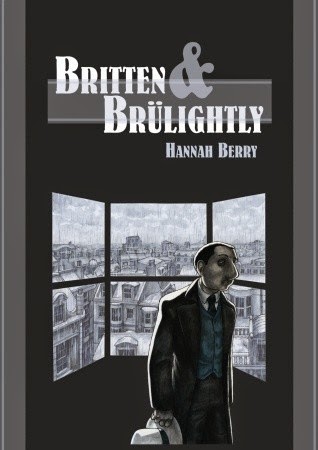
Britten and Brülightly by Hannah Berry

I love the idea of graphic novels. I love the idea that drawings can instantly tell us things about people and situations and language provides depth, gloss, and character. Persepolis by Satrapi gave us serious biography graphically, and The Photographer by Lefevre and Guibert gave us serious war reportage. Now Britten and Brülightly takes us part of the way to what I imagine is possible for a graphic literature. The art is superbly suitable for the noirish mystery. It is nuanced, and shows us slight variations in meanings. The choice of frames impells the story forward at a reasonable clip (could, perhaps, have used a few more frames as I had to flip back a couple times). The authorial voice for Britten is dour and dry and funny. Britten and his sidekick, Brülightly, manage to solve the mystery of a thwarted love affair which involves death, birth out of wedlock, and hidden family histories. I loved the characterizations, but hated the ending. The story line at the end was not all I would have wished, but overall the effort was exceptional. I look forward to the direction this book has moved us.


Tuesday, February 17, 2009

Wrack and Ruin by Don Lee

Wrack and Ruin


I adored this book. It had me laughing in public places and snickering into my coffee. All the characters had real flaws but Lee was fair--everyone was flawed. And what's more, I liked them the better for it. Lyndon Song, ex-New York sculptor and brussel sprouts-farmer extraordinaire, and his failed financier brother Woody, make a madcap pair amongst the other odd personages of Rosarita Bay, California.

Lee was much more fluent in this work than in his earlier work, Country of Origin, and it seemed he was having a better time as well. The action and personalities seemed so very Californian to me, and since I live on the east coast, it felt like a trip away. A television series that gives me that same "quirky California" feel is Six Feet Under.