Showing posts with label netgalley. Show all posts

Tuesday, June 26, 2018

Transcription by Kate Atkinson

Hardcover, 352 pgs, Expected pub: Sept 6th 2018 by Transworld Publishers Ltd, ISBN13: 9780385618724

Not all of Kate Atkinson’s novels have been what she calls historical fiction, but the last couple have been. This novel may hew closest to the truth, though like she says in the Author’s Note at the end, she wrenched open history and stuffed it with imaginative reconstruction, at least one fantasy for each fact.

The author tells us afterward what her intentions were. This is particularly delicious, and I argue, respects the reader. We get to look into her construction and think. She answers questions we've formed, and instead of farming out possible answers to various reviewers, she’s blunt with us about elements we’d been wondering about. There is something comparable in theatre, when the actors takes off their masks for the final bow and we all celebrate together.

Atkinson returns to the Second World War, periodic releases from the National Archives of secrets from that time fueling her creative process. When she discovers [true fact] an ordinary-seeming bank clerk was a major cog in rounding up British supporters of Nazis, her story had a frame. When she discovered [true fact] hundreds and hundreds of pages of transcripts of conversations of dissident groups in London, her story had a heart.

What Kate Atkinson does is not necessarily unique (using historical documents to create fiction), but what she does with it is unique. Her style, tone, and characters are recognizably hers. She is funny: one knows there are people out there whose droll delivery of witty responses to ordinary questions is quintessentially British but we don’t come across it enough. Atkinson can do repartee.

By now Atkinson may be incapable now of writing fiction with a chronological timeline. This novel has only three time periods to work with and really only one central character, which simplifies the action enough that I only had to reread an earlier section once. This was partly due to my surprise, maybe a little exasperation, and finally willingness to be led out of the action at what seemed like a critical moment…again! I was burrowed in like a tick, and am yanked to a later, earlier, whatever time. (I didn't really mind...stretching out the experience of reading Atkinson again, luxuriously.) Atkinson manages to satisfy and confound a reader at the same time.

Atkinson’s characters always have the ‘ghost of Jackson Brodie’ about them. This is a very good thing, considering how much we liked Brodie and wouldn’t mind having him resurrected. We could make the case that the main character in this novel, Juliet Armstrong, is a female Jackson Brodie—honest and therefore vulnerable, she doesn’t have so high an opinion of herself that she is insufferable. In the end she is well able to take care of herself. She’s smart, and a very good liar, and keeps herself a little distant. After all, who can one trust?

At eighteen, Juliet is parentless: "her mother's death had revealed that there was no metaphor too ostentatious for grief." Young and alone, Juliet was not, however, callow. She lied like crazy through a job interview with a flippant and overly-inquisitive young man who interviewed her for a job, which she was surprised she got. Later she learned he'd known every lie, and appreciated the ease with which she misled him.

This book is about spies, spies working in the service of the British government, or so we believe. What is special is that we see what is British about them—what is ordinary, patriotic, courageous, honorable. But we also see a nation at war and we see duplicity, hunger, ambition, pettiness. Then we lay over that the work of the other nations at war, France, Germany, Russia, the United States and a few exceptional people emerge alive, not unscathed, but breathing at the end. The tension comes when we are not sure who will remain standing.

Atkinson writes about the middle of the twentieth century, but she could be talking about the twenty-first:
Juliet could still remember when Hitler had seemed like a harmless clown. No one was amused now. (“The clowns are the dangerous ones, Perry said.”)

and

Do not equate nationalism with patriotism…Nationalism is the first step on the road to Fascism.
One always senses the intelligence in Atkinson’s work. She not only writes a good story--which means getting the humanity right--she makes us think while we read. She’s unpredictable. And frankly, I like her politics. It’s always a pleasure to enjoy another of her books.

This novel is due out September 25th in the U.S., published by Little Brown; it looks like it will be out September 6th in Britain by Transworld. Preorder now!


Saturday, February 10, 2018

Algorithms of Oppression by Safiya Umoja Noble

Hardcover, Expected pub: Feb 20th 2018 by New York Univ Press, ISBN13: 9781479849949

Noble began collecting information in 2010 after noticing the way Google Search and other internet sites collect and display information about non-white communities. Her results dovetail with other work (e.g., Weapons of Math Destruction by Cathy O'Neil) positing that algorithms are flawed by their very nature: choosing & weighting only some variables to define or capture a phenomenon will deliver a flawed result. Noble wrote this book to explore reasons why Google couldn’t, or wouldn’t, address concerns over search results that channel, shape, distort the search itself, i.e., the search “black girls” yielded only pornographic results, beginning a cascade of increasingly disturbing and irrelevant options for further search.

In her conclusion Noble tells us that she wrote an article about these observations in 2012 for a national women’s magazine, Bitch, and within six weeks the Google Search for “black girls” turned up an entire page of results like “Black Girls Code,” Black Girls Rock,” “7-Year-Old Writes Book to Show Black Girls They Are Princesses.” While Noble declines to take credit for these changes, she continued her research into the way non-white communities are sidelined in the digital universe.

We must keep several things in mind at once if the digital environment is to work for all of us. We must recognize the way the digital universe reflects and perpetuates the white male patriarchy from which it was developed. In order for the internet to live up to the promise of allowing unheard and disenfranchised populations some voice and access to information they can use to enhance their world, we must monitor the creation and use of the algorithms that control the processes by which we add to and search the internet. This is one reason it is so critical to have diversity in tech. Below find just a few of Noble's more salient points:
We are the product that Google sells to advertisers.

The digital interface is a material reality structuring a discourse, embedded with historical relations...Search does not merely present pages but structures knowledge...

Google & other search engines have been enlisted to make decisions about the proper balance between personal privacy and access to information. The vast majority of these decisions face no public scrutiny, though they shape public discourse.

Those who have the power to design systems--classification or technical [like library, museum, & information professionals]--hold the ability to prioritize hierarchical schemes that privilege certain types of information over others.

The search arena is consolidated under the control of only a few companies.

Algorithms that rank & prioritize for profits compromise our ability to engage with complicated ideas. There is no counterposition, nor is there a disclaimer or framework for contextualizing what we get.

Access to high quality information, from journalism to research, is essential to a healthy and viable democracy...In some cases, journalists are facing screens that deliver real-time analytics about the virality of their stories. Under these circumstances, journalists are encouraged to modify headlines and keywords within a news story to promote greater traction and sharing among readers.
An early e-version of this manuscript obtained through Netgalley had formatting and linking issues that were a hindrance to understanding. Noble writes here for an academic audience I presume, and as such her jargon and complicated sentences are appropriate for communicating the most precise information in the least space. However, for a general audience this book would be a slog, something not true if one listens to Noble (as in the attached TED talk linked below). Surely one of the best things this book offers is a collection of references to others who are working on these problems around the country.

The other best thing about this book is an affecting story Noble includes in the final pages of her Epilogue about Kandis, a long-established black hairdresser in a college town trying to keep her business going by registering online with the ratings site, Yelp. Noble writes in the woman’s voice, simply and forthrightly, without jargon, and the clarity and moral force of the story is so hard-hitting, it is worth picking up the book for this story alone. At the very least I would recommend a TED talk on this story, and suggest placing the story closer to the front of this book in subsequent editions. For those familiar with Harvard Business Review case studies, this is a perfect one.

Basically, the story is as follows: Kandis's shop became an established business in the 1980s, before the fall off of black scholars attending the university "when the campus stopped admitting so many Blacks." To keep those fewer students aware that her business provided an exclusive and necessary service in the town, she spent many hours to find a way to have her business come up when “black hair” was typed in as a search term within a specified radius of the school. The difficulties she experienced illustrate the algorithm problems clearly.
“To be a Black woman and to need hair care can be an isolating experience. The quality of service I provide touches more than just the external part of someone. It’s not just about their hair.”
I do not want to get off the subject Noble has concentrated on with such eloquence in her treatise, but I can’t resist noting that we are talking about black women’s hair again…Readers of my reviews will know I am concerned that black women have experienced violence in their attitudes about their hair. If I am misinterpreting what I perceive to be hatred of something so integral to their beings, I would be happy to know it. If black hair were perceived instead as an extension of one’s personality and sexuality without the almost universal animus for it when undressed, I would not worry about this obsession as much. But I think we need also to work on making black women recognize their hair is beautiful. Period.

By the time we get to Noble’s Epilogue, she has raised a huge number of discussion points and questions which grew from her legitimate concerns that Google Search seemed to perpetuate the status quo or service a select group rather than break new ground for enabling the previously disenfranchised. This is critically important, urgent, and complicated work and Noble has the energy and intellectual fortitude needed to work with others to address these issues. This book would be especially useful for those looking for an area in the digital arena to piggyback her work to try and make a difference.

Below please find a 12-minute TED talk with Ms. Noble:


You can buy this book here: Shop Indie Bookstores

Friday, November 17, 2017

I Can't Breathe: A Killing on Bay Street by Matt Taibbi

Hardcover, 304 pgs, Pub Oct 24th 2017 by Spiegel & Grau ISBN13: 9780812988840

The detailed nature of this book about the life and death of Eric Garner allows us to see, in horrible living color, exactly where we’re at in terms of race relations in the United States. Eric Garner died July 17, 2014 in Staten Island, victimized on this day by police who put him in a chokehold and ignored his pleas that he could not breathe. What Taibbi does exceptionally well in this difficult book is allow us to see Eric Garner for the man he was—a well-liked and respected member of his community.

The entire story told here is a long and winding one, going back to pick up relevant cases along the way, including that of Carnell Russ of Alabama, whose death in 1971 by pistol shot at close range in a police station was challenged in court a number of times until finally we learn a monetary award was never paid to Carnell’s widow. Forty-five years later the original prosecutor in the Eric Garner trial, Dan Donovan, was elected to Congress, proud of his role in protecting the white people, in his eyes, unjustly under attack for upholding the law.

So carefully has Taibbi prepared his case in the writing of this book that when we read the words “disrespect for the law, contempt for society, a refusal to abide by the responsibilities of a civilized people,” we briefly imagine the words were chosen to describe the men and women of the NYC police force who refused to give credence to citizen complaints about uncalled for police harassment and reckless endangerment. But no, this language was used by Joseph Concannon, retired NYPD captain and staunch defender of whatever the police did in the course of their duties, illegal or not.

City politicians elected before, during, and after the prosecution of the Eric Garner case come off looking weak and ineffectual at best, deliberately obfuscating at worst. The case of the killing of Eric Garner came amidst a rash of police killings around the country that were well publicized, mostly due to actual video of the crimes. It is absolutely horrifying to imagine for a moment how these cases would have been treated in the absence of a video record. Even in these cases, obstruction into the behaviors of repeat offender police is rampant, common, and from the point of view of the citizenry, indefensible.

The black lives examined in this work are extremely stressful. Putting ourselves in their place, we might even say these lives and conditions of life are hopeless. But Eric Garner did not see things that way, and certainly on the day he died, he was the happiest he’d been in a very long time, his son having just been awarded a sports scholarship for advanced education. Taibbi is able to make us feel the heat that day in July, and the satisfaction the big man would have felt. We’re plenty pleased, too.

I have wondered, in thinking of Taibbi’s past work, what it would be like to to be on the other side of one of his scathing investigations. Now we know, because he co-authored a book during his expat days in Moscow, in which he targeted everyone in the outsized-profits-fueled economy, from foreigners gaming the system to Russian oligarchs and their deadly, beautiful hookers. Adolescent, ridiculous, and forgettable, excerpts I read from that earlier work should have meant a far longer, more circuitous path to legitimate journalism. The argument in the link above charges Taibbi with sexism and misogyny, a shadow of which, it could be argued, appeared in his description here of Assistant DA Anne Grady.

It is my contention that Taibbi’s work uncovering the hows and whys of the life surrounding Eric Garner is a far weightier thing on the scales of right and wrong-doing than that earlier work. It is important we all scour our own past for sexism—doling it out or letting it pass—before nailing the coffin shut on the talent and real heart shown here. With this book, Taibbi blows past any criticisms that could be leveled for those earlier errors in judgment and gives us something terribly important: a honest, raw look at where we stand in our race relations right now. Perhaps only bad boys could understand, empathize with, and give us the nuance of all the imperfect characters Taibbi details for us here, and get to the depth in this story that explains Eric Garner’s life and untimely death.

Several of the Irish-sounding names in this history are exactly those of loved ones within my own family, though I don’t believe I am related to any of them. My grandfather was a Boston cop. What I take from this is that whatever place these white policemen go to in their heads when it comes to fairness and justice, it is not inevitable, and it doesn’t come from the color of their skin. I recall the recently-discovered 19th-C diary of African American boy convict Austin Reed,
“Yes, me brave Irish boys, me loves you till the day that I am laid cold under the sod, and I would let the last drop of this dark blood run and drain from these black veins of mine to rescue you from the hands of a full blooded Yankee…Reader, if you are on the right side of an Irishman, you have the best friend in the world.”
A lot has happened from then to now, but nothing that can’t be undone.


You can buy this book here: Shop Indie Bookstores

Tuesday, June 6, 2017

Woolly by Ben Mezrich

Hardcover, 304 pages Expected publication: July 4th 2017 by Atria Books ISBN13: 9781501135552

Mezrich picks interesting topics, I will concede that. Readers may already have heard some years ago that a Harvard lab was working on de-extinction of the Woolly Mammoth. Mezrich brings us up to date on this project; indeed, the first and last chapters in this nonfiction are set in the future.

If you are familiar with Mezrich’s writing, the author weights the concept of narrative nonfiction heavily on the narrative and fiction sides, ostensibly to stoke momentum and get folks interested. The only problem is that his very good instincts about what is intrinsically an interesting story fights with his method. Sometimes the reader has to thrash through pages of invented dialogue to reach a critical conclusion, a real buzz killer if there ever was one.

But this story works on many levels, and while we are following his careful step-by-step thrust with one eye, our mind is busy on the operations of a lab and the implications of the study for medicine, for wildlife, for every aspect of our visible and invisible world. Mezrich eventually addresses many of these key issues in the text, usually making the science sound responsible and considered.

I started to grow more uncomfortable towards the end of the book, when we are reminded that the science has progressed so far so fast that genomic modifications have escaped the lab environment and can be undertaken in a made-over garage for relatively small costs, and that billionaires of every stripe are lining up to make their money count for something big.

The real excitement of this story is in our imaginations, and what the skills and knowledge of present-day scientists can allow us to imagine. Mezrich places us in fund-raising meetings with billionaires, allowing the most humble among us to enjoy the same stories and sense of excitement that fuels movers and shakers. If the glamour of the whole thing begins to seem suspect at some point, I think you’ve caught my sense of unease.

Mezrich shares the history of the project, including the work by Nikita Zimov in Northern Siberia, determining that woolly mammoths seemed to have played a role in preserving the permafrost levels of the tundra, by upturning the soil and exposing lower layers to the freezing temperatures. His father, Sergey Zimov, apparently theorized that reestablishing animal herds that roamed Siberia earlier in human history might play a role in keeping escaping carbon and methane, now sequestered in permafrost, from accelerating the speed at which the earth warms.

The fact that woolly mammoth remains are discovered regularly now in thawing and melting ice and snow of the north is something I had not known. The ancient ivory from the tusks is not protected and is therefore an important source of income for hunters, sold in lieu of protected elephant tusks, for the same reasons, to the same buyers.

The scientists involved in the story at one of the Church labs at Harvard are fascinating individuals in their own right, each with a backstory that only fuels our interest. The project has been going on long enough now that the twenty-something personnel involved at the beginning of the project are turning it over to others, younger ones still, to ensure continuity of skills on such a forward-looking project. The whole concept and execution of the mammoth idea is sufficiently…mammoth…and complex enough to make readers feel as though they have been subtly changed by the experience.

The real life story ends with woolly mammoth DNA implanted in an elephant cell. Dr. Frank Church, the originator of this project, to his credit, decides not to use elephants to gestate the beast that might develop, but to construct a synthetic uterus. That is currently underway. Stay tuned.


Due out July 4th.


You can buy this book here: Shop Indie Bookstores

Thursday, June 1, 2017

Sing, Unburied, Sing by Jesmyn Ward

Hardcover, 304 pages Expected publication: September 5th 2017 by Scribner ISBN13: 9781501126062

This brilliant novel reads like a thriller yet teases out and lays bare a disturbing family history of violent, unresolved death resulting from a culture of race relations profoundly at odds with national ideals.

Jesmyn Ward is a Southern writer in the gothic tradition, a worthy successor to Faulkner, O’Connor, Welty, and McCullers. She shows the cruelties not just within families but between families and races. Her characters have so much at stake. What Ward writes is what we have inherited. We can change it, but first we have to acknowledge it.

The bulk of this novel takes place over the course of one day, the day Jojo and his sister Kayla accompany his mother Leonie to Parchman’s, a prison, to pick up his father Michael. Everything is revealed in that one day. Resolution takes a little longer.

Ward’s willingness to “go there,” her vision uncut and her language clear and exact, gives her work the aspect of witness. And yet she inhabits the young man Jojo so completely that he became our eyes and our judgment. It feels like a gift, to be able to see how families bend and break under the weight of all they carry…the weight of all those killed violently and not yet laid to rest.
“Last night, Richie crawled under the house and sang.”
Richie is the ghost of a poor murdered boy, and he is not the only ghost in this family’s present. Jojo’s uncle Given is also a spirit, albeit one that gives comfort, advice, and warning. It proves difficult for family members to deal with the spiritual needs of the ghosts as well as the temporal needs of those around them. It is confusing, demanding, intrusive. Add to that, not everyone has “the sight.” Jojo has it.

Ward opens her story with the butchering of a goat, giving us a taste of the education Jojo has on the farm, under the tutelage of his grandfather. The violence of the experience jolts us awake, nerve endings jangling. We need whatever instincts this incident has aroused in us to get through the day trip to Parchman’s, which becomes a descent into the dark heart of delusion and destruction.

Ward manages to instill the work with the impetus of a thriller: a reader becomes completely trapped by the closeness in the old car, the desultory conversation, the turn onto unfamiliar roads, the unexpected stop. The blood scent has put the wind up: we’re not sure who will come out alive at the end of the trip. Ward exquisitely calibrates her descriptions to resonate with us: we recognize these people, these motivations, these zones of danger.

Making an exciting work of fiction is an art, but Ward elevates the stakes by making an exciting work of fiction socially relevant and critical to the conversation going on in our nation. Just last summer a book of essays edited by Jesmyn Ward and written by important American writers and thinkers, The Fire This Time: A New Generation Speaks about Race, was released to great acclaim. The essays address the ongoing race issues our country has never resolved and struggles with yet.

Ward is among the finest and most important writers we have. Make sure you catch everything she puts out.


You can buy this book here: Shop Indie Bookstores

Friday, May 26, 2017

Blind Spot by Teju Cole

Hardcover, 352 pages Expected publication: June 13th 2017 by Random House ISBN13: 9780399591075

This book of photographs paired with short essays is due out in the next two weeks. I want to give you ample time to order one for delivery on publication. Teju Cole’s art is exceptional at the same time it is accessible. In my experience, the confluence of these two things happens only rarely, which is how Cole has come to occupy an exalted place in my pantheon of artists. If I say his photography can stop us in our tracks, it says nothing of his writing, which always adds something to my understanding. Today I discovered his website has soundtracks which open doors. And there it is, his specialness: Cole’s observations enlarge our conversation.

This may be the most excellent travel book I have read in recent years, the result of years of near-constant travel by the author. Scrolling through the Table of Contents is a tease, each destination intriguing, irresistible, stoking our curiosity. Each entry is accompanied by a photograph, or is it the other way around?
“I want to make the kinds of pictures editors of the travel section will dislike or find unusable. I want to see the things the people who live there see, or at least what they would see after all the performance of tourism has been stripped away.”
Yes, this is my favored way of travel, for “the shock of familiarity, the impossibility of exact repetition.” It is the reason most photographs of locales seemed unable to capture even a piece of my experience. But Cole manages it. In the entry for “Palm Beach,” his picture is of a construction site, a pile of substratum—in this case, sand—piled high before an elaborate pinkish villa. His written entry is one of his shortest, only three sentences, one of them the Latin phrase Et in Arcadia ego, washing the scene with knowledge of what we are viewing, and what is to come.

Cole calls this work a lyric essay, a “singing line” connecting the places. There is some of that. What connects all these places for me are Cole’s eyes…and his teacherly quality of showing us what he is thinking. It is remarkable, and totally engrossing.
“Human experience varies greatly in its externals, but on the emotional and psychological level, we have a great deal of similarity with one another.”
Yes, this insight, so obvious written down, is something I have been struggling with for such a long time, going back and forth over the idea that we are the same, we are different. Cole tells us that this book stands alone, or can be seen as fourth in a quartet addressing his “concern with the limits of vision.” I want to sink into that thought, in the context of what he has given us, because outside the frame of a photograph, outside of our observation, outside of us, is everything else.

My favorite among the essays, if we can call them such, filled as much with what Cole did not say as with what he did, is the piece called “Black River.” Cole evokes the open sea, Derek Walcott, crocodiles, and white egrets. A tropical coastal swamp filled with crocodiles also had white egrets decorating the bushy green of overhanging mangroves, the large white splashes almost equidistant from one another, the closest they can be for maximum happiness, I like to think, t hough it could also be minimum happiness, I guess. Any closer and there will be discord, like the rest of us live.

The arrival in bookstores of a book by Teju Cole is an event. His pictures makes us look, and his words are like the egrets, spaced for maximum pleasure. Whether or not you read this as a series or alone, make sure you pick it up, just to gaze. You need have no agenda. His magic does not make much of itself. He takes us along for the ride. Bravo!


You can buy this book here: Shop Indie Bookstores

Thursday, January 26, 2017

Building the New American Economy by Jeffrey D. Sachs

Hardcover, 152 pages Expected publication: February 7th 2017 by Columbia University Press ISBN13: 9780231184045

Jeffrey Sachs’ new book, which runs about 150 pages, has a Foreword by Bernie Sanders. Sachs directly addresses the new Trump administration, and makes suggestions about our nation’s priorities. Sachs wrote it fast, since the election, and it shows. He'd supported Bernie, but Sanders was not explicit when it came to running the government. These are Sachs' ideas, but knowing there is someone in political life that he supports helps to flesh out Sanders' ideas as well.

Sachs allows that we might be able to comprehend priority spending of the government, so shares some national budget particulars:
“Federal taxes account for about 18 percent of GDP, mostly income and payroll taxes…Together with state and local taxes, the total tax collection of all levels of government amounts to around 32 percent of GDP.”
On the spending side, first is military spending at 5% of GDP. Next is what Sachs calls “mandatory spending” but what Republicans call “entitlements:” Medicare, Medicaid, Social Security, income support programs, etc. This is a rising share of GDP, at 12.6%. The third category of spending is interest payments of government debt, which will rise when interest rates increase. Public debt to national income is about 75%, and average interest charges on that debt are at about 1.5% of GDP per annum. Finally, we have non security discretionary spending, or our investment in the future, which in the scenario Sachs talks about here, doesn’t even make it to the drawing board unless we take on further debt.

The reason Sachs gives us is that income taxes, etc are only 18% of GDP while military, mandatory spending, and interest payments alone are 19%. He is a smart guy, and he may be right, but if you are asking us to decide on which categories or programs to cut, I will need to see the whole budget, many thanks. [Unfortunately the graphs and charts are not reproduced in the ebook of this pre-publication galley.]

Anyway, Sachs suggests we cut military spending and increase discretionary spending commensurately, leaving the other categories to be adjusted in smaller ways. In theory, I don’t have a problem with this. I have lately weighed good and bad in American foreign policy in the past fifty years, and see lots of room for a reduced role, though one has to acknowledge the vacuum of leadership is going to be filled, perhaps by a country we don’t admire much, or at all.

When we abdicate as a superpower, we also jettison some of the trust and reliance of our allies, as some of their positions and spending were predicated on our own. It is a much more fragmented and divided world, a world that may not be so amenable to policies the U.S. supports. And Sachs’ proposals for the future are all about global cooperation. He suggests that we use our military spending instead on global development projects, which will keep some portion of goodwill headed our way.

Sachs also recommends a value-added tax like they have in Scandinavia which would raise another 3-4% of income. The huge discrepancies in income from top to bottom of the U.S. income ladder will still be there, they just won’t be as great, and more in line with the world’s other great democracies. Sachs is even willing to consider restructuring corporate taxes, like Trump has already proposed, but only “if combined with an end to corporate loopholes and foreign tax deferral provisions.” Definitely one of the main income disparities is who even pays taxes in the U.S.

Sachs looks not very far into the future and see some major changes in our economy: an end to internal combustion mobility and the beginning of a low-carbon lifestyle, regardless of government leadership. It would help if government was in front, using their think tanks and scientific offices to help direct some of the changes, but what we really have to guard against is allowing entrenched corporate interests to hijack our future and investment money. We can decide these things without government, though.

Trump has stated he wants states to make their own decisions on many things we have in the past asked the federal government to do. States with wealth, educated workforces, and well-funded universities (like Massachusetts, California, and New York) may make out very well, drawing more similarly-minded folks to them, and exacerbating the cross-talk divisiveness among the states. They’d have to capture taxes from individuals who wish to work, but not live, in their states. But my feeling is, if we can’t work together within our own country, how can we expect to work across national boundaries on important issues like climate change, exploration, and energy supplies?

When Sachs discusses the changes in the workplace, I find my credibility meter reading low. I agree that even educated workers will be replaced in the modern economy as computers and machines get more capable. But Sachs is suggesting that older, experienced workers pay some part of their wages to younger people who cannot find jobs.

Hello! We’re already doing that! It’s called taxes, and it is a stupid idea. Older workers, whether they want to believe it or not, are going to die, and if they haven’t mentored young people to get experience and be able to take on the stress of creativity everyday, they may be surprised when the whole show goes tits up. [This was Hillary Clinton’s problem. She thought she needed to do everything herself.]

We cannot continue to have older workers stay in the workplace as long as they want—and continue to decline—keeping younger folk from earning and gaining experience, let alone spur creativity. May I suggest this is a real problem? People who have been working for forty or fifty years cannot keep up, no matter what they believe about themselves. And it is not good for the country.

Sachs has one idea towards the end that is kind of interesting: that Wall Street be tasked with earning and churning the financial investment monies for our infrastructure retooling. I actually really like that idea, and think the incentives could be restructured to focus on this. Once the wonky windfall profits not only on Wall Street, but everywhere in corporate America, are tempered with reasonable tax policy and closing of tax havens and loopholes, people might remember they must play well with others. We don’t have long, however: we should already be well into flood abatement.

There are lots of other things lightly touched on in this book, including a discussion of why “free trade” is not free for everyone. Sachs has a blog where he makes notes and posts articles and media accounts that he find interesting or thinks we need to discuss. In the summer of 2016, his important and informative discussion about the election, globalization, immigration, and Brexit was subsequently picked up by NPR and discussed on radio. He pointed to what is now called “populist” anger and explains the real substantive issues behind this. Jeffrey Sachs is professor of economics and sustainable development at Columbia University, former director of the Earth Institute, and special advisor to UN Secretary General Ban Kin-moon. He is the author of The End of Poverty.


You can buy this book here: Shop Indie Bookstores

Sunday, January 8, 2017

The Signal Flame by Andrew Krivák

Hardcover, 272 pages January 24th 2017 by Scribner ISBN 1501126377 (ISBN13: 9781501126376)

Krivák takes his own blessed time when telling stories. His novels are quiet, but not especially slow; they are full of drama, generations of crises. It has been five years since the publication of Krivák's quietly spectacular first novel, The Sojourn, which followed the sharpshooter Jozef Vinich during World War I. This book, it turns out, follows Vinich’s family, based now in the hill country of northeastern Pennsylvania, where they run a mill.

War and its opposite, peace, are inescapable twin themes running through Krivák’s work, lacing the generations together. We are introduced to the Irishman silversmith who landed penurious in New York, only to be conscripted into the Union army, fighting at Gettysburg, one of the last men standing. Afterward he built a snug and comfortable house that lasted well, uninhabited, for many years until it again became a happy home.

Jozef’s grandson Sam goes to Vietnam, a corporal, and is missing in action. But Sam had the noticing, or attention, gene that Jozef had exploited in the earlier conflict to keep himself alive: “Just movement like the breeze, except there was no breeze that day.” No one wants to believe Sam is dead. His brother and mother hold the fort at home, missing him, waiting for him to come back one day.

The family history is complicated, threads overlapping and woven into the fabric of that small area where everyone knew everyone else. But Krivák patiently and clearly relates the relevant histories with their attendant tragedies and small successes until those histories are as clear as our own. When, in the final pages, Hannah stands near the corner of her land and finds a smooth-barked beech with the generations of family carved into its side, we know just who is being described. JV + HP, BK + HV, BK + AD, SK + RY, each set of carving clearer in its presence on the tree’s skin. What is so remarkable is how long the family lasted in that place, without moving or shipping anchor, and the violence done to the dreams of each in that place one might think of as sleepy, or otherwise passed by.

The attention to language, to the unhurried unfurling of a long-form mystery, is Krivák’s special skill. We often ask the question, “how did this happen?” but we rarely have the patience to hear the answer. Krivák makes it interesting enough that listening is no chore, recalling as it does the lives of each of us in its moments of kismet and inevitability, love and violence, birth and death.

What I liked best, perhaps, was the genuine kindness even in the confusion among people. There is no triumphalism over the indignities of failure, but neither is there any abnegation of responsibility. These Americans accept responsibility for their forefather’s actions, strive to understand, and be better for any mistakes made. They are capable of change, of understanding, and forgiveness. It is a remarkably uplifting fiction, despite the difficulties each family undergoes.

One of the more delicious descriptions in the book is the occasion of a day trip to West Virginia from northeast Pennsylvania. Despite nothing out of the ordinary happening, we greet this part of the story with the excitement children might feel when told of a trip away. Krivák’s descriptions thrill us with their clarity and accuracy: we know of whom he writes.

Another description that catches a moment perfectly is this description of Sam's brother Bo fishing with the parish priest, whom Bo wanted to ask for advice:
"The split up on the stream, Bo took the faster water up top and fished with a muddler minnow. Father Rovnávaha worked a black ant in a lower pool where brookies were rising to terrestrials. In all this time from house to stream, they had said no more than five words to each other."
They sat streamside on rocks for a coffee break, Bo walking to the edge to pick a mayfly off a stone. They'd been using the wrong flies. Then Bo broached the topic that was troubling him.

There is no sensationalism here. Krivák writes about a time long gone, fifty and more years ago. It is a small, almost private novel, about making a wooden hutch for someone as a Christmas present, and when placed in their home, “looks like it had always been here.” The fiction has something of that inevitable feel, as though it weren’t made-up at all, but memoir, and deeply felt. These are beautifully written and constructed novels, and there is room for more, if Krivák wanted to move into the controversies of a modern-day novel. I read later that these will be a trilogy. Read them in any order, but don't miss them.


You can buy this book here: Shop Indie Bookstores

Tuesday, August 9, 2016

Darktown by Thomas Mullen & Interview with the Author

Hardcover, 384 pages Expected publication: September 13th 2016 by Atria / 37 INK ISBN13: 9781501133862

The experience of two black police officers forms the kernel of Thomas Mullen's explosive new novel set in a 1948 Atlanta that was “two parts Confederate racist to two parts Negro to one part something-that-doesn’t-quite-have-a-name-for-it-yet.” Black policemen are as discriminated against in their own headquarters as are black civilians, so these beat cops must have strong moral grounding and resilient natures to put up with the task at hand. Their poorly equipped office is in the basement of the YMCA, run by a man who’d had his door kicked down twelve times for imagined crimes. That man was happy to find a place in his building for the new Darktown police force.

The Wiki for Darktown reports that the Negro neighborhood of Atlanta
stretched from Peachtree Street and Collins Street (now Courtland Street), past Butler Ave. (now Jesse Hill Jr. Ave.) to Jackson Street. It referred to the blocks above Auburn Avenue in what is now Downtown Atlanta and the Sweet Auburn neighborhood. Darktown was characterized in the 1930s as a "hell-hole of squalor, degradation, sickness, crime and misery”.
Because white police officers did not often want to respond to citizens living in Darktown, the neighborhood was unconstrained and plagued by bad behaviors. In 1948 the Atlanta Police Department trained and hired eight black men, some WWII veterans, to patrol Darktown and keep the peace.

One enters a fiction about race relations written by a white man with a certain amount of trepidation. At the start of the novel we are treated to descriptions of truly despicable behaviors, epithets, taunts, and conditions to which Atlanta's first black officers were exposed, and while we suspect it is all too true, we are not comfortable. No one likes to be reminded how bad it must have been. Not long into the narrative, however, we almost imperceptibly begin to relax into the telling of a crime story that involves shadowy power well beyond the reach of a Negro beat cop a few months into the job. A young pretty black woman is found dead in a garbage heap and the last known person to have been with her was a white ex-cop, fired for corruption some time ago along with some mates on the force.

This is not a novel just about race. This is a novel about policing. One of the things that Mullen reveals to us in this book is the true nature of “the job”: the thorny ethical conundrums and moral relativism that haunts those mean streets. We suspect that police officers have to deal with these difficulties every day of their working lives, and we begin to question whether any man or woman is up to the task. After all, some difficult choices are often made quickly, on the spur of a moment when the police themselves may be facing physical danger.

What is moral relativism? It is the notion that there is no universal concept of right or wrong, good or bad, and that truth and goodness must be examined from the place at which the individual stands. It’s why justice is so hard to nail down, and why judges and juries are so important. But this concept can be stretched to unsupportable lengths, and we are presented with examples of that in this book. It makes for thoughtful reading.

Mullen challenges us with this novel, and if I said "we relax into the reading," I certainly didn't mean for the last half of the story, which ramps up the tension to terror. The film rights for this novel were optioned in a competitive bidding war long before its publication date. The film contract was eventually won by Sony TV with Jaime Foxx as executive producer, Rachel O’Connor producing. It does have a cinematic feel: dark, hot, buggy nights loaded with sweat, blood, and moral conundrum.

Mullen could easily make this first in a series, he was so competent in involving readers with his characters and their edgy situation in the context of crime within and without the Atlanta police force. It feels all kinds of relevant today, as the white population is waking up to race in America and how "discriminatory behavior" manifests. The Epigraph at the beginning of the novel is a quote from one of the first black officers to be inducted into the Atlanta Police Department, Officer Willard Strickland:
”I must tell you, it was not easy for me to raise my right hand and say, ‘I, Willard Strickland, a Negro, do solemnly swear to perform the duties of a Negro Policeman.’”
Many thanks to Thomas Mullen for bringing us this absorbing and difficult story, and to Netgalley and Atria Books for sharing the e-galley with me in advance of publication on September 13, 2016. Below, Thomas Mullen answers some questions about Darktown.

----------------------------

Ques: Your novel is a soul-crushing look at conditions for the first black police officers in Atlanta and I note you have a quote from Officer Willard Strickland for your Epigraph. Can you tell us how much of the book is imagined and how much parallels the actual, related experiences of these men?

  MULLEN: The specifics of the book's plot and the characters are invented, but the context is based on historical fact: the rules the black officers had to operate under (not being able to arrest whites, not being able to use headquarters, or drive squad cars, or even walk the beat in white neighborhoods) and the hostile response they received from white officers (the death threats, the repeated use of epithets in their presence, the attempt to frame them for crimes). Those details I didn't invent but found in my research.

  Ques:  I am not going to deny that reading racial epithets, taunts, and threats towards the black policemen from their white colleagues made me extremely uneasy and uncomfortable, no matter that it could have been factually true. Did you, as a white novelist, have second thoughts about writing a history from the point of view of black men discriminated against for their color?

MULLEN: I needed to be accurate to the times. If I had, say, not had any instances in which whites used the n-word, or had made the white cops seem friendlier to the black officers than they really were, then I would have been whitewashing history. That would only play into the hands of revisionists who like to claim, "hey, it was better in the good ol' days." I take no pleasure in showing instances of racism and cruelty, but to pretend they didn't happen would be dishonest. And I think it's important to remember what these men had to go through, every day.

As far as the black point of view in the book, roughly half of the book is from black characters' perspective and about half is from white characters' perspective. But what's important here is that each character has his or her own, unique perspective--no character should be a mere stand-in for their race, or gender, or religion, or anything. I always want my characters to feel as 3-D and authentic and real as possible, in my other books and in DARKTOWN.

  Ques: Many writers would steer clear of a subject so rife with conflict. Do you consciously seek the most explosive subject you can find, confident in your ability to navigate criticisms and the shoals of accusation?

  MULLEN: I wouldn't say that I consciously go toward explosive subjects, but I do think that my work has always grappled with what it means to be an American. My first novel, THE LAST TOWN ON EARTH explored the eternal conflicts of society vs. individualism and security vs. liberty through the lens of the 1918 flu epidemic; my second, THE MANY DEATHS OF THE FIREFLY BROTHERS, explored the American Dream and financial insecurity through a tale of Great Depression bank robbers; my third, THE REVISIONISTS, tackled terrorism, espionage, and political idealism. It seemed to me, when I started writing this book four years ago (two years before Ferguson and Black Lives Matter), that race has always been a vital and ongoing component of the American story; it was influencing people's response to President Obama, the rise of Tea Party movement, terrorism, the economy, so much else. I don't think writers should steer clear of important subjects.

  Ques: Officer Denny Rakestraw goes some way towards assuaging the conscience of white readers of this novel and acting according to his conscience, and yet he and Officer Lucien Boggs wrestle with moral relativism. Is this something policemen must face every day of their working lives?

  MULLEN: I'm drawn to moral dilemmas and complex issues, and yes, it seems to me that policing is rife with them, whether in 2016 or 1948. All the major characters in DARKTOWN are wrestling with what's the best--or the smartest, or the safest, or the most moral, or the most opportunistic--way to remedy their problems, and the way they come to these often-conflicting decisions is what moves the book forward.

  Ques: Can you give us some idea of how long this novel took between conception and execution? Is this an idea you have been wishing to write or did you literally “meet” the idea in the form of Officer Strickland?

  MULLEN: I got the idea for the book when I read a 4-page passage about the 1948 hiring of Atlanta's black officers in Gary Pomerantz's excellent history of Atlanta, "Where Peachtree Meets Sweet Auburn." I spent two years researching (which is where I found Strickland's speech, at Atlanta's Auburn Avenue Research Library) and writing the first draft, then another year or so on edits with my agent.

  Ques: I note your novel has been optioned for TV. Congratulations! I’m sure it has occurred to you and to others who have read your novel that your characters could conceivably live a long life as a crime series. Have you considered that?  

MULLEN: Yes, long before I got the TV deal I had envisioned this as a book series. One of the many things that intrigued me about setting a book in 1948 is that so much is going to happen in the next 20 years--from Brown v. Board of Education and the white backlash to school desegregation, to Martin Luther King Jr. returning to Atlanta in 1960, and so much more--that will greatly impact these characters. There are so many stories to tell, and I'm looking forward to taking readers along for a fascinating ride.

  Thank you so much!

-------------------------


You can buy this book here: Shop Indie Bookstores

Tuesday, July 19, 2016

Known and Strange Things: Essays by Teju Cole

This book of essays by Teju Cole aren’t always essays: they might be scraps of thought, well-digested and to an immediate point. They are fiercely intelligent, opinionated, meaningful in a way that allow us to get to the heart of how another thinks. And does he think! Let’s be frank: many of us don’t do enough thinking, and Cole shows us the way it can be done in a way that educates, informs, and excites us.

The work in this volume are nonfiction pieces published in a wide variety of outlets and that he chose from an eight-year period of travel and almost constant writing. The emphasis in these pieces, he tells us in the Preface, is on “epiphany.” We can enjoy kernels of ideas that may have had a long gestation, but have finally burst onto the scene with a few sentences but little heavy-handedness or any of the weight of “pronouncements.” This reads like a bared heart in the midst of negotiating life, as James Baldwin says in The Fire Next Time, “as nobly as possible, for the sake of those coming after us.”

Cole references Baldwin in all these pieces in his unapologetic gaze, but he does so explicitly in several pieces, notably “Black Body” in which he tells of visiting the small town in Switzerland, Leukerbad (or Loèche-les-Bains), where Baldwin’s Go Tell It on the Mountain found its final form. Cole expands on his time in Switzerland in “Far Away From Here,” which might be my favorite of these essays. Cole tells how he was given six months to work and write in Zurich and though he did precious little writing, he was totally absorbed every day, gazing at the landscape, walking the mountains, photographing the crags, trails, and lakes, thinking, unfettered. This is someone who carries all he needs in his head, and I loved that freedom as much as he.

But how can I choose a favorite from among these pieces when each spoke of ways to approach a subject with which we have struggled—or haven’t yet…About race and class: “how little sense of shame [Americans] seemed to have,” he writes, looking at America from his upbringing in Lagos. Cole echoes Baldwin again in “Bad Laws” about Israel and its laws concerning the rights of Palestinians:
”The reality is that, as a Palestinian Arab, in order to defend yourself against the persecution you face, not only do you have to be an expert in Israeli law, you also have to be a Jewish Israeli and have the force of the Israeli state as your guarantor…Israel uses an extremely complex legal and bureaucratic apparatus to dispossess Palestinians of their land, hoping perhaps to forestall accusations of a brutal land grab.”
Earlier Baldwin reminded us that “…few liberals have any notion of how long, how costly, and how heartbreaking a task it is to gather the evidence that one can carry into court [to prove malfeasance, official or not], or how long such court battles take.” Americans looking at Israel and Palestine should be able to discern some outline of our own justifications and methods, and vice versa.

Photography is one of Cole’s special interests and he is eloquent in Section Two "Seeing Things" in discussing what makes great photography as opposed to the “dispiriting stream of empty images [that the] Russians call poshlost: fake emotion, unearned nostalgia.” And then he discusses “Death in the Browser Tab,” wherein he tells us what he sees and what he knows after retracing the steps caught by the phone footage recording Walter Scott being shot in the back by eight bullets from a .45-caliber Glock 21.

Politics is what humans do, though “the sheer quantity of impacted bullshit in politics” is clearly not something Cole relishes. In "The Reprint" Cole admits he did not vote until sixteen years after he was eligible, and when he did vote finally, for Obama, “like a mutation that happens quietly on a genetic level and later completely alters the body’s function, I could feel my relationship to other Americans changing. I had a sense—dubious to me for so long, and therefore avoided—of common cause.” He notes that Obama was “not an angry black man, the son of slaves” but a biracial outsider who invisibly worked his way to the center of the political establishment piggybacking the experience of American blacks by hiding in plain sight. The night Obama won, Cole was in Harlem.
“There was as exuberant and unscripted an outpouring of joy as I ever expect to see anywhere… Black presidents are no novelty for to me. About half my life, the half I lived in Nigeria, had been spent under their rule, and, in my mind, the color of the president was neither here nor there. But this is America. Race mattered.”
Cole will speak out in "A Reader's War" against Obama’s “clandestine brand of justice” and his “ominous, discomfiting, illegal, and immoral use of weaponized drones against defenseless strangers…done for our sakes.” He admits that Obama believes he is trying “to keep us safe,” and writes “I am not naive…and I know our enemies are not all imaginary…I am grateful to those whose bravery keeps us safe.” It is one of the most difficult questions about political and military power that we face today and Cole wrestles the issue heroically. Not any of us have yet answered this question well, and until we do, the disconnect between justice and drone strikes will continue to plague us. We have unleashed a terrible swift sword on far away lands while we continue to suffer the brutality of a thousand cuts from our own citizens. Cosmic justice?

When Cole talks about literature I experience a frisson. There is nothing quite like someone very clever and well-spoken addressing something about which one cares deeply. His insights add to my pleasure, and detract nothing. His description of the poetry of Derek Walcott remind me of the first time I encountered Walcott’s work: “This is poetry with a painterly hand, stroke by patient stroke.” I have forever thought of Walcott in this way, in color and in motion: turquoise and pale yellow, cool beige and hibiscus pink, the palest gray and an ethereal green I am not sure is water, air, or sea grass. The ocean creates tides through his work, and it seems so fresh.

When Cole writes of his visit to V.S. Naipaul in “Natives on the Boat," we sense how Cole’s initial reserve is eventually won over by Naipaul’s deeply curious and wide-ranging questions. In the very next essay, “Housing Mr. Biswas,” Cole writes an ecstatic celebration of Naipaul’s accomplishment in creating the “smart and funny, but also often petulant, mean, and unsympathetic” Mr. Biswas in Trinidad,
“an important island in the Caribbean but not a particularly influential one on the world stage…the times and places—the farms, the roads, the villages, the thrumming energy of the city, the mornings, afternoon, dusks, and nights—are described with profound and vigilant affection…it brings to startling fruition in twentieth century Trinidad the promise of the nineteenth century European novel.”
He’s right of course. Naipaul is a beloved writer of a type of novel no longer written, and perhaps now not often read.

Reading all these essays in one big gulp was a lot to digest so I am going to recommend a slower savoring. This is a book one must own and keep handy for those small moments when one wants a short, sharp shock of something wonderful. By all means read it all at once so you know where to go back to when you can dig up copies of some of the photos he talks about or want to recall how Cole manages in so few words to convey so much meaning. His is a voice thoughtful in expressing what he sees and yet so vulnerable and human I want to say—read this—this man is what’s been missing from your lives.


These collected essays will be published August 9, 2016. I read the e-galley provided to me by Netgalley and Random House. I note that some of the essays about art or photography that were initially published in newspapers sometimes were accompanied by examples of the work he discusses. In a perfect world, these would be included in the final book, but truthfully, his writing is clear and compelling enough to not make that nicety strictly necessary. Apologies to the publisher for quoting from a galley: my excuse is that the work is previously published and therefore no surprise.


You can buy this book here: Shop Indie Bookstores

Tuesday, July 12, 2016

The Fire This Time by Jesmyn Ward

In the Introduction to this collection of essays by an impressive roster of writers known for thoughtful and articulate discussion of their experience with race in America, Jesmyn Ward explains that she wanted something more than newspaper accounts or editorials when faced with the events of the past eighteen months in the USA. Her own book on the death of five young men of her acquaintance in her own short life, Men We Reaped, meant that hearing of and seeing via public media further deaths of black men by white men was traumatic enough to want to gather friends, neighbors, and most of all, those she admires for their clarity of voice, to ask “How do we deal with this?” “How do we think about this?” “How can we stop this?”

This collection references James Baldwin’s The Fire Next Time which is a work that addresses the future in a letter to Baldwin’s nephew, and the past and present in an essay about religion. Ward mentions that she intended to gather the commissioned essays in three parts - Past, Present, and Future—but found that most of the essays dealt with the past because the past explains the present and impacts the future. Unless the past is acknowledged and consciously dealt with in the present, the future will always be a question mark. The essays gave Ward hope because words matter. Words help us to cope. I agree with her.

The names of the writers in this collection you will recognize, and if you don’t at first, you will in the future. One name I’d never seen before wrote my favorite essay in the collection, called “Black and Blue.” Garnette Cadogan quotes Fats Waller at the start
"My skin is only my skin.
What did I do, to be so black and blue?"
Cadogan relates his experience as a Jamaican man in the United States—how he had to learn how to dress (cop-proof and IV league), how to speak, how not to run, or make sudden movements, or wait on the streets for friends…you get the picture. His personality and behaviors had to be twisted to fit the circumstances. In a sense, this happens to all of us, wherever we move, if we want to fit in, but not like that. Not like that. And he said something I’d never heard before when considering a black man’s experience:
"I always felt safer being stopped in front of white witnesses than black witnesses."
Apparently the cops have greater regard for the concern and entreaties of white witnesses than they do for black witnesses. I recall the old chant "White Silence is Violence." Cadogan also said that “my woman friends are those who best understand my plight,” due to the fact that women are often targeted on the street by men simply because of their sex. And he said that having to be hyperaware of one’s environment before speaking, moving, acting is what children do when they are learning, returning adult males (and females) to childhood status, even in cities where they live. My brain fizzes.

Claudia Rankine, poet and author of Citizen, winner of the National Book Critics Circle Award for Poetry in 2015, has an essay which begins
"A friend recently told me that when she gave birth to her son, before naming him, before even nursing him, her first thought was, I have to get him out of this country."
I totally see where that friend of Rankine’s is coming from, and have had that same thought while reading Jill Leovy’s Ghettoside. Black men in the United States do not have enough of a childhood and they can grow, if they live long enough, gnarly and twisted by society’s expectations. This can’t be right. I’d get my son out also.

All the essays were ravishing and brought me something important, like Wendy Walters’ description of the slave graves discovered under a street intersection in Portsmouth, NH. My excitement quickened to see an essay by Mitchell S. Jackson, whose first novel The Residue Years was a finalist for the Hemingway/PEN Award, the Center for Fiction’s Flaherty-Duncan First Novel Prize, and the Hurston/Wright Legacy Award. In his essay called “Composite Pops”, Jackson talks about male role models in a way that recalled to me Iceberg Slim. Slim was a con-man, a pimp, and a miscreant, but he had self-confidence, the push to succeed, wisdom, and love and he spread all of these around generously. I can think of a far worse father figure than he.

You will recognize the names Natasha Trethewey, Poet Laureate, Isabel Wilkerson, Pulitzer winner in Journalism, Edwidge Danticat, Haitian novelist and MacArthur Fellow, all of whom have essays in this collection. But there will be names new to you in this remarkable collection which will open worlds you have not yet dreamed of. Once again we recognize that the work and thoughts—the words—of Jesmyn Ward bring us along, sometimes kicking and screaming in horror, to a new place of understanding. Many thanks.

Thanks to Netgalley and Simon & Schuster/Scribner for a chance to read the advance galley of this title which is due in bookstores August 2, 2016. Order it early and often.

You can buy this book here: Shop Indie Bookstores

Saturday, June 25, 2016

The Complete Guide to Contemporary World Fiction by M.A. Orthofer

Orthofer lives in New York currently and was founder in 1999 of the complete review, a website dedicated to reviews of recent literature from around the world. In 2002 Orthofer included a blog, The Literary Saloon, which carries news from interviews, reviews, and notes on awards, publication, items of interest from around the internet. Orthofer has been updating it nearly every day.

The reach of Orthofer’s interests is nothing short of astounding. In this compendium of contemporary world literature he tries to include short mention of the work of leading litterateurs around the world and includes dates of publication and translation when a work is mentioned. This is an indispensable guide for those interested in world literature for it introduces readers to new authors and commonalities among authors either in genre or style that allow us to find what suits our own voracious reading habits.

This work can be read for itself, but it is more likely to be used as a reference text for readers interested in contemporary world literature. It can be downloaded as an ebook or referenced from the hardcopy. Continents are broken into constituent parts and each countries’ authors are mentioned with reference to their major works. While I have always thought myself interested in “world literature,” the range of this work makes me realize how parochial my reading has been, mostly limited to the overseas imaginings of writers of English. I note a recent entry in The Literary Saloon claims there has been a huge outpouring of translations of contemporary Arabic literature, a trend surely long awaited.

North American literature is not included in this work because the author is pointing to the need for American readers to vary their diet and expand their horizons:
”Because American authors provide an enormous amount and variety of work, American readers are arguably spoiled for choice even without resorting to fiction from abroad…In almost every other country, foreign literature occupies a central and prominent position, but in the United States it seems to sit far more precariously on the fringes…foreign literature can offer entirely new dimension and perspectives…great literature knows no borders.

When I founded the Complete Review (complete-review.com) in 1999, one of my goals to to take advantage of the Internet’s tremendous reach and connectivity…Ironically, though, one of the shortcomings of this and most other Internet resources is its tremendous scope…[This book] provides an entry point and more general overview various nations’ literatures, as well as a foundation to help readers navigate what is available on the Internet.”
—from the Introduction
Orthofer has attempted something most of us might consider impossible, and he has done a convincing job of it. If it lacks anything, it is up to us to help straighten it out. I highly recommend everyone have a look at this book to see what you are missing. If it seems overwhelming, I sympathize. Imagine how Orthofer felt when he began.

You can buy this book here: Shop Indie Bookstores

Wednesday, July 29, 2015

Blanche Passes Go by Barbara Neely

Neely writes genre fiction that is quite unlike any other out there: crime without the cops, mystery without a clue, and the romance of a strong, opinionated woman. It is beautiful and flawed and very real. Neely has an agenda, yes she does, but it’s revelatory to hear her concerns. She talks it all out on the page, so we get the picture from where she’s standing. She is fun but thoughtful; playful, but looks straight in the eye of some edgy situations. I mean, maybe you’ve thought about what to do when your neighbor is being beaten by her husband inside her house, loud enough for all the world to hear. Day after day. Well, Blanche comes up with a solution that worked pretty well and it didn’t involve a weapon of mass destruction or murder. Blanche constantly surprises us.

This mystery novel, #4 of the Blanche White series, brings Blanche down to North Carolina from Boston. Her sister’s son and daughter who are in her care, Malik and Taifa, are children no longer and are off for summer work in Vermont and Maine. Blanche is going to help her best friend, Ardell, with her catering business during the bicentennial celebrations in Farleigh, her hometown. Blanche had left behind in her hometown both a former lover, now married, and her rapist, so the pleasure of her homecoming was mitigated somewhat by what she might uncover hidden in her psyche. Besides, her Mom was as armored against intimacy as always, and never seemed to listen, even though she was getting older and needed more assistance than ever to keep everything in working order.

Nothing about this novel was ordinary. Almost every page expressed some real truth or revelation. Neely must have decided at some point she might be polite in company but she was going to write what she thought people ought to know. Thank god for it. Thank god for her. You don’t have to adhere to her beliefs, but by golly, she’s going to tell you what she thinks. She might even give some of us the words to articulate our own defense for a course of action we wanted to take but for one reason or another, felt unable. She makes a lot of sense. Blanche is an example to us.

As a mystery, the novel works very well. The denouement is guaranteed to blow you out of the water. As we begin, we imagine this novel might just be another opportunity to spend time with Blanche and hear her wisecracks on everything from real food to what men like. Nothing wrong with that! But Neely is too sophisticated and wise to just give us what we think we want: she’s gonna surprise us with something we can learn from, delighting us at the same time she is instructing us.

Blanche makes mistakes--really big, life-and-death mistakes--in this novel, all the while sounding like she has things pretty much under control. But we all have done that, haven’t we? Just as we think we’ve learned a few lessons and can dish it out, life and people surprise us. Neely makes us think. She teaches us how to think.

As the train from Boston to North Carolina makes it way south, Blanche slips into patios, anticipating her homecoming. It feels perfectly natural, though we know Blanche of Boston looking after teens is less lenient with herself. We want to relax, too, and hear the real Blanche fooling with Ardell, or romancing her new love interest, Thelvin.

The following quote is classic Neely:
”When the children were small and using up every moment when she wasn’t working for money, she’d soothed herself with a one-day-they’ll be grown fantasy. Now that they were practically grown, instead of trying to convince them to be careful of strangers, pick up their toys, and eat their okra. She was urging them to use condoms, to avoid hard drugs, and to become their very best selves. Different topics, more stressful topics. Who started that bullshit about parenting getting easier as the children got older? What parenting lost in intensity it picked up in worriation.
Or this:
”[Blanche] made up her own spiritual practice, including reverence for her Ancestors and the planet, and seeking energy from trees and healing from the sea. Some things she’d learned from African, Afro-Caribbean, Native American, and Asian ways of having a spiritual life, but she always added her personal twist. Until she’d come up with her own rituals she’d been hungry for ways to demonstrate her belief that there was more to life than she could see—ways that didn’t require her being a member of the Christian or the Muslim or any other religion that had played a part in African slavery. She also had no time for any religions that said she needed a priest or priestess to act as a go-between or worshipped a god called He. She was her own priest and goddess.”

The Blanche White series has four books. Each of them is special in its own way. Originally published in the 1990s by Penguin Books, they are now published in eBook format by Brash Books and can be bought wherever books are sold. Neely’s voice is extraordinary and outside the usual genre categorizations. The Blanche books are a little mystery, a little crime, a little romance, a little social commentary, and altogether unique. As a special treat, we are given a recipe for Blanche's Muscat Sauce from Blanche's Gig from Hell at the end.

My earlier review of Blanche Cleans Up has links to video of Neely talking about her work.


You can buy this book here: Shop Indie Bookstores

Monday, July 7, 2014

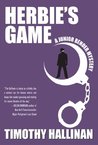
Herbie's Game by Tim Hallinan

Herbie's Game (Junior Bender #4) Junior Bender is a burglar. That’s a fact. What keeps it from being a hard, cold fact is Bender’s heart. Bender has a set of codes by which he lives and a set of rules given him by his mentor, Herbie, by which he works. One of those rules “was to delay as long as possible the moment the mark realizes his stuff has been boosted.” That means not taking everything, nor making a mess. Another rule is not to take anything the mark can’t live without.

When Bender finds himself holding a matching set of brooches that prove to be irreplaceable, their pricelessness makes him less pleased than uneasy. And Herbie his mentor is dead--not just dead, but tortured. Bender wants to know why, and who was responsible.

Los Angeles is central to the action in this series, and Hallinan goes right for the nub of a characterization, be it cities or people. When entering a house, for instance, he might toss off a comment about the front lawn looking recently replaced:
“Judging from the eye-ringing emerald hue of the lawn, the grass had never endured a dry minute since it was planted, about forty-five minutes ago. There are two schools of thought associated with good lawns: the British approach, which says you simply plant it and roll it for several centuries, and the Los Angeles nouveau-riche view, which says you just put in a new one whenever the old one gets a little ratty.”
And this:
"I went into the kitchen and filled a very nice Baccarat glass with ice water and carried it into the big living room, with its art deco windows that faced east toward downtown. The window framed only a fragment of the usual view, since the top floors of our relatively small collection of skyscrapers disappeared abruptly into a line of yellow-brown smog as hard and sharp as the stripe on a shirt.”

Hallinan has a real knack for and sensitivity in portraying girls and women as whole beings. In this novel he has two new fourteen-year-old computer savants who already have a productive history of online theft from various state coffers. Bender recruits them to assist him in his search for Herbie’s killer, though he has twinges of conscience about it. One senses his deep compassion…for himself, but also for the girls. When one of them throws her popsicle stick out the window of his moving vehicle, he has to talk himself out of stopping to pick it up. He imagines becoming their mentor, now that his own has passed. It’s actually kind of frightening, though of all the mentors these girls could possibly meet, Junior Bender might be considered the finest still breathing.

Hallinan has an instinctive ability to dots his i’s and cross his t’s (important in mystery and thriller-writing) and still move the action along in character-revealing scenes. His creation of the lovely Ting Ting, a slim-waisted martial arts bisexual that captures the hearts of bruisers and wasters, is not just an aside to the action…I argue it is the action. These characters have their basis in life, though perhaps not in lives we often encounter. Either Hallinan runs into folks like these on a regular basis, or they are all running around his head...pretty wild, even for southern California.

In his Afterword, Hallinan admits that he “had to kill off a few” characters he’d created earlier in the series because they were cluttering up the scenery, such that readers wanted them in every installment. Imagine creating such rich characterizations that we feel peripheral characters are neglected when we don’t see them.

Hallinan has a fluency born of long and deep reading, and constant writing. His other series featuring Poke Rafferty are set in Thailand, which is where I first discovered his unerring eye for what I call “the tell”: uncovering the (sometimes laughable, sometimes painful) characteristic of a place or a person that may define it, and that we recognize in our heart-of-hearts as true. My use of heart-of-hearts is not cliché. Hallinan has more “heart” than any other thriller/mystery writer I know. He and his characters seem to actively practice the Zen Buddhist (?) No Asshole Rule. And characters call each other on transgressions.

Reading Hallinan is just fun and because of that, it reminds me of the Don Winslow mystery series about surfing. I mean, really, can crime be more fun than hanging out with these guys? Junior Bender is such a softie, we don’t like to think of him actually killing people, though he does in this one. He carries a gun after all. It’s not just for show.

I received an advance copy of this title through Netgalley from Soho Publishers in exchange for an honest review.

You can buy this book here: Shop Indie Bookstores

Sunday, June 8, 2014

Any Other Name by Craig Johnson

Any Other Name (Walt Longmire, #10) The very first sentence of Johnson’s latest Longmire adventure mentions coal trains. Shortly afterward Lucian Connally, Longmire’s old boss and retired sheriff of Absaroka County, tells a story about ways to die on a coal train. I’m not giving anything away by saying that Longmire uses another of his (how many?) lives to escape a coal shuttle train in the course of his investigations. A little more ragged, a little more scarred, he limps toward the future that includes a very pregnant and emotional daughter Cady, and that irrepressible and foul-mouthed Under Sheriff Vic Morretti.

I don’t think I was aware of coal in Wyoming. “The single largest source of coal in the United States, the Powder River Basin contains one of the largest deposits in the world and has made Wyoming the top coal-producing state since the late eighties.” We hear a lot about coal in West Virginia, but I hadn’t thought about it in Wyoming. This information gave me the impetus I needed to look into the (unsurprising) Wyoming Senator John Barrasso’s position on recent changes to EPA standards on carbon emissions. I wish Walt would weigh in on the logic of his representatives. Something along the lines of “Which do you think is more important: our livelihoods or our lives?"

The timeline in this novel is short…I think all the action takes place in a matter of days. Longmire is not in Absaroka County, but in the neighboring Campbell County, where an old friend of Lucian’s has apparently killed himself. In investigating the death, Longmire uncovers a series of kidnappings of young women that no one in Campbell County seems to consider connected. Lucian describes Walt Longmire as a gun: “Once you point him and pull the trigger, it’s too late to change your mind…you’re going to find out [what the mystery is], one way or the other…I’ve never seen him quit, which is where most of ‘em ain’t up to snuff.” And Longmire doesn’t quit on this one, either, though he’d have plenty of reason to do so.

A white buffalo makes an appearance again in this episode, a symbol considered holy and rare and meaningful. Walt has two dream sequences of this creature, which might mean one’s desires will come to fruition, once at the beginning of the case and one near the end. The case was solved, but not without damage. You may need to refresh your memory about the myth by rereading a portion of the earlier episode, HELL IS EMPTY, in which Walt follows a band of escaped convicts to the Cloud Peak Wilderness Area to search for the grave of a victim called White Buffalo. The whiteout snow conditions featured in that earlier episode are reprised here as well. It sounds deadly.

We meet some new and unforgettable characters, including a young rookie, Corbin Dougherty, and the villain Curtis Hansen, nicknamed “Thor.” But mostly the legend of Walt Long-Arm-of-the-Law Longmire continues to build. Craig Johnson’s Longmire has a compelling view of law enforcement that considers shades of gray and has a dial for “intent.” We like him on our side, at our back, and on our bookshelves.


You can buy this book here: Shop Indie Bookstores