Showing posts with label first-time author. Show all posts

Sunday, May 5, 2019

Shortest Way Home by Pete Buttigieg

Hardcover, 352 pgs, Pub February 12th 2019 by Liveright, ISBN13: 9781631494369

Since beginning Buttigieg's book, I have travelled across the country and spoken with lots of folks outside of my usual cabal. Nearly everyone I spoke with had heard of Buttigieg, current Mayor of South Bend, Indiana, running for President as a Democratic candidate. Only one of the people I spoke with mentioned his homosexuality as a reason for his possible failure to connect, and the same person was also skeptical about his age.

Buttigieg himself would remind voters that his age has been the thing that conversely has energized people, particularly older voters, who recognize that their generation left his generation with a big problem when it comes to climate change. Older people who have no stake in what will come are unlikely to move the needle as far and as fast as it needs to move. Time to step aside and hope for fresh ideas. At least that is what Buttigieg is peddling.

When I listen to him talk, I agree. I just want all the old men and women who have left both parties in a shambles with attempts to hold onto power (What power do they exhibit, may I ask? It’s positively derisive.) to leave the stage asap.

This book is easy enough to read, though does not rank with Barack Obama’s Dreams from My Father which broke the mold on literary presidential memoirs. Truthfully, I picked up the book in the midst of an infatuation with Buttigieg’s calm sense and blunt assessments, and before I finished, I felt the bloom had left the rose. I still admire him and definitely consider him a frontrunner but I am not infatuated anymore. This is a good thing. I go into my support of his candidacy with a clear head.

Buttigieg is genuinely talented in languages, and it makes one wish we learned what he did from his linguist mother. One of my favorite of his stories is when he told Navy recruiters that he’d studied Arabic in hopes of landing an intelligence job at a desk somewhere and they wrote down that he’d studied “aerobics.” That is classic SNAFU.

Buttigieg describes the feeling at rallies for presidential candidates Bernie Sanders and Donald Trump. The two rallies had the ambiance of a party, but while Bernie’s parties seem joyous and goofy—Bernie with the finch, Bernie riding a unicorn, buttons featuring glasses and hair—Donald Trump’s parties have a edge, like a party where “you’re not sure if a fight will break out.” This is good storytelling. We know exactly what he is saying and can feel the roil.

What kills me about Buttigieg is that he is so quiet about some of his biggest accomplishments, e.g., he applied for a Rhodes scholarship and got it, he decided to run for president and he is a frontrunner. He doesn't thrash about explaining his calculations: a nobody mayor of a small city calmly and quietly declares an exploratory committee and begins criss-crossing the country before anyone else has even thought to get into the race and captures a lot of press because of his youth and his self-possession.

He could see the Democratic party had lost its way, punctuated by the loss in 2016, to say nothing of the turmoil in what used to be a Republican party. He could see that sitting back and watching ‘the clash of the white hairs’ was not going to advance us because these folks appear bewildered by where we have landed. He thought he could be useful, pointing out the obvious and taking steps to address some of our most urgent issues. Gosh darn it if he isn’t.

One of the more startling and interesting things Buttigieg said about government is that
“some of the most important policy dynamics of our time have to do with the relationships, and the tension, between state and local government.”
I pulled that quote out for you to see because I think this is something national pundits and talking heads miss completely.

Way back in the 1970’s and 80’s Lee Atwater, a Republican strategist, figured this out and moved to capturing the heartland. That strategy has brought us gerrymandering and court-packing and other state-level indications of one-party dominance. But local governments are finding that counties walking in lock-step to the state does not always work for their particular conditions. There is great inequality as a result of GOP leadership at the state level. What is government about anyway?

A Koch Brothers-funded think tank called the American Legislative Exchange Council is pointed to as generating model legislation for adoption in state legislatures and finds sympathetic state actors to carry the bills.
“Legislation is often nearly identical from state to state—so much so that journalists sometimes find copy-paste errors where the wrong state is mentioned in the text of a bill. Tellingly, by 2014, ALEC had decided to expand its model beyond the state level—not by going federal, but instead targeting local policy through a new offshoot called the American City County Exchange.”
Democrats must be willing to compete in red zones—many times it is only because they are not competing that they have less support.

Buttigieg makes the point that many folks got involved in local and county government as a matter of course in their lives, as one aspect of community participation, and they chose the most organized party to help them on their way. That would be the Republican party. They are pretty inculcated with the party line after a few years, but they may not agree with everything the party posts. That is why Indianans could vote for both Mike Pence and Pete Buttigieg. Voters really can read, think, make up their own minds.

We have to be in it to win it. I am more and more reluctant to declare myself Democrat after seeing some of the shenanigans local, state, and national leaders get up to. But I’ll be damned if I’ll sit by and watch the plotters and weavers poison the well. If ever there was a time to stand up and participate with your voices, now is that time. Choose your issues, decide at which level you can intervene, look to see where you might have some degree of influence, and get engaged. No more cheering from the sidelines.


Tuesday, January 30, 2018

Reading with Patrick by Michelle Kuo

Hardcover, 296 pgs, Pub July 11 2017 by Random House, ISBN13: 9780812997316, Lit Awards: Reading Women Award Nominee for Nonfiction (2017)

Michelle Kuo’s debut stopped me in my tracks. All other work I had on my plate was shoved to the side while I read this nonfiction detailing Kuo’s after-college years teaching English to at-risk kids in Helena, Arkansas in the Mississippi Delta region. As a piece of literature, this memoir succeeds beautifully; her organization is laced with poetry and the work exudes a kind of transcendental grace. More than once I found myself barking out sobs at the waste of lives we tolerate every day and for her recognition of the means by which we express and acknowledge thanks.

Back in 2009 Kuo had published a piece in the NYT Magazine about her two years teaching in Arkansas, and a special student she had there. In one year that student’s reading had progressed two grade levels and his attendance had improved dramatically. His classmates has also named Ms. Kuo a great influence on their lives. The at-risk school closed for lack of funding just as her kids were entering high school. Then Ms. Kuo left to attend law school in Boston.

One of the things I liked best about this story is the self-questioning Kuo does regarding her reasons for choosing to teach in the Delta. She explains how racism impacted her and how, learning of writers of the civil rights movement, she felt exhilarated and enabled. She did not think she would do well trying to change the minds of self-interested people in power, but she thought she could bring notions of empowerment to those who had no advocates.

Kuo’s parents are my favorite characters in this story. Immigrants from Taiwan, they’d sacrificed everything to give their children more opportunities. When their clever and talented daughter graduated from Harvard and chose to teach in the Mississippi Delta region, they were confused, embarrassed, hurt. She could go anywhere and do anything, and she chooses social and racial justice work in the deep South. She doesn’t claim religious beliefs, and the work wasn’t easy. By the end of her story all of us can see that her generosity of spirit comes directly from her parents, though they didn’t recognize it at first.

Kuo names the chapters in her story after works of literature: poems, short stories, novels, or in one case, after the words of an affidavit her prize student, Patrick, signs to acknowledge his role in the death of a man. Patrick had dropped out of school when Ms. Kuo left for law school, had allowed his reading and writing skills to languish, and was a vulnerable teen with no oversight in a town that didn’t care very much. Kuo returns to the Delta to teach Patrick in prison, organizing her life so that she can try, in a few short months, to bring back some of the promising boy she’d seen years ago.

There were other teachers from northern schools who’d come to the Delta to teach in underserved communities and some had stayed. When Kuo returned to Helena, she was treated to their successes: the segregated black school did better on their state math scores than did the white schools. For the first time white families were complaining their better-resourced schools weren't providing the same kind of opportunity others had; they were moving their kids over.

What Kuo hadn’t been prepared for was that the man she saw in jail bore almost no resemblance to the promising boy she’d left years before. Now nineteen, Patrick could no longer read or write well. He expected nothing from anyone, least of all from himself. But he did remember what it felt like to have Ms. Kuo as a teacher. “It made going to school—you know, made it really mean something, somebody that care for you.”

Kuo infuses her work with the language of poets, and insists that we, like Patrick, listen to the sounds and decipher the deeper meanings. She shows us what teaching can be, and what a gift it is when done right. Discipline and good behavior often comes from not wanting to disappoint a mentor, and that impetus is what Kuo provided for Patrick. She draws for us the everyday reality of Patrick’s world so we do not blame him for his own inadequacies.

In this way, the memoir is a political book. We are persuaded that certain educational and social polices are not as helpful as others. We can see that there can be benefits to assistance and huge, disgraceful, unacceptable human losses without them. It is unforgivable of us to allow such disparities in opportunity, but we need those whose opportunity is stolen to acknowledge and address that lack. Ms. Kuo teaches us about that nexus, and we are grateful.


You can buy this book here: Shop Indie Bookstores

Friday, January 13, 2017

You Can't Touch My Hair by Phoebe Robinson

Paperback, 320 pages Published October 4th 2016 by Plume Books Original TitleYou Can't Touch My Hair: And Other Things I Still Have to Explain ISBN13: 9780143129202

We may not be in a post racial society but I tell you what: when funky, funny Phoebe can tell us what white people do that makes her crazy, and why she doesn’t want to be anybody’s token black friend, I think we’ve moved the needle since the last century. I remember the first time an African man told me that the only pictures he’d had taken in his years of graduate school were those taken by a Singaporean man who knew how to get the camera to register his skin color and expression. Robinson says something similar here: maybe it’s best if we first acknowledge a color difference before we declare it doesn’t matter.

Robinson does plenty of things in this “breakout book deal” but the thing that drew me in was the chance to learn, unfiltered, how black women had such dope-fantastic hair while white folk have to make do with boring thin stuff that flies away and looks pretty much the same everyday, no matter what we do to it. I first learned a little about the time and energy and money serious black hair coiffeurs require in Chimamanda Ngozi Adichie’s novel Americanah, but now I think I get it. And no, I don’t think anyone should have to do this so that other folks will love them more. It is, however, an art form, another art form that black folk have created, perfected, and strutted.

Shonda Rhimes, in her book Year of Yes, tells us as a teen she tried to get her hair looking like Diana Ross every morning before classes. I did the same thing with some magazine model or other whose look was so far from mine that a million years of evolution wouldn’t have changed that difference between us. It is definitely not worth the effort. And the “creamy crack” or “crack cream” sounds positively dangerous. Forget it immediately. Get a wig if you want to toss straight hair so much and definitely don’t subject yourself to chemical burns. Come on. If that is what’s required, f- them. I wouldn’t do it. Who the heck is calling the shots here?

When Robinson describes a bedroom scene where the woman is wearing an elastic do-rag to protect her afro and she insists that a real man would still get a boner regardless, I laughed all right. But then it occurred to me that is the definition of drop-dead sexy: strong and sexy, when black womanhood doesn’t even need to fling her hair around to get to home base. She commands the stage. I’m impressed. Personally, I’d kill for the simplicity of a close crop and call it quits. But I ain’t no Phoebe Robinson.

Jessica Williams, Phoebe’s “work wife,” writes the introduction to this book. Williams was a writer/correspondent on The Daily Show and now the two perform standup at various locations in Brooklyn and work a podcast (WYNC) called 2 Dope Queens. Robinson had a vision of where she wanted to go and to that end began a blog called Blaria in 2014. When the Robinson and Williams standup routine started to take off, a new piece in the NYT tried to keep track. Robinson also has a talk-show style podcast she started last year called Sooo Many White Guys. She's angling for Oprah's job, and I think she's becoming a worthy successor. She certainly has drive.

If the material is sometimes juvenile, well, juvenile can be funny. There is one thing that may eventually limit the range of the women, though: all their references for jokes relate to TV or movies. When it works, it’s very good indeed, but not everyone is so deep into popular culture, or have looked at it with such seriousness and depth of understanding. It is fascinating to watch Robinson deconstruct an old movie like a college professor does a piece of literature, but then our mind starts thinking…what else can this woman do that would be—less fun, maybe—but more important?

Then I remember what she is doing, desensitizing race relations, telling white folk what bothers black folk, sharing some intimacies and some vulnerabilities, and I realize she is doing exactly what she needs to be doing right now, and she is doing it funny, she is doing it sexy, she is doing it in braids, in long soft curls, in dreads, and in a bust-'em afro. She’s strong, she’s sexy, she’s outspoken, and she’s unstoppable now. I’m a fan.

2 Dope Queens 2016 holiday podcast on YouTube:


You can buy this book here: Shop Indie Bookstores

Thursday, December 29, 2016

Foreign Soil: And Other Stories by Maxine Beneba Clarke

Hardcover, 272 pages Jan 3rd 2017 by Atria / 37 INK (first published April 29th 2014) Orig Title Foreign Soil ISBN13: 9781501136368

The extraordinary sense of dislocation we experience in Maxine Beneba Clarke’s first short story collection is intentional. Every story describes a different type of “foreignness.” Clarke takes on the voice and persona of every nationality of yellow, brown, black, or white person, those with red hair, chestnut, or soft black curls. Each story describes a pain, an experience that is commonplace enough among the natives she describes to be recognizable. Clark makes us uncomfortable. Slipping on the cloak of “other” isn’t always convincing, but her work is always an interesting and effective challenge to readers.

Clarke writes from Australia, but from an Australia that feels unfamiliar even in its English. Her stories put us on the back foot, and make us query. We are constantly scouring the words she has given us to divine her meaning. It feels sometimes as though she left us clues, but the cultural markers are not the ones we are familiar using. We have the experience of being the “other.” I grew to admire the discomfort Clarke evoked in me, at how many unfamiliar incidents she forced me to look at closely. If she did an insufficient job of navigating and communicating that episode, why am I so sure and how would I do it? Oh yes, she’s a clever one.

The most absorbing and impelling, while still not entirely comforting, was the title story, “Foreign Soil.” An Australian hairdresser falls for a client and accompanies him back to Uganda. Cultural habits learned from childhood start seeping into his behaviors before he is even out of the airport. By the time she discovers she is pregnant, she knows she is not going to marry this man.

Many of Clarke’s stories could easily be turned into a classic horror stories. They have that feel. We grow afraid to peer around the next page, wondering what damage will be done to her characters in the meantime. Even in “Foreign Soil” we wonder if the wife won’t be walled up, literally and forever, inside the doctor’s quiet, lonely compound in Africa.

The story “Shu Yi” likewise has a horror pedigree reminiscent of Shirley Jackson, or other horror greats. An Asian immigrant without good language skills must navigate a white middle school which hosts one black adolescent. The black student is asked to interface the two groups, but is unwilling to risk her position of safety, an invisibility she feels she has earned. Observing, or putting ourselves in place of the black student—any road will get you there—deliver unto us the most vivid discomfiture.

Some of the stories are interlocking, or self-referencing. For instance, we may discover one of the stories being discussed later in the collection, as in “The Sukiyaki Book Club.” The emergence into metafiction is entirely consistent with the self-acknowledging feel of the whole work. Clearly no one author could have experienced, or even known people who experienced, all these different lives.

The stories, therefore, are a suggestion, a question-mark, an initial attempt to understand what others’ lives are. Readers are meant to take the fútbôl and run with it, changing what needs to be changed, adding flourishes and corrections until we finish up together, panting and laughing and sure we did our best, win or lose.

An example of an early story which put the wind up was “Harlem Jones,” about a young angry black man determined to make his mark in a London demonstration, even to the point of “cutting off his nose to spite his face.” This story did not seem to quite capture the mind of a young man: there was not enough fear and, at the same time, immortality, in it.

Dissatisfied, I moved on, only to discover this was a thread, a kind of authorial technique. Clarke wanders in over her head, and looks to us. I grew to like her relying on us to think, to add our own understanding and our own spices. I did, though, also see room for greater clarity in style. Writing as a profession presumes we have something to say, but also that we say it well, and clearly, so that it is not mistaken. There was room for greater clarity, even supposing Australian and American are two different languages.

Clarke is a slam poetry artist, Australian, of Afro-Caribbean descent. Her Australia is unlike any I have encountered before. She has three books of poetry published or shortly due out, has won awards for this story collection even before it was published, and has a memoir, The Hate Race, just published August 2016 in Australia. She has talent and plenty of room to run with it. Expect to hear more from her.


You can buy this book here: Shop Indie Bookstores

Tuesday, December 27, 2016

Mincemeat by Leonardo Lucarelli

Hardcover, 352 pages Published December 6th 2016 by Other Press ISBN 1590517911 (ISBN13: 9781590517918)

Storytelling and cooking may have something in common—imagination—but they also have a similar way of feeding people, and doing it well can be positively inspiring. Leonardo Lucarelli reminds us that good chefs use very, very sharp knives in the mastery of their craft, and good writers learn the same skill. Lucarelli says repeatedly he did it all “for the money,” while we laugh uproariously as he waxes eloquent about that meal he prepared--alone--for 250 capoeira enthusiasts in the hull of a rusty old ship with no kitchen docked beside Rome in the Tiber…

There is some special delight in listening to a man at the top of his career as a chef in a country known for spectacular cuisine and flamboyant male displays tell us how, by bravado, native (naïve?) talent—but no training—he goes from zero to one thousand in a matter of years. And he continued to manage it, learning on the job, telescoping years of trial-and-error into moments of insight literally seared into his memory...and his hands.

He is arrogant, abrasive, acerbic…and that is just the A’s. Lucarelli began cooking as a teen, when meals his mother left at home for his brother and himself needed a little massaging to be exciting. He cooked for friends, and the first gift to his first real girlfriend was bread, wrapped in a napkin, four corners tied together. (It had been his fourth try, and was the only loaf not obviously wrong on the outside.) Taste and presentation: he knew it might have something to do with winning hearts. Though that early attempt failed, his gradual emergence as a rock-star in the kitchen gave him plenty of opportunities to bedazzle the ladies.

Drugs go along with sex & rock & roll, and there are hair-raising moments in this memoir when we are not entirely sure Lucarelli is going to escape with his faculties intact. The momentum he achieves in his writing contrasts with the stumbling advancement of his career as he tangles with the law, makes poor choices in work and in life, wrecks his motorbike…everything revolving about an important friendship with Matteo, the grounded center of who he really was. Matteo was an ‘on again-off again’ roommate in Rome, Lucarelli’s alter-ego. A reprinted email from Matteo late in the book shows us Matteo’s talent seeing, feeling, and speaking truth, and how important he was to Lucarelli’s sense of himself.

It always interests me when “bad boys” discover their inner homebodies. Lucarelli was no exception, and truthfully, the portion of the memoir devoted to his life after rockstar status was some of the most interesting and affecting of what he chose to share. Lucarelli shows us that everything we learn can be used in the next gig, and how teaching cooking skills may have rewards that equal or exceed chef-dom when the pros and cons of each are laid side-by-side.

It is not just food or cooking that is so interesting about this memoir, however. Lucarelli reveals insights into the economics of modern Italy from his earliest mention of anti-globalization demonstrations in Genoa in 2001, reminding us that discussions revolving around these issues are not new and have been viewed as critical for many years in countries other than the United States.

More striking even were his revelations about the fluid nature of restaurant employment: under-the-table payments to all restaurant staff, even chefs, to avoid tax; direct wage payments from the night’s take; lack of contracts or protections for staff; the precarious position of most owners when it comes to loan sharks or bank loans. It seems there is no safety. What a remarkably poor investment, one might conclude, unless owners know something investors do not.

Taxes. It is hard to discover from just one memoir how widespread the practice must be, but one cannot but note how commonplace avoidance appears to be for those making even small incomes in Italy. In the United States, poor and middle-class wage earners generally pay taxes while the wealthy exploit investment loopholes that result in little or no tax payments. Tax avoidance may, in the end, be most responsible for both the exuberant display of, and the eventual destruction of, western ‘values.’

The other discussion, worthy in Italy just as it is in the United States, is the importance of immigrant labor, even illegal immigrant labor, in keeping restaurants afloat. Lucarelli even gives a somewhat impassioned defense of the illegals he has known that is well worth reading and considering. What art would not have been produced but for the 'slave' labor of illegals? These very issues we must consider when addressing our own problem of illegals in America.

Economic issues were not discussed in the Wall Street Journal review of this title by food critic Moira Hodgson, but Hodgson does give you an exciting look at Lucarelli’s anecdotes. Take a look for yourselves.

P.S. One last thing that warmed my heart: When Lucarelli began working in restaurants and clubs in the early 2000's, it seems every menu contained several vegetarian options, and at least one vegan option. Mediterranean food is especially easy to 'veganize,' but more importantly, it wasn't odd, but obvious. Nearly twenty years later, American restaurants are limping half-heartedly (heart-attackedly?) into enlightenment.


You can buy this book here: Shop Indie Bookstores

Thursday, December 15, 2016

Between You & Me: Confessions of a Comma Queen by Mary Norris

Hardcover, 228 pages Published April 6th 2015 by W. W. Norton & Company
ISBN13: 9780393240184


Mary Norris’ conversational manner first made me think that the person always behind the scenes at The New Yorker, America’s prestigious literary magazine, wanted her day in the sun. “ME!” I imagined her pointing, two thumbs to her chest, “I’m HERE!” The more I read, though, the more chummy she seemed. “I want to read what you guys are saying on the web, in reviews, articles, and blogs,” she seemed to be saying, “but don’t bug me with bad punctuation. It’s not easy, what I do, but here are a few pointers…”

I love her for that. It really isn’t easy, what she does, and when she gets into accusative, transitive, and copulative verbs, though they do sound right up my alley, my eyes watered just a little. But I am so glad she laid to rest the “you and me” bit. She gives an example of the “pratfall in dialogue form” when a TV character, known to be a bit dim, tries to elevate his diction by saying archly, “We have already reserved that bowling alley for Teddy and I.” She mentions that David Foster Wallace was “a fabulous stickler—a snoot, in his own term.” He lists “between you and I” second in a catalogue of blunders, and Garner, author of Garner’s Modern American Usage, notes this grammatical error is “committed almost exclusively by educated speakers trying a little too hard to sound refined but stumbling badly.” Well, that puts a nail in it.

My problem, I freely admit, is commas. I can actually feel readers cringing to read some of the stuff I have generated, though you probably know all about this failing of mine. I am always wishing I had a copy editor to just run through the thing with a Palomino Blackwing* and tell me what I meant to say. That’s why I got this book. I love the example in her discussion of serial commas or not: "This book is dedicated to my parents, Ayn Rand and God."

What I actually learned from this book is that there is, as I’d hoped, quite a lot of flexibility in the actual putting together of a sentence. The ultimate objective, of course, is clarity. "THE PRIME NECESSITY IS TO SAFEGUARD AGAINST MISREADING." As such, "if commas are open to interpretation, hyphens are downright Delphic." Ah, she hits all the sore spots. For those of us who write quite a lot, we worry about these things. "There is a phase in the life of every copy editor when she is obsessed with hyphens." That’s a relief. Further good news is that one might be able to argue for one’s intent in case of disagreement with, say, another copy editor or writer of the dreaded ‘letter to the editor', but one should at least try to be consistent within the same essay.

As for the dash—for years my letters home were filled with dashes—with not a period in sight. Once I realized my dashes were getting longer and so populous I barely had room for a few words squeezed between them, I knew the game was up. I had to begin writing comprehensible sentences. Norris says of the dash:
"Women seem to use it a lot, especially in correspondence, as if it were a woman’s prerogative to stop short without explanation, to be a little vague, to have a sudden change of heart, to leave things open-ended."
Exactly. Leave ‘em guessing.

My favorite funny bit may be the time she changed 'terrine of foie gras' to 'tureen of foie gras,' never having seen the term terrine and being unable to find it in a dictionary. I also greatly appreciated A.A. Milne's observation that
"If the English language had been properly organized...there would be a word which meant both 'he' and 'she,' and I could write: 'If John or Mary comes, heesh will want to play tennis,' which would save a lot of trouble."
Lu Burke was a colleague of Norris, a proofreader from her arrival at The New Yorker in 1958 to her retirement in 1990. On her desk she kept a canister wrapped in brown paper and marked with hand-drawn commas. It had a perforated lid, like the red-hot pepper shakers at a pizzeria. Lu thought The New Yorker’s “close” style of punctuation used too many commas. “In almost every way Lu was the opposite of Eleanor” Gould, the magazine’s legendary grammarian, query proofreader, and a certified genius. It is probably best organizations have long-running disagreements about punctuation. It keeps everyone sharp for the next opportunity to press their point.

Norris tells great stories with illustrative examples from the works of authors you will recognize, but the stories about her own life make her accessible. Who wouldn’t be impressed and intimidated by the behind-the-scenes editors who make possible the output of a weekly literary magazine of such reputation? She had me laughing so often it made me realize that I would love to see “pratfalls in grammar” illustrated in a separate column. She is a gem.


*Palomino Blackwing: Even the name of this pencil sounds somewhat thrilling to someone who never knew there was anything worth using beyond a Dixon No. 2 Ticonderoga. Norris tells us what she learned about herself when the Dixon No. 1 Ticonderoga could no longer be found for sale. Besides pencils, she became something of an expert on pencil sharpeners and once made a pilgrimage to a pencil sharpener museum in Ohio, a tale so well told and filled with zany details that it could easily have been published to great acclaim in her own magazine.


You can buy this book here: Shop Indie Bookstores

Friday, September 30, 2016

The Book of Human Emotions by Tiffany Watt Smith

Emotions are funny things…some flit through us at the speed of light, barely registering on our face or consciousness, while others linger, hovering over us, coloring our perceptions of each new day. Descartes thought here were six basic emotions: wonder, love, hatred, desire, joy, and sadness, but most of us can name several more of which we have intimate knowledge.

There are emotions that we experience only once or twice in a lifetime and yet someone somewhere has probably identified and named that particular feeling. It is reassuring and something joyous, I think, to discover that some strong emotion is shared. Tiffany Watt Smith does not attempt a comprehensive catalog, but she makes the excellent point that we need more words for our feelings rather than trying to narrow the breadth and width of human experience into discrete and limited categories. It is a marvelous, revelatory read.

Watt Smith worked in theatre before beginning an academic career. Somehow that seems entirely appropriate to emotion-spotting. An actor with a range of experiences may need some prompting on how they should feel about a certain scene, and the words help to give them context. Or perhaps actors are teaching us as audience an emotion we instinctively recognize but have never been able to put into words.

The book is filled with a sense of good humor. Even in definitions of those feelings we would be happy to do without, like disappointment and despair, Watt Smith does not leave us feeling bereft. She always puts in a little upswing at the end which shows us the way out, or makes us smile in relief and pleasure that we are not in that space now.

I particularly liked her discussion of compassion in which she recognizes that
”For Tibetan Buddhists, the wish to free a person from suffering is ideally experienced in equanimity, with a quiet confidence. For many of us, however, compassion is considerably more anxious territory…requiring a person to discover very vulnerable parts of themselves…Only the wisest can bend themselves to another’s pain without being rendered numb and helpless themselves: the “compassion fatigue” we hear about in the caring professions today.”
Her discussion of contempt puts me in mind of Donald Trump, as do many things these days. Contempt is a performative emotion in that it turns a spectator into a participant, inviting a conversation. One can watch a spectacle, but once one acts or speaks in contempt, one is provoking a response.

Disgust is a prime candidate for a “universal” emotion as it is instantaneous and involuntary, though Watt Smith points out that often “something out of place” is often the culprit to feelings of involuntary disgust: a hair in one’s soup, soup on one’s beard or clothing, or simply a disagreeable smell where we don’t expect to find it.

There is a word which has no equivalent in English, though I have seen the emotion described in a novel by a woman of Bangladeshi descent, called maya-lage. Watt Smith calls it fago in this book, which is a type of love and pity felt for those in need, mixed with sadness, sorrow, and compassion. It is the feeling one gets contemplating the fate of those who experience an earthquake, or other natural disaster.

I can’t recommend this book more highly for all of us, but especially for those in the creative professions. It is filled with irresistible descriptions of feelings we may have experienced but for which we had no words, and may inspire attempts to capture those emotions as they cross the mind-body divide. The author goes around the world seeking words that express a human state. It is completely absorbing. One doesn’t have to read the entries in order—one is encouraged to skip around.

You will not want to miss emotions for which definitions appear in a country we just visit—that a nationality has created a word for a sensation may mean it is a characteristic feeling in a certain culture, like han, a feeling of sadness and hope at the same time…a yearning for things to be different (Korea), or torschlusspanik, a German word for the agitated, fretful feeling that time is running out, or “gate-closing panic.” I am quite sure the Chinese must have similar expression somewhere, knowing what I do about their culture. I must also mention the extraordinary capture of characteristic feeling in the term greng jai, “the feeling of being reluctant to accept another’s offer of help because of the bother it would cause them.” Greng jai is a Thai phrase.

Buy this one. Watt Smith is a delightful companion, and many of the words you will want to find again. Below, Tiffany Watt Smith gives a short TED-like talk on her work.

Tiffany Watt Smith @ 5x15 from 5x15 on Vimeo.

You can buy this book here: Shop Indie Bookstores

Sunday, January 31, 2016

The Life and Adventures of a Haunted Convict by Austin Reed, edited by Caleb Smith

Hardcover, 352 pages Published January 26th 2016 by Random House

There can be no doubt that this remarkable document uncovered and authenticated recently by a team led by Caleb Smith at Yale University is something altogether new in the annals of prison literature. A young free black inmate of New York’s prison system, ten years old at first incarceration in 1833, shares his history in rich detail and with great storytelling skill.

If at first I thought this might be a story of the wrongly accused—the boy was only ten years old!—I was soon disabused of that idea, given Austin Reed’s own testimony that his mother was despairing of his precocious criminality and bad habits, sending him out to be indentured to a farmer some distance into the country from the corrupting influence of city life Rochester, N.Y. Within days Reed had made that farmer angry enough to give him the whip, at which point Reed threw himself on the mercy and tender attentions of another nearby farmhouse, who promptly made an effort to bring the boy back to his home in Rochester again, to the near-suicidal despair of Reed’s mother.

It turns out that Reed’s sister was as indignant as Reed himself was about the whipping, and stirred the boy to take a pistol and a knife to that angry farmer who initially indentured him. Thus attempted murder must be considered when considering his case, and though the murder failed, Reed did manage to light the farmer’s barn and house on fire, burning it nearly to the ground if his own record is to be believed. That is how he was put into the prison system the first time. (Here I will admit to an exceedingly strong hankering to know what became of the sister. If this were fiction, we could make something up. I want the nonfiction story of that strong-willed creature so filled with rage.)

What makes this work so thrilling to read is that the reader finds oneself taken with this “bright boy” despite his best efforts to complicate his life, forcing one to imagine the position and condition of a free black in a northern city before the Civil War, and examine what could cause such indignation on the part of the sister and the boy when authority of any kind attempted to constrain their unruly behaviors. When Reed tells us that being in the House of Refuge in New York City as a young boy taught him many scams and illicit behaviors of which he had been previously unaware, and to which he took like a duck to water, we shudder to think of what will become of him. So it is foretold that he was incarcerated most of his adult life for felonies and larcenies of all sorts.

An astonishing and full-throated defense of immigrant Irish we may never again hear and yet shows the depth of Reed’s feeling for those boys who, crushed like him by the “hand of oppression,” shared his cells:
“Poor Pat…shivering in poverty and clothed in rags of disgrace and shame, while freedom is planted deep in his breast…poor and helpless on these shores, with no one to extend them a hand…Yes, me brave Irish boys, me loves you till the day that I am laid cold under the sod, and I would let the last drop of this dark blood run and drain from these black veins of mine to rescue you from the hands of a full blooded Yankee…Reader, if you are on the right side of an Irishman, you have the best friend in the world.”

This beautifully written, edited, and annotated memoir of Austin Reed’s time in jail is revelatory for what it says of the cruelties and inconsistencies in the justice system, but it also gives an unforgettable glimpse into the mind of a black man in the system at the time. Prison “cut off from all virtue” a man who could only “sit brooding on vice and preparing for crime.” Fantastically detailed in places, the memoir recreates the adventures of a picaresque hero more usually found in the pages of a novel. Reed had many protectors and mentors during his time in prison, and due to his native intelligence, pride, and charm (and despite his crimes), managed to live out his years to old age. A letter he wrote to the prison system in 1895 is discussed in the Introduction.

While I have called this work a memoir, it is not a memoir in the usual sense. It is a personal history in the manner of literature at the time, and uses fictional devices and structure in places to make the story flow and involve readers. The prison warden also notes that Reed is “a most notorious liar…a deep knowing impudent and brazen-faced boy…” Inconsistencies between Reed's record and the researched history of the time suggests Reed took some liberties with the truth. Reed wanted the work published: he actively tried to make that happen at different stages in his life. Reed had a sensibility that reminds one of Iceberg Slim, another proud brother who had a strong sense of his own talents who used prison to learn many shortcuts to the life he wanted to live. Iceberg Slim also came to advise against a life of crime, but he could see the attractions of it, and the reasons for it, in the black community.

I cannot recommend this entrancing book more highly.


You can buy this book here: Shop Indie Bookstores

Saturday, February 21, 2015

Smoke Gets in Your Eyes by Caitlin Doughty

Caitlin Doughty helped me. At first, I don’t mind saying, she repulsed me with her (what I thought initially) childish and macabre sense of humor. What happened over the course of reading this book is that I became informed--reminded and informed--about the "responsible exposure to decomposition" which we as a culture are so good at hiding, denying, refusing. If I never completely relaxed, I think that is quite normal. But she really earned her $24.95 for the price of the book. That’s a lot of teaching going on.

I don’t want to be responsible for the shock readers might feel who stumbled onto this review by accident. This book is about the crematory industry and death. It is useful, but if that is not what you came for, don’t read this book nor this review.

(view spoiler)[-----------------------------------
Caitlin Doughty reminds me of the little minx Lauren Ambrose that played in the TV serial Six Feet Under. They look nothing alike. It is a personality thing…and the subject matter, of course. I thought I would just skim this because I was having difficulty entering into the humor of this book, but I found myself learning things…slowing down…nodding my head…reading aloud to family…and laughing, against my will, at some of the scenes Doughty conjured in my head.

Doughty makes an awful lot of sense. She is a licensed mortician, youngish. She worked in a crematory at the beginning of her career, after obtaining a degree in Medieval Studies. She’d done her thesis on medieval witches accused of roasting dead infants and grinding their bones. "A year later I found myself literally roasting dead infants and grinding their bones….[those witches] were burned alive at the stake. I, on the other hand, …was thanked by the poor parents for my care and concern. Things change." See what I mean about her sense of humor?

Anyway, what I learned was extremely useful. She relates the story of a woman who said that her mother died "unexpectedly" after hospice care for six months. Doughty didn’t buy it:
"When a young person dies unexpectedly, the family will likely face what [Jessica] Mitford called the "necessity of buying a product of which they are totally ignorant." The sudden death of a young person is a horrible tragedy. In their sorrow the family should not have to worry that a funeral home would take advantage and upsell them to a more expensive casket or funeral-service package. But anyone who works in the death industry can readily tell you that a slim minority of cases involves the sudden death of a young person. Most deaths come after long, significant diseases or very lengthy lives…why [someone would] not look up the best funeral homes in the area, compare prices, ask friends and family, figure out what’s legal, or most important, talk to her mother about what she herself wanted when she died? …Refusing to talk about it and then calling it "unexpected" is not an acceptable excuse."

Doughty does the work of sharing the history of the business of funeral homes with us: How it developed into a huge industry in the United States as opposed to cremation, and how Jessica Mitford—yes, that Jessica Mitford—almost single-handedly turned public opinion around with her book, The American Way of Death, published in 1963, the same year Pope Pius VI overturned the ban on cremation for Catholics.

Cremation is still the lesser-used option, but there is a movement afoot now to take back the business of dying with home wakes and 'natural burials' in bucolic settings. Doughty addresses the latter option, saying that she’s decided on a natural burial for herself. "Not only is a natural burial by far the most ecologically sound way to perish, it doubles down on the fear of fragmentation and loss of control. Making the choice to be naturally buried says, 'Not only am I aware that I’m a helpless, fragmented mass of organic matter, I celebrate it. Vive la decay!'"

A website she doesn’t mention gives a range of options for those who want that modicum of control, including home wakes and natural burials: WBUR Radio piece with links. After hearing Doughty’s stories and watching some of her YouTube video series, and knowing that she hints at times to prefer being torn apart by buzzards on a hilltop in Tibet rather than be cremated, one just has to think…about death: what it is and how it affects us.


Doughty may be irreverent, but she’s earned it. She earns our forgiveness with her admission:
"Everything I was learning at Westwind I wanted to shout from the rooftops. The daily reminders of death cast each day in more vivid tones…my work at Westwind had given me access to emotions I didn’t know I was capable of. I would start laughing or crying at the drop of a damn hat…[my] emotional range was blasted apart, allowing for ecstasy and despair like I had never experienced…I went from thinking it was strange that we don’t see any dead bodies anymore to believe their absence was the root cause of major problems in the modern world. Corpses keep the living tethered to reality."

Doughty quotes the social critic Camille Paglia: "Human beings are not nature’s favorites. We are merely one of a multitude of species upon which nature indiscriminately exerts its force."

Irresistibly, Doughty shares the original Hans Christian Anderson story of "The Little Mermaid," to go with her vignette about growing up in Hawai’i. Kids’ story "The Little Mermaid" is not, despite Disney’s re-creation of the fable in film, and adults reading it in 1836 when it was published would learn not to complain about their lot in life because things could be a whole lot worse.

She tells us about the wide menacing smile of a skull. "It was unnerving to think this same deranged grin lurks just beneath the flesh of everyone’s face, the frowning, the crying, even the dying." And she tells us that "Buddhist monks hoping to detach themselves from lust and curb their desire for permanence would meditate on the form of a rotting corpse."

Yes, she can be gruesome, but what she managed to do is keep my skittering mind focused on the issue of death for a couple hours, for a day. Who wants to think about this? Nobody. But it is a truth, and frankly, like Doughty, I would always have preferred to have been initiated into the secrets of reality than told as a child that there really is “a happy ending.” It keeps things real, and it keeps us focused, and it keeps us striving. Because, darn it, the scythe is at the door. (hide spoiler)]


You can buy this book here: Shop Indie Bookstores

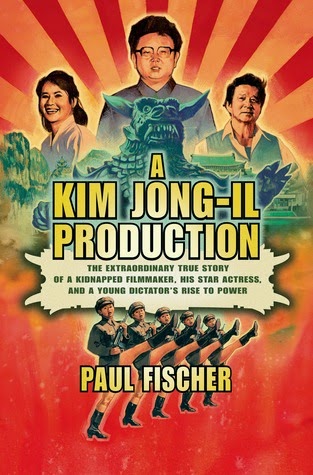
Interview with Paul Fischer, author of A Kim Jong-Il Production: The Extraordinary True Story of a Kidnapped Filmmaker, His Star Actress, and a Young Dictator's Rise to Power

Paul Fischer’s book took me by surprise. I had read some memoirs of escapees from North Korea, some novels, and some 'experience memoirs' from people who had either visited North Korea or worked there. I read the papers. I still knew next to nothing about the Kims and their regimes, in power since the 1940s.

In this debut piece of long-form nonfiction, reviewed by me earlier in this blog, Fischer gives us details about the film-crazy but otherwise undistinguished "Dear Leader" Kim Jong-Il, son of "Great Leader" Kim Il-Song. Jong-Il had a specialty—an interest in foreign film--and he and his father used that interest with the fervor of preachers: to shape thought. As film producer himself, Fischer may have been perfectly suited to diagram the heart of the Kim enigma.

Fischer generously agreed to answer my questions about his writing process, and his thinking on other matters below:

1. The writing in A KIM JONG-IL PRODUCTION was so involving at the same time it was informative. Did the structure sort itself out while you were writing or did you begin with a narrative structure and fill in the pieces with research?

I did a lot of research to start with, and then when I felt I had enough to get started I started writing, even though I was still researching at the same time. I researched all the way through, really: I was always on the lookout for more details, for something extra that was sharp and revealing and could save me three paragraphs with one great detail or sentence. I had a rough structure to start with, and that didn’t really change, except for the first reel of the book, which leads up to the kidnappings themselves. In the first several drafts of the book it was very, very long and very, very detailed, and absolutely didn’t have that balance you’re talking about, between being gripping and being informative. We even played around with using flashbacks and all that but it just felt forced. It took a lot of work to sculpt that down to what felt like the right balance. After the kidnappings themselves the narrative has this very clear, very organic forward momentum, and I knew as long as I went with that, stuck with the story, and didn’t digress, I would be ok.

--photo courtesy of WGBH Forum Institute--The entire video of Fischer's reading at Harvard Bookstore is available here.


2. You landed a behemoth publisher for your first book. How was your proposal pitched? That is, did you have just a concept, only one chapter, or was most of the work done?

I had a very, very detailed proposal. My agent was very clear and very rational about this: I’d never written anything before, this was a larger-than-life story that would only work if written with some kind of rigour, and the only way we’d get the best publisher for it would be if we proved I could be trusted to write a book like this and see it through to the end. I didn’t want to “waste” time on such a long proposal, when I could be writing the book itself, but I understood the logic and my agent was very good at nudging me into agreeing. We spent months on this proposal that ended up being forty thousand words — the book itself is about a hundred and eight thousand or something — and included an outline, a breakdown of methodology, a marketing pitch, everything.

I don’t really know of any other agents who would have done that. Everyone else I met talked to me about working on a twelve-page proposal, something like that, and I'm dead certain I never would have been with the publishers I have now if that’s all we’d done. And, to be honest, because having written something that was forty thousand words long, writing something that was a hundred didn’t feel that daunting anymore.

3. What did your writing day look like? You did a lot of traveling for this book. Did you need to keep a writing schedule to keep the work going and was that difficult?

I wrote first thing in the morning, I didn’t stop until I had two thousand words, and I always stopped at a point where I knew what I was looking to write next, so that I would start up again easily the next morning, instead of picking up again first thing in the morning somewhere I was stuck and frustrated. Those were the only three rules. Early on two thousand words was daunting and took me the whole day; but later on I got two thousand words cracked out by lunchtime and carried on and could get three, four times that in a day. I tried not to worry about whether it was two thousand great words until I had a whole first draft written — I worried about that once it was out of my head and on the page. For a first draft it just mattered that it was at least two thousand words, every day, six days a week.

4. Did you learn anything from visiting North Korea that you didn’t already know from your interviews?

I did, tons. I found photos and books and maps that are very hard, or expensive, to find outside of North Korea. Mostly it was the mindset that was really informative. For ten days I personally, 24/7, underwent the way the state micro-manages your experience of itself, and tries to control your perception of reality. I kind of understood that from the research, but I didn’t feel it in my gut until I was there, with guides who were lying to me, and they knew they were lying to me, and they knew that I knew that they were lying to me, but you still all continue this charade. It’s a very surreal, unsettling, upsetting feeling, when you know how much people there are truly suffering — a suffering no one mentions. A writer friend of mine who read the book told me this lovely thing that the North Korean sequences felt to him like “something happening three or four rooms away in a parallel universe,” which is something sort of intangible that I wouldn’t have understood how to express just from books and interviews.

5. What led you to film production in the beginning of your career and do you think that is something you plan to continue?

I do, I’d love to write a book and then make a film and then write a book and then make a film…the best of both worlds. I still think of myself as a film producer first. As for the first part of the question, I’d always wanted to be a film director, and then I went to film school and quickly learned I wouldn’t be particularly great at it. But I produced a couple of classmates’ short films, and I found I really enjoyed that process: of making things happen, of enabling someone more unique and creative than myself to make something special, and protecting and supporting them as they did so. The logistical and business parts of film producing I enjoy. The creative aspects, where a writer or director has something different and fragile they’re trying to do and they need someone to help them make it real, is literally the best feeling I’ve ever had doing anything, ever.

6. Since you are familiar with the language of film, have you ever considered screenplays?

I’ve co-written a short, and I’ve also spent the last six or seven years trying to write a TV mini-series about Laurence Olivier and Vivien Leigh, which I'm only just finishing now. That’s been a great school in researching real lives, in really trying to write things that are truthful and accurate but also dramatic and revealing, without sacrificing one to the other.

I love working with screenwriters so much — it’s such a great collaborative process, trying to figure it out together — that I hope I can do both: write some films myself when they’re really close to my heart, and defer to another writer when I know they can do a better job than I would.

7. What is the best novel you have read recently and the best recent nonfiction title?

Oh that’s hard. The Zone of Interest [by Martin Amis] is incredible writing. Karl Ove Knausgård — I usually find books like those self-indulgent, but every page he writes is so alive it engages all my senses and some of his sentences and paragraphs take my breath away and I need to stop and sit with them before I continue reading. I just read Independence Day, which is the first Richard Ford book I’ve read, and it did the same to me.

Non-fiction — Ghettoside [by Jill Leovy] moved me and made me really angry at the injustice described, in equal measure. I just finished The Disaster Artist [by Greg Sestero and Tom Bissell] today and it made me cry with laughter.

8. What advice would you give to someone hoping to emulate your success?

I had confidence, curiosity, and an itch to scratch: I needed to write it. If no one read or published it, I’d have written it anyway, because I wanted to spend time in that world and make sense of it and tell that story. I guess I knew that one of my strengths as a producer is to cut through to what works in a piece of material, to have a decent bullshit detector as the saying goes, and that that would serve me well with something like this.

I can’t remember who said this, but you either do it for the process or you do it for the reward, and life’s a lot happier if you do it for the process, because you have no control over the reward. So that would be it: if you’re doing it for the reward, don’t do it.


You can buy this book here: Shop Indie Bookstores

Tuesday, February 10, 2015

A Kim Jong-Il Production by Paul Fischer

This work of creative nonfiction will undoubtedly catch many Asia-watchers by surprise. Facts about North Korea are thin on the ground here in America, but this book blasts open a personal history of Kim Jong-Il with a canny, graceful, and wise commentary that is far beyond what anyone else has been able to manage. It is an enormous feat of research, but more than that, it is so compulsively readable that we are held captive.

It begins detailing the history of two individuals who were instrumental in the South Korean film industry in the 1940s and 50s. Before you ask how relevant that information is to us today, just remember that the author is a film producer who claims these early films have a cult following now, perhaps because of the Gangnam rage that has spread worldwide, and has opened a glimpse into a world never before considered worthy of serious study. We couldn’t have a better introduction to film in South Korea nor have we ever had a more detailed look at the North Korean film fanatic Kim Jong-Il, who kidnapped the two leading lights in the South Korean film industry to bolster his own propaganda machine.

The beautiful and talented South Korean film star Choi Eun-Hee was kidnapped first. Fischer compares her favorably to Marilyn Monroe (with whom she was photographed) in terms of star quality and stage presence. Choi's former husband, the film director and producer Shin Sang-Ok, was taken later, though because he’d tried to escape he was imprisoned in North Korea for a number of years. Eventually they were reunited in Pyongyang and began producing films for Kim Jong-Il’s ailing film industry. This book is partially based on their memoir of their time in captivity and their successful escape to the West.

Perhaps more importantly, we learn a huge amount about the Kim regimes. This material may be out there somewhere, in a hundred escape memoirs, spy reports, or academic papers but I have never seen so much information about Kim Jong-Il and North Korea in one place before. Besides all this great new information, the writing is absolutely first-rate, the story fantastic, and the immersion into film so well-informed that it seems like a trick.

Who is Paul Fischer and how does he know so much about North Korea? The Introduction and Afterword discuss sources, and mostly my concerns about veracity of content were allayed. It may be possible that no one ever bothered before to gather together the dispersed information in just this way before. I just don’t know. Frankly, it is Fischer’s skill that is simply stunning, besides the vast trove of collected information about the Kim regime and North Korea. Fischer's sentences are rich and coherent in a way writers only dream of, and the sections pass easily into one another while we readers are led deeper into the intricacies of film lore and the strange and frightening propaganda machine of Kim Jong-Il.

I have no idea whether or not Shin Sang-Ok and his wife Choi Eun-Hee were abducted or if they defected to North Korea. In my mind it is regrettable either way but not particularly relevant now. It is not what I focused on. I have heard some of the details of kidnapping, of prisons, of life in North Korea, but nothing like this detailed look north of the 38th parallel. This book has everything: grandeur, mystery, terror, and a fluency that makes this tremendous storytelling no matter what side of the political spectrum you fall on.

This book must be labelled creative nonfiction because of the conversations recounted verbatim and the reconstructions of scenes so complete you would think Fischer 'produced' them. I don’t care. If one-fourth of the information in this book is true we have made great headway in understanding and demystifying a completely obscure regime. You will recall the splash Truman Capote made with his fictional recreation of the nonfiction event he wrote about in In Cold Blood. Let’s call this in the same vein until we can verify, but remember this man Paul Fischer. He has burst on the literary scene with a truly stupefying and important offering. If he can make films the way he can write we are in for a real treat.

I listened to the Random House Audio production of this book, beautifully read by Stephen Park. I have ordered the Flatiron Books print edition to look it over more carefully. As I say, books like this don’t come along very often. To think this was a debut that took about two years to put together is extraordinary.

Paul Fischer answers a few questions here. Boston radio station WGBH's Forum Institute filmed a portion of Fischer's reading at the Harvard Bookstore in February 2015. That YouTube video is available here.

You can buy this book here: Shop Indie Bookstores

Monday, January 26, 2015

Not That Kind of Girl by Lena Dunham

Hardcover, 265 pages Pub 2014 by Random House ISBN13: 9780812994995

I am late to the Dunham phenomenon, but am fully onboard now. I am gob-smacked by this book of essays by the creator of the TV serial Girls, the Third Season of which I came upon recently and absently slipped into my VCR late one night. I didn’t know there was a controversy about her work, but of course now I realize there must be. She is a red-hot societal critic. She appears highly evolved to me. She is not cruel.

She astonishes me by her willingness to put her finger right there and point at something significant that many of us will twist to avoid confronting in a thoughtful way. To say Dunham’s work is refreshing doesn’t capture it. It is bracing, like standing in a winter wind, but not caring because you are with friends and are going back in where the fireplace is blazing and someone is going to say something funny and real.

This series of essays must be taken separately from her work as writer, director and character on a television show. This is not Hannah. Both are a kind of memoir, that is, they recreate some of Dunham’s lived experience. But we hear much more in the essays that exhibit her shrewdness, her now-adult clarity and experience, her ability to withhold (“There are things I will not say, that I will think and leave in my head”). But by golly, the things she does say, about the directors and producers she met in Hollywood, about her obsessive fears, about the cringe-producing dates and sex, ring so true, so exactly true, that even if they are not our experience, we believe.

Years ago I read a piece of literature and remember thinking then that some human experience was universal. When I mentioned it one day in a university literature class, the professor snarled “not everyone has the same experience and feels the same way.” I was shocked. It is probably true what that teacher said. Certainly not all of us are white, rich enough to go to Oberlin, bright enough to realize that getting a job, any job, is not enough for any kind of real life. But I argue it doesn’t matter where you came from or how you grew up. There is something in Dunham’s conclusions and experience that resonates. When she writes of visiting her dying great-aunt and receiving her warped and misshapen knitted scarves as gifts, when she writes of her fear of death, sickness, pregnancy, when she writes of the kindness and boredom she encountered in the baby-clothes shop, of the condescension she encountered in school and Hollywood—this stuff translates. We may not have done what she did, but we know that stuff. And she is both bright enough and brave enough to point to it.

In the section when Dunham describes her summer camp experience, she admits to being more attuned to her adult caretakers, the camp counselors, than to her camp mates. This doesn’t surprise me. She wanted more the attention and experience of the adults than of the teens. She was always observant, curious, outside. Psychologists must have helped. She spent a lot of time in their company over the years. It doesn’t appear to have hurt her, thank goodness, but instead may have given her a framework for her questions.

Thank goodness, in fact, for Lena Dunham. She survived the indignities of youth, not unscathed but whole. She understood enough to guess that her confusion and desperation was, if not universal, at least interesting and helpful in allowing us to recognize and celebrate our own authentic selves. She shares her experiences so that we, hopefully, can laugh and see the absurdity of the same. Women and men don’t have to go through elaborate rituals others have created just so that we can connect in a real way, but there are always the painful bits we get just a little bit wrong.

Towards the end of these essays Dunham confides that her real loves are “gossip, food, and the internet.” Those interests aren’t broad enough for her to earn the label “voice of a generation” since that hardly constitutes a voice. But her work is political, which may be why there is conflict when considering her work. It is political because it considers commonly accepted (and sometimes even legislated) ways of interacting, which she shows to be deficient in some way. She has given us enough thoughtfulness and authenticity to make us wonder what she thinks about things other than slipping into bed with another disaffected youth. We’ll have to wait for that. She might never share her thoughts on pressing international issues with us, but her work on the internal rather than the external is just as important if it spurs us to think. Art, wherever it manifests, is a win for all of us. Reign on, Lena Dunham!


You can buy this book here: Shop Indie Bookstores

Tuesday, October 14, 2014

The Third Plate by Dan Barber

The Third Plate: Field Notes on the Future of Food The grace and fluency with which James Beard Award-winning Chef Barber relates his experiences in his Blue Hill restaurant in New York City, walking the fields of his Stone Barns organic farm in Great Barrington, Massachusetts, and in his travels to Europe and throughout the United States left me wide-eyed with wonder. This extraordinary memoir and travel account is engrossing in a way that few writers achieve. Barber is gentle in his instruction, but he is telling us what he has learned about the inadequacy of the current concept of food sustainability, and it is a lesson we really need to assimilate and organize around.

Happily, his lessons are filled with well-cogitated thought, possibilities, solutions, humor, and beautiful images. I’d heard Corby Kummer interview the New York restaurateur on the New York Times book podcast back in the spring of ‘14, and thought it sounded like something I’d like to look at. I felt no urgency. Only when I obtained a copy for someone else and began to browse through it did I discover the can’t-put-it-down page-turning clarity, and the irresistible humor in Barber’s writing. I am trying now to figure out how many copies of the book I can give away for Christmas without repeating myself.

This book is divided into four sections, called Soil, Land, Sea, and Seeds. You won’t have heard these stories in quite this way before, and if they seem familiar, you will find it enlightening to see what Barber has chosen to highlight. Barber moves gradually through his dawning realization that the way we have been eating, in restaurants and at home, is not actually going to be able to sustain the land, the ocean, nor the planet, no matter that we gradually move from pesticide-grown vegetables to organics. There has to be a greater understanding of the web of interconnections between the soil and our eating habits. We have to be willing to increase the diversity of our diet and think about eating foods that replenish the balance in the soil along with ones we use more commonly.

It may be obvious to those who have paid attention to the concept of sustainability that we haven’t yet come around to actually managing the task ahead of us. Barber suggests it is more than simply changing our diets from meat-centric to vegetable-centric. He concludes that we “cherry-pick” our vegetables and therefore limit the amount a farm can sustainably produce for a given community. A farm has to grow cover crops on at least some of the land, and that is part of the cost of crops we actually eat. He urges us to think about how this works in fact, and what this reality means for pricing, output, and consumption.

But I may be making it sound boring. In Barber’s hands, it is anything but that. His work is filled with enlightening vignettes about the places, the people, the restaurants that led him to learn so much about sustainability and its opportunities. Barber awakened me to certain understandings about plant pairings that I’d sort of heard about, but never really believed possible: like having four different crops growing in the same space at the same time to preserve and replenish soil vitality. Especially, or perhaps only, in small scale operations where crops are harvested by hand might this be possible…but it is possible, in fact desirable!

Vignettes about the fish farmers and restaurants featuring fish were particularly interesting. I hadn’t followed the latest developments in that field and am astonished, pleased, and heartened to know that there are some doing things which enhance wildlife rather than diminish it. He tells of a fish farm in Spain which hosts vastly increased numbers of migrating birds as well as produces exceptional-tasting fish for market. It gives me hope that the work on the west coast of the USA to preserve and restore the tidal salt marshes near San Francisco might be successful for life of all kinds, including our own.

Barber outlines his own learning curve, his oversights and humiliations, and he is very funny in places, showing the reactions of people with different world views meeting (at Barber’s behest) face to face and trying to be civil, or in speaking of finely tuned chefs at their most passionate or most perplexed:
’Dan,’ [Ángel] said, turning to me, ‘have you ever cooked naked in your kitchen?’
Ángel features in another very funny bit:
”[Santiago] goes to different ponds in Veta la Palma [Spain] at different times of the year. Always at the full moon,” Ángel said.

Thinking of Steiner and his lunar planting schedule, I guessed, “Because the fish have better flavor when the moon is full.”

“No,” [Ángel] said, looking puzzled. “So he can see what he’s catching.”


The section on wheat farming was completely new and fascinating to me. In the very beginning of the book Barber reproduces a photograph of the perennial Midwest native prairie wheat (with root system) alongside higher-yielding grain varieties planted to replace it. I was truly shocked by the difference in the profiles of the two plants, and thought it indicative of what modern agriculture has done, in every aspect of our food profile, to the concept of sustainability. The good news is that there are folks around the country thinking about our food future. Barber managed to create an international community of thoughtful practitioners striving to figure out how we can best produce what we will need to live on earth.

This completely fascinating book happens to be very easy to read. Someone in your family, not just the foodies, will love reading of Barber’s researches and spending time with this thoroughly decent guy who is willing to share his successes and failures in the field.


You can buy this book here: Shop Indie Bookstores

Saturday, September 6, 2014

You Deserve Nothing by Alexander Maksik

You Deserve NothingMaksik’s debut novel is not a perfect thing, though he does a magnificent job catching the idiom and inflection of high school enrollees in the International School of France (ISF), an American school in a wealthy enclave of Paris. Three voices interweave: Marie, a student learning the power of her sexuality; Will, a thirty-three year-old teaching Sartre, Camus, Faulkner, and Shakespeare in a senior English seminar; Gilad, a student in Will’s class who, with Will, witnesses a man being pushed under a train at the subway.

The tentative and unclear thoughts of high school students is as frustrating to read as it was to experience: the cloudiness of motivations, of adult lives and decisions suddenly being thrust upon them, of the importance of their own place in a universe so small it includes only their friends and their parents. They tell us enough of what is going on in their heads that we believe there is little more there than what we are given.

It is the voice of teacher Will that makes us work: he gives us half-truths, possibilities for actions, and motivations that glance off the truth but that are not the truth. The death of his parents is one such possibility: both gone at once, suddenly. Will had left his wife then. But another reason for his actions might lie closer to watching a man randomly being thrown under a train in a Paris subway. He claims it has no effect upon him. It may be enough to make one think that one has little or no control nor impact on the direction of one’s life, so what does it matter? Will’s student, Gilad, makes the point that we should do just do the best we can and expect nothing in return. That is the human condition. We deserve nothing.

(view spoiler)

This is a man facing the existential crisis and losing himself. Even his girlfriend thinks him a ghost. He claims to be pleased that his students adore him but he is empty, numb, vacant. The teenaged journal entries are trying but they reflect a childish truth. The deadness of Will’s world is terrifying.

Maksik uses whatever material is to hand to demonstrate his novelistic skills. He has the goods. Now, this reader hopes he extends his reach beyond the issues facing a wealthy international school and brings his novelistic and philosophical skill to bear on the larger questions that face us in the world as it is. After all, “to be or not to be, that is the question.” Once that question has been answered, one is either engaged or dead.

Maksik’s second book, A Marker to Measure Drift, faces those larger questions. Bravo!

Two points I must comment upon: one good, one bad. Midway, Maksik gives us one of the hottest sex scenes I can recall. It should go down in the annals. In the final scene, however, is an embarrassingly empty gesture with a gold Cartier pen and a plastic ballpoint. I didn’t like that as well, but we can’t always have it all. Keep your ears cocked for news of this man. He’s not lightweight.

----------------
Later
It occurs to me that I am unsure, now, why this book is entitled You Deserve Nothing. I mean, why not We Deserve Nothing or I Deserve Nothing? Could it be that the people or persons he tries to understand by writing their point of view in his novel have had their repayment, explanation, and opportunity to defend themselves and he no longer feels obligated to feel badly or responsible? Curious...

You can buy this book here: Shop Indie Bookstores

Thursday, August 7, 2014

The People's Republic of Amnesia by Louisa Lim

The People's Republic of Amnesia: Tiananmen Revisited Louisa Lim is an experienced China-watcher and has been an NPR and BBC reporter in China for at least a decade. She has completely captured a strange phenomenon of modern-day China: the heady mix of strong-arm political repression and an intolerant nationalism that is captured in the term “moral absolutism.” She shares the candid views of a cross-section of Chinese citizens and in the process manages to give an excellent update to our view of post-Tiananmen China.

Lim gives us a series of snapshots that capture the ambiguity and nervous pride with which ordinary citizens view their government: “aren’t we better off than we were four years ago?” When a young girl chooses “official” as her desired profession “because they have more things,” there must be some sidelong glances and reluctant acknowledgements at the unevenness of officialdom's wealth creation. But the political consciousness of ordinary citizens is strangely truncated. Those aspiring to work for the government do so for economic security, not with hopes of political change or influence.

The conversation started in 1989 by students at Tiananmen Square was not then ripe for democracy in China as we know it in the West, but some officials knew the risks to the Party and to the country of avoiding discussion of political reform and for suppressing the protests without some acknowledgement of their underlying discontents. That the conversation has been so utterly changed since the loosening of restraints with economic freedoms should not amaze me as much as it has. The government has effectively erased the memory of 1989, so much so that young people don’t even know about that time, and older folks don’t want to talk about it. How so many people can willfully forget that earlier moment when the stability of the Party was in jeopardy is explained: China’s turn towards economic liberalization happened because of Tiananmen.

Lim peels back the veil on the events in Chengdu during June 1989 when protestors sympathetic to students in Beijing’s Tiananmen Square also marched and were also suppressed, beaten, jailed, killed. It astonishes me still that we don’t know the extent of the crime, and won’t either, until the government changes hands. Surely there was extensive documentation: some of the dead in Beijing and Chengdu lay for days in morgues or hospitals and photos of loved ones showing their injuries appeared many months after their deaths.

I imagine one day it will be the Chengdu policemen who, on their deathbeds, wish to be forgiven and come clean with what happened in 1989. They must be as haunted as Chen Guang, the military photographer-turned-painter in Beijing, whose work at Tiananmen on June 4, 1989 haunts him still.

Lim has an easy, clear, and precise style that is not without humorous moments. She juxtaposes lives of ordinary citizens with remarks by former officials. In one vignette, she tells of Yang Xiaowu, “a jovial distributor of grain alcohol” who visits Yan’an regularly, once with his sales staff for a bonding exercise. (Yan’an is where the Communist Party ended the Long March in 1935. A huge statue of Mao Zedong dominates a square built in front of the Revolutionary Memorial Hall there.) “[This is] the right place to come…because Mao’s classic essay ”On Protracted War” was [Yang’s] business bible. He used it to help his team map out their strategy for marketing booze.”

Bao Tong was Policy Secretary for Zhao Ziyang and Director of the Office of Political Reform for the PCP before both were placed under house arrest in 1989. “Describing the mood at the highest levels of government Bao Tong painted an atmosphere so weighted by factional mistrust that any discussion of the issues was impossible…According to Bao Tong, [he and Zhao Ziyang] never had a single conversation about what stance to take toward the student movement. ‘This wasn’t something you would discuss,’ he said.” This remarkable and revealing admission reminds me that fear of reprisal haunts even the anointed in China, though the lack of discussion saved neither man.

What I liked best about this book is the journalistic skepticism Lim brings to the party: everyone has faults, mistakes, and good intentions in their pasts. No one is unequivocally good or bad Even Deng Xiaoping, according to Bao Tong, “went back and forth like a pendulum.” The student rebels at Tiananmen are not lionized, but placed in the context of their historical moment. I incline towards the viewpoint of Jan de Wilde, consul general in Chengdu at the time of the protests: “I don’t think they had the foggiest idea what freedom and democracy actually meant in China or anywhere else. They were still very much [operating] in the framework of a one-party state.”

Tiananmen has not been forgotten by everyone, and the issues it raised are as valid today as they were twenty-five years ago. Undoubtedly some folks have begun to think about what political change would look like in a modernizing China. However, recent rhetoric from the center and the tight control the Party has on social discourse does not hold out hope for a “revolution from within” the Party. The change, when it comes, will be demanded by all those “moral absolutists” making up the population that the Party has created, and heaven help the Party then.

“All blood debts must be repaid in kind…”—Lu Xun

Louisa Lim’s brave and unblinking look at modern China is a book I hadn’t known I was waiting to read.

--Later: Lim mentions Zhao Ziyang's secret memoir of the Tiananmen debacle and I managed to rustle up a copy. I have reviewed it here: Prisoner of the State: The Secret Journal of Premier Zhao Ziyang. Simon & Schuster, May 2010, ISBN 9781439149393.

You can buy this book here: Shop Indie Bookstores