Showing posts with label poetry. Show all posts

Thursday, May 9, 2019

On Earth We're Briefly Gorgeous by Ocean Vuong

Hardcover, 256 pgs, Expected publication: June 4th 2019 by Penguin Press, ISBN13: 9780525562023

This work is called a novel but it is a ball of flame tossed into a dark night, blinding, brilliant, searing. Who knows if it is poetry or novel or memoir; the language fills the mouth and is saturated with truth. We recognize it. We’ve tasted it. We are pained by it. It still hurts.

Something here is reminiscent of the epic poetry of Homer. Life's brutality, man’s frailty, the odyssey, the clash of civilizations, the incomparable language undeniably capturing human experience, these things make Vuong someone who heightens our awareness, deepens our experience, shocks us into acknowledgement of our shared experiences. What have we in common with a Greek of ancient times singing of a war and the personal trials of man? What have we in common with a gay immigrant boy writing of war and the personal trials of man?

The story is clear enough but fragmentary. In a Nov 2017 LitHub interview, Vuong tells us
”I’m writing a novel composed of woven inter-genre fragments. To me, a book made entirely out of unbridged fractures feels most faithful to the physical and psychological displacement I experience as a human being. I’m interested in a novel that consciously rejects the notion that something has to be whole in order to tell a complete story. I also want to interrogate the arbitrary measurements of a “successful” literary work, particularly as it relates to canonical Western values. For example, we traditionally privilege congruency and balance in fiction, we want our themes linked, our conflicts “resolved,” and our plots “ironed out.” But when one arrives at the page through colonized, plundered, and erased histories and diasporas, to write a smooth and cohesive novel is to ultimately write a lie. In a way, I’m curious about a work that rejects its patriarchal predecessors as a way of accepting its fissured self. I think, perennially, of Theresa Hak Kyung Cha’s Dictée. This resistance to dominant convention is not only the isolated concern of marginalized writers—but all writers—and perhaps especially white writers, who can gain so much by questioning how the ways we value art can replicate the very oppressive legacies we strive to end.”
The novel he speaks of is this one. I did not understand that paragraph when I first read it as well as I do now. I am more aware, too, having looked closely for the Western world’s acknowledged historical tendency to erase or ignore pieces of experience not congruent with their own worldview.

The language Vuong brings is exquisite and extraordinary: “The fluorescent hums steady above them, as if the scene is a dream the light is having.” “…the thing about beauty is that it’s only beautiful outside of itself.” “The carpet under his bare feet is shiny as spilled oil from years of wear.” “…repeating piles of rotted firewood, the oily mounds gone mushy…” “He had a thick face and pomaded hair, even at this hour, like Elvis on on his last day on earth.”

Vuong repeats motifs to tie the experiences of one person to the rest of his life, to tie one person’s experiences to those of others: “I’m at war.” “We cracked up. We cracked open.” “…you never see yourself if you’re the sun. You don’t even know where you are in the sky.” “…my cheek bone stinging from the first blow.” “I was yellow.”

A teen, immigrated to the U.S. from Vietnam with his mother, grandmother, and aunt finds himself fleeing his “shitty high school to spend [his] days in New York lost in library stacks,” from whence he, first in this family to go to college, squanders his opportunity on an English degree.

The teen discovers his gayness and does not flee it, though his white lover agonizes and denies all his life. We watch that boy fall, wither, die under the scourge of fentanyl and opioid addiction and Vuong places the scourge in the wider context of an awry world.

Despite (or perhaps because of) the fragmented, shattered nature of the tale, there is a real momentum to this novel, Vuong telling us things not articulated in this way before: a familiar war from a new angle, the friction burn of the immigrant experience, the roughness of gay sex, the madness of living untethered in the world. The language is so precise, so surprising, so wide-awake and fresh, that we read to see.

Last year, in September of 2018, I reviewed Vuong’s first book of poetry, Night Sky with Exit Wounds. The poems had many of the same tendencies toward epic poetry—they were big, and meaningful. Below I have attached a short video of Vuong reading from that collection to give you some idea of his power.


Among his honors, he is a recipient of the 2014 Ruth Lilly/Sargent Rosenberg fellowship from the Poetry Foundation, a 2016 Whiting Award, and the 2017 T.S. Eliot Prize. He is an Assistant Professor in the MFA Program for Writers at the University of Massachusetts at Amherst. He is thirty years old.


Friday, September 14, 2018

Night Sky with Exit Wounds by Ocean Vuong

Paperback, 89 pgs, Pub April 5th 2016 by Copper Canyon Press, ISBN 155659495X, Lit Awards: T.S. Eliot Prize for Poetry (2018), Forward Prize for Best First Collection (2017), Thom Gunn Award for Gay Poetry (2017), Goodreads Choice Award Nominee for Poetry (2016)

Published in 2016, this is Ocean Vuong’s first full collection. We will never know how a boy emerges, so young, with a talent so great. A poem chosen at random lights deep, protected nodes in our brain and attaches to our viscera. We recognize his work as surely as we appreciate a painting, or a piece of music. He appears a conduit, not a creator.

One of the poems in this collection has a title referencing a Mark Rothko painting. Glancing at it, we know immediately why he pairs it with these words.
Untitled (Blue, Green, and Brown, 1952)

The TV said the planes have hit the buildings.
& I said Yes because you asked me
to stay. Maybe we pray on our knees because god
only listens when we're this close
to the devil. There is so much I want to tell you.
How my greatest accolade was to walk
across the Brooklyn Bridge
& not think of flight. How we live like water: wetting
a new tongue with no telling
what we've been through. They say the sky is blue
but I know it's black seen through too much distance.
You will always remember what you were doing
when it hurts the most. There is so much
I need to tell you--but I only earned
one life & I took nothing. Nothing. Like a pair of teeth
at the end. The TV kept saying The planes...
The planes...
& I stood waiting in the room
made of broken mockingbirds. Their wings throbbing
into four blurred walls. & you were there.
You were the window.
Rothko's Blue, Green, and Brown, 1952
It was the phrase How we live like water: wetting a new tongue with no telling what we've been through. That phrase stopped me.

In an interview with The Guardian, Vuong says “life is always more complicated than the headlines allow; poetry comes in when the news is not enough.” Vuong won awards for this collection, and gained recognition. He now is an associate professor in the MFA program at the University of Massachusetts Amherst and writing a novel.

In an interview with Lit Hub Vuong explains
“I’m writing a novel composed of woven inter-genre fragments. To me, a book made entirely out of unbridged fractures feels most faithful to the physical and psychological displacement I experience as a human being. I’m interested in a novel that consciously rejects the notion that something has to be whole in order to tell a complete story. I also want to interrogate the arbitrary measurements of a “successful” literary work, particularly as it relates to canonical Western values. For example, we traditionally privilege congruency and balance in fiction, we want our themes linked, our conflicts “resolved,” and our plots “ironed out.” But when one arrives at the page through colonized, plundered, and erased histories and diasporas, to write a smooth and cohesive novel is to ultimately write a lie.”
 Vuong brings with him the possibility of a vision that is articulate enough to share, brave enough to bolster. It's a kind of blessing, a grace note we don't really deserve, his voice.

Vuong’s poetry is available as an ebook from many libraries. He is what we call a ‘literary light.’


Thursday, February 15, 2018

Woods etc. by Alice Oswald

Hardcover, 56 pgs, Pub May 5th 2015 by Faber & Faber (first published January 5th 2005), Orig TitleWoods Etc., ISBN13: 9780571218523 Lit Awards: T.S. Eliot Prize for Poetry Nominee (2005), Geoffrey Faber Memorial Prize (2006)


If you have never fallen heart over head for a poet, you may not know the delight of reading a poem you want to memorize. I mean, what is a poet anyhow? Alice Oswald appears to be that thing, for me.
I was once a man. Very tired.
Very gone-inwards glaring outwards at the road.
His pusky eyes, his threadbare hair,
feet frozen in his boots, back sore.
—from “Five Fables of a Length of Flesh”
This slim collection, called Woods etc. is so deceptive in its dark green cloth cover. The etc. is tacked on, but the book is certainly at least as much about that, the unspecified other.
This is the dandelion with its thousand faculties

like an old woman taken by the neck
and shaken to pieces

This is the dust-flower flitting away

This is the flower of amnesia.
It has opened its head to the wind,
all havoc and weakness…
—from Head of a Dandelion
This book begins with the sea and ends with the stars. We move quickly from "oscillation endlessly shaken" to being airborne: "We are crowds of seabirds…we are screaming…" Not every poem has a tree but every poem has nature key.

The title poem begins mid-thought, and a title “Marginalia at the Edge of the Evening” glazes one’s eyes as we picture it. Then we come upon an alphabet primer in the form of a ballad with foot notes, called “Tree Ghosts,” written as a memorial to Clifford Harris, a lifelong forester at Dartington Woods, on the Dartington Estate in southern Devon, run through by the River Dart.

The River Dart
The River Dart

Oswald won the T.S. Eliot Prize in 2002 for poems collected in a book called Dart. When I encountered Memorial, Oswald’s book interpreting Homer’s Iliad, the world I lived in subtly changed. A month and immersion into the ancients later, I learned that Oswald gave a memorized recitation of the book--the entire book--in Edinburgh. So began my thralldom. Her book Falling Awake, is similarly memorable.


You can buy this book here: Shop Indie Bookstores

Saturday, February 3, 2018

War Music by Christopher Logue, Homer

Paperback, 240 pgs, Pub Oct 12th 2003 by University Of Chicago Press (first pub 1981), Orig Title: War Music: An Account of Books 1-4 and 16-19 of Homer's Iliad, ISBN13: 9780226491905

Christopher Logue was a poet. Irreverent and utterly original, he was asked to “contribute to a new version” of Homer’s Iliad. Despite protestations that he knew no Greek, he looked over the earliest attempts to translate the work and came up with something…irreverent and utterly original.

Logue offers “an account” of Homer’s Iliad, just as a later poet, Alice Oswald in Memorial, would offer an interpretation…not a translation. Lovers of the Iliad, those who know well the story and joyfully encounter each new translation, will just as eagerly sink into the off-beat nature of this poet’s unique and modern take.

We know Achilles hated Agamemnön, but Achilles’ shouted challenges to the older man in the voice of earlier translators did not have the modernistic sensibility of Logue’s:
‘Mouth! King mouth!’
Then stopped. Then from the middle of the common sand said:
“Heroes, behold your King—
Slow as an arrow fired feathers first
To puff another’s worth,
But watchful as a cockroach of his own.”
Ah, I love that. May I say I can think of another leader who fits the ‘watchful cockroach’ image, who sports a hair mantle not unlike that of the cockroach's carapace. Damn hard to eradicate him, too.

The sport of the gods is evident throughout, despite the bloody gore of a war among equals.
“But they just smile. They are the gods.
They have all the time in the world.
And Lord Apollo orchestrates their dance.
And Leto smiles to see her son, the son of God,
Playing his lyre among them, stepping high,
Hearing his Nine sing how the gods have everlasting joy,
Feasting together, sleeping together,
Kind, color, calendar no bar, time out of mind,
And how we humans suffer at their hands,
Childish believers, fooled by science and art,
Bound for Oblivion—
And Aphrodite, Queen of Love, “her breasts alert and laden with desire…” addresses Helen:
“Do stop this nonsense, Helen, dear…
...Try not to play the thankless bitch:
‘Such a mistake to leave my land, my kiddywink…’
What stuff. Millions would give that lot
For half the looks that I have given you…
...Be proud. You have brought harm. Tremendous boys
Of every age have slaughtered one another
Just for you!
… Bear this in mind:
Without my love, somewhere between the Greek and Trojan lines
A cloud of stones would turn your face to froth.
So, when they lift the curtains, and he looks—you hesitate.
And then you say: Take me, and I shall please you.”
Pause.
What do you say?
‘Take me, and I shall please you.’
“Good. Now in you go.”
Christopher Logue died in 2011, so his account of Books 1-4 and 16-19--this fragment that ends with the death of Petroclus--is what we have left. His similes remain: "Spears like nettles stirred by the wind," “Dust like red mist,” Pain like chalk on slate,” Arrows that drift like bees,” “Tearing its belly like a silk balloon…” And so it goes on.

One is never finished with the Iliad when one has read it. It lingers, and while it does, Christopher Logue’s version gives some joy.

Jeffrey Brown, Arts Correspondent for PBS’ Newshour, reviews War Music in the NYT and gives some background about the work.


You can buy this book here: Shop Indie Bookstores

Friday, February 2, 2018

The War That Killed Achilles by Caroline Alexander

Hardcover, 296 pgs, Pub Oct 15th 2009 by Viking Adult (first pub January 1st 2009), ISBN13: 9780670021123

What is so startling about the Iliad is its immediacy, its emotion. Real, recognizable feelings and behaviors are so evident that the fact they happened in a time before Christ just falls away. We find ourselves rooting for these men and women even as we see the plotting of the gods and they obvious way they place a thumb on the scales of justice.

Once one has gone even a little way into the Iliad, one’s curiosity blooms: how can this story have survived? what is its history? are there more stories? how did people learn this story? One wants to talk with someone else about the book, someone knowledgeable, a teacher perhaps. Alexander obliges, but she is interesting not just for first-time readers. She has her own translation of the Iliad, and has a vast understanding of the other works from this time, as well as the culture.

The stories of the Iliad and the Odyssey may never really leave one after an encounter with them. There are darn few pieces of literature in history that have that kind of impact. It is endlessly interesting to read new translations and go through the whole thing again every couple of years, listening to debates about who does it best. This has gone on since they were first delivered orally. Alexander’s book indulges that curiosity, leading a discussion of points we raced past in the midst of discovery.

I thoroughly enjoyed reading this in conjunction with this latest reading: this time I listened to Stephen Mitchell’s version, read Peter Green’s, and consulted all the earlier versions. I really loved the new translations but think I may prefer Fagles above the others. It is just so easy to get stuck into poetically, and the edition, I have to admit, is so luxurious and pleasing with its deckled edges and parchment-colored paper (as opposed to white). It is easier to turn the pages, which is something which frankly never occurred to me before. It is lightweight. In a book of this size, that is something.

If you notice that the spelling of character’s names in my various reviews of this book are all over the place, just understand that practically every translation of this book has a different set of spelling concerns. Today one can guess which edition others are reading by the way they spell characters’ names. I happen to love this diversity. It adds to the awe-struck understanding that this work has been translated endless times by endless people and makes one wonder: how has it changed over time after being touched so much?

The sumptuous funeral accorded Patroklos accords with heroic burials in different cultures from different ages, allowing for the input from cultures who enjoyed the Iliad after its initial introduction. The detail of the burial is consistent with the pattern of archeological evidence. Alexander shares a discovery in 1980 on the Greek island of Euboia of an Iron Age burial site the owner wanted for a vacation home. It was the site of a heroic burial dating approximately to 1000 B.C. which contained the bones of a 30 to 45-year-old male wrapped in a fine linen robe buried alongside a woman adorned in gold. This is close to Homeric times and provides evidence that heroic burials as described in the Iliad happened at least from this Iron Age site.

Alexander is able to bring many of the questions we have together in one place while referencing scholars who have tried to answer. She acknowledges the Iliad has been called the “poetry of combat” but she says it is not merely “impersonal slugging matches” but personalized heroic deaths, giving life to men at the moment of their death. It makes me weep to think of it.

And yet, Alexander points out that the Iliad insistently humanizes the enemy, despite recording endless pathetic deaths: three times as many Trojans die as do Achaeans. We have sympathy for the Trojans. This is the way the book is written.

Alexander writes beautifully here:
“Priam and Achilles meet in the very twilight of their lives. Their extinction is certain and there will be no reward for behaving well, and yet, in the face of implacable fate and an indifferent universe, they mutually assert the highest ideals of their humanity.”
And this, dear friends, is how we know that man is not merely a greedy sod out to “win” what they cannot ever truly win, for time erases glory made of gold. This is a very worthwhile accompaniment to the great Iliad. Thank you, Caroline Alexander and Viking Press for a truly interesting and inspiring work of scholarship.


You can buy this book here: Shop Indie Bookstores

Tuesday, January 30, 2018

Reading with Patrick by Michelle Kuo

Hardcover, 296 pgs, Pub July 11 2017 by Random House, ISBN13: 9780812997316, Lit Awards: Reading Women Award Nominee for Nonfiction (2017)

Michelle Kuo’s debut stopped me in my tracks. All other work I had on my plate was shoved to the side while I read this nonfiction detailing Kuo’s after-college years teaching English to at-risk kids in Helena, Arkansas in the Mississippi Delta region. As a piece of literature, this memoir succeeds beautifully; her organization is laced with poetry and the work exudes a kind of transcendental grace. More than once I found myself barking out sobs at the waste of lives we tolerate every day and for her recognition of the means by which we express and acknowledge thanks.

Back in 2009 Kuo had published a piece in the NYT Magazine about her two years teaching in Arkansas, and a special student she had there. In one year that student’s reading had progressed two grade levels and his attendance had improved dramatically. His classmates has also named Ms. Kuo a great influence on their lives. The at-risk school closed for lack of funding just as her kids were entering high school. Then Ms. Kuo left to attend law school in Boston.

One of the things I liked best about this story is the self-questioning Kuo does regarding her reasons for choosing to teach in the Delta. She explains how racism impacted her and how, learning of writers of the civil rights movement, she felt exhilarated and enabled. She did not think she would do well trying to change the minds of self-interested people in power, but she thought she could bring notions of empowerment to those who had no advocates.

Kuo’s parents are my favorite characters in this story. Immigrants from Taiwan, they’d sacrificed everything to give their children more opportunities. When their clever and talented daughter graduated from Harvard and chose to teach in the Mississippi Delta region, they were confused, embarrassed, hurt. She could go anywhere and do anything, and she chooses social and racial justice work in the deep South. She doesn’t claim religious beliefs, and the work wasn’t easy. By the end of her story all of us can see that her generosity of spirit comes directly from her parents, though they didn’t recognize it at first.

Kuo names the chapters in her story after works of literature: poems, short stories, novels, or in one case, after the words of an affidavit her prize student, Patrick, signs to acknowledge his role in the death of a man. Patrick had dropped out of school when Ms. Kuo left for law school, had allowed his reading and writing skills to languish, and was a vulnerable teen with no oversight in a town that didn’t care very much. Kuo returns to the Delta to teach Patrick in prison, organizing her life so that she can try, in a few short months, to bring back some of the promising boy she’d seen years ago.

There were other teachers from northern schools who’d come to the Delta to teach in underserved communities and some had stayed. When Kuo returned to Helena, she was treated to their successes: the segregated black school did better on their state math scores than did the white schools. For the first time white families were complaining their better-resourced schools weren't providing the same kind of opportunity others had; they were moving their kids over.

What Kuo hadn’t been prepared for was that the man she saw in jail bore almost no resemblance to the promising boy she’d left years before. Now nineteen, Patrick could no longer read or write well. He expected nothing from anyone, least of all from himself. But he did remember what it felt like to have Ms. Kuo as a teacher. “It made going to school—you know, made it really mean something, somebody that care for you.”

Kuo infuses her work with the language of poets, and insists that we, like Patrick, listen to the sounds and decipher the deeper meanings. She shows us what teaching can be, and what a gift it is when done right. Discipline and good behavior often comes from not wanting to disappoint a mentor, and that impetus is what Kuo provided for Patrick. She draws for us the everyday reality of Patrick’s world so we do not blame him for his own inadequacies.

In this way, the memoir is a political book. We are persuaded that certain educational and social polices are not as helpful as others. We can see that there can be benefits to assistance and huge, disgraceful, unacceptable human losses without them. It is unforgivable of us to allow such disparities in opportunity, but we need those whose opportunity is stolen to acknowledge and address that lack. Ms. Kuo teaches us about that nexus, and we are grateful.


You can buy this book here: Shop Indie Bookstores

Thursday, January 18, 2018

The Iliad by Homer, translated by Various

Foolish me. I thought I was going to look at the different editions of The Iliad and choose the one most readable but did not reckon with the overwhelming beauty of the language and story. The truth is, it does not matter which edition you choose, so long as you read at least one. It is inevitable that you will find yourself drawn to the question of the most beautiful and complete rendition but you may (wisely) concede defeat at the beauty of each.

The Homeric epics are said to be the greatest martial stories ever sung or written of all time, so if for some reason they did not resonate for you in high school, you may want to revisit what your teachers were talking about. When they describe the death of a man in the full bloom of his strength looking like an flower in a rainstorm, head and neck aslant, unable to withstand the beating rain, we understand. I listened to the audio of Stephen Mitchell’s streamlined translation, and it was utterly ravishing and compelling.

The Iliad is one episode among many in Homer’s epics, and it may have been assumed that listeners of the original spoken performance would be familiar with all the players in this war. It is argued by some, including British scholar M.L. West, that The Iliad has had pieces added to it over the years. Stephen Mitchell follows West’s scholarship and strips out the extra passages, a notion expanded upon in a review of Mitchell’s translation by classicist Daniel Mendelsohn in The New Yorker (2011). Mitchell’s translation may be the most readable, the most listenable one in English. It is also the shortest. Mitchell also shortens the lines in English so that they have speed and momentum for an impressive delivery.

The recent (2017) Peter Green translation, begun when Green was nearly 90 years old, is similarly easy to read; Green tells us that he began in a relaxed attitude for diversion and completed the whole within a year. Colin Burrow reviewed Green's translation in the June 18th 2015 edition of the London Review of Books. Neither the writing or the reading of this version is anguished or tortured, and Burrow points out that Green was a historian but didn't allow that to obfuscate or weigh down the poetry.

The Green & Mitchell versions both retain a long recitation of those who prepared their ships to sail with Agamemnōn to Troy to bring back Helen, the wife of Menelaös. One imagines ancient listeners shouting when their region is named, much along the lines of the cheering section of a field game, when each player’s name is called. And later, as the blow-by-blow of the battle proceeded, one imagines each region cheering when mention of their leader is declaimed, though some died horrible deaths.


This is another reason to read this ancient work: We live and die not unlike one another, we who lived so far apart in time, and perhaps the ardor young men of today have for the sword and for fame will be doused by the utterly desolate manner of death recounted here, one in particular that I cannot forget: a spear through the buttock and into the bladder meant a painful and ugly death. However, it is true that Achilles chose fame over life, knowing that his exploits in Troy would mean his physical death but his fame amongst men would be sung for “thousands of years.”

One wonders how the ballad was delivered—in pieces or over a period of days—perhaps in sections by different singers? Caroline Alexander, after a lifetime of her own research into the Homeric epics argues in The War That Killed Achilles: The True Story of Homer's Iliad and the Trojan War that the work certainly required days to recite, and may have been performed in episodes. The length of the piece now suggests the work was once short enough to be memorized, with a few repeated lines leaving headspace for the singer's invention and modification as befits the oral tradition.

I wonder now which European language has the most translations, and do they sometimes dare to attempt translations from ancient Greek to, say, French, and then to English? It seems we have enough scholars understanding ancient Greek to give us satisfactory versions without resorting to piggybacked translations. An attempt was made by John Farrell in the Oct 30, 2012 edition of the Los Angeles Review of Books to untangle the English translations and sort them for clarity and poetry. Those of us who love this work will read all the versions, especially the fascinating introductions to each in which the translators themselves wax eloquent about what they loved about it. Mitchell's introduction is especially accessible and impelling: I couldn't wait to get to the story.

I have read reviews of people who prefer Lattimore, Fagles, Fitzgerald, or Lombardo translations and all I can say is I’m not the one to quibble about great works. Daniel Mendelsohn "graded" four translations in the article discussing Mitchell's translation. It must be a curse and a blessing both (for one's self and one’s family both) to understand ancient Greek and to feel the desire to translate Homer. All the questions any editor/translator must address, e.g., spelling, which edition is ‘original,’ more poetry or prose, whether to render the translation literally or by sense…how exhausting the decisions, but how fantastically exciting, too.
In the end, whichever edition gives you the greatest access for your first attempt to breach the ramparts of this ancient work is the one to choose for a first read. The other editions will naturally come later, once you have the sense of the story, a few names nailed down, and have that deepening curiosity about the poetry and the beauty.

One last observation is that the men in this epic were mere playthings of the gods, gods that could be cruel, petty, jealous, and vengeful. These gods were helpful to individual men or women insofar as it helped their cause vis à vis other gods. There was striving among men, but most of the time human successes or failures had less to do with who they were than with who they knew. Was it ever thus.


※ Mitchell: Paperback, 560 pgs, Pub Aug 14th 2012 by Atria Books (first published -750), Orig Title Ἰλιάς, ISBN13: 9781439163382; Audio Pub: Simon & Schuster Audio, 10/11/2011, Unabridged, ISBN-13:9781442347311

※ Green: Paperback, 544 pgs, Pub May 14 2015 by University of California Press, ISBN13: 9780520281431

※ Alexander: Paperback, 608 pgs, Pub Sept 13 2016 by Ecco, ISBN13: 9780062046284

※ Fagles: Paperback, Deluxe Edition, 683 pgs, Pub Apr 29 1999 by Penguin Books, ISBN13: 9780140275360

※ Fitzgerald: Paperback, 588 pgs, Pub Jan 2 2004 by Farrar, Straus & Giroux, ISBN13: 9780374529055

※ Lombardo: Paperback, 574 pgs, Pub Mar 12th 1997 by Hackett Pub Co, Inc., ISBN13: 9780872203525

※ Lattimore: Paperback, 599 pgs, Pub Nov 15th 2011 by University Of Chicago Press, ISBN13: 9780226470498


You can buy this book here: Shop Indie Bookstores

Monday, January 8, 2018

Falling Awake by Alice Oswald

Hardcover, 96 pgs, Pub Aug 23rd 2016 by W. W. Norton Company (first published July 7th 2016), ISBN13: 9780393285284, Lit Awards: Costa Book Award for Poetry (2016), T.S. Eliot Prize for Poetry Nominee (2016), Forward Prize Nominee for Best Collection (2016), Griffin Poetry Prize Nominee for International Shortlist (2017)

I have a new favorite poet and and I can’t stop thinking about her work. But you have to hear her speak the work to get the full impact so therefore below I have attached a video of Oswald reading the first poem in this 2016 collection, called "A Short Story on Falling."

I have learned that this appears to be Oswald's ninth book of poetry, and that her second book, Dart, won the T.S. Eliot Prize in 2002. According to her wiki, Oswald "is a British poet from Reading, Berkshire. Her work won the T. S. Eliot Prize in 2002 and the Griffin Poetry Prize in 2017. In September 2017, she was named as BBC Radio 4's second Poet-in-Residence." It is absurd to fall in love with language again, but here I am, helpless in her hands.

Her visualizations are unforgettable. In "You Must Never Sleep Under a Magnolia," we learn of "shriek-mouthed blooms" and the first flowering like a glimpse of flesh. And what of
Old scrap-iron foxgloves
rusty rods of the broken woods

what a faded knocked-out stiffness
as if you'd sprung from the horse-hair
of a whole Victorian sofa buried in the mud down there...
--from Evening Poem
Or what about "Tithonus: 46 Minutes in the Life of the Dawn" whose characterization of Tithonus reminds us of another babbling old man:
It is said the dawn fell in love with Tithonus
and asked Zeus to make him immortal, but forgot
to ask that he should not grow old. Unable to die,
he grew older and older until at last the dawn
locked him in a room where he still sits babbling
to himself and waiting night after night for her appearance.
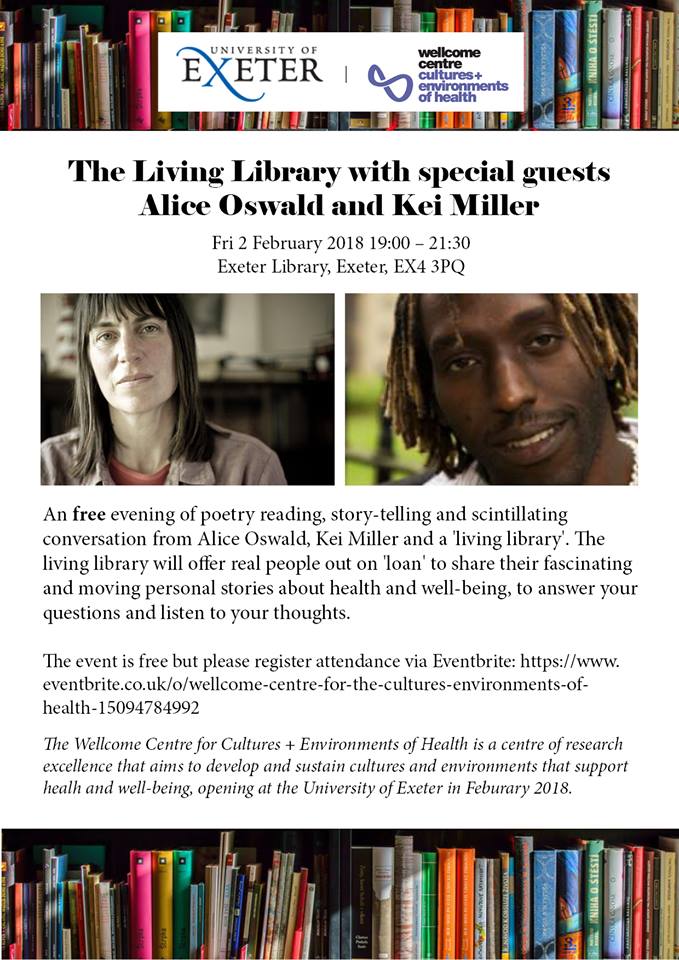
As it happens, just when I discovered this unbeatable voice, I learn that she and another newly discovered favorite author, Kei Miller, will be speaking together, in a month, at the same venue in England, as part of the Bath Spa Poetry Series:


It is enough to bring the dead to life. What I wouldn't give to hear these two... ♬♪ If I were a rich man ♬♫

Listen to Oswald reciting her poem, "A Short Story on Falling," from memory:


You can buy this book here: Shop Indie Bookstores

Memorial: A Version of Homer's Iliad by Alice Oswald

Hardcover, 112 pgs, Pub Sept 10th 2012 by W. W. Norton Company (first published October 6th 2011), ISBN13: 9780393088670, Lit Awards: Warwick Prize for Writing (2013), T.S. Eliot Prize for Poetry Nominee (2011), Popescu Prize for translation (2013)

The poetry of Alice Oswald is preternatural…preternaturally gorgeous, preternaturally immediate and relevant and precise. We want to sink into that language and be in that bright place—perhaps not to live (among the flashing swords), but to die there, amongst one’s brethren, with poetry read and songs sung in one’s honor.

Everything about this book is beautiful, and new and bright and contemporary. The Afterword written by Eavan Boland answers all the questions one has while reading this wholly original poem, this ‘oral cemetery’ memorializing the men who fought the Trojan War. I am tempted to suggest you read the Afterword first, but no, of course you must proceed directly to the glory that is the language exploring the feel of the Iliad, a story with so many deaths, so many deaths of young and old and brave and foolish and handsome men.
EPICLES a Southerner from sunlit Lycia
Climbed the Greek wall remembering the river
That winds between his wheat fields and his vineyards
He was knocked backwards by a rock
And sank like a diver
The light in his face went out…

…Even AMPHIMACHOS died and he was a rarity
A green-eyed changeable man from Elis
He was related to Poseidon
You would think the sea could do something
But it just lifted and flattened lifted and flattened.
Oswald gives the names she memorializes at the beginning of her work and then proceeds to tell in startlingly immediate language, how exactly they met their end, or some tiny biographical note that makes them, contrarily, come alive.
EUCHENOR a kind of suicide
Carried the darkness inside him of a dud choice
Either he could die at home of sickness
Or at Troy of a spear wound
His mother was in tears
His father was in tears but
Cold as a coin he took the second option…
The ancient critics of the Iliad praised its ‘enargeia,’ or ‘bright unbearable reality.’ And that is exactly how we perceive the language Oswald gives us: all the bright young brave men, all dead.
ECHEPOLUS a perfect fighter
Always ahead of his men
Known for his cold seed-like concentration
Moving out and out among the spears
Died at the hands of Antilochus
You can see the hole in the helmet just under the ridge
Where the point of the blade passed through
And stuck in his forehead
Letting the darkness leak down over his eyes.
Oswald strips the narrative from the oral tradition and gives us a kind of lament poetry aimed at translucence rather than translation. She wants to help us see through to what Homer was looking at. But the context is remarkably unnecessary. It is about young men at war. We understand immediately, sadly.
And IPHITUS who was born in the snow
Between two tumbling trout-stocked rivers
Died on the flat dust
Not far from DEMOLEON and HIPPODAMAS
The poetry of war. Breathtaking. Heartbreaking.

Alice Oswald reads a portion of Memorial


You can buy this book here: Shop Indie Bookstores

Sunday, December 3, 2017

Augustown by Kei Miller

Pub May 1st 2017 by Pantheon Books (first pub Aug 11th 2016) ISBN13: 9781101871621 Awards: Nominated 2016 Green Carnation Prize, Nominated 2018 Andrew Carnegie Medal, Nominated 2017 Shortlist RSL Ondaatje Prize, Nominated 2017 Shortlist HWA Endeavour Ink Gold Crown

An inverted gold crown on a jet background graces my cover of Kei Miller’s 2016 novel Augustown and the fiction points to the couple of days in the 20th C when the power structure inverted in a small town in Jamaica. A flying preacher, Alexander Bedward, is instrumental in inspiring the beginnings of the Rastafarian movement in 1920’s Jamaica. That story is wrapped around a more current parallel story of Gina, the clever girl some thought would also fly. Power and powerlessness entwine in this novel.

A town is populated with memorable figures like blind Ma Taffy, gun- and drug-runner Marlon, the dread-headed part-white child Kaia born out of wedlock, the childless spinster Sister Gilzene who could sing an operatic soprano, Rastafarian fruit peddler Clarky, the uptight upright teacher Mr. Saint-Josephs whom we suspect is insane, and a white family: a corporate father with ugly values, his wife learning to ignore him, and a boy who was selfish in the way white people are when they ‘do not see color.’

A bit of a thriller, this novel, because we scent blood early on, with the guns Marlon stashes under Ma Taffy’s house, Clarky dying, and crazy old Bedward rising up like some kind of lunatic second coming going. Oppression surrounds and weighs on us like humidity.
“The rastaman thinks, draw me a map of what you see
then I will draw a map of what you never see
and guess me whose map will be the bigger than whose?
Guess me whose map will tell the larger truth?”
—from Cartographer Tries to Map a Way to Zion
Only after I looked for interviews with Miller did I realize he is considered a poet first, though in descriptions of his education he says he started with prose stories. He is lavishly talented, and writes with an enlightened sexual awareness. This novel has a strong set of female characters and in his 2010 collection of poems called A Light Song of Light, we also get that sense of even ground, and more:
Every bed was made illegal by the brush
of chest against chest, and by our sweat.
--from A Short History of Beds We Have Slept in Together
Miller saves his challenges for colonialists and by his words we recognize Miller understands rage and sorrow.
"...how they have forced us to live in a world lacking in mermaids--mermaids who understood that they simply were, and did not need permission to exist or to be beautiful. The law concerning mermaids only caused mermaids to pass a law concerning man: that they would never again cross our boundaries of sand; never lift their torsos up from the surf; never again wave at sailors, salt dripping from their curls; would never again enter our dry and stifling world."
--from The Law Concerning Mermaids
Historical figures feature in this poetry collection, including Alexander Bedward again, Singerman (Marley?), Nathaniel Morgan, Coolie Duppy, etc. and there is a strong scent of homesickness. Miller has lived in Great Britain for some years now and perhaps is telling the same story over and over, in a new way each time, pruning and training the branches until they remind him of home.

In the poetry collection The Cartographer Tries to Map a Way to Zion published in 2014, Miller’s language is English but there appear so many words we have never seen that we are unsteady, unsure, very nearly undone.
Unsettled

So consider an unsettled island
Inside—the unflattened and unsugared

fields; inside—a tegareg
sprawl of roots and canopies,

inside—the tall sentries of blondwood
and yoke-wood and sweet-wood,

of dog-wood, of bullet trees so hard
they will one day splinter cutlasses,

will one day swing low the carcasses
of slaves; inside—a crawling

brawl of vines, unseemly
flowers that blossom from their spines;

inside—the leh-guh orchids and labrishing
hibiscuses that throw raucous

syllables at crows whose heads are red as annattos; inside—malarial mosquitoes

that rise from stagnant ponds;
inside—a green humidity thick as mud;

inside—the stinging spurge, the nightshades,
the Madame Fates;

inside—spiders, gnats and bees,
wasps and lice and fleas; inside—

the dengue, the hookworm, the heat
and botheration; unchecked macka

sharp as crucifixion. This is no paradise—
not yet—not this unfriendly, untamed island—

this unsanitised, unstructured island—
this unmannered, unmeasured island;

this island: unwritten, unsettled, unmapped.
—from Cartographer Tries to Map a Way to Zion
The unsettlement one feels when reading the poem is curiously the way Miller makes us feel in his novel, though he does not use such words. We retain a kind of distance. Just as well. There is danger everywhere. The only other place that ever gave me this sense of familiarity and menace was another island with a bloody colonial history, Tasmania.

This is a new cultural sphere; it takes some time to accustom to this point-of-view. The language which is at once foreign and familiar, continental and island, melodic and profane, knowing and naive. Hope is not an obvious choice when one is the underclass. Rastafarians have a mighty sense of their closeness to god and ghost. White folk don’t offer the same opportunities. This truth is such a relief after centuries of colonial cant.

We can feel the tide, the sun, the heat; we smell the flowers, the sea, the mangoes. Miller’s language in Augustown is easily poetic, not caught in it but casual and natural. The story, Gina’s growing up and standing up, is where we’re focused. And yet…and yet the bleaching light on the sunbaked road and the overhanging flowers thrust their way into the story, embellishing it, making us a little homesick, too.

The chapter on autoclaps squeezed the heart and was almost pure poetry. This chapter made the book Kei Miller’s. Any other author may have left that chapter out, and they would have been utterly wrong.

We, humans in the world, for centuries in every country, have put men in charge of…everything…our well-being, our safety, our protection. Since barely cognizant, I have always thought that was a lot to lay on one half of the human race. Kei Miller seems to understand this.

And finally, the place, Jamaica, is clearly what Miller is about. He is centered on this and staking out this territory as his own.

The extraordinary talent is evident in Miller’s Youtube video, him talking about his new book of poetry


You can buy this book here: Shop Indie Bookstores

Monday, August 28, 2017

Days Without End by Sebastian Barry

Hardcover, 259 pages Pub Jan 24th 2017 by Viking (first pub October 20th 2016) ISBN13: 9780525427360 Literary Awards Man Booker Prize Nominee for Longlist (2017), Costa Book Award for Novel (2016), Walter Scott Prize (2017), Costa Book of the Year (2016)

Has an Irishman written the Great American Novel? The question is not theoretical; Sebastian Barry’s latest novel is the fourth time he has been longlisted for the Man Booker Prize. It is his seventh, but it doesn't have the density of a novel. It is Barry’s long experience writing for the theatre—thirteen plays already—that lends excitement to this work. After the years of excellent effort, suddenly Thomas McNulty springs full-grown from Barry’s well-tilled field. The success of this gem of a novel set in 1850’s America is all about preparedness and inspiration.

The novel is not long but is fluent and unstrained; it makes big statements about human existence, war, love, about what we want, and what we get. It is remarkable how squarely Barry lands in the middle of the American debate so clamorous around us now, about race, diversity, sexuality, what we fight for and who fights for us—questions we’ve never satisfactorily answered.

Barry gives us humor in a horribly violent world, surprising and delighting us with his deadpan delivery. His diverse cast of characters are reliant on one another, all viewed through the eyes of an Irishman who’d suffered such terrible deprivations as a child that man’s cruelty nevermore surprised him. What did surprise him was that we could find a way to love, to happiness, despite our sorrows.

In the early pages Thomas McNulty meets John Cole under a hedge in a rainstorm. John Cole is a few years older, but both the orphaned boys are wild things, having ‘growed' in the school of hard knocks. Uncanny judges of character, they almost instantly decide they stand a better chance together in the rough-and-tumble than alone and set off on a series of adventures. The pace of the novel is swift. When I go back to find a memorable passage, I am shocked at how quickly events unfolded, and how quickly I am deeply involved.

The language is one of the novel's wonders. Barry doesn’t try to hide his brogue, but uses it: a stranger in a strange land. That distance and perspective allows Thomas to make comment upon what is commonly observed
"Everything bad gets shot in America, says John Cole, and everything good too."
and
"I know I can rely on the kindness of folk along the way. The ones that don’t try to rob me will feed me. That how it is in America."
The novel constantly surprises: when the boys answer the ad hung awry on a saloon door in a broken-down Kansas town, “Clean Boys Wanted,” we prepare for the worst. Within pages we are jolly and laughing, then agonized and pained, then back again, our emotions rocketing despite the tamped-down telling of the historical backward gaze. Our initial sense of extreme danger never really leaves us, but serves to prepare us for the Indian wars, those pitiful, personal slaughters, and the Civil War, which comes soon enough.

The most remarkable bits of this novel, the sense of a shared humanity within a wide diversity, seemed so natural and obvious and wonderful we wanted to crawl under that umbrella and shelter there. These fierce fighting men fought for each other rather than for an ideal. Their early lives were so precarious they’d formed alliances across race, religion, national origin when they were treated fair. “Don’t tell me a Irish is an example of civilised humanity…you‘re talking to two when you talk to one Irishman.”

And then there is the notion of time, if it is perceived at all by youth: “Time was not something then we thought of as an item that possessed an ending…” By the end of the novel, the characters do indeed perceive time: “I am doing that now as I write these words in Tennessee. I am thinking of the days without end of my life. And it is not like that now.” We have been changed, too, because we also perceive time, and sorrow and pain and those things that constitute joy. We have lived his life, and ours, too.

Barry gets so much right about the America he describes: the sun coming up earlier and earlier as one travels east, the desert-but-not-desert plains land, the generosity and occasional cooperation between the Indian tribes and the army come to dispatch them, the crazy deep thoughtless racism. But what made me catch my breath with wonder was the naturalness of the union between Thomas Thomasina McNulty and John Cole and the fierceness of the love these two army men had for an orphaned, laughing, high-spirited, bright star of an Indian girl they called Winona.

Barry understands absolutely that our diversity makes us stronger, better men. Leave the pinched and hateful exclusion of differentness to sectarian tribes, fighting for the old days. We know what the old days were like. We can do better. I haven’t read all the Man Booker longlist yet but most, and this is at the top of my list. It is a treasure.

I had access to the Viking Penguin hardcopy of this novel--I'm still surprised at how small it is, given the expansive nature of the story--but I also had the audio from Hoopla. I needed both: the pace of the novel is swift, and may cause us to read faster than we ought. Barry writes poetically, which by rights should slow us down. The Blackstone Audio production, though read quickly by Aidan Kelly, allows us to catch things we will have missed in print and vice versa. At several stages in this novel, crises impel us forward. As we rush to see what happens, we may miss the beauty. Don't miss the beauty. Books like these are so very rare.


You can buy this book here: Shop Indie Bookstores

Friday, October 21, 2016

The Angel of History by Rabih Alameddine

This novel contains so much naked yearning, sadness, despair, and exhausted hilarity—poking fun at man’s powerlessness in the hands of Satan and Death accompanied by Angels—that we could be forgiven for imagining it a memoir. Alameddine has given us something rich upon which to sup, slowly, for there is much to assimilate. A poor Arab son of a whore (literally, as it turns out) is intellectually realized by nuns and priests in Beirut, schooling paid for by an absent father.

The boy and his schoolmates discover his gayness early, and the rest of his life is nary a denial, only acceptance, and once he found his circle, a verbally rich and figuratively celebratory consummation. Consumption is the other half of the story, the harvesting of lives, the dropping away of the circle. Alameddine does not shrink from the most revealing descriptions of life, love, and death in the life of a "little brown gay" man, just giving us pieces sometimes, as though he can’t remember clearly. He probably can’t, which is how we get the feeling that this is something remembered rather than merely invented.

This is not an easy read, there is so much thoughtful erudition here. Our eyes take in more than our brains can process. References to earlier works are everywhere apparent, some boldly proclaimed—Mikhail Bulgakov, Goethe, the Bible, the Quran—others we see faint outlines of in the swirl of colors and language that comprise invention, memory, and forgetting. This is a novel unlike any other, for that little brown gay Arab has given us something we have not seen before, all beauty and crescendo and wit and the most unbearable sense of loss. This is a revealing, naked novel that expresses a longing for acceptance, despair of a kindly world, and a stunning reversal—that hoarse, defiant shout, drenched in a kind of mad joy, into the void.

The novel opens with Satan having a conversation with Death. Shortly we learn that the man they came to discuss, Jacob, has signed himself into a mental hospital…to check his despair. The man, the little brown gay Arab, had lost many friends to AIDS in the scourge. He wants both to forget and to remember. It is not just his life he must remember, but all of it. All of his history, starting with his Yemeni blood. Satan tells us “forgetting is as integral to memory as death is to life.” It is not immediately obvious why we need to know this, and we are not sure we understand it anyway. We will forget it, and remember it again and again.
"Yemen is one of my favorite places, [said Death]...That nation has refreshed and rejuvenated me for centuries."
Love between partners is a momentous thing, not easily found and not easily lost. It lasts forever, some believe, or its vestiges linger forever. It leaves a mark. One is not supposed to lose one’s partner to death in mid-life. It is cruel. It is unnatural. This is the place where Jacob finds himself, struggling through a life filled with losses since childhood. Now in adulthood, he should be expert at it. And there is some resilience there that we poke and prod with interest. How will Jacob respond to his challenges?
”As it was in the beginning, said Satan, lying on my bed, so shall it be in the end, so shall it be first, last, midst, and without end, basically you’re screwed, Jacob, you know, the supremacy of Western civilization is based entirely on the ability to kill people from a distance….You can never win, Jacob.”
Death, on the other hand, promises peace, lethe, forgetfulness, and silence. “Peace on demand, instant gratification.” Which will our confused and suffering Jacob choose? His answer is foreshadowed throughout the novel and has something to do with his covering angels. Despair is normal, despite Jacob’s need for a psych ward. Despair is what we get, sometimes. Forgetting and remembering…you can’t have one without the other.
One early memory is Jacob envying his older cousin, a schoolgirl who faced life silently, in a beige school uniform. Jacob tells us “My Halloween costume that years [was] a headscarf with two pink pigtails sprouting out of it…”

An interview with Rabih Alameddine gives some notion of his carefully hidden depths. This link has the conversation recorded in a noisy cafe. I prefer it, though there is also a written transcript. It is a messy, imperfect thing, this interview, but Alameddine is just so irrepressibly himself.


You can buy this book here: Shop Indie Bookstores

Saturday, January 16, 2016

Light of the World by Elizabeth Alexander

Hardcover, 209 pages Published April 21st 2015 by Grand Central Publishing (first published April 14th 2015)

"Oh beauty, you are the light of the world!"
--Derek Walcott
It is said the way to deal with loss is to remember. Alexander chooses the most gorgeous memories for the elegy of her husband Ficre, like a bowl of blowsy, fragrant roses or a rarely-blooming South African bonsai covered in pink blossoms that exude a sweet perfume. The unusual capacity of both artists to see beauty and possibility in the world gave them loving friends that each of them gathered about themselves and cherished for one another. They lived a life of such richness and beauty that they cannot now be sad it had to end. That it was a privilege, both of them would acknowledge.

Ficre Ghebreyesus was only days past his fiftieth birthday when he died of a massive heart attack one evening on his treadmill while he waited for his wife and the mother of his two sons to return from a poetry reading. The memories of their meeting, the births of their sons, their life together--he as a chef and painter, she as a teacher and poet--is as wonderful as anything I have ever read, and as mysterious in alchemy as any chemistry.

Gorgeous. Unforgettable. Oh joy, oh pain, oh beauty.


You can buy this book here: Shop Indie Bookstores

Wednesday, January 13, 2016

The Face: Cartography of the Void and Other Works by Chris Abani

ebook, First Edition, 59 pages Published September 23rd 2014 by Restless Books

The work of Chris Abani crosses national boundaries. He calls himself a “global Igbo,” referring to his lineage, and to the fact that he has so many foreign influences on his experience as a Nigerian. Brought up privileged in an educated middle-class household with a white British mother and an Oxford-educated Igbo father, Abani had access to western music, American novels, Bollywood films, Indian mysticism as a youth. He was a precocious fourth son, starting to write in his early teens.

His face, which he talks about in his memoir, The Face: Cartography of the Void, has a kind of universality so that people often mistake him for Lebanese, Arab, Indian, Dominican, Cuban, Hawaiian, or Maori. When his Korean manicurist in L.A. called his face “comfortable,” Abani writes
"Comfortable face. I liked it. Made me think of a well-worn armchair that I’d like to collapse into after a rough day. A face made for sitting in. Where one could sip a sweet spicy ginger tea and talk about love and books and karaoke. A face worn in by living, worn in by suffering, by pain, by loss, but also by laughter and joy and the gifts of love and friendship, of family, of travel, of generations of DNA blending to make a true mix of human. I think of all the stress and relief of razors scraping hair from my face. Of extreme weather. Of rain. Of sun. I think of all the people who have touched my face, slapped it, punched it, kissed it, washed it, shaved it. All of that human contact must leave some trace, some of the need and anger that motivated that touch. This face is softened by it all. Made supple by all the wonder it has beheld, all the kindness, all the generosity of life.
Comfortable face."
It is not just the face of Chris Abani that is comfortable. He makes us comfortable about ourselves, about the world, about our fears and aspirations. Abani’s fiction reveals the insides of characters who are often different in some way, their very differentness expressing their underlying and universal humanity. We are all different from one another. It is our differentness that makes us the same.

At the same time, Abani makes us uncomfortable. In an essay he wrote for Witness magazine entitled, “Ethics and Narrative: the Human and Other,” he writes
"In making my art, and sometimes when I teach, I am like a crazed, spirit-filled, snake-handling, speaking-in-tongues, spell-casting, Babylon-chanting-down, new-age, evangelical preacher wildly kicking the crutches away from my characters, forcing them into their pain and potential transformation. Alas, or maybe not, I also kick the crutches away from my readers. And many have fled from the revival tents of my art, screaming in terror."
When we go to dark places in ourselves, Abani suggests, we can come back, better. “When you are at your worst, you can see yourself most clearly.” At your worst, you can see your choices most clearly, and choose goodness, compassion. This is a man who has seen the darkness in humans and who still [mostly] likes us, who can laugh, make jokes, love others deeply. We feel safe with him, and if he can’t save us when something bad happens, at least we shared something real with another for awhile. Abani writes fiction and poetry—how real and important can that be? Quite real enough to reveal both the dark heart and warm center that most humans harbor.
“Language actually makes the world in which we live.”
Language, and literature, at its best, can be transformative. We can create our world anew by what we say, what we think, what we read, what we write. But we therefore have an obligation to use words [and actions] that do not harsh the environment, but gentle it, that explain and improve the world.

Abani is a black man, but his writing has few markers for what passes for “black” in America. In a 2014 interview with Rumpus Magazine Abani tells Rumpus interviewer Peter Orner that having grown up in a black-majority country, he was not defined by his race until he left Nigeria and went to Britain and the United States.

Though he has lived in the United States for some ten years or more, Abani does not write in the style of white or black America, though he clarifies in an NPR interview, “Africa could never have the literature it does without the influence of black Americans.” African literature makes no attempt to fit into the Western canon: African writers are having this conversation over here, and if you want to join in you must make accommodation. Interestingly, Abani finds writing in America freeing, partly because of the language, which is constantly influenced by our immigrant population, and because of the vitality and variety of experience and geography.

Abani’s students, and we readers, often “forget he is black” because he assumes the right to speak with his own voice and deals with universal themes. But Abani observes and occasionally writes of the oppression of black people in this country: "Slavery [in America] is not really over". In this memoir he mentions that when he is stopped while driving, the cops seem surprised and almost “offended by his [British] accent.” He recognizes that as an educated middle-class African, he has a privileged position in American society. “Race in America has more to do with social position than it has to do with biological race.”

Abani now teaches writing at Northwestern University in Chicago. Daria Tunca of the University of Liège in Belgium has compiled a wonderfully complete bibliography of Abani’s work (and short biography) which includes links to interviews, readings, and Abani’s website. I share my favorite links below because I feel his work is essential reading/listening. Somehow the issues we face in the world are pointed to by this big man with the small voice and small toes. And he gives us some answers: You reflect my humanity back at me. Ubuntu.


A few links to important talks, essays, writings:

NPR Illinois Radio Interview (2006)

Kate Durbin Interviews Chris Abani (2007)

TED talk on the Stories of Africa (2007)

TED talk “On Humanity” (2008)

Witness essay, “Ethics and Narrative” (2009)

Chris Abani with Walter Mosley in Conversation (2010)

The Rumpus Interview with Peter Orner (2014)


• Becoming Abigail (2006)

• Hands Washing Water (2006)

• Virgin of Flames (2007)

• Song for Night (2007)

• There Are No Names for Red (2010)

• Sanctificum (2010)

• The Secret History of Las Vegas (2014)


You can buy this book here: Shop Indie Bookstores

Tuesday, January 12, 2016

Sanctificum by Chris Abani

Paperback, 96 pages Published April 1st 2010 by Copper Canyon Press

This is my favorite among Abani’s published poetry collections and I think it might be because it is completely accessible. One doesn’t have to know anything about Chris Abani to understand the language and heartache and courage. “Om” appears first and has seven parts on five pages. I reprint a piece from each part:
"I never told anyone that every sliver of orange I ate
was preceded by words from high mass.
Per omnia saecula saeculorum.
Spit out pit. Amen.
Juice. Amen. Flesh."
and
"The dog’s black tongue was more terrifying than its teeth."
and
"Sorrow lodged like a splintered bullet next to the heart."
and
"Sand, where there is no water, can ablute,
washing grain by grain even the hardest stone of sin."
and
"The way a photograph cannot remember the living."
and
"Sanctificum."

A section of the collection is entitled 'God's Country," perhaps a nod to Percival Everett, whose novel of the same name is a must read for fans of American literature. Abani's "God's Country" ends
"When we say love we mean, I want.
When we say sorry we mean, forgive me.
There is little room for anyone else.
But Bean, she loves me.
How else can she keep forgiving me?"
Abani can talk about sadness, about places that are sad, without being sad:
A LETTER TO ROBERT PINSKY

This is wood, enchanted wood.
Still the fire scorches and we say wood
still the pain burns from the club
and then we say wood
still the planks dovetail and we caress
the smooth and the rough
sensuous, delectable, and yet sorrowful
and then we say wood.
My favorite poem is too long to quote, twelve sections on ten pages, called “Pilgrimage.” It talks of words and their meanings, faith and its lack, history and hope, fear and courage, love and rage. Well, I will quote just a little because it speaks to the sadness without being sad:
"Some may call me a pessimist, but I am not.
There is nothing gained from loss.
I drink tea in the shade and believe in poetry.
I am a zealot for optimism."
In "Histories" Abani has a short poem
DEAR YUSEF KOMUNYAKAA

Your poem "Ode to the Drum"
pulled me back from many night terrors.
May I roll it around my lips and not kill it
for its exquisite touch.
May I find a way to beat a song back
into these tired lines, these words.
Amen."
At the end of one of his TED talks, Abani reads Komunyakaa's "Ode to the Drum" "in a way Komunyakka would be proud to hear it read."

In a short poem near the end called “Dew,” Abani writes
"My desire is struggling up the mountain.
My fear is a shower of pebbles.
Your son is trying to be a good man, Mum.
Your son is going to be all right.
There are no names for red."
That is not the poem in its entirety, and it does not end there. But that phrase that appears again and again in Abani’s work is perplexing to me. I don’t know what he means, “there are no names for red.”

The real strength in Abani’s work is his willingness to see and not be ruined by the seeing. He has enough reserves to still give succor to those of us stumbling along beside him. "I have always envied the stigmata," he tells us of those wounds that will not heal…"I want to put my fingers in the wounds and swirl them around." And so he does.

This book was published in 2010 by Copper Canyon Press.

Other works by Chris Abani include:
• Becoming Abigail (2006)
• Hands Washing Water (2006)
• Virgin of Flames (2007)
• Song for Night (2007)
• There Are No Names for Red (2010)
• The Secret History of Las Vegas (2014)
• The Face: Cartography of the Void (2014)


You can buy this book here: Shop Indie Bookstores

Hands Washing Water by Chris Abani

Paperback, 90 pages Published October 1st 2006 by Copper Canyon Press

”We are lucky to live now, I mean, look how far we’ve come.”—from “Foucault’s Funk”

Chris Abani, when asked by Walter Mosley in 2010, said he was a novelist first because he thought in stories. He works on poetry and novels concurrently, using one to break the logjams of the other. He works constantly.

The poems in this collection are food, a kind of fruit we have never tasted before, good in our mouth but unfamiliar on our tongue. We try something new in every poem, moving from Paris to the Caribbean, from California to New Zealand. Africa is there, and New York, Harare, Egypt, and Antwerp. At the pyramids

"Rabab tells me: We know how to build graves
here. I nod. I know. It is the same all over Africa."
One extraordinary twelve-part poem, “Buffalo Women,” imagines the correspondence between a white woman and a recently emancipated slave who is fighting in the Civil War. The agony of their separation and the possibility of no return is everywhere evident.
"Remember the bird of paradise you planted?
Well it has spread in the garden, so that it looks as though
a gaggle of tropical birds have gone beserk...
...I am enclose some rags to stanch your blood
and a long piece of sheet to swaddle yourself."
In “A Warrior’s Pride,” we learn to sharpen a broadsword till it cleaves a single blade of grass. Soot, ash, water, stone.
”Grandfather says:
Heed this! A severed head cannot be put back
This is a warrior’s wisdom.”

In Auckland, Abani feels at home. He has a face that is often mistaken for another nationality. Sometimes mistaken for a Maori (“It can be dangerous”), he says
"All of me meets here, an alchemy of parts--
the Pacific of residence, the Atlantic of birth,
the English of heritage, and a culture, like mine,
old enough to have words for birthing the earth."

My favorites in the collection are “Low-Down Dirty Blues,” written for Walter Mosley, and “Harare” which has a refrain in each stanza “This is kwela.” Kwela is a distinctive pennywhistle-based jazzy urban street music from South Africa (according to Wikipedia) that has influenced Western music, notably Paul Simon’s album “Graceland”. Another favorite in this collection is
UNFINISHED SYMPHONY

The light this morning is an aria,
I turn back to the stirring of the coffee.
A way to ground this time
between the hush and the turning. Outside
a hummingbird is spreading rumors
among flowers. Even now.
Even after all the wounds have healed,
I scratch around a phantom scab, avoiding
what lies beneath. When I open the window,
rosemary and thyme spill in.
Later I will loam in the herb garden,
crumbling the dirt, whispering dirges,
spicing the plants with sharpness. For now,
there is Percival’s painted fire
and the coffee. Sometimes
it is enough.
In the TED talk below, Abani told us about seeding the names of the dead, singing melancholic dirges while planting. When it comes time to harvest, joyful songs commemorate the village’s newborns. The other reference in this poem is to the paintings of novelist Percival Everett.

>

This collection, first published in 2006 by Copper Canyon Press, is now available as an ebook by that publisher. The Notes at the end of this collection give the reader a frame of reference for each poem, except for the title poem, which has no notes.

Other work by Chris Abani:
• Becoming Abigail (2006)
• Hands Washing Water (2006)
• Virgin of Flames (2007)
• Song for Night (2007)
• There Are No Names for Red (2010)
• Sanctificum (2010)
• The Secret History of Las Vegas (2014)
• The Face: Cartography of the Void (2014)


You can buy this book here: Shop Indie Bookstores

Monday, January 11, 2016

There Are No Names for Red by Christ Abani and Percival Everett

This collaborative work features the poetry of Chris Abani and the oil paintings of Percival Everett, also a novelist. Published in 2010, the 7.5" x 10" format with a wainscoting of gray in the bottom third of a white page gives plenty of space to display Everett’s work alongside numbered stanzas of what might be a single poem by Abani.

Desire is a theme Abani returns to again and again in his writing, and the first line of the first stanza holds that word aloft for us to contemplate:
“The way desire is a body eroding
into a pile of salt marked with a crown of birds:
and black.”
While I cannot be exactly sure what Abani meant by those lines, it sounds a great deal like death, outside, a feast for birds, blackening in the sun.

Desire and death, "all the terror we can bear", "survival", "hunger", "sorrow, of weight beyond measure", "drowned". These poems describe the "box of wood and canvas…red lines cut thick as paste."
"My first death was a butterfly."
The poems describe the perpetrators, so many over the years, over the continents: Auschwitz, Jim the Crow, Boer, Mau Mau, Rwanda.
"If I were a better man, I would have compassion."

and

"I walk the stations of that pain
with all the relish of a self-flagellating
monk…"
Everett’s paintings are bold, saturated with color, reds, golds, deep indigo with definite forms and irregular thick black grids.
"Like Van Gogh it is what is not alive that lives here…
…This knife pulls a jagged wish
through oils thick as butter…
…Percival’s heart bleeds on a stiff white canvas window."
And then, suddenly, three torsos, painted warm on a red background, without heads, arms or legs standing backs to us, graceful in form and beautiful, male and two females, without ethnicity, race, or national origin, undeniably alive, and in motion.

Abani finishes "It’s not hard to kill a childhood,"
and
"How nicely they’ve fixed the bullet holes in the walls,
in Rwanda. Painted bright petals around some areolas."
Abani sees Rwanda in the torsos. We bring ourselves to the interpretation of paintings, photographs, literature. But now we must admit that Percival’s paintings no longer share the same horror of Abani’s vision. We must begin again, and see how Abani is caught in the web of his nightmare and cannot get free:

"There is a green one above my desk.
Ripe, viridity fairer than lime and yet darker...
...Some nights,
when I look up suddenly, I am back in a cell and fear
chokes me and then my guilt...

...In the end, there are no names for red but fire,
hydrant, apple, ball, heart, blood, sacrifice, and altar.
Look, my nephew says, fire engine."

A remarkable collaboration by two remarkable artists.

Paperback, 56 pages Published April 1st 2010 by Red Hen Press

Other work by Chris Abani:
• Becoming Abigail (2006)
• Hands Washing Water (2006)
• Virgin of Flames (2007)
• Song for Night (2007)
• Sanctificum (2010)
• The Secret History of Las Vegas (2014)
• The Face: Cartography of the Void (2014)


You can buy this book here: Shop Indie Bookstores