Showing posts with label Atria. Show all posts

Thursday, January 18, 2018

The Iliad by Homer, translated by Various

Foolish me. I thought I was going to look at the different editions of The Iliad and choose the one most readable but did not reckon with the overwhelming beauty of the language and story. The truth is, it does not matter which edition you choose, so long as you read at least one. It is inevitable that you will find yourself drawn to the question of the most beautiful and complete rendition but you may (wisely) concede defeat at the beauty of each.

The Homeric epics are said to be the greatest martial stories ever sung or written of all time, so if for some reason they did not resonate for you in high school, you may want to revisit what your teachers were talking about. When they describe the death of a man in the full bloom of his strength looking like an flower in a rainstorm, head and neck aslant, unable to withstand the beating rain, we understand. I listened to the audio of Stephen Mitchell’s streamlined translation, and it was utterly ravishing and compelling.

The Iliad is one episode among many in Homer’s epics, and it may have been assumed that listeners of the original spoken performance would be familiar with all the players in this war. It is argued by some, including British scholar M.L. West, that The Iliad has had pieces added to it over the years. Stephen Mitchell follows West’s scholarship and strips out the extra passages, a notion expanded upon in a review of Mitchell’s translation by classicist Daniel Mendelsohn in The New Yorker (2011). Mitchell’s translation may be the most readable, the most listenable one in English. It is also the shortest. Mitchell also shortens the lines in English so that they have speed and momentum for an impressive delivery.

The recent (2017) Peter Green translation, begun when Green was nearly 90 years old, is similarly easy to read; Green tells us that he began in a relaxed attitude for diversion and completed the whole within a year. Colin Burrow reviewed Green's translation in the June 18th 2015 edition of the London Review of Books. Neither the writing or the reading of this version is anguished or tortured, and Burrow points out that Green was a historian but didn't allow that to obfuscate or weigh down the poetry.

The Green & Mitchell versions both retain a long recitation of those who prepared their ships to sail with Agamemnōn to Troy to bring back Helen, the wife of Menelaös. One imagines ancient listeners shouting when their region is named, much along the lines of the cheering section of a field game, when each player’s name is called. And later, as the blow-by-blow of the battle proceeded, one imagines each region cheering when mention of their leader is declaimed, though some died horrible deaths.


This is another reason to read this ancient work: We live and die not unlike one another, we who lived so far apart in time, and perhaps the ardor young men of today have for the sword and for fame will be doused by the utterly desolate manner of death recounted here, one in particular that I cannot forget: a spear through the buttock and into the bladder meant a painful and ugly death. However, it is true that Achilles chose fame over life, knowing that his exploits in Troy would mean his physical death but his fame amongst men would be sung for “thousands of years.”

One wonders how the ballad was delivered—in pieces or over a period of days—perhaps in sections by different singers? Caroline Alexander, after a lifetime of her own research into the Homeric epics argues in The War That Killed Achilles: The True Story of Homer's Iliad and the Trojan War that the work certainly required days to recite, and may have been performed in episodes. The length of the piece now suggests the work was once short enough to be memorized, with a few repeated lines leaving headspace for the singer's invention and modification as befits the oral tradition.

I wonder now which European language has the most translations, and do they sometimes dare to attempt translations from ancient Greek to, say, French, and then to English? It seems we have enough scholars understanding ancient Greek to give us satisfactory versions without resorting to piggybacked translations. An attempt was made by John Farrell in the Oct 30, 2012 edition of the Los Angeles Review of Books to untangle the English translations and sort them for clarity and poetry. Those of us who love this work will read all the versions, especially the fascinating introductions to each in which the translators themselves wax eloquent about what they loved about it. Mitchell's introduction is especially accessible and impelling: I couldn't wait to get to the story.

I have read reviews of people who prefer Lattimore, Fagles, Fitzgerald, or Lombardo translations and all I can say is I’m not the one to quibble about great works. Daniel Mendelsohn "graded" four translations in the article discussing Mitchell's translation. It must be a curse and a blessing both (for one's self and one’s family both) to understand ancient Greek and to feel the desire to translate Homer. All the questions any editor/translator must address, e.g., spelling, which edition is ‘original,’ more poetry or prose, whether to render the translation literally or by sense…how exhausting the decisions, but how fantastically exciting, too.
In the end, whichever edition gives you the greatest access for your first attempt to breach the ramparts of this ancient work is the one to choose for a first read. The other editions will naturally come later, once you have the sense of the story, a few names nailed down, and have that deepening curiosity about the poetry and the beauty.

One last observation is that the men in this epic were mere playthings of the gods, gods that could be cruel, petty, jealous, and vengeful. These gods were helpful to individual men or women insofar as it helped their cause vis à vis other gods. There was striving among men, but most of the time human successes or failures had less to do with who they were than with who they knew. Was it ever thus.


※ Mitchell: Paperback, 560 pgs, Pub Aug 14th 2012 by Atria Books (first published -750), Orig Title Ἰλιάς, ISBN13: 9781439163382; Audio Pub: Simon & Schuster Audio, 10/11/2011, Unabridged, ISBN-13:9781442347311

※ Green: Paperback, 544 pgs, Pub May 14 2015 by University of California Press, ISBN13: 9780520281431

※ Alexander: Paperback, 608 pgs, Pub Sept 13 2016 by Ecco, ISBN13: 9780062046284

※ Fagles: Paperback, Deluxe Edition, 683 pgs, Pub Apr 29 1999 by Penguin Books, ISBN13: 9780140275360

※ Fitzgerald: Paperback, 588 pgs, Pub Jan 2 2004 by Farrar, Straus & Giroux, ISBN13: 9780374529055

※ Lombardo: Paperback, 574 pgs, Pub Mar 12th 1997 by Hackett Pub Co, Inc., ISBN13: 9780872203525

※ Lattimore: Paperback, 599 pgs, Pub Nov 15th 2011 by University Of Chicago Press, ISBN13: 9780226470498


You can buy this book here: Shop Indie Bookstores

Thursday, September 21, 2017

Lightning Men (Darktown #2) by Thomas Mullen

Hardcover, 384 pages Pub Sept 12th 2017 by Atria/37 INK ISBN13: 9781501138799 Series Darktown #2

Thomas Mullen’s Darktown series, about the first black policemen in Atlanta’s police force, is about race but it is also about the institution of policing. We are seeing how corruption and discrimination can take hold, and we ask ourselves what is the best way to combat the ever-widening spiral of deceit. We interrogate our own moral grounding and question whether we would be able to withstand the social and economic pressure put to bear to get us to go along on controversial arrests or worse.

It is that evaluative distance and internal interrogation that Mullen creates in us that may be the most remarkable thing about his books. We are thinking critically and watching the narrative unfold from a protective distance even though his stories are gripping—after all, this is life and death in neighborhoods just like ours—and we really never know where he is going to steer us next. But these novels aren’t really mysteries, and they aren’t police procedurals in the typical sense. Do we need a new genre category for the historical and sociological recreation he manages?

Mullen places us in the moment by citing newspaper headlines mentioning what is happening in the country and around the world in 1950:
“Late morning the house is quiet with Cassie and the kids out at a park. Rake read the paper and enjoyed the solitude. An American minesweeper had become the first U.S. ship sunk in the Korean conflict; Joe McCarthy was insisting on a more thorough investigation into the Communist infiltration of the top echelons in the American government; and officials announced that the mysterious explosions in a Brooklyn neighborhood, initially feared to be a Red attack, had in fact been caused by a gas leak…”
These headlines do more than situate us in 1950, they also remind us that prejudice and crazy theories about racial or political superiority have been around before and have passed, though not without a fight. One of the very next scenes is a meeting between a cop seeking information on an old case and an FBI agent who’d been involved at the time. The FBI man suggests they meet in a coffee shop to discuss the matter, and the moment Lucien Boggs, a black policeman, begins to walk into the coffee shop attached to a department store, we wonder…Mullen doesn’t let us down. He shows us the disdain and harsh attitude of the woman behind the counter, and the surprise and shutting down of the FBI agent who told Boggs to wait outside until he finished his coffee.

Earlier, a white cop came across a flyer posted to a stop sign in a suburb of Atlanta: “Zoned as a White Community” and emblazoned with a lightning bolt, “just like the ones sewn onto the sleeves of SS troopers he’d seen in Europe.” Mullen takes time to discuss the group he calls the Columbians, a group distinct from the KKK, indeed disdainful of it. This group supported Nazi ideas including the concept of a master race, and apparently believed America fought the Nazis in World War II only because the Japanese bombed Pearl Harbor, making ‘sides’ more clearly defined. Otherwise, America had been more concerned about the red menace from the Soviets.

The rivalry between the Columbians and the KKK, who are derided by practically everyone for the bedsheets disguise, is central to this story and instructive in that it clarifies motives and actors in the messy phenomenon that is racism today. Mullen also spends some time answering the notion that blacks bring misfortune upon themselves. He opens the story with the release of Jeremiah Tanner from prison. Tanner had paid his debt, and readers are inclined to be sympathetic. Throughout the story, our impressions of Jeremiah will change several times, from believing him the most evil of all to believing him the most generous of all. This is Mullen’s skill.

The black lives in this latest novel are so much more difficult and complicated than we imagine at first. Their choices all appear to be bad ones. No surprise, then, that they find themselves in the middle of illegal or compromising situations again and again, and yet when we hear their explanations, they sound rational, making choices we might make in the same place. When you have bad choices, your decisions may look poor also.

The white men’s lives are less appealing altogether. There are a couple of white policemen wrestling with the morality of discrimination and the exclusion of black folk, but most make no effort to push back against the few bad apples that extract fealty or promise retribution within the force. They would revolt against the bad guys on the force, we sense, but they aren’t impacted enough. They need stronger incentives to do right. They aren’t heroes after all, just working men.

Mullen also manages to pack in an excellent example and discussion of the lack of reasonable housing in Atlanta at the time for blacks who did not want to live in substandard apartments in dangerous neighborhoods. The real estate industry wouldn’t certify black realtors so called them “realtists,” a word I found laughably close to “realists.” The phenomenon of “white flight” from neighborhoods into which black residents have moved is discussed in some detail.

When Mullen’s first book in this series, Darktown, came out last year, I asked him how he could write the black man's point of view. His answer shows his authorship of these characters:
“As far as the black point of view in the book, roughly half of the book is from black characters' perspective and about half is from white characters' perspective. But what's important here is that each character has his or her own, unique perspective--no character should be a mere stand-in for their race, or gender, or religion, or anything. I always want my characters to feel as 3-D and authentic and real as possible, in my other books and in DARKTOWN.”
But are his characters authentic? Authentic enough for the series to be acquired prior to publication by Jamie Foxx for TV production. Let’s just say the outline of the characters are there, and our imaginations (or actors) fill in the missing bits that make the piece real. So this is interactive fiction, in a sense. It needs our imagination, experience, and constant attention to understand what precisely is happening here, and to whom. This is an impressive series.

NPR's Scott Simon interviews Thomas Mullen about Lightning Men:


You can buy this book here: Shop Indie Bookstores

Tuesday, June 6, 2017

Woolly by Ben Mezrich

Hardcover, 304 pages Expected publication: July 4th 2017 by Atria Books ISBN13: 9781501135552

Mezrich picks interesting topics, I will concede that. Readers may already have heard some years ago that a Harvard lab was working on de-extinction of the Woolly Mammoth. Mezrich brings us up to date on this project; indeed, the first and last chapters in this nonfiction are set in the future.

If you are familiar with Mezrich’s writing, the author weights the concept of narrative nonfiction heavily on the narrative and fiction sides, ostensibly to stoke momentum and get folks interested. The only problem is that his very good instincts about what is intrinsically an interesting story fights with his method. Sometimes the reader has to thrash through pages of invented dialogue to reach a critical conclusion, a real buzz killer if there ever was one.

But this story works on many levels, and while we are following his careful step-by-step thrust with one eye, our mind is busy on the operations of a lab and the implications of the study for medicine, for wildlife, for every aspect of our visible and invisible world. Mezrich eventually addresses many of these key issues in the text, usually making the science sound responsible and considered.

I started to grow more uncomfortable towards the end of the book, when we are reminded that the science has progressed so far so fast that genomic modifications have escaped the lab environment and can be undertaken in a made-over garage for relatively small costs, and that billionaires of every stripe are lining up to make their money count for something big.

The real excitement of this story is in our imaginations, and what the skills and knowledge of present-day scientists can allow us to imagine. Mezrich places us in fund-raising meetings with billionaires, allowing the most humble among us to enjoy the same stories and sense of excitement that fuels movers and shakers. If the glamour of the whole thing begins to seem suspect at some point, I think you’ve caught my sense of unease.

Mezrich shares the history of the project, including the work by Nikita Zimov in Northern Siberia, determining that woolly mammoths seemed to have played a role in preserving the permafrost levels of the tundra, by upturning the soil and exposing lower layers to the freezing temperatures. His father, Sergey Zimov, apparently theorized that reestablishing animal herds that roamed Siberia earlier in human history might play a role in keeping escaping carbon and methane, now sequestered in permafrost, from accelerating the speed at which the earth warms.

The fact that woolly mammoth remains are discovered regularly now in thawing and melting ice and snow of the north is something I had not known. The ancient ivory from the tusks is not protected and is therefore an important source of income for hunters, sold in lieu of protected elephant tusks, for the same reasons, to the same buyers.

The scientists involved in the story at one of the Church labs at Harvard are fascinating individuals in their own right, each with a backstory that only fuels our interest. The project has been going on long enough now that the twenty-something personnel involved at the beginning of the project are turning it over to others, younger ones still, to ensure continuity of skills on such a forward-looking project. The whole concept and execution of the mammoth idea is sufficiently…mammoth…and complex enough to make readers feel as though they have been subtly changed by the experience.

The real life story ends with woolly mammoth DNA implanted in an elephant cell. Dr. Frank Church, the originator of this project, to his credit, decides not to use elephants to gestate the beast that might develop, but to construct a synthetic uterus. That is currently underway. Stay tuned.


Due out July 4th.


You can buy this book here: Shop Indie Bookstores

Tuesday, March 28, 2017

Never Caught by Erica Armstrong Dunbar

Hardcover, 272 pages Pub February 7th 2017 by Atria / 37 INK ISBN13: 9781501126390

The story of Ona Maria Judge, slave to President George Washington who escaped his presidential residence in Philadelphia and fled by sea to Portsmouth, New Hampshire in May 1796, may be one of the most intriguing escape narratives ever told. I’d first heard of Oney Judge and Washington’s pursuit of her from a mind-expanding history of black freed men and slaves in New Hampshire called Black Portsmouth, written by Valerie Cunningham and Mark J. Sammons.

In this work, historian E.A. Dunbar examines and interprets details of George Washington’s households in New York, Mount Vernon, and Philadelphia. There are many intriguing holes in the narrative, but Dunbar hews closely to the facts she uncovered and adds her understanding of how a black slave in this period would have viewed the environment and opportunities. Dunbar describes the calculation a nubile slave would make when contemplating being passed to an owner with a history of sexual interest in colored women. The startling insight of the observation was clear the instant it was articulated and certainly was not found in original documents.

The slaves in George Washington’s household came to him through his wife, Martha, widow of Daniel Parke Custis, a rich farmer. Ona Maria Judge was a teen when George Washington became president in 1789, and she was a valued house servant and seamstress. Mrs. Washington made clear that she would gift Judge to her granddaughter Eliza Custis Law, who married Thomas Law in 1796, a British subject who had made his fortune in India. Judge later told a newspaper interviewer that she “was determined never to become her slave.” (Italics preserved from the original.)

Dunbar’s research succeeds in that it does what good nonfiction ought to do—it makes one interested to know more. In this case, Dunbar introduces us to an exceedingly interesting family dynamic—granddaughter Eliza Law ended up separating from Thomas Law eight years later, finally divorcing (!) in 1811—and advances a theory about why Thomas Law later freed Ona’s sister, who took Ona’s place as servant slave in Eliza’s household. I formed a different theory based on the information Dunbar gives us in this book, but mine would require more research before I could field it confidently.

Ona’s sister, whose name was Philadelphia, appeared to have had a much easier life than did Ona. Philadelphia married a free man, William Costin, in Federal City, as the Washington D.C. area was then known. Costin, a mulatto, was illegitimate cousin to Philadelphia's mistress, and a free man. Ona had escaped to her freedom and struggled ever after with trying to balance making a living with preserving her anonymity. She lived as a fugitive eight miles outside of Portsmouth, in Greenland, which at that time must have seemed very remote indeed. The contrast between the lives of the two sisters is exceedingly tragic. I suspect they never knew the fate of the other, or we would have learned of it.

Washington asked friends in New Hampshire several times for help in locating “the girl, who was brought up & treated more like a child than a Servant.” The friends did find Judge but she refused to be returned to the Washingtons, saying that she “would rather suffer death” than return to slavery. She’d “never received the least mental or moral instruction of any kind, while she remained in the Washington family,” a most damning indictment of the Washingtons as slave owners. Judge is described in the newspaper ad to recover her as light Mulatto, freckled, and delicately made, “with many changes of very good clothes.”

Oney Judge Staines gave two published newspaper interviews fifty years or so after her escape. The first time she told her story was to abolitionist Thomas H. Archibald of the Granite Freeman in May 1845, 49 years after her disappearance from Washington’s household. A facsimile of a portion of the interview is reprinted at a chapter head, but is frustratingly short and without sufficient detail. No explanation is given why the rest of the interview is not published in full. We know there is more because Dunbar mentions
"In her 1845 interview, Judge told of her journey to Portsmouth, New Hampshire, on a vessel that was commanded by Captain John Bowles. Judge remained secretive about her escape almost her whole life, only announcing the name of the captain more than a decade after his death in July of 1937: 'I never told his name till after he died, and a few years since, lest they should punish him for bringing me away.'"
The second interview was published New Year’s Day 1847 in an important national abolitionist newspaper, The Liberator. The lack of opportunity to view these original documents makes it difficult to consider this history a full-blown success. One critic made the point that this might be considered a “young adult” history. This can be to the good: Dunbar writes clearly and simply, though she may allow some interpretation and stock historical detail to take the place of facts that might be relevant to the case she was seeking to advance.

For instance, it seems strange that we did not learn more about the mysterious “French gentleman” whom George Washington assumed had abducted Ona and had gotten her pregnant. Washington was under this misapprehension for years, understanding what happened only in 1799 when Portsmouth’s head of Maritime Customs reported to back to Washington that Ona had married a free black seaman, Jack Staines, in Portsmouth in 1797 and bore his child in 1798.

The story of Ona Maria Judge is immediately interesting to anyone who hears of it, both at the time and now. We may assume Judge wanted us to know what happened because she granted the newspaper interviews. This history is a good beginning to uncovering a ravishing story which touches on our interpretation of the earliest days of our nation and our first president.


You can buy this book here: Shop Indie Bookstores

Tuesday, August 9, 2016

Darktown by Thomas Mullen & Interview with the Author

Hardcover, 384 pages Expected publication: September 13th 2016 by Atria / 37 INK ISBN13: 9781501133862

The experience of two black police officers forms the kernel of Thomas Mullen's explosive new novel set in a 1948 Atlanta that was “two parts Confederate racist to two parts Negro to one part something-that-doesn’t-quite-have-a-name-for-it-yet.” Black policemen are as discriminated against in their own headquarters as are black civilians, so these beat cops must have strong moral grounding and resilient natures to put up with the task at hand. Their poorly equipped office is in the basement of the YMCA, run by a man who’d had his door kicked down twelve times for imagined crimes. That man was happy to find a place in his building for the new Darktown police force.

The Wiki for Darktown reports that the Negro neighborhood of Atlanta
stretched from Peachtree Street and Collins Street (now Courtland Street), past Butler Ave. (now Jesse Hill Jr. Ave.) to Jackson Street. It referred to the blocks above Auburn Avenue in what is now Downtown Atlanta and the Sweet Auburn neighborhood. Darktown was characterized in the 1930s as a "hell-hole of squalor, degradation, sickness, crime and misery”.
Because white police officers did not often want to respond to citizens living in Darktown, the neighborhood was unconstrained and plagued by bad behaviors. In 1948 the Atlanta Police Department trained and hired eight black men, some WWII veterans, to patrol Darktown and keep the peace.

One enters a fiction about race relations written by a white man with a certain amount of trepidation. At the start of the novel we are treated to descriptions of truly despicable behaviors, epithets, taunts, and conditions to which Atlanta's first black officers were exposed, and while we suspect it is all too true, we are not comfortable. No one likes to be reminded how bad it must have been. Not long into the narrative, however, we almost imperceptibly begin to relax into the telling of a crime story that involves shadowy power well beyond the reach of a Negro beat cop a few months into the job. A young pretty black woman is found dead in a garbage heap and the last known person to have been with her was a white ex-cop, fired for corruption some time ago along with some mates on the force.

This is not a novel just about race. This is a novel about policing. One of the things that Mullen reveals to us in this book is the true nature of “the job”: the thorny ethical conundrums and moral relativism that haunts those mean streets. We suspect that police officers have to deal with these difficulties every day of their working lives, and we begin to question whether any man or woman is up to the task. After all, some difficult choices are often made quickly, on the spur of a moment when the police themselves may be facing physical danger.

What is moral relativism? It is the notion that there is no universal concept of right or wrong, good or bad, and that truth and goodness must be examined from the place at which the individual stands. It’s why justice is so hard to nail down, and why judges and juries are so important. But this concept can be stretched to unsupportable lengths, and we are presented with examples of that in this book. It makes for thoughtful reading.

Mullen challenges us with this novel, and if I said "we relax into the reading," I certainly didn't mean for the last half of the story, which ramps up the tension to terror. The film rights for this novel were optioned in a competitive bidding war long before its publication date. The film contract was eventually won by Sony TV with Jaime Foxx as executive producer, Rachel O’Connor producing. It does have a cinematic feel: dark, hot, buggy nights loaded with sweat, blood, and moral conundrum.

Mullen could easily make this first in a series, he was so competent in involving readers with his characters and their edgy situation in the context of crime within and without the Atlanta police force. It feels all kinds of relevant today, as the white population is waking up to race in America and how "discriminatory behavior" manifests. The Epigraph at the beginning of the novel is a quote from one of the first black officers to be inducted into the Atlanta Police Department, Officer Willard Strickland:
”I must tell you, it was not easy for me to raise my right hand and say, ‘I, Willard Strickland, a Negro, do solemnly swear to perform the duties of a Negro Policeman.’”
Many thanks to Thomas Mullen for bringing us this absorbing and difficult story, and to Netgalley and Atria Books for sharing the e-galley with me in advance of publication on September 13, 2016. Below, Thomas Mullen answers some questions about Darktown.

----------------------------

Ques: Your novel is a soul-crushing look at conditions for the first black police officers in Atlanta and I note you have a quote from Officer Willard Strickland for your Epigraph. Can you tell us how much of the book is imagined and how much parallels the actual, related experiences of these men?

  MULLEN: The specifics of the book's plot and the characters are invented, but the context is based on historical fact: the rules the black officers had to operate under (not being able to arrest whites, not being able to use headquarters, or drive squad cars, or even walk the beat in white neighborhoods) and the hostile response they received from white officers (the death threats, the repeated use of epithets in their presence, the attempt to frame them for crimes). Those details I didn't invent but found in my research.

  Ques:  I am not going to deny that reading racial epithets, taunts, and threats towards the black policemen from their white colleagues made me extremely uneasy and uncomfortable, no matter that it could have been factually true. Did you, as a white novelist, have second thoughts about writing a history from the point of view of black men discriminated against for their color?

MULLEN: I needed to be accurate to the times. If I had, say, not had any instances in which whites used the n-word, or had made the white cops seem friendlier to the black officers than they really were, then I would have been whitewashing history. That would only play into the hands of revisionists who like to claim, "hey, it was better in the good ol' days." I take no pleasure in showing instances of racism and cruelty, but to pretend they didn't happen would be dishonest. And I think it's important to remember what these men had to go through, every day.

As far as the black point of view in the book, roughly half of the book is from black characters' perspective and about half is from white characters' perspective. But what's important here is that each character has his or her own, unique perspective--no character should be a mere stand-in for their race, or gender, or religion, or anything. I always want my characters to feel as 3-D and authentic and real as possible, in my other books and in DARKTOWN.

  Ques: Many writers would steer clear of a subject so rife with conflict. Do you consciously seek the most explosive subject you can find, confident in your ability to navigate criticisms and the shoals of accusation?

  MULLEN: I wouldn't say that I consciously go toward explosive subjects, but I do think that my work has always grappled with what it means to be an American. My first novel, THE LAST TOWN ON EARTH explored the eternal conflicts of society vs. individualism and security vs. liberty through the lens of the 1918 flu epidemic; my second, THE MANY DEATHS OF THE FIREFLY BROTHERS, explored the American Dream and financial insecurity through a tale of Great Depression bank robbers; my third, THE REVISIONISTS, tackled terrorism, espionage, and political idealism. It seemed to me, when I started writing this book four years ago (two years before Ferguson and Black Lives Matter), that race has always been a vital and ongoing component of the American story; it was influencing people's response to President Obama, the rise of Tea Party movement, terrorism, the economy, so much else. I don't think writers should steer clear of important subjects.

  Ques: Officer Denny Rakestraw goes some way towards assuaging the conscience of white readers of this novel and acting according to his conscience, and yet he and Officer Lucien Boggs wrestle with moral relativism. Is this something policemen must face every day of their working lives?

  MULLEN: I'm drawn to moral dilemmas and complex issues, and yes, it seems to me that policing is rife with them, whether in 2016 or 1948. All the major characters in DARKTOWN are wrestling with what's the best--or the smartest, or the safest, or the most moral, or the most opportunistic--way to remedy their problems, and the way they come to these often-conflicting decisions is what moves the book forward.

  Ques: Can you give us some idea of how long this novel took between conception and execution? Is this an idea you have been wishing to write or did you literally “meet” the idea in the form of Officer Strickland?

  MULLEN: I got the idea for the book when I read a 4-page passage about the 1948 hiring of Atlanta's black officers in Gary Pomerantz's excellent history of Atlanta, "Where Peachtree Meets Sweet Auburn." I spent two years researching (which is where I found Strickland's speech, at Atlanta's Auburn Avenue Research Library) and writing the first draft, then another year or so on edits with my agent.

  Ques: I note your novel has been optioned for TV. Congratulations! I’m sure it has occurred to you and to others who have read your novel that your characters could conceivably live a long life as a crime series. Have you considered that?  

MULLEN: Yes, long before I got the TV deal I had envisioned this as a book series. One of the many things that intrigued me about setting a book in 1948 is that so much is going to happen in the next 20 years--from Brown v. Board of Education and the white backlash to school desegregation, to Martin Luther King Jr. returning to Atlanta in 1960, and so much more--that will greatly impact these characters. There are so many stories to tell, and I'm looking forward to taking readers along for a fascinating ride.

  Thank you so much!

-------------------------


You can buy this book here: Shop Indie Bookstores

Thursday, December 17, 2015

Tamarack County by William Kent Krueger

William Kent Krueger gifts us a Christmas murder mystery, #13 of his Cork O’Connor series set in the woods of northern Minnesota. This crime novel is strong enough in characterizations to stand alone, and it showcases Krueger’s extraordinary skill with dialogue, character, and plot. It is fast enough to be read in an evening and as smooth and warming as spiked eggnog. When the ribbons and paper have been stripped from holiday gifts and you want to sink into the quiet of a winter’s day, reach for a novel that refreshes your interest in storytelling like this one.

Cork O’Connor, former Sheriff of Tamarack County and now a private investigator, may be unique in the annals of ex-police. He has grown in the years we have known him, and while he has a streak of barely-controlled violence, he doesn’t exhibit post-trauma and stress in the time-honored way of aging avengers: with a bottle. His comfort comes from family, now three adult children who are showing an independence of thought that doesn’t always align with their father’s. O’Connor struggles to allow them the freedom to fail, surprising himself when they do not always, fail.

Krueger excels in his ability to place us in northern Minnesota, situating us near an Indian reservation that features a casino on tribal land. He constructs realistic dialogue and narrative that includes Indian mysticism, love, sex, philosophy, all without a break in the action. Krueger exhibits a generous attitude towards the things that matter to us now: he has O’Connor mull over the use of a noisy snowmobile in the pristine forest, a hunter’s collection of stuffed mammals and fish on his wall, a man’s focus on a woman’s physical charms to the exclusion of her “content” or character. O’Connor struggles with the loneliness of a parent whose children are leaving home, and with the departure of his lover, tending her own child in another state.

This is some of the very best genre fiction being produced in the U.S. today, and this particular novel is a special treat for sheer skillfulness and its ability to interest, excite, and soothe, all at the same time. I marvel at the endless well of criminality displayed in this series, and in Krueger's ability to portray the humanity of his characters. You still have time to order a copy of this before the curtain falls on Christmas, so get a copy for that day when you just want to lie around and be quiet for a change. Merry Christmas!


You can buy this book here: Shop Indie Bookstores

Saturday, October 4, 2014

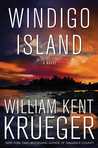
Windigo Island by William Kent Krueger

Windigo Island (Cork O'Connor, #14) When I first read William Kent Krueger’s Cork O’Connor series, Iron Lake, I was struck by the coldness between whites and Indian populations in Minnesota and admit to finding it off-putting. Krueger’s latest novel is fourteenth in the Cork O’Connor series, and the coldness between the races is still there, but I have a completely different perception of it. Now I feel so grateful to Krueger for pointing out such a failing in our management of race relations that the treatment of Indians on reservations and off is still a hideous blemish we have to confront every day in parts of our country. Indian attitudes should be cold. It would be a miracle if they weren’t.

Krueger gives us a window into a world many of us will never experience firsthand, shares words, customs, traditions, and details of Indian life that can be mined for the underpinning of Indian heritage and culture. But he also shares his clear-eyed view of what our country looks like—both physically and psychically—from the waterfront in Duluth and waves breaking on the shores of Lake Superior’s rock-strewn islands to the inside of a home for runaways and a dinner table laid for guests in an Indian home.

In this installment, Krueger brings us to North Dakota where some Indians are working to preserve a landscape that is threatened by oil companies dedicated to oil retrieval in the Bakken Formation through the process of fracking. As it turns out, the worthless land the government gave to the Indians way back when happens to be right on top of the Bakken formation which has emerged as one of the most important oil formations in the United States. This must be God’s little joke on the white folk, though I’ll bet the reservation Indians see precious little that will benefit them and a whole lot more that won’t.

Besides this important piece of information, Krueger also shares the history of child prostitution on the Great Lakes near and around Duluth, or what is sometimes called the human trafficking of young girls, many from differing Indian tribes and reservations that were all shoved together at some point, and which now experience gang or tribe-on-tribe violence similar to an inner city history of interracial gang warfare.

Krueger peoples this modern history with realistic characters including the loving and generous children of lawman-turned-private investigator Cork O’Connor. Though O’Connor himself has a tendency towards hard justice, his children exhibit the gentling influence of their tribal blood and the Indian tradition exemplified by the close family friend “Uncle” Henry Meloux.
"In every human being, there are two wolves constantly fighting. One is fear, and the other is love. The one which will win is the one you feed."

Uncle Henry is closing on 100 years old, though no one knows for sure. He is of the Anishinaabeg Tribe, or what is sometimes called the Iron Lake Ojibwe. He lives alone in a cabin in the woods by a lake and is considered by his tribe members and many others to be an elder of enormous moral understanding and weight. His thinking is elliptical and his pronouncements often indirect, carrying a hard-won wisdom that puts one in mind of great Buddhist leaders, signaling an inclusiveness in the circle of life that is not typical of "the white man."

Krueger introduces a rich cast of characters that seem to have their basis in real life. Sometimes Cork’s twenty-something daughter Jenny seemed not to grasp the menace of the situation in which her crew found themselves while journeying to find men responsible for holding captive some young girls, but she was wily and careful and was forced into action by the end. I tend toward Cork’s end of the spectrum of justice dispensation, but we always need someone questioning those choices.

Krueger’s series gives us a very interesting look at the modern Midwest, in all its glorious dishabille.


You can buy this book here: Shop Indie Bookstores

Sunday, June 22, 2014

I am Pilgrim by Terry Hayes

I Am Pilgrim: A Thriller British-born Terry Hayes’ filmography runs to nearly twenty films. Perhaps best known in the U.S. for Mad Max Beyond the Thunderdome, he was also script writer and producer of Dead Calm, the horror/thriller that featured a couple alone on a yacht on the Great Barrier Reef when murderers come calling.

Now, Hayes' debut novel is an espionage wunderkind that was originally published in 2013 in England by Bantam and Transworld Press and came out this summer in the U.S. Re-released in hardcover this year by Atria and in audio by Simon & Schuster, it is making a huge splash in the summer reading market.

I just finished two nonfiction spy histories: Ben MacIntyre’s new A Spy Among Friends about spies in Britain and Kai Bird’s The Good Spy about American spies. I thought I was done with spies for awhile, so imagine my surprise to discover Hayes writes about espionage as well. But Hayes’ operative, code-named Pilgrim, is run straight from the White House (!) by The Whisperer, an old White House insider who appears to be dying, maybe from throat cancer. (?)

Hayes luxuriates in the ability to tell detailed backstories about all his characters, for a novel has the potential to have far more of everything than a screenplay. Like many mysteries and thrillers, this novel has the de rigueur two threads: A young white lesbian is killed in New York City and a terrorist gets mujahideen training in Afghanistan. What is absolutely gob-smacking is how the two threads actually come together in Turkey.

The proof that a U.S. billionaire was murdered in Turkey has the most far-fetched daring inter-continental plot solution--even the characters themselves are skeptical. But brazen and ingenious it is, and one has to hand it to Hayes. He brings his understanding of film to the world of fiction.

Perhaps I am a little risqué for some folks, but I would suggest this story is a young adult title. The level of detail of actions and motivations would make it exciting reading for teens. There is some gun violence, but bodily harm is mostly done to Pilgrim himself. Since Pilgrim is describing it, it’s more interesting than fearsome. The good guy Pilgrim does some bad things, but his heart is in the right place. Even the bad guy, undeniably evil, has reasons for what he does. There is one person, however, that is bad through and through. That is the killer of the young woman in New York.

The story solves both crimes, but one killer escapes to kill another day, which must be why this book is called Pilgrim #1 on Goodreads. The first book of a series, it is sure to garner a large and enthusiastic audience. I listened to this on Simon & Schuster audio, read very capably by Christopher Ragland, and was provided with the audiobook by Simon & Schuster in exchange for an honest review.

Thriller readers everywhere are sure to be entranced with this finely constructed mystery and I immediately recommended the title to members of my family who enjoy thrillers.


You can buy this book here: Shop Indie Bookstores

Sunday, January 26, 2014

Badluck Way by Bryce Andrews

It feels a privilege to read this acutely observed and deeply felt memoir by a thoughtful, literate, conservation-minded ranch hand in southwest Montana. He worked the Sun Ranch in the upper Madison River Valley of southwestern Montana only one year but did enough thinking for far more than that. In his early twenties, Andrews had experience working summers on a ranch outside of Billings, Montana, and was ready when he saw an advertisement for a six-month position as a Grazing Coordinator and Livestock Manager at the Sun Ranch.

Sun Ranch was centered in an important wildlife corridor in the Greater Yellowstone Ecosystem. Wolves had been reintroduced to the area, and there were large populations of elk as well as grizzlies, lynx, mountain lion, and wolverines. The idea was to integrate ranching into a functional natural ecosystem.

I have mixed feelings about cattle ranching in the west and Andrews does, too: “Often, I was tempted to construe ranching as nothing more than a protracted act of violence.” The fences needed to manage cattle are barriers to free-ranging wild herds, and cattle, managed properly or not, can cause enormous damage to a fragile landscape. But Andrews allows us to consider all this while he shares with us reminiscences that hallow our history in the west: he was a cowboy in the modern day.
“Day followed wild day, and over time amounted to a process of seasonal change. Immersion in that constant cycling was the ranch hand’s highest privilege.”

Wolves play an important part in this narrative. Since reintroduction, they had settled in the Madison River Valley, and one pack in particular, The Wedge Pack, lived above the ranch.
”The Wedge Pack, like most others, was a family unit centered on a single breeding pair. Aerial surveys had reported that two consecutive litters of pups had been successfully raised in the foothills and steep valleys behind the Sun…The ranch had been lucky last year. The wolves had stuck to killing elk, and the cattle had come home fat at the end of the summer.”

But the summer of 2006 was different, and the wolves changed up their diet to include Angus beef rather than just elk. Damage to the herd was responded to in the time-honored way: with a rifle. The revenge-killing of an alpha male wolf seemed to cut both ways for Andrews. Concerned with preservation of the wilderness and wildness of the area, he deplored the necessity of killing the predators in the ecosystem but recognized the necessity for it. “Like the Wedge Pack, we did our best to make a living from a hard place.”

Andrews is a wild thing also, like those wolves he talks about.
”Every night, at or after sunset, I ran the benches and hills of the Sun Ranch. I’ll admit I was looking for trouble. When I saw deer or elk from a long way off, I tried to sneak up on them. Using the features of the land—little dips and swales I had never noticed before—I did my best to get close.

It was wicked, feral fun. I drew near herds of deer, elk, and antelope, sometimes crawling on my hands and knees to stay hidden in the sage and grass. When the animals saw or smelled me, I sprinted toward them, scattering them to the horizon. They always left me in the dust, alone and smiling under a many-colored sky.

I chased everything I could—coyotes, jackrabbits, and a badger who unexpectedly turned to fight. Once, in a moment of extremely poor judgment, I ran a black bear up Moose Creek and then looked over my shoulder all the way back down. There was never any malice in it, only simple joy. I loved to feel the wind, lay claim to my landscape by crossing it, and watch the deer outpace me before disappearing in the rising night.”

Andrews managed to find a job that ordered the priorities in his life: he could be in places and do things he really enjoyed and that matter to him and the larger world. He stepped away from the noise of our everyday lives to observe, think, and write. “I am living at the center of my heart’s geography.” We are lucky he took the time to share his findings and remind us of cowboys and the wildlife corridors left in our hearts.

Marcie Stillman conducts a KUOW radio interview with Bryce Andrews that allows us to understand his motivations: “I was my best self when I was working out-of-doors.” “That landscape had beauty and brutality as its two defining qualities.”

The publisher's website has two short videos of Bryce Andrews talking about his work and his reading. I received a galley of this book from Netgalley in exchange for an honest review.


You can buy this book here: Shop Indie Bookstores

Friday, November 15, 2013

The Flamethrowers by Rachel Kushner

Hardcover, 383 pgs, Pub Apr 2nd 2013 by Scribner, ISBN13: 9781439142004, Lit Awards: James Tait Black Memorial Prize Nominee for Fiction (2013), Women's Prize for Fiction Nominee for Longlist (2014), Folio Prize Nominee (2014), National Book Award Finalist for Fiction (2013), International DUBLIN Literary Award Nominee (2015)

I had a second opportunity to review this title and my second attempt was published in the online journal Avatar Review. The link is here. Below was my first attempt after reading the novel in 2013.

-----------------
”The flamethrowers with their twin tanks, and their gas mask were Sandro’s favorite of the assault company dolls. The asbestos sweater and balloon pants and gauntlet gloves you could outfit them with so they could not carbonize when they set a woods on fire. A woods or bunker or enemy machine gun nest, depending. A supply line of trucks or a laddered stack of bodies, depending.

The flamethrowers could have been from a different century, both brutal and ancient and at the same time horribly modern. The flame oil in the twin tanks they carried was five parts tar oil and one part crude, and they had a little canister of carbon dioxide and an automatic igniter and a belt pouch with spare igniters. The flamethrower was never, ever defensive. He was pure offense…a harbinger of death…

But then his father told him the flamethrowers were…cumbersome and heavy and slow-moving targets and if they were ever caught they were shown no mercy. That’s not a thing you want to be, his father said…”

This astonishing meditation on art, rebellion, wealth creation, love, truth, and friendship kept me rapt throughout, but I am not going to lie to you. This is a big work, with lots of moving pieces, and it takes more time to process than others might. I’m not sure I got it all. If art is meant to inspire, to challenge, or to change the viewer, this work succeeded on all counts.
“Difficult to even talk about…I feel changed. Like, say my mind is a sweater. And a loose thread gets tugged at, pulled and pulled until the sweater unravels and there’s only a big fluffy pile of yarn. You can make something with it, that pile of yarn, but it will never be a sweater again. That’s the state of things.”

It is the late ‘70s. Reno is a young drifter with pretensions to art. She lands in New York and hangs at the edges of a group whose composition changes with the inclinations of Sandro and Ronnie. Sandro, Ronnie, and Gianni, the men Reno spends her time with and learns from, are central but elusive figures in this drama. Sandro’s father, the man who teaches Sandro about how life really works, is also a central but elusive figure.

Reno is, literally and figuratively, a printer’s reference, a human Caucasian face against which film color corrections could be matched to a referent. Subliminally viewed, if at all, her face might sometimes leave an afterimage. Only filmmakers and projectionists knew of her existence. “Their ordinariness was part of their appeal: real but unreachable women who left no sense of who they were. No clue but a Kodak color bar, which was no clue at all.”

When we first see her, Reno is riding a fast motorcycle in the desert and later photographs her tracks. Sandro elevates her work by calling this a type of ‘land art.’ She wipes out, smashing the motorcycle, but her efforts lead to a larger success in setting a land speed record—more sport than art. She travels to Italy to promote the bike she rode in the Southwest desert.

I have seen references to this as a “feminist” novel. It would not have occurred to me to say that, though there is some movement of a young, untried woman towards a greater understanding of her place in the world who then begins to take charge of her freedom. She also has a glimpse, towards the end of the story, of the men in her life not merely as simple stock images or disposable short outtakes of a larger film. “Cropping can make outcomes so ambiguous…” These are men with all the feelings and dreams, histories and futures of men and she is growing up.

Reno as a character is particularly attractive in that she is able, in the course of this novel, to go off without a lover, rent an apartment on her own, and ride a motorcycle about New York City. This may be the dream of any young person anywhere: it is not feminism, but life. But what held me were the ideas about art, about looking, about believing, about making the effort.

Reno’s friend Giddle believed herself to be a performance artist of sorts, but somewhere along the way she lost the thread, the point. Sandro made empty boxes. Ronnie photographed beat-up women. Reno made short films of street life. The art created by these folk, and the folk themselves when we first meet them, are stock images, referents for life. But by the end we have had growth and all are in the process of becoming.

Sandro’s father has a critical role in this novel. The backdrop of his powerful and moneyed world of making tires for racing vehicles represents the old guard against which the artists and Italian Red Brigade demonstrators were rebelling. Yet he was a rebel in his time. The father taught Sandro important truths about the world: that there is evil and greed; that power matters; that guns don’t always fire as advertised; that Flamethrowers can be clumsy targets rather than objects of envy. Flamethrowers’ fire often ran back up the hose and consumed the perpetrator.

Kushner held me spellbound with her descriptions of New York’s art scene in the ‘70s. Using Patti Smith’s National Book Award-winning Just Kids as a referent, we get a similar feeling of a young, edgy, trial-by-error art scene. I can’t help but wonder how closely she captured the riots in Italy in the same period.

Something happens in this masterwork that is all internal. It left me looking about myself, contemplative, silent. The poet Marianne Moore wrote that “the deepest feeling always shows itself in silence.” I reread most of it to see if I could untangle it in my mind. I got bits and pieces straightened, but ended up with more questions. But to me this is a sweet confusion. We don’t often have the opportunity to enjoy works of this quality.

A lot of this book is concerned with film. I can imagine this book as a film done in the European tradition—lots of long, slow panning shots and minimal dialogue—following the storyline, such as it is. Would be as confusing and absorbing as the book, I imagine. Kudos to Kushner.


You can buy this book here: Shop Indie Bookstores

Thursday, June 13, 2013

Children of the Jacaranda Tree by Sahar Delijani

Children of the Jacaranda Tree On the eve of the 2013 presidential election in Iran, Shahar Delijani invites us to look at what past elections have meant for three generations rooted in post-revolutionary Tehran from 1983 to present day. This is a novel that reads like a memoir, tracing the experiences and thoughts of Iran’s disenfranchised and dissident population. If ever you wondered what it must have been like to be a part of Arab Spring as it played out in massive demonstrations in Tehran, this is one woman’s attempt to share that experience and its roots in Iranian society and its diaspora.

From the opening scenes of a prison birth to the later reminiscences of a woman receiving someone else’s clothes from prison officials after the death of her husband while in custody, this is inflammatory stuff, heart-breaking and heart-hardening stuff. The effect of events like these on families and personalities is charted and surmised, each generation seemingly adding to the ranks of the disaffected. By this count the opposition to the government in Tehran will never go away but instead grows daily. Conversations among the psychologically traumatized characters in this novel echo what was heard in Beijing after the Tiananmen Square demonstrations. This kind of disaffection isn’t going to evaporate without boiling first.

I am not as familiar with customs in the Middle East as I am with those in Asia, so I find the fictional personal interactions recorded here fascinating, supposing that this records faithfully a middling wealthy and cosmopolitan slice of Iranian society. And, though it doesn’t necessarily make good novelistic technique, I enjoyed reading of young male/female relationships. I am struck with the conservatism on one hand and the liberality on the other.

This is Delijani’s debut novel, and while she still has room to grow as a novelist, this book illustrates storytelling. I don’t think the two things are necessarily the same. I never felt involved in this story, but watched from a distance the interactions between characters. Surely there are overlaps in customs, feelings, and intentions, especially among Iranians displaced to the West, and yet I felt a great distance. This could be age (hers or mine or the characters'), or it could be one of the stages of cultural familiarity: Geert Hofstede, Dutch guru on the dimensions of culture, once posited that people go through stages of recognition when encountering another culture. At first, without our own cultural markers, we feel disoriented and distant, as though “we are different from them.” Gradually, as we become more familiar and discover that these are humans, too, we begin to think “we are all the same.” As familiarity grows into deep knowledge, we move back to “we really are different.” I think I am still at Stage 1 with Iran.


You can buy this book here: Shop Indie Bookstores

Friday, March 29, 2013

Ordinary Grace by William Kent Krueger

Ordinary Grace
“It seemed to me a good day to be dead and by that I mean that if the dead cared no more about the worries they’d shouldered in life and could lie back and enjoy the best of what God had created it was a day for exactly such. The air was warm and still and the grass of the cemetery…was soft green and the river…reflected the sky [like] a long ribbon of blue silk…”

The thirteen-year-old narrator of William Kent Krueger’s new mystery juxtaposes death and bucolic beauty, but we know the dead can’t see. Set in a small town north of everywhere in America and south of Canada, this is a tale of an extraordinary summer in an ordinary town in Minnesota--the summer when everything seemed to come untethered and God drew His awful grace (vengeance?) like a sword. There is always something dark or threatening about mysteries by William Kent Krueger. It has to do with half-hidden resentments that may flame into retribution, or ugly prejudices on the lips of town folk or law keepers.

Krueger has created characters that sharpen our instincts: Doyle, the small town cop with no more sense of right than a hormonal teenaged bully; Redstone, the tall, taciturn Dakota whose greatest compliment is that one “might have Sioux blood”; the WWII veteran-turned-preacher who had spent all his pride and was left only with generosity. Our narrator, Frank, is impulsive and on the cusp of discoveries about life. He may not be entirely reliable.
“Happiness…is only a moment’s pause here and there on what is otherwise a long and difficult road. No one can be happy all the time. Better, I think, to wish for…wisdom, a virtue not so fickle.”

Imagine an aerial shot of three boys pedaling their bikes as fast as they can along a country road in high summer. We can’t hear the buzz of insects in the fields, nor the frogs burping along the river, but we can see the boys. We don’t know where they are going, but we imagine the excitement of the day’s first swim, or the urgency of finishing a tree fort, or the need for an ice cream soda at the drug store. Then we notice a car speeding behind…in pursuit or accompanying the boys, we do not know. Now we begin to suspect something may be wrong. They are all going too fast.

Krueger continually confounds our expectations of “ordinary” by placing it next to extraordinary: high summer small town in southern Minnesota, a fish-filled river, a clergyman’s nuclear family. But there are flaws in the picture: the daughter, a ravishingly talented musician, has a hare lip. The world-famous pianist teaching her lost his sight in the war. His sister is deaf from birth. No wonder we don’t trust the sunshine. There is darkness here and wisdom has a terrible price.

This engrossing novel is a great success for Krueger, who is best known for his Cork O’Connor mystery series set in northern Minnesota.


You can buy this book here: Shop Indie Bookstores

Tuesday, May 22, 2012

A Fistful of Collars by Spencer Quinn

A Fistful of Collars


One cannot help but wonder how long Spencer Quinn can go on with a series featuring a canine narrator. Each time I open one I expect this will be his swan song, but the author simply doesn’t flag--each new book in the series is as entertaining as the last! He manages to inhabit the minds-eye of a dog looking at human habits and create a voice for what a dog may think. If you imagine this cannot be funny for the fifth time, think again. Quinn has done it.

This is perfect beach reading. It puts you in a good mood, ready to laugh. It doesn’t take a lot of concentration to wonder how the pair, Bernie & Chet, are going to manage the investigations they get involved in. Bernie is perpetually broke; he keeps buying Porsches & wrecking them; and Chet tells us the background on each of the perps. He tells us things about them no self-respecting narrator would bother with: how they smell, for instance.

In this book, we are treated to a close-up of the film industry. Little Charlie, Bernie’s son, gets a speaking role! Which makes one think…Lassie and Rin Tin Tin were film stars…perhaps one day the name Chet will be in lights?!


This book is due to be released in September 2012. You can buy this book here: Shop Indie Bookstores