Showing posts with label Bloomsbury. Show all posts

Wednesday, July 11, 2018

Milk!: A 10,000-Year Food Fracas by Mark Kurlansky

Hardcover, 400 pgs, Pub May 8th 2018 by Bloomsbury Publishing, ISBN13: 9781632863829

Kurlansky is justly famous for his earlier works about Salt and Cod, among other things, so when I saw this 2018 Bloomsbury Publishing nonfiction about Milk, I was interested. I was particularly interested to see what he would say about humans consuming milk after infancy, when approximately sixty percent of the world's human population appear to lose their tolerance for and ability to digest lactose. Europeans, Middle Easterners, North Africans and some of the Indian subcontinent appear to lack a gene which shuts off production of lactase--an intestinally-controlled enzyme which digests lactose present in all milk.

In 2006 Cornell University's T. Colin Campbell published his thirty-year study on the eating habits of Chinese people called The China Study. The findings of Campbell's study blew me away, one of which was that consumption of milk products can cause osteoporosis in adults, a finding exactly opposite to what we have been told here in America. Kurlansky does not mention this startling information, sadly. But that study made me look closely at where the promotion of milk products was coming from—the industry itself, and lobbyists targeting government scientists, commercial attachés, and spokespeople.

Kurlanksy does remark on lactose intolerance briefly at the beginning and again in the section on China. He indicates that while there is a growing tolerance for dairy products gradually in China among the wealthier and more worldly citizens, it fights with the notion that the Chinese are genetically lactose intolerant. It may be that livestock was discouraged in a country which needed all possible land for food production, and that reintroducing dairy stimulates the production of lactase.

Kurlansky mostly elucidates the uses of milk in the part of the world that uses it daily, giving recipes that have survived the ages, showing some changes in those recipes over time. And certainly coincidentally but with a weird synchronicity he discusses breast-feeding throughout the world and throughout history. Breastfeeding has come and gone in popularity, with scientists in the past forty years generally concluding that until clean water and sterile bottles and low pricing for formula could be achieved throughout the world, perhaps breast milk was superior to any industrial formula.

It is now de rigueur to pump breast milk, offering convenience and nutrition. Pumping breast milk induces lactating mothers to produce more than they need, which has led to an oversupply. Some entrepreneurs have endeavored to sell soap made with breast milk; those selling breast milk ice cream in London found they couldn’t keep up with demand. Some sell breast milk on the internet to athletes who believe it makes them stronger. Some people buy it when they are ill, believing it has medicinal qualities. Some testing internet purchases found 10% of the time cow’s milk was mixed in, while 75% was contaminated with bacteria and/or pathogens.

It turns out that yogurt made from yak milk makes that made from cow’s milk seem boring and tasteless due to the high percentage of fat in yak’s milk. Consumption of milk in the United States has declined almost 40% since the 1970s, and now large scale industrial farming is the key to survival of the industry. At the end, Kurlansky takes another quick trip around the world to look at how dairy farms manage and what problems they are encountering now, including some of the profit calculations small producers are making.

Kurlanky is a wonderful writer of nonfiction who manages to take on big subjects and make them intelligible to the non-specialist. If you are looking for specific information, this book may simply be too diffuse, but Kurlansky is a wonderful host for a general reader.


Wednesday, May 16, 2018

Dreamland: The True Tale of America's Opioid Epidemic by Sam Quinones

Hardcover, 384 pgs, Pub Apr 21st 2015 by Bloomsbury Press (first published April 15th 2015), ISBN13: 9781620402504, Lit Awards: PEN/John Kenneth Galbraith Award for Nonfiction Nominee for Shortlist (2017), Los Angeles Times Book Prize Nominee for Current Interest (2015), National Book Critics Circle Award for General Nonfiction (2015)

The spectacular public service reporting Sam Quinones does in this nonfiction is so detailed and many-faceted that it left me feeling a little voyeuristic, not having been visited by the scourge of opioid addiction myself. Good lord, I kept thinking, so this is what we are dealing with. I knew something was different, I just didn’t have any conception of the size, scope, method, and means of this problem.

Quinones starts his story in the early 1980s when the first ranchero Xalisco marketers came up from Mexico with an innovative method for just-in-time drive-by selling of drugs to rich white kids in the suburbs. They explicitly avoided cities and black people because they admitted they were afraid of them, their violence and their gang activity. Besides, the thinking went, blacks never had any money. They’d just as soon steal from a dealer as pay him. The white kids had money and wanted convenience above all.

At almost the same time, and a cultural habitat away from small-time drug dealers of black tar heroin from Mexico, a drug company owned by the Sackler medical empire released an opiate derivative in pill form meant to alleviate pain. Early on, it is possible that creators, marketers, and prescribers of this plague did not know what they had unleashed. But within a couple of years, it is difficult to avoid the conclusion that great numbers of people within and without the company sold the product in full knowledge of its wicked potency and addictive properties.

Quinones has been researching and reporting on this topic for a couple of decades, and lived in Mexico for ten years, observing the supply-side. Before having a comprehensive understanding of the subject, Quinones thought the heroin problem began with U.S. demand for drugs. After researching the situation in the heartland United States, he has decided that our problem now with heroin and fentanyl overdoses was paradoxically caused by a huge supply of opioid pills, prescribed by doctors in legal clinics, and condoned at every level of society and government in our country.

The story Quinones shares is un-put-down-able and truly remarkable, particularly his discussion of the marketing techniques for black tar heroin used by the small farmer-seller systems first set up by residents of Xalisco. Their method of growing-packaging-selling expansion into the heartland of America should make us sit up and pay attention. Ground zero for the meltdown of middle America is identified by Quinones as Portsmouth, Ohio, a middle class town at the center of a web of major cities like Cincinnati, Cleveland, Louisville, Indianapolis, Pittsburgh. The first known vector of the opioid infection was an unscrupulous doctor who overprescribed pills, knowing they were addicting his patients. Aided by ordinary well-meaning doctors who listened to marketing spiels by the drug makers, and who believed the pills to be non-addictive, the infection spread rapidly. Quinones tells the tale as it unfolded, involving Medicaid scams and cross-state purchases and sales.

What Quinones tells us gives us lessons for many other supply-side problems (marijuana? guns?) we may face in our society, now or in the future. When asked in an interview why restrictions on Class A prescription pills or opiates of any sort would produce the better outcomes, Quinones points out that when prohibited liquor was once again allowed to be sold openly, it was classified as to strength and sold differently. He warns that we are rushing to sales of marijuana with potency levels unknown fifty years ago and may wish we’d instituted some restrictions or controls before it becomes socially acceptable.

This nonfiction is dispassionate enough to allow us time to adjust our thinking around the problem of young people—entire families, really—losing their place in a productive society, with almost no way out. Now, with the recognition of the problem being forced upon our politicians, teachers, medical personnel, and law-enforcement officers, some changes are being instituted which may help after the fact of addiction, never a good time to try and solve a problem. With discussion and buy-in by ordinary citizens it may be possible to attack this problem before it begins.

There are at least seven interviews with Quinones free on Soundcloud, ranging in length from 15 minutes or so to an hour and a half. You have to hear some of these stories. It's mind-blowing. I listened to audio version, very ably read by Neil Hellegers, and produced by Bloomsbury. It is a must-read, must-listen.


Sunday, September 17, 2017

Bitch Doctrine: Essays for Dissenting Adults by Laurie Penny

Hardcover, 288 pages Pub August 1st 2017 by Bloomsbury USA ISBN13: 9781632867537

British journalist and opinion writer Laurie Penny is eminently quotable. She has enormous facility with a phrase, but also goes for big ideas. She is therefore doubly dangerous. If words are power, watch out for this keg of dynamite. It is only difficult to see where her experience and confidence comes from. She is thirty years old but sounds like a scarred and ancient sage in some kind of time warp.

This book is a collection of essays reworked as themed chapters in a discussion of gender, economic, and social equality. Both she and I are amazed we are back at this place, talking about gender discrimination in the workplace.
“Women make up over 50 per cent of graduates, and tend to match or outperform men in any test where intellect and aptitude are the only measures of success—school examinations, for example. But whenever large numbers of men are involved in the hiring or selection process, women fall behind.”
I actually have no idea whether this is objective fact, especially in math and the sciences, but close enough. You get the point. It would be laughable, and used to be, behind closed doors, or behind hands if men were present. But now we don’t feel like laughing anymore and are tired of this argument about “objective merit.” I like Penny’s phrase, “When you’re used to privilege, equality feels like prejudice.” Welcome to the melting pot, white men.

Penny is hilarious on 'The Tragedy of James Bond:'
“The experience was like having your forebrain slowly and laboriously beaten to death by a wilting erection wrapped in a copy of the Patriot Act: savage and silly and just a little bit pathetic.”
But before you roar your displeasure over her attack, she freely admits watching the films are a guilty pleasure. And she adores Daniel Craig, “who appears to be about as unsexist as anyone who has worked in Hollywood for twenty years can be.”

She talks of how Lena Dunham in “Girls” never was and never could be the voice for all women, and how men’s experiences and performances are not expected to speak for all men. She speaks of trigger warnings, which even friends of mine have decried as excessive:
“Trigger warnings are fundamentally about empathy. They are a polite plea for more openness, not less; for more truth, not less. They allow taboo topics and the experience of hurt and pain, often by marginalized people, to be spoken frankly. They are the opposite of censorship.”
I could quote this woman all day long. She writes extremely cogently, answering ideas that have been floating about your head and your world and have never been adequately articulated. Even if you don’t agree, her point of view has an inexorable logic that in her snarky tone has a bell-like clarity.

Penny had her struggles with gender identity, and comes out on the side of a spectrum of sexuality: “I consider ‘woman’ to be a made-up category, an intangible, constantly changing idea with as many different definitions as there are cultures on Earth….Gender is something I perform.” She’s way ahead of me here. I have not faced her struggles and had not considered her dilemmas, but I have heard of them now and I must consider that for a certain portion of the human race, gender is not as clear cut as it seems.

She speaks of violence, and the rape culture, and the Liberal Limit—the exhaustion of liberals with the speed and constant drumbeat of change. A ten-point 5-page discussion of Free Speech—what it is and what it isn’t—doesn’t really address hate speech. If she considers it at all it is under point 5: “Freedom of speech does not mean that all views are of equal worth.” This almost casual dismissal of one of the hardest things to reconcile about when free speech works for all of us and when it doesn’t weakens her argument and makes her seem the young upstart she appears to be, rather than the old soul she will become. Not completely finished cooking yet, then. We have more to look forward to.

Laurie Penny is a very impressive writer and likable. When she added an Introduction published after the election of Donald Trump to the American presidency, she speaks of her impressions:
“..the lacquered, lying sack of personality disorders...made no attempt to hide his vision of the entire damn world as the next acquisition in his dodgy property portfolio.”
We need this woman. She amuses us, commiserates with us, and leads us. Her work is on a level of language virtuosity with Matt Taibbi, much-vaunted American political journalist whose snark reaches the level of art.


You can buy this book here: Shop Indie Bookstores

Monday, April 3, 2017

White Rage: The UnspokenTruth of Our Racial Divide by Carol Anderson

Hardcover, 256 pages Pub July 27th 2016 by Bloomsbury USA (first published May 31st 2016) ISBN13: 9781632864123 Literary AwardsNational Book Critics Circle Award for Criticism (2016)

This is a completely enraging book. Anderson basically fits her material into five chapters, beginning with the aftermath of the Civil War through President Obama’s presidency. She is pointing out the ways that America has been granting rights to all its citizens with one hand while taking away the rights of some with the other. She has it all copiously documented, which is useful because she tells us some frankly unbelievable things: did you know 1) in the early part of the 20th Century black folk were arrested and prevented from leaving the South when they faced discrimination in work and housing because they constituted the “workforce”; and 2) in the 1980s two L.A. gangs, the Blood and the Crips, were sold drugs and weaponry by anti-Sandinista forces funded by our own C.I.A., beginning the massive drug war the country has been struggling with since.

These are just two examples in a book entirely filled with examples of the way rights for blacks have been curtailed in the United States, since its founding. And it continues to this day, with new abridgments to rights granted under the 1965 Voting Rights Act in 2013, when the Supreme Court ruled in Shelby vs. Holder that states with the longest histories of voting discrimination no longer need to have the federal government approve voting changes made prior to elections. Since then, seventeen states had new voting restrictions in place for the first time for the 2016 presidential elections, including strict requirements for government-issued I.D.s, cutbacks on early voting, and new difficulties in registering to vote or being removed from the voting rolls without notification.

Besides all that, the disparity in funding for public schools means that districts with primarily black populations have less, sometimes far less, funding than schools in districts with primarily white populations, all perfectly "legal" when school districts are funded by taxes. Discriminate on lower education, higher education, wages, and housing and yes, black districts will have fewer taxes, and the cycle is perpetuated. I am just understanding the pervasiveness of “racism with plausible deniability.” Anderson’s persistent and careful documentation of the continual challenges the states put in the way of implementing the Supreme Court decision Brown vs the Board of Education show us the way laws can be undermined by new oral argument, written decisions, and execution.

When growing up I was not always aware of the sometimes subtle ways—and even sometimes big, national, loud judicial and congressional decisions—that constrained African Americans, preventing them from realizing their full potential, but I knew enough to be shocked when President Obama was elected. Even without the consciousness I should have had, I knew enough about America’s racism to find it extremely unlikely that people would put aside their prejudices long enough to elect a bi-racial man, even if he did graduate from Harvard Law School. I am happy to be proved wrong on those two elections, but I am not so happy as I continue to learn the ways one’s rights can be infringed regardless of how we vote and the ways the attacks on rights just never ends.

This is an important, even necessary book. For those without the background in the ways black lives have struggled, it is eye-opening. For those who already know the background, it has lots of references altogether in one place, and an extensive bibliography. This is another one of those recent books that seems like it should have been written fifty years ago. It probably was, with a different title. This has been going on an awfully long time, at least 350 years, though a book written earlier wouldn’t have had all the examples of how abrogation of the rights of African Americans is happening right now. This may go on until the end of time, so there is still a undeniable need for you to learn about it and work to stop it.


You can buy this book here: Shop Indie Bookstores

Tuesday, August 30, 2016

Hot Milk by Deborah Levy

Long-listed for the 2016 Man Booker Prize, this novel comes after a long history of successful poetry, novels, and screenplays by Levy, so we are primed to find it praiseworthy. And it is, but she very nearly tips us into the deep, endlessly cycling the trauma of caring for someone apparently suffering a psychosomatic illness. To make it thrilling, Levy throws in parallels to Europe’s debt crisis and America’s pushy Big Pharma colonization. If you take the cover story as what Levy was trying to convey, you miss the beauty of her satire and the humor in her (wo)man-made disaster.

Sofia Irina is a half-British half-Greek anthropologist, trained to look for cultural memory which links the past to our present attitudes and actions. She quit working on her Ph.D. ostensibly to care for her mother, who is unable to walk. No explanation can be found for the mother’s malady so mother and daughter travel to Spain in hopes a specialist there may be able to elicit a cure.

The Doctor they have contracted with in Spain is a traditionalist who eschews Big Pharma, represented by a handsome gnat of a young man who seeks to discredit the Doctor’s carefully staged proofs that the illness Sophia’s mother suffers are in her head. The Doctor has a sexy Sunny vodka-swilling daughter who works with him and represents Spain’s youthful disdain for the old ways. It goes on like this, each character representing something larger than themselves, culminating in Levy's masterpiece: a luscious blond German autocrat attractive to both sexes who manages to import old fabrics from China and export them again at a markup after she adds her skillful embroidery.

An early scene which derailed a fine reviewer was the one where Sophia, delighted to find herself by the beach in sunny Spain, swims far out only to be stung by the swarms of medusa jelly-fish that have become a menace due to overfishing. (The birthplace of Medusa is Greece.) She runs back to shore to be treated for the painful stings, only to realize late that her bikini halter has broken and she is topless, jiggling insanely as she stomps about with the pain.

Besides the enormous fun we have with Levy’s impersonation of financial crises, there are other themes Levy raises about an adult daughter caring for her mother in illness. Again and again in the course of the novel, we are pointed to the notion that some people would never consider doing things that are not to their own advantage. This notion is first explicitly stated when Sophia visits her estranged and happily remarried father to ask for financial assistance or, at the very least, moral support for her efforts to care for his first wife. What some might consider his debt or obligation, he refuses to honor. His new young wife snorts with derision that he would consider doing anything not to his advantage.

Women—wives, mothers, daughters, sisters—often do things not strictly in their best interests. They do it out of love, usually, or say they do. But when one is the head of one’s own household, one is responsible for oneself—to oneself—to manage, to persist, to succeed. How one succeeds is not always by putting oneself first. [I might point out that people who put themselves first in every instance are the most unbearable and uncivilized bores, to say nothing of the possibility of culpability in a large societal context.]

There is more in this novel: forbidden love and lustful sex, fabulous deep white cotton sheets from Berlin, blue embroidery thread that spells out a mistaken and potentially lethal message, a pregnant white cat and a chained dog who howls whether or not he is leashed. I don’t want to take all the fun out of this novel by speculating on possible meanings of these for readers. Keep your eyes and mind open for the delights this novel offers and try not to be frustrated with the air of post-adolescent confusion. The claustrophobia of a strictly line-by-line reading might lead one to underestimate what Levy was attempting. If the stage is set for a close (re)reading, I think you will find yourself instead enjoying Levy's facility with keeping many balls in the air at one time, once again earning our respect.

I was helped in understanding this novel by many reviewers at the online site Goodreads, including one in particular, whose great insights pushed me to examine my initial lackluster evaluation more closely.


You can buy this book here: Shop Indie Bookstores

Thursday, August 18, 2016

The Drowned Detective by Neil Jordan

The first fifty pages of this mystery were perfectly composed to trap the reader with its sense of menace and uncertainty. The tight construction and lack of explanation forces the reader to contemplate coincidence, involving us completely in the drama unfolding. A private investigator living in an unnamed Eastern European country is trained to look for inconsistencies and clues wherever he looks, and when he discovers a man’s cufflink in his wife’s handbag, the lives in his circle of family and colleagues are thrown into disarray.

There is far more to the story, including a parents’ search for a girl gone missing years ago and who, in an old photograph, is the same age as the detective’s daughter. Petra. That is her name. The daughter. Whose daughter?

Jordan draws us deep into the complex turnings of a mind under duress, circling back time and again to images and memories that haunt the subconscious. It is a fabulous examination of how the mind rids itself of a terror that it cannot examine directly. Supernatural elements are introduced, but somehow they seem perfectly at home with what is happening on the streets and in the opera houses of this European city on the edge of civil implosion and external invasion.

Neil Jordan’s work has been memorable since his first collection of stories, Night in Tunisia, won the 1979 Guardian Fiction Prize. Most everyone will remember his film, The Crying Game, which won an Academy Award and a BAFTA. His other work has been likewise critically acclaimed. Published this year by Bloomsbury, Jordan’s latest detective novel puts the genre to shame by the intensity of its writing and the closely written examination of a marriage under pressure. The language makes it cinematic, atmospheric, and painfully realistic.

This is a short novel, though the language makes one want to pause. Writers anxious to see a master at work could do worse than read this for what it shows about brevity. One doesn’t need more words to get one’s point across. One needs what this man has.


You can buy this book here: Shop Indie Bookstores

Monday, June 1, 2015

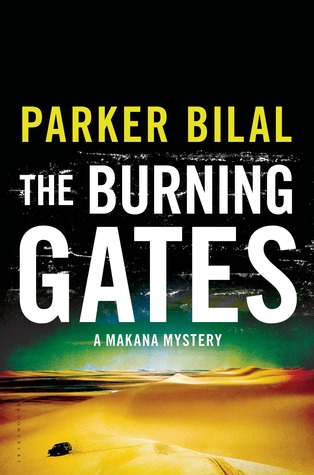
The Burning Gates (Makana #4) by Parker Bilal

London-born, Spain-based Parker Bilal is on my short list of great thriller writers writing today. His Makana Mystery series features a private investigator originally from the Sudan and now working in Cairo. Bilal gives us all kinds of atmosphere, politically-relevant motive, morally-complex characters, and a beating heart. His writing is blessedly free from idiom and extraneous storylines—the exotic setting and complexity of his main character’s life is enough to keep us off balance and searching for familiar ground.

In this installment, U.S. government contractors have gone off the reservation in Iraq to pursue a former high-ranking military official from the old Iraq regime who appears to be profiting from his theft of Kuwaiti ‘war spoils’ which was the impetus for U.S. involvement in the First Gulf War. It is now 2004, and the Egyptian political scene is chaotic while private investigator Makana wends his way between bribe-takers, informants, and status-seekers, seeking justice.

We get a street view of Cairo’s neighborhoods as Makana does his rounds, and have the opportunity to see how Cairenes operate day-to-day. Best of all are characterizations of some of the less wealthy inhabitants of the city: we see where they live, how they live, what they think, and how they eat. Cairo has always been a cosmopolitan place. Its location in the heart of the Middle East give it a unique perspective, and the central character in this series, Makana, allows us to look at the region with an even further remove.

Parker Bilal is the pen name of Jamal Mahjoub, who publishes award-winning literary novels under his own name.


You can buy this book here: Shop Indie Bookstores

Monday, January 12, 2015

Can't We Talk About Something More Pleasant? by Roz Chast

Can't We Talk about Something More Pleasant? One imagines the word “cartoonist” should be paired with “funny,” and certainly I am accustomed to think “funny” when hearing the name Roz Chast. But not any more. The only thing I thought was funny enough to laugh at in this book-length cartoon about the decline of her parents was the part she did not draw out: the photographs of her parents’ apartment after they left it one day for a ‘trial run’ at an assisted living facility. For some reason, the 1950’s vintage ammonia inhalants placed prominently in the small bathroom medicine cabinet struck me as very funny.

But for the first time I felt Roz Chast and I could be friends in some alternate universe where our circles intersected. We are nothing alike, but she opened up her world and her thinking and her motivations in this piece and made herself very vulnerable. And I cannot help but find her experience and explanations interesting and worthy of respect. It is so different from my own way of thinking that I feel sure I could learn something—a new way to look at the world, perhaps. I have never understood the distance that adult children have toward their parents’ needs though I honestly think that is the norm, and this book went some way to giving me one person’s explanation.

In an interview with Terry Tazioli for the TV segment Well Read, Chast said she used her parents’ decline and death as a subject and she would encourage her own kids to do the same when her time comes because “it is all material.” She spent a couple of years agonizing over this stuff, and it is the agonizing stuff that makes the best material, for cartoons, for literature, for music or film. That this book made so many of the “Best Of” lists shows how it resonated with the public at large.

But it wasn’t funny, really. What kept me reading was not “wondering how it would turn out,” since I already had an idea about that, but how Roz was managing it. When Elizabeth Chast, Roz’s mother, was diagnosed with a digestive-tract fistula at 96, her sister, a retired R.N., recommended she “have the operation” to remove it. In my experience, this devil-may-care attitude towards the actual hands-on nursing care required in such a situation (even if it goes well!) is typical of the R.N.s I have known…it’s almost as though they have no idea, or so devalued is the day-in and day-out effort of recovery and of care in their eyes that they don’t even see it. How can that be?

Anyway, Chast's description of the assisted-living facility caught many of the weirdnesses therein very well. I always thought the door art was helpful for those folks who were looking for their rooms, though I suppose if you’ve forgotten your room number and floor, you’ve probably also forgotten what was decorating your door. But Chast caught the dinner-table cliquishness, the empty game rooms, the choking and falling over very well. That is not so funny for me. It is more awful than anything. I am not sure how things will go for my loved ones and me, but I’m not looking forward to that.

I admire Chast for putting together this book. She spent a few years with this problem and was able to digest it enough to share her experience. It wasn’t the “waste of time” so many of us fear. I argue that it is the point. Birth, love, death...these are the things that matter to all humans. Certainly when death comes there is opportunity for breakthrough moments of understanding and intimacy.

No one can want a lingering death, but that may be what we face. It is infinitely preferable to know what death can look like, so that we can make modifications to that outcome that if we can. My great aunt wanted to live to 102, and darn it, she did. But I know now I’m not going to set a goal like that. I’m sure it gives some folks the impetus to carry on, but I am not sure that carrying on is the point, exactly.

Chast provokes strong feelings in this book, and many of us that face these issues may very well handle them differently. The book began to resonate when Roz talked about her mother’s emotional distance, denial, and lack of empathy. It is important to remember that when we get to that place: the mental strength and indomitable will that keeps us independent may not be the same skill we need when we can no longer cope on our own. We need to start thinking again about others—what they are experiencing, and how best we can fit in a changed world. If you want others to care, you must care also, and show it.


You can buy this book here: Shop Indie Bookstores

Tuesday, May 6, 2014

The Residue Years by Mitchell S. Jackson

Hardcover, 352 pages, Pub Aug 20th 2013 by Bloomsbury USA ISBN13: 9781620400289 Literary AwardsPEN/Hemingway Foundation Award Nominee (2014), Hurston/Wright Legacy Award Nominee for Fiction (2014)

This spectacular debut novel was a finalist for the 2014 Pen/Hemingway Award, an award that went ultimately to NoViolet Bulawayo for her astonishing debut We Need New Names. Jackson has an earlier book of stories and essays called Oversoul: Stories and Essays, published in 2012, which deserves to be unearthed.

This fiction has the feel of real lives on the brink, aided by the coldly invasive government forms and drug treatment schedules that divide sections of the story. Never been booked nor needed to fill out an Incident Report? No matter. The folks here can tell you just how hopeless it feels, and how little of the whole story the forms capture. And they’ll tell you they never want to have to do it again, hoping against hope that they and everyone else in their neighborhood-sized universe has the strength to stay on the right path.
“Son, if you’re going to risk your love, save all the space you can for hurt.”--Grace
Grace and Champ (“name it first, then make it so”), mother and son, come close, so close to fulfilling the promise of their names. This is the story of their curved and intersecting paths: how Grace, straight from rehab, is cherished by Champ and how Champ creates a vision of world he has control over. He’s determined: “Say it first and believe it second; that’s my psalm.” No one else is creating a habitable place for those he loves—why shouldn’t he?

The Pacific Northwest has its share of the complicated rhythms of race. This story is set in the ‘hoods of Portland, where it rains almost constantly and most of the population is whiter ‘n a salt lick. There are just enough black people about to remind you the importance of family.

We watch a boy do a man’s work and a mother try to marshal inner reserves that are too meager. The character of Michael jittering out of the gloom on a rainy night strikes terror, and rightly so. “With friends like these…”

The interleaved voices of Champ and Grace circle one another like a contrapuntal melody, each adding emphasis and context until finally coming together in a sinuous and discordant harmony. The outcome we have feared from the start has the smooth and clarion inevitability of Greek tragedy or a blues progression.
“Listen, don’t forget this. Don’t let this slip your mind. Most of us, if we’re lucky, we see a few seconds of the high life. And the rest are the residue years.”--Mister


You can buy this book here: Shop Indie Bookstores

Wednesday, January 8, 2014

Men We Reaped by Jesmyn Ward

I wonder now if I will ever see the title of a new book by Jesmyn Ward that does not thrill me at the same time it fills me with trepidation. Ward’s talent is such that we read what she writes even when we do not want to. Her despair and distress cuts like a blade. She wants it to hurt. So that we know. And we do, now. Has there ever been anyone who could tell this story in this way?

”I never knew Demond when he was younger. I came to know him as an adult, when he was old enough to have sharp smile lines and the thin skin at his temples was threaded through with veins. The skull beneath looked hard…'You should write about my life,' Demond said…I heard this often at home. Most of the men in my life thought their stories, whether they were drug dealers or straight-laced, were worthy of being written about…Now, as I write these stories, I see the truth in their claims...'I don’t write real-life stuff,' I said.”

That was then. Ward writes real-life stuff, in such a way that we come away changed, knowing.
”This is where the past and the future meet…This is the summer of the year 2000. This is the last summer I will spend with my brother, [Josh]. This is the heart. This is. Every day, this is.”
But even she admits it is hard to know, really know people. But she may come closer than anyone else has. Closer than anyone else has bothered to.
“I know that sense of despair. I know that when [Roland] looked down at his copper hands and in the mirror, at his dark eyes and his freckles and his even mouth, that he thought it would be better if he were dead, because then all of it, every bit of it, would stop. The endless struggle with his girlfriend, the drugs that lit his darkness, the degradations that come from a life of poverty exacerbated by maleness and Blackness and fatherlessness in the South—being stopped and searched by the police, going to a high school where no one really cared if he graduated and went to college, the dashed dreams of being a pilot or a doctor or whatever it was he wanted, realizing the promises that had been made to him at All God’s Creatures day camp were empty and he didn’t have a world and a heaven of options—all of these things would cease.”

Five deaths in five years. Young black men with a life expectancy of 23 years. Families with a shifting sense of belonging, sometimes including the community, sometimes losing members, fathers and brothers especially, to other families. The lowering heat of a muggy, buggy Mississippi night with dampness on the window crank and seats of an eighties-model gray-blue Cutlass. Drug selling as last-ditch income production. Casual racism, "I don’t believe in the mixing of the races”, thrown out with lacerating results.
“How could I know then that this would be my life: yearning to leave the South and doing so again and again, but perpetually called back to home by a love so thick it choked me?”
Ah. So she is like us after all. Just like us. I expect she knows now that despair and loneliness knows not race nor income level. None of us is spared that at least. But the other, well...I'm glad she told us. I believe it makes a difference.

I came away with a vivid sense of the terrible burden of anger, frustration, and loneliness that Ward carried. I hope she does not carry it still, but only picks it up again now and again to try it on and to see it does not fit her anymore.

You may find that, having bared all, Ward intrigues more than ever. Here she talks about the writing of her memoir. Jesmimi is her blog which she doesn’t update very often, or perhaps only when she’s stuck.


You can buy this book here: Shop Indie Bookstores

Wednesday, April 17, 2013

The Golden Scales by Parker Bilal

The Golden Scales: A Makana Mystery
"The light sand swirled across the bare tarmac like smoke, as if the wind were intent on swallowing up the road, wiping away man’s futile endeavors to tame nature and return this place to the wilderness it was meant to be.”

This quote comes in Chapter 33, but in some way it carries with it the sense of the whole novel. “Off to their right was evidence of what the future held in store for the city as it expanded, growing like some unsightly tumor into the unblemished desert. Clusters of buildings scattered along the roadside provided housing for workers employed in the isolated industrial complexes build by the government to relieve pressure on the capital. Eventually all these dots would be joined up into one big sprawl…the warm desert air blew through the open windows, bringing with it the scent of lost kingdoms…”

A luxury housing complex was being built in the desert, meant to be self-sufficient with golf courses, and swimming pools, surrounded by perimeter fences and security guards, but “The wind had picked up and sand had built into drifts that covered the road almost completely in places...the ochre landscape featured windblown and withered palms with fronds snapping in the air like switches, and the barbed wire hummed in the air as if charged with electricity.” Sounds a little like the uncompleted basement tombs that crater previously undeveloped Irish seaside vistas described by Tana French in Broken Harbor. Overbuilding and underthinking: two common characteristics of unreasonably optimistic real estate financiers around the world in the last decades, even in Cairo.

This is a politically astute, perceptive, and atmospheric thriller police procedural mystery set in Cairo. One actually wants to shade one’s eyes from the sun, and spit the sand from one’s tongue. The mystery is bi-fold and the two pieces appear connected. A British woman is tortured and murdered, and a famous soccer star goes missing. Various moneyed factions are warring for turf, the Islamists are seeking control over the more secular police force, and the foreigner is the daughter of a member of Britain’s House of Lords. Bilal uses a big canvas and paints Cairo as the international city it is. Asking around yields tiny clues that finally add up.

If I had any complaint, it would be that there were too many words. But I like the view we get of modern Egypt and its stressors, the food, the desert. I look forward to more of Parker Bilal. He writes with sophistication, assurance, and deep sense about living on earth.

Parker Bilal, pseudonym for Britain-born Jamal Mahjoub, has written several novels before this popular series, among them Travelling with Djinns ( Viajando con djinns) and The Drift Latitudes as well as historical novels about major moments in political or scientific upheaval. He is not a lightweight. There is depth in his portrayal of a Sudanese national in Egypt as the key character for this series. This is the first of a series, so you may want to start here, or try one of his stand-alone novels.


Monday, February 4, 2013

Swimming Home by Deborah Levy

Shortlisted for the 2012 Man Booker Prize, this slim novel reads like a play, the action centered on a small group of people gathered at a tourist villa in seaside France. Levy's history as a playwright and poet informs her work as a novelist. Description is given like stage direction: ”His daughter, Nina Jacobs, fourteen years old, standing at the edge of the pool in her new cherry-print bikini, glanced anxiously at her mother.” The spare quality of the language is as precise in places as poetry.

Consider the name Kitty Finch. Both predator and prey, she is our protagonist. Her eyes are the grey of the tinted windows of the Mercedes rental--harder to see into than out of. She is quite mad: “touched, barmy, bonkers, barking…” And she likes to be naked, which is where we first see her, floating as though dead in the pool of the tourist villa in the Alpes-Maritimes.

She is not dead when they find her, the family that takes her in. She is off her meds, and stalking the famous poet in the family, though they don’t know that at first. What they all seem to understand at a glance, and we readers also, is that this young woman is going to infect them all.

The truth is, in Deborah Levy’s hands, all of the characters are naked, even young Nina Ekaterina in her cherry-print bikini is naked at the end. Isabel, her mother, is a hyper-kinetic TV journalist who doesn't spend enough time with her daughter and dreams of leaving her famous poet husband, “JHJ, Joe, Jozef, the famous poet, the British poet, the arsehole poet, the Jewish poet, the atheist poet, the modernist poet, the post-Holocaust poet, the philandering poet,” after another of his trysts. The friends Laura and Mitchell wear their defeat at the closing of their store like an empty wallet or a fat-padded suit. Madeline, the doctor, is old and close to death: “her nails were crumbling, her bones weakening, her hair thinning, her waist gone forever. The smell of burnt sugar made her greedy for the nuts that would at last, she hoped, choke her to death.” For all of these characters, “ITS RAINING.”

But they all realize, eventually, that there really isn’t anything they would change about each other. Isabel wanted to tell Jozef that “she would have liked to feel his love fall upon her like rain. That was the kind of rain she most longed for in their long unconventional marriage.” And Nina finds herself talking to her father years later, on a bus when “rain is falling on the chimney of Tate Modern.” “Life must always win us back” from our dreams, especially when it rains.

My favorite passage, given to Joe, is quoted here at length:
”I can’t stand THE DEPRESSED. It’s like a job, it’s the only thing they work hard at. Oh good my depression is very well today. Oh good today I have another mysterious symptom and I will have another one tomorrow. The DEPRESSED are full of hate and bile and when they are not having panic attacks they are writing poems. What do they want their poems to DO? Their depression is the most VITAL thing about them. Their poems are threats. ALWAYS threats. There is no sensation that is keener or more active than their pain. They give nothing back except their depression. It’s just another utility. Like electricity or water and gas and democracy. They could not survive without it. GOD, I’M SO THIRSTY. WHERE’S CLAUDE?”

My guess is that this would be a great book to listen to on audio. Check it out and report back.

You can buy this book here: Shop Indie Bookstores

Wednesday, May 23, 2012

Salvage the Bones by Jesmyn Ward

Hardcover, 261 pages Pub 2011 by Bloomsbury (first published 2010) ISBN13: 9781608195220 Literary Awards National Book Award for Fiction (2011), New York Public Library Young Lions Fiction Award Nominee (2012), ALA Alex Award (2012), Dayton Literary Peace Prize Nominee for Fiction (2012), Hurston/Wright Legacy Award Nominee for Fiction (2012) International DUBLIN Literary Award Nominee (2013)

There is a moment in the beginning of this book when I want to put the book down (the birthing of puppies). There is a point in the middle when I breathe raggedly, as though from a gut punch (Ward’s description of the dog fight). And there are long stretches at the end of this book when I cannot take my horrified eyes from the page, when I feel my insides crumbling and my heart breaking and my memories reeling and I know I have read something extraordinary.

Jesmyn Ward just gives us words, but words like none other has written. She has put them together in a way that creates a world apart but with all the love, pain, pathos, hope, fear, and loyalty that we will recognize from the finest examples of our literature. When she describes the color and texture of a man’s arm, or the watery pressure of a new pregnancy, or the terror of discovering rising water through the floorboards of one’s living room, Jesmyn Ward has caught that thing as though it were alive.

When I try to say in a few words the story of this novel, everything I write is inadequate. A poor family lives outside a town but near the coast in Mississippi. Our narrator is fourteen with hair that frames her head “like a pillow.” She has three brothers, a father that drinks too much, and several paramours but one in particular. Katrina hits and we experience the storm.

This is classic literature, and, difficult as it may seem at first, wholly appropriate for teens. It is a little like saying A Long Way Gone: Memoirs of a Boy Soldier by Ishmael Beah is a teen title. That book, about a teen forced into soldiering in Sierra Leone, is similarly hard-hitting. It might be better for our teens to know than not to know. They are exposed to so much anyway--a little reality might improve their outlook. I wouldn't "require" this novel, but I would add it to reading lists. Teens can do much worse than experience the exquisite sense of language in this wholly original work.


You can buy this book here: Shop Indie Bookstores