Showing posts with label reread. Show all posts

Tuesday, September 6, 2016

Secondhand Time by Svetlana Alexievich, translated by Bela Shayevich

I was eleven or perhaps twelve years old when I learned that ignorance is no excuse for anything.

That revelation completely changed the way I viewed the world. I ran to my parents, separately, I remember, my eyes wide. I said to each of them, “Ignorance is no excuse!” It won’t save anyone from the repercussions of whatever they are ignorant of. You can die as a result of ignorance or you can participate in something evil as a result of ignorance.

As I remember it, my parents did not say anything. There is much I would think as a result of my eleven-year-old coming to me with such a revelation, and I am not sure I would know what to respond, either. But it was a big moment, and it came from reading a novel.

Now I wonder which novel gave me such an insight, but I cannot remember. I was an ordinary schoolgirl, with no special access to literature. I read too much, my sisters said, and most of them were bodice-rippers…

This book reminds me of that moment of realization. The insights into what man is and how he responds to national, political, and personal trauma come fast and hard in this work. Alexievich begins by recording voices from the Gorbachev years: “Those were wonderful, naïve years…” Both for and against Gorbachev, the voices record people’s naiveté. They had an excuse, the lack of reliable, comprehensive news coverage being one of them, but it would not save them from their future nor their past.

There is simply nothing to compare with this fabulous reconstruction of the lives of people under communism and after. Alexievich records the stories of people under the dictatorship of the people, and there is so much nuance, so much pain, fear, crazy love, faith, and delusion tied in with people’s understanding of those years that it becomes as clear a record of what humanity is that we have.

“Changing the nature of man” was on the table. From the sounds of some voices, it succeeded on every measure. But if nature can be changed, we question again that "nature." Naomi Klein tells us man is not hopelessly greedy but it is hard to see that when greed is rewarded and protected. The Soviet Union, Russia, has gone through enormous social upheaval in the last one hundred years, and Alexievich manages to give us a window through which we can begin to see what happened to people. It is breathtaking.

Among the voices are ordinary folk, high Kremlin officials, members of the brigades who spent their days shooting “enemies of the people.” We see what they were thinking at the time and what they are thinking now. Because governance the world over has many similarities, constraints, and imperatives, everyone who can read should see how governance actually plays out, no matter what we believe.

Alexievich has taken memory and made literature. For me, it will be one of the most meaningful books I have ever come across. I listened to the Penguin Random House Audio version of this, narrated by a full cast. It was beautifully done, and I highly recommend this method of consumption.

An interesting piece written by Sophie Pinkham in the New Republic magazine gives us some insight into how Alexievich may have gone about constructing her work. I disagree with Pinkham's conclusions, but her dogged research into the creation of the work itself reveals how this work has become Art.


You can buy this book here: Shop Indie Bookstores

Tuesday, August 30, 2016

Hot Milk by Deborah Levy

Long-listed for the 2016 Man Booker Prize, this novel comes after a long history of successful poetry, novels, and screenplays by Levy, so we are primed to find it praiseworthy. And it is, but she very nearly tips us into the deep, endlessly cycling the trauma of caring for someone apparently suffering a psychosomatic illness. To make it thrilling, Levy throws in parallels to Europe’s debt crisis and America’s pushy Big Pharma colonization. If you take the cover story as what Levy was trying to convey, you miss the beauty of her satire and the humor in her (wo)man-made disaster.

Sofia Irina is a half-British half-Greek anthropologist, trained to look for cultural memory which links the past to our present attitudes and actions. She quit working on her Ph.D. ostensibly to care for her mother, who is unable to walk. No explanation can be found for the mother’s malady so mother and daughter travel to Spain in hopes a specialist there may be able to elicit a cure.

The Doctor they have contracted with in Spain is a traditionalist who eschews Big Pharma, represented by a handsome gnat of a young man who seeks to discredit the Doctor’s carefully staged proofs that the illness Sophia’s mother suffers are in her head. The Doctor has a sexy Sunny vodka-swilling daughter who works with him and represents Spain’s youthful disdain for the old ways. It goes on like this, each character representing something larger than themselves, culminating in Levy's masterpiece: a luscious blond German autocrat attractive to both sexes who manages to import old fabrics from China and export them again at a markup after she adds her skillful embroidery.

An early scene which derailed a fine reviewer was the one where Sophia, delighted to find herself by the beach in sunny Spain, swims far out only to be stung by the swarms of medusa jelly-fish that have become a menace due to overfishing. (The birthplace of Medusa is Greece.) She runs back to shore to be treated for the painful stings, only to realize late that her bikini halter has broken and she is topless, jiggling insanely as she stomps about with the pain.

Besides the enormous fun we have with Levy’s impersonation of financial crises, there are other themes Levy raises about an adult daughter caring for her mother in illness. Again and again in the course of the novel, we are pointed to the notion that some people would never consider doing things that are not to their own advantage. This notion is first explicitly stated when Sophia visits her estranged and happily remarried father to ask for financial assistance or, at the very least, moral support for her efforts to care for his first wife. What some might consider his debt or obligation, he refuses to honor. His new young wife snorts with derision that he would consider doing anything not to his advantage.

Women—wives, mothers, daughters, sisters—often do things not strictly in their best interests. They do it out of love, usually, or say they do. But when one is the head of one’s own household, one is responsible for oneself—to oneself—to manage, to persist, to succeed. How one succeeds is not always by putting oneself first. [I might point out that people who put themselves first in every instance are the most unbearable and uncivilized bores, to say nothing of the possibility of culpability in a large societal context.]

There is more in this novel: forbidden love and lustful sex, fabulous deep white cotton sheets from Berlin, blue embroidery thread that spells out a mistaken and potentially lethal message, a pregnant white cat and a chained dog who howls whether or not he is leashed. I don’t want to take all the fun out of this novel by speculating on possible meanings of these for readers. Keep your eyes and mind open for the delights this novel offers and try not to be frustrated with the air of post-adolescent confusion. The claustrophobia of a strictly line-by-line reading might lead one to underestimate what Levy was attempting. If the stage is set for a close (re)reading, I think you will find yourself instead enjoying Levy's facility with keeping many balls in the air at one time, once again earning our respect.

I was helped in understanding this novel by many reviewers at the online site Goodreads, including one in particular, whose great insights pushed me to examine my initial lackluster evaluation more closely.


You can buy this book here: Shop Indie Bookstores

Tuesday, January 12, 2016

Sanctificum by Chris Abani

Paperback, 96 pages Published April 1st 2010 by Copper Canyon Press

This is my favorite among Abani’s published poetry collections and I think it might be because it is completely accessible. One doesn’t have to know anything about Chris Abani to understand the language and heartache and courage. “Om” appears first and has seven parts on five pages. I reprint a piece from each part:
"I never told anyone that every sliver of orange I ate
was preceded by words from high mass.
Per omnia saecula saeculorum.
Spit out pit. Amen.
Juice. Amen. Flesh."
and
"The dog’s black tongue was more terrifying than its teeth."
and
"Sorrow lodged like a splintered bullet next to the heart."
and
"Sand, where there is no water, can ablute,
washing grain by grain even the hardest stone of sin."
and
"The way a photograph cannot remember the living."
and
"Sanctificum."

A section of the collection is entitled 'God's Country," perhaps a nod to Percival Everett, whose novel of the same name is a must read for fans of American literature. Abani's "God's Country" ends
"When we say love we mean, I want.
When we say sorry we mean, forgive me.
There is little room for anyone else.
But Bean, she loves me.
How else can she keep forgiving me?"
Abani can talk about sadness, about places that are sad, without being sad:
A LETTER TO ROBERT PINSKY

This is wood, enchanted wood.
Still the fire scorches and we say wood
still the pain burns from the club
and then we say wood
still the planks dovetail and we caress
the smooth and the rough
sensuous, delectable, and yet sorrowful
and then we say wood.
My favorite poem is too long to quote, twelve sections on ten pages, called “Pilgrimage.” It talks of words and their meanings, faith and its lack, history and hope, fear and courage, love and rage. Well, I will quote just a little because it speaks to the sadness without being sad:
"Some may call me a pessimist, but I am not.
There is nothing gained from loss.
I drink tea in the shade and believe in poetry.
I am a zealot for optimism."
In "Histories" Abani has a short poem
DEAR YUSEF KOMUNYAKAA

Your poem "Ode to the Drum"
pulled me back from many night terrors.
May I roll it around my lips and not kill it
for its exquisite touch.
May I find a way to beat a song back
into these tired lines, these words.
Amen."
At the end of one of his TED talks, Abani reads Komunyakaa's "Ode to the Drum" "in a way Komunyakka would be proud to hear it read."

In a short poem near the end called “Dew,” Abani writes
"My desire is struggling up the mountain.
My fear is a shower of pebbles.
Your son is trying to be a good man, Mum.
Your son is going to be all right.
There are no names for red."
That is not the poem in its entirety, and it does not end there. But that phrase that appears again and again in Abani’s work is perplexing to me. I don’t know what he means, “there are no names for red.”

The real strength in Abani’s work is his willingness to see and not be ruined by the seeing. He has enough reserves to still give succor to those of us stumbling along beside him. "I have always envied the stigmata," he tells us of those wounds that will not heal…"I want to put my fingers in the wounds and swirl them around." And so he does.

This book was published in 2010 by Copper Canyon Press.

Other works by Chris Abani include:
• Becoming Abigail (2006)
• Hands Washing Water (2006)
• Virgin of Flames (2007)
• Song for Night (2007)
• There Are No Names for Red (2010)
• The Secret History of Las Vegas (2014)
• The Face: Cartography of the Void (2014)


You can buy this book here: Shop Indie Bookstores

Monday, January 11, 2016

Becoming Abigail by Christ Abani

Paperback, 120 pages Published March 1st 2006 by Akashic Books

Chris Abani is a novelist and poet who often writes about his native Nigeria. Graceland, his novel about a boy in whiteface growing up poor in Lagos, broke onto the literary scene like a storm. Since then, Abani has written several books of poetry, as well as novels and novellas, all of which look frankly at conditions under which the most exploitable among us must live.

Becoming Abigail looks at the life of a young girl raised by her father in Nigeria. Her mother, also called Abigail, died in birthing her and ever since, her father looked at the child to fill the gap made by her mother’s death. Abigail’s inadequacies were agonizing to her.

The story opens in London, where the fourteen-year-old Abigail was brought by a "cousin" after the death of her father. Abigail feels responsible for all the pain in her world. The cousin dresses her in thick makeup and skirts too short. Abigail looks much older than fourteen. Her confusion about safety, trust, love makes her vulnerable, and at the same time, invulnerable.

Abani enters a woman-child’s places of pain and sees, and speaks of it. It is a searing experience. One would think that, having viewed the worst in humankind, the author would have no kindness within him, but the opposite appears to be true. He embodies a generosity of spirit that refreshes.

This short novella can be read in a sitting. Abani's clarity and willingness to examine truth is what makes his writing exceptional and essential. This novella is informative for what it tells us of experience, and how that forms or deforms us.

Other work by Abani:
• Hands Washing Water (2006)
• Virgin of Flames (2007)
• Song for Night (2007)
• There Are No Names for Red (2010)
• Sanctificum (2010)
• The Secret History of Las Vegas (2014)
• The Face: Cartography of the Void (2014)


You can buy this book here: Shop Indie Bookstores

Thursday, June 26, 2014

Carnival by Rawi Hage

“Everything ends with a flight, I thought…”
O strange and wondrous story of an ordinary man “conceived on the circus trail by a traveler who owned a camel and a mother who swung from the ropes.” This story of a circus performer-turned-taxi driver is perhaps not as strange as Hage’s last novel which featured a cockroach. Suffice it to say, Hage wants to take us out of our comfort zone so that we really look at what his characters are experiencing, thinking, and saying.

The sympathetic and unnamed narrator, friend of society’s underclasses, both invokes and evokes Bohumil Hrabal’s Too Loud a Solitude, as he was gifted a large library which fills his small apartment to overflowing. He spends his free time reorganizing the volumes according to a personal and impressionistic system.
“Dead protagonists take priority over triumphant, happy-ending characters but are surpassed by books with open-endings books that don’t have moral conclusions. Novels with open endings I consider to be of a higher rank; hence they are located before novels with happy endings, which I often call religious or “resurrection” endings…As for historical novels, they are organized based on the name of the winner of the first battle that appears in the book. For instance, War and Peace will be filed in the N section, N in reference to Napolean, of course...and here, if you look above the toilet…all libraries must submit to a certain order…“

Our narrator is called “Fly.” When asked if it refers to the insect or the action, he answers “I’m not sure.” But I think I might know. Once his mother, in a state of mental distress, came in from the circus outside and saw her son shivering and naked, cold and wet from a storm.
“She called me some other name. And she laughed when she saw me naked and stared at me. Flying man, she kept on saying, flying man, let me please you. And she drew me close to her bosom and kissed my neck and her hand swept across my skin and touched me and held my erection and stroked me until I came. There you go she said now you can leave and march towards your desert and your stone.”
Fly is a taxi driver in a city that sounds like New Orleans to me; there is a week-long annual Carnival that involves much of the city. He alternately calls his taxi his boat, his plane, his ride, his car. He “flies” to pick up fares or to get home. Or to escape.
“There are two kinds of taxi drivers: the Spiders and the Flies. Spiders are those drivers who wait at taxi stands for the dispatcher‘s call or for customers to walk off the streets and into their hungry cars….Flies are wanderers, operators who drive alone and around to pick up the wavers and the whistlers on the edges of sidewalks and streets…I am a wanderer.”

Fly masturbates on a carpet that his true father had left him. One suspects it is a prayer rug, but it suits Fly to lie on it and fantasize endlessly, his mind filled with dreams of “gladiators, sailors, or women in need of rescue.” Fly does occasionally share his seed with women, but he prefers to be alone, perhaps to concentrate on his imaginary world rather than working to please another.

---SPOILER AHEAD----
Violence has a central role in this narrative. Violence is part of our worlds, though it is visited more upon some than others. Fly himself is violent, though he seems to use it more as a means of communication rather than from psychopathy. Taxi drivers begin to turn up dead, killed in gruesome ways. The litany of the dead recalls Roberto Bolaño’s 2666 in which he lists endlessly the names of Mexican girls killed in the desert over a period of years.

The victims in this novel are male immigrants on the night shift. We are set up to imagine the killers of the taxi drivers to be the work of two feral boys who grew up rough and live under an overpass by a river. Fly knows the boys, and tries to help them but finds his efforts too little too late. One of the boys’ mother is a drug addict, the nominal “father” a pimp. “I don’t judge those who can’t dream…” Fly says.

Other people are murdered: a psychiatrist, an industrialist, a college professor. The boys admit to these murders, though the mystery of the taxi drivers remains unsolved. By the end, nearly everyone close to Fly is dead or disappeared. He flies.
----END OF SPOILER----

Every review I have looked at picks out different authors or works of literature of which this book is reminiscent: Calvino, Kafka, Wallace, O’Toole are a few, but I suspect there are many more. Hage is aligning his story of a neglected underclass of misfits with the vast body of literature, and placing his group in that hallowed hall. Why shouldn’t it be there? he seems to be asking. Their lives are as interesting and telling as any other. Their lives are our responsibility.

In a remarkably difficult but revealing interview with CBC Radio 1's Q host Jian Ghomeshi, we learn a little about the Lebanese Canadian author Rawi Hage. Hage, born in Lebanon, lived in the United States for a few years before moving to Montreal. He thinks of himself as integrated but he has that “outsider” vision allows him to zero in on cultural touchstones and problems.
“There is a war out there, and believe me, Fly, it was never really between Jews, Muslims, Hindus, Crusaders, and Confucius. The final battle is between those who love, respect, and liberate the body and those who hate it, Fly…”
Thus the masturbation, and the library--feeding the body and the brain. But real food is another story.
“Communists and Muslims are not the enemies to fear in this land, Fly. It is the food consumption that will eventually blow up in everyone’s face.”

Hage is a very interesting man and author. I think he could have helped us out by making his story more user-friendly; I had to work hard to get somewhere with this and I’m still I’m not sure I got all that he meant. I do think Hage is doing something unique…he has his own style and his own subjects. I hope I have the opportunity to see his earlier work.


You can buy this book here: Shop Indie Bookstores

Monday, December 9, 2013

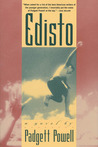
Edisto by Padgett Powell

Edisto For years I’d heard about folks interested to get a first edition copy of this novel, so I’d assumed it was a classic. Written in the time before Goodreads, it does not have a long history of reviews there, but I trust many members have read this classic since it first came out in 1985. Republished now as an ebook under the aegis of Open Road Media, this little gem gets a new airing.

A young boy grows up in his single mother’s beachside home in South Carolina. She works all day as a professor so often leaves him to his own devices. He makes friends among the locals, his maid’s friends, and chums at the local public school. Thinking that a little encouragement from birth might make a difference in his development into a writer of repute, his mother surrounds his crib with classic literature. He is given a notebook in which to record his adventures.

Our boy, Simons (pronounced Simmons) Everson Manigault, is twelve. He has a vocabulary that belies his chronological age, but there is much about the world he still needs to learn. The mysteries of adulthood top his list.

Written in dialect and in the sketchy way of a journal, this may be a little hard to follow at first, but rewards the reader in the end. I recommend plowing through, for by the end you have entered into the language, the time, the place, and the ethos. Circling back to the start once again, you will realize how much you understood, and how much you would still like to glean from this marvelous harvest. We understand, deep in our bones, what has happened here, and how the world, truly a mystery to an adolescent who has no grasp of larger issues, appears to unfurl in all its tattered glory.

You can buy this book here: Shop Indie Bookstores

Wednesday, October 2, 2013

Brief Encounters with Che Guevara by Ben Fountain

Brief Encounters with Che Guevara: Stories
”…I had no idea God and the Devil live so close together. They’re neighbors, in fact, their houses are right beside each other, and sometimes when they’re sitting around with nothing to do they play cards, just as a way to pass the time. But they never wager money—what good is money to them? No, it only souls they’re interested in…[Che Guevara in Brief Encounters...]”

Che Guevara never actually makes an appearance in these stories—just sightings of him—but his philosophy gets a workout. Sometimes events just have a way of confounding even a well-thought-out life, where every step is taken with good intentions toward some worthy goal.

Moral dilemmas face us in each of the eight stories and Fountain does not make it easy for us. The characters may decide to do something morally questionable, but their conflict is not resolved sufficiently to finish the task without second-thinking and regret. There is always another, starker moral dilemma right around the corner as a result of their first choice.

This first collection of stories won Fountain a heap of attention in 2007 when it came out, as did his first published novel, Billy Lynn's Long Halftime Walk (2012). His writing is clear and free of flourish, though his locations are richly imagined. In this collection he spans the globe, though he pays special attention to Haiti, a place that allowed him to explore in microcosm “power and money and history and race and the most brutal sort of blood-politics.”¹ The Haiti stories make me the most uncomfortable in this collection, yet it is the one place he’d visited and so arguably knows most about.

The stories highlight displaced persons confronting the world’s troubles: a woman is forced to share her soldier husband with his dreams; a captured American doctoral student in Colombia manages to continue his ground-breaking study of birds of the Central Cordillera; a peacekeeper in Haiti finds a way to save a piece of Haiti’s cultural heritage; an aid worker in Sierra Leone tries to finance her sideline sewing co-op.

A word might be said about the final story in the collection, which moves us back to the nineteenth-early twentieth centuries. The story is about a Jewish prodigy in Vienna facing racial taunts as she develops her extraordinary repertoire over a period of years. The tone of this story is so sharply different from the others in the collection that we must ask ourselves why it was included. The language is reminiscent of George DuMaurier’s story of Svengali and his creation, the beautiful songstress Trilby O’Ferall. This story would not have been out of place in a Maupassant collection. It may give us an insight into the author’s opinions on the dilemmas he poses in the previous stories. In all the interviews he’s given, I’ve not seen a question about the inclusion of that story addressed, though I might rest easier if I had.

It turns out that I discovered I have read this collection before, when it came out in 2007. At the time I was not recording or writing about my reading and so did not wrestle as thoroughly with the questions it poses. It stands up very well to a second reading (and more!) so I recommend the collection for packing the punch of a novel without all the words. Besides, this man’s moral compass spins in a world that challenges the best of our well-thought-out and perfectly inadequate solutions.

¹”A Conversation with Ben Fountain”, reprinted in the Ecco paperback edition of Brief Encounters with Che Guevara, P.S., p.3


You can buy this book here: Shop Indie Bookstores