Showing posts with label animals. Show all posts

Sunday, November 3, 2019

An Elephant in My Kitchen by Françoise Malby-Anthony with Katja Willemsen

Hardcover, 336 pgs, Expected pub: Nov 5th 2019 by Thomas Dunne Books (first pub June 13th 2019), ISBN13: 9781250220141

For those who find animal emotions and inter-species friendships absorbing, this is a wonderful story about the ways rhinos, hippos, and elephants connect with each other and with humans.

Françoise Malay-Anthony was wife to the original Elephant Whisperer himself, Lawrence Anthony, who wrote a book of that name with famed nature-writer Graham Spence about his experiences creating an animal preserve in South Africa, called Thula Thula. At first Thula Thula was simply a preserve for herds of elephants whose habitat was disappearing. Soon it became apparent that poaching of elephant tusks and rhino horns was leaving vulnerable and traumatized babies to fend for themselves in dangerous territory.

Thula Thula gradually became known for emergency treatment of large animals prematurely separated from their mothers. A dedicated team of young volunteers from around the world worked hard to save endangered rhinos and baby elephants abandoned by their herd.

Leadership for this turn in the direction of Thula Thula, also a game reserve with hotel and bush drives for tourists to bring in money, came at the instigation of Françoise Malby-Anthony after the death of her husband, a time when she was anxious about managing the property without the extraordinary skills her husband possessed.

We learn of her vulnerability in light of world-class scam artists who sought to divert from her goal to make the environment better for animals in the wild. Her education in the ways of the wild—the wild world of tusk and horn poaching—is painful.

The viciousness of poaching by unscrupulous actors with enormous cash reserves has changed the entire focus of those in Africa seeking to preserve large animal habitat and populations. Trained security has had to devise ingenious methods of divining poachers plans and methods. This change in focus from trying to create a nurturing environment to defending territory and wildlife against indescribable violence is a disheartening change and a difficult way to live.

Compare those horrors with a young male elephant seeking the limelight—turning his rump to a jeep full of camera-toting watchers and twerking for the crowd. And an exploration of the character of rhino surprises readers utterly for what it tells us of their fearfulness and gentleness.

We likewise meet a hippo initially very suspicious of being asked to step into a green wading pool with a scant amount of water. We meet the handlers who become these distressed animals’ best buddies, teaching them to play despite their trauma, and protecting them as best they can from the nightmares that plague them.

If readers enjoy the stories in this book, one absolutely must make an attempt to locate a copy of The Elephant Whisperer referenced above because of what it adds in richness to the story and the description of the environment and told by a world-class raconteur.


Monday, January 21, 2019

The Koala of Death (Gunn Zoo Mystery #2) by Betty Webb

Paperback, 250 pgs, Pub Aug 1st 2010 by Poisoned Pen Press (first published May 27th 2010), ISBN13: 9781590587584, Series: Gunn Zoo Mystery #2

This is the perfect book to pick up when you find yourself unable to read with concentration for any reason. Webb has such an easy, involving style, personable characters, and smart insights about animal habits that it is hard not to be curious where she is going with the central mystery. In the end she relied on more than a few stereotypes to describe TV anchors, rich technologists, and wealthy beauty queens, but the path was enjoyable and what we want from mystery series: character development and movement.

Red-haired and freckled, the aptly nicknamed Teddy is an unlikely combination of enthusiastic zookeeper and reluctant heiress. Her beauty queen mother is intent upon marrying her off to a Silicon Valley man but Teddy herself tends towards the half-European half-Latin sheriff who cares for two kids from his first marriage. A new zookeeper is found dead under suspicious circumstances, and though her former boyfriend is taken into custody, the killings do not stop.

What I liked best about this was the sunny California feel of living just inland from the seaside quay where Teddy keeps moored her live-aboard boat. The low-key zoo is placed in scented environs near a eucalyptus forest and features photogenic blue-tongued anteaters and cuddly koalas. Webb’s writing is humorous and assured even while unraveling a complicated mystery involving lots of peripheral characters and possible murderers.

I have a niece who will be zoo-keeping at San Diego Zoo this coming spring, a zoo mentioned several times in the course of this mystery, so I admit to some focused attention on the animals mentioned and animal care. While the fiction may not all be accurate, it is a refreshing, inventive angle from which to approach a mystery, and gives the author a chance to indulge some serious research.

Webb was once a journalist for a Phoenix-based newspaper and began writing fiction at the turn of the 21st century with a Desert Series featuring Scottsdale-based investigator, Lena Jones. Webb’s work on that series is said to have been based on real cases, and always addressed some pressing societal issue like sex trafficking, despoliation of the environment, welfare fraud, native rights. It is said there is a strong frontier feel to the series.

Frankly, Webb seems a natural when it comes to fiction. She understands how to tell a story and chooses her topics well. She gives readers plenty of credit for following her into the intricacies of a mystery or knowing where to put the emphasis on an important topic. Webb also teaches creative writing at Phoenix College. My guess is the class would be worthwhile, and a blast.

I read this for my new Mystery bookclub, the topic of which is "Death in a Hot Climate."


Wednesday, January 3, 2018

Five-Carat Soul by James McBride

Hardcover, 320 pgs, Pub Sept 26th 2017 by Riverhead Books, ISBN13: 9780735216693, Lit Awards: Andrew Carnegie Medal Nominee for Fiction (2018)

On his website James McBride has a short biographical video in which he talks about his mother, his music, and his writing. Every one of the twelve kids in his New York City family growing up played music and read books. McBride himself plays saxophone, and played in a traveling band while writing his first book, The Color of Water. McBride says "we’re all the same…there’s none of that black and white stuff when one gets to the nursing homes…they’re all just happy their body parts are still functioning." That may well be, but please let’s not wait that long to get past race.

McBride’s yarn-spinning tone is in full voice right from the first story, “The Under Graham Railroad Box Car Set,” where we learn about the fabulously valuable toy railroad set made for General Robert E. Lee’s five-year-old son Graham by Horace Smith, of Smith & Wesson fame. Rumors of the train set swirled for more than a century before a photograph of it appeared one day at the home of a seller of vintage toys living in Buck’s Country, Pennsylvania.

The very finest stories in this collection come at the end, including “Mr. P & The Wind,” a fable which really should be published as a stand-alone paperback storybook for adults with pen-and-ink drawings, like that of Chekov or Kipling at the end of the 19th Century. In this story, animals residing in a zoo discuss their lives before zoo-dom, what their real natures are like, and their understanding of reincarnation. One thing they’d learned very well in the zoo was that humans—the Smelly Ones—were able to kill expeditiously but they had little to no understanding of the Order of Life.

This piece ranks as a bedtime story for grownups, a just-long-enough, miraculously inoffensive and reassuring vehicle for dispensing wisdom and life experience, certainly exceeding the feel-good but ultimately empty bloviation of the Dr. Seuss book often gifted at graduations, Oh, The Places You’ll Go! The animals communicate in Thought Shapes which do not register to humans who have not learned the language. In this way, whales can communicate with lions and panthers, difficult and exciting though that is to comprehend. A Smelly One, Mr. P, learns to Thought Shape.

Four of the stories in this collection center around the five-and-a-half-member Five-Carat Soul Bottom Bone Band, and we could see what they were learning from their neighborhood: Pig and Dirt were former members, Bunny, Dex, half-member Ray-Ray, Beanie, Goat, and Butter, our narrator. The time was different back then, when the band practiced over Mr. Woo’s grocery, before Mr. Woo killed “Buck Boy,” who had tried to rob him.

Then there was “Blub” the young man the band boys always thought was younger. He had a tender heart and was easily led, and ended up working a murder charge until Butter could tell the court a story about Blub back when he gave more love than he got, back when a girl with a cat could darn near break his heart. “It ain’t him,” Butter would testify. “They got the wrong man.”

In “The Moaning Bench” we get a whiff of the everlasting…the everlasting hellfire that awaits those who have not examined what it means to be penitent. In “The Christmas Dance” we review again the role of black soldiers in Italy during the Second World War. Two survivors of a horribly-ravaged regiment were surprised in a 1944 Christmas Day attack that took out most of their fellow soldiers. On Christmas Day every year they get together to dance, and to remember.

Two stories tell of Abraham Lincoln, whose difficult choices and grief binds him to us even now. “The Fish Man Angel” was my second favorite story in the collection. Lincoln’s loss is palpable as he curls up in the stable with his dead boy Wille’s favorite pony, sharing loneliness and warmth. From that vantage point he overhears the cruelty of one black man speaking to another and fixes that problem at least.

The second of the Lincoln stories, “Father Abe,” describes a young mixed-race orphan called Abe Lincoln seeking clarification about his parentage: surely if his name is the same as the president, wouldn’t that man would be his father? The 9th Louisiana Colored Infantry Regiment, briefly and exhaustedly paused in Richmond, VA near the end of the war, found Little Abe persistent in his demand to know which man was his father.

Stories like these seem designed to entrance even much-older children who have their own children. That’s the thing about McBride. His writing allows adults time to relax, to play a little. He feeds our credulous, childlike selves; we put aside his work to think on it a bit. McBride has a reservoir of humor and goodwill that saves his work from both despair and from too great an optimism.


You can buy this book here: Shop Indie Bookstores

Saturday, November 11, 2017

What It's Like to Be a Dog: And Other Adventures in Animal Neuroscience by Gregory Berns

Hardcover, 320 pgs, Pub Sept 5th 2017 by Basic Books, ISBN13: 9780465096244

Berns uses what he’s learned about human cognition and emotion in the title of this book, which promises insights into the understanding of the dog brain. To be fair, the book does discuss experiments and findings involving what happens in a dog’s brain while commands are given and associations are made. But the book goes far beyond the dog to discuss cognition and sentience in animals of many kinds, principally by using evidence from MRI and fMRI brain scans. It is a fascinating look at the study of neuroscience on animals.

Despite the density of terms required to study neuroscience, Berns guides us easily through the basics, allowing us to understand the principal goal of their studies on dogs: to determine how dogs process information. I will admit to a degree of awe to think they could manage to get a dog to voluntarily crouch within a noisy MRI machine and stay immoveable long enough to be scanned while the scientists perform tests. Georgia dog trainer Mark Spivak was given a shout-out at the end of this book for his insights and indefatigable efforts to this end.

The decades-long work of Peter Cook of the pinniped labs in Santa Cruz, CA is highlighted for several chapters beginning with “Seizing Sea Lions.” Berns and Cook worked together to determine the effects of domoic acid toxicity on normal patterns of connectivity in the brains of dead sea lions. Domoic toxicity caused by agricultural runoff was determined to be the cause of a wave of malnourished sea lion strandings during El Niño years.

After the sea lions come dolphins, a discussion of how echolocation manifests in the brain, and some indication how dolphin brains resemble and differ from other mammals. Then back to dogs, where studies have shown a real possibility that rats and dogs may experience regret: regret for choices that do not turn out as desirable as anticipated. Berns acknowledges it is difficult to imagine regret in a rat, but he suggests that our word for it does not limit the experience of the emotion to those who understand the word. From here he moves from “what do words mean to animals”?

The detail in his discussion of dog training with words and visual cues may lead other scientists to suggest tweaks that may lead to even greater understanding of the emotional responses of animals. Enough work has been done now on a variety of mammals (and even crows!) to show emotions are a part of their brain activity and daily life. But what appeared to be almost a failure of dogs to recognize words led to a new insight:
“It may be that in a dog’s semantic space, actions and things are very close, which would explain why it was so difficult to teach the dogs the names of things. The semantic representation for ‘squirrel’ might be to ‘chase and kill,’ while ‘ball’ becomes ‘chase and retrieve.’…Human represent the world with nouns…it might require a shift in perspective—in this case, from a noun-based worldview to one based in action…In an action-based worldview, everything would be transactional.”
In one of the final chapters, called “A Death in Tasmania,” Berns tries something completely different. He writes of his experience traveling to Australia to view the habitat and scan the brain of an Tasmanian Tiger, a marsupial mammal species thought to be extinct. As an experience and as a piece of research, it is as different from his earlier work as studying the brains of placental mammals and marsupial mammals, two animals who evolved differently over millennia. Berns uses narrative nonfiction techniques to situate us visually, historically, physically in “one of the last great wildernesses on Earth…utterly unique and worthy of protection.”

The chapter on Tasmania really highlighted Berns’ special skills as a scientist—his ability to look beyond the lab to the wider meanings of neuroscience “for the rest of us,” as he emphasized in his final chapter on the “Dog Lab.” Working for so long on understanding the extent of animal cognition, consciousness, sentience, or self-awareness has led him to animal advocacy, if only for our own selfish reasons. “We, Homo sapiens, might soon be an animal in the eyes of our successors…” given our tinkering and experimentation with the human genome. One day unmodified humans may be considered undesirable, inferior.

Berns has skill in involving us, allowing us to follow his work. He would like to map the brains of the Earth’s megafauna with the best science and equipment available today.
“The WWF estimates that two-thirds of many species’ populations maybe gone by 2020. Apart from the ecological catastrophe, scientific opportunities may be lost forever. It is imperative that we begin the archival process for all species, and especially for megafauna…”
Is 2020 a misprint? I surely hope so.


You can buy this book here: Shop Indie Bookstores

Tuesday, June 6, 2017

Woolly by Ben Mezrich

Hardcover, 304 pages Expected publication: July 4th 2017 by Atria Books ISBN13: 9781501135552

Mezrich picks interesting topics, I will concede that. Readers may already have heard some years ago that a Harvard lab was working on de-extinction of the Woolly Mammoth. Mezrich brings us up to date on this project; indeed, the first and last chapters in this nonfiction are set in the future.

If you are familiar with Mezrich’s writing, the author weights the concept of narrative nonfiction heavily on the narrative and fiction sides, ostensibly to stoke momentum and get folks interested. The only problem is that his very good instincts about what is intrinsically an interesting story fights with his method. Sometimes the reader has to thrash through pages of invented dialogue to reach a critical conclusion, a real buzz killer if there ever was one.

But this story works on many levels, and while we are following his careful step-by-step thrust with one eye, our mind is busy on the operations of a lab and the implications of the study for medicine, for wildlife, for every aspect of our visible and invisible world. Mezrich eventually addresses many of these key issues in the text, usually making the science sound responsible and considered.

I started to grow more uncomfortable towards the end of the book, when we are reminded that the science has progressed so far so fast that genomic modifications have escaped the lab environment and can be undertaken in a made-over garage for relatively small costs, and that billionaires of every stripe are lining up to make their money count for something big.

The real excitement of this story is in our imaginations, and what the skills and knowledge of present-day scientists can allow us to imagine. Mezrich places us in fund-raising meetings with billionaires, allowing the most humble among us to enjoy the same stories and sense of excitement that fuels movers and shakers. If the glamour of the whole thing begins to seem suspect at some point, I think you’ve caught my sense of unease.

Mezrich shares the history of the project, including the work by Nikita Zimov in Northern Siberia, determining that woolly mammoths seemed to have played a role in preserving the permafrost levels of the tundra, by upturning the soil and exposing lower layers to the freezing temperatures. His father, Sergey Zimov, apparently theorized that reestablishing animal herds that roamed Siberia earlier in human history might play a role in keeping escaping carbon and methane, now sequestered in permafrost, from accelerating the speed at which the earth warms.

The fact that woolly mammoth remains are discovered regularly now in thawing and melting ice and snow of the north is something I had not known. The ancient ivory from the tusks is not protected and is therefore an important source of income for hunters, sold in lieu of protected elephant tusks, for the same reasons, to the same buyers.

The scientists involved in the story at one of the Church labs at Harvard are fascinating individuals in their own right, each with a backstory that only fuels our interest. The project has been going on long enough now that the twenty-something personnel involved at the beginning of the project are turning it over to others, younger ones still, to ensure continuity of skills on such a forward-looking project. The whole concept and execution of the mammoth idea is sufficiently…mammoth…and complex enough to make readers feel as though they have been subtly changed by the experience.

The real life story ends with woolly mammoth DNA implanted in an elephant cell. Dr. Frank Church, the originator of this project, to his credit, decides not to use elephants to gestate the beast that might develop, but to construct a synthetic uterus. That is currently underway. Stay tuned.


Due out July 4th.


You can buy this book here: Shop Indie Bookstores

Wednesday, October 5, 2016

Patterns in Nature: Why the Natural World Looks the Way it Does by Philip Ball

This is a gorgeous-looking book. Since this topic has been one I have been promising myself to examine for some time, I picked up this striking volume from a face-out display in my public library which has, I was surprised to learn later, a large collection of Philip Ball's books, but not yet his latest, called The Water Kingdom, about China and its relationship with water. It sounds fascinating.

This book about patterns found in nature has very little discussion within. One must make do with the magnificent photography that includes some of the very best pictures I have seen of a certain weather phenomenon, say, or a geologic feature. Many of the microscopic subjects (viruses, insect eyes, closeups of sea creatures) are artificially colored so that the features stand in stark contrast. It is definitely coffee-table quality.

For creatives and artists, this work is positively inspirational. Scientists may use it to demonstrate some observable phenomenon, but although the photos are labelled, the text sometimes proved insufficient to adequately explain the complicated reasons for why such patterns appear. Some of the less complex subjects and accompanying text were sufficient to pique further investigation elsewhere.

Something I may have encountered before but do not recall ever seeing in quite the same way were pictures of Chladni figures, or fine grains on a flat surface subjected to sound waves. The grains formed intricate patterns. The figure I use an example here is not from Ball's book. His was so glamorous it sent me spinning to find more information.

The other single coolest thing I have ever seen was a photo of Fingal's Cave on the Isle of Staffa in Scotland. Again, this is not the photo that Ball included in his book, but hopefully will give you some idea why it was so thrilling to me. Cracks have formed six-sided posts of basalt.


Something similar can be found at a place in California called Devil's Postpile: columnar cracks in the side of a hill. Unbelievably cool.

Devil's Postpile

There is much, much more in this book. While I did not find answers to all my questions, the book contains gorgeous examples of patterns you will wish to research further, having seen them in such brilliant detail.

Hardcover, 288 pages Published April 5th 2016 by University Of Chicago Press ISBN 022633242X (ISBN13: 9780226332420)


You can buy this book here: Shop Indie Bookstores

Friday, September 30, 2016

Coyote America by Dan Flores

Dan Flores has done something fascinating in this book, rehabilitating the image of a persecuted carnivore lowest on our opinion roster of animals, including cockroaches and rats. He makes the case that coyotes should be America’s national avatar, displacing the bison or buffalo. Extremely clever, adaptable, and pioneering, the coyote was designated a principal deity by American Indians--North America’s oldest deity, responsible for creating all of North America.

Flores tells us that coyotes live within a couple miles of us at all times now…even those of us in major metropolitan areas. Coyotes are cosmopolitan, and have been living in urban areas since the time of Columbus at least. They are perceptive, wily fellow-travelers with us.
”Suffice it to say here that as we humans head off into an uncertain and probably dangerous future of our own making, it might be wise to keep an eye on [coyotes]. I, for one, am going to be very interested in how coyotes cope with the twenty-first century and what insights we might draw about our own circumstances from a coyote history that so often seems to mirror ours.”
Coyotes are predators, feeding mainly on small mammals, birds, or fruits. They are sociable, hunting in packs. Contrary to the notion that coyotes were responsible for cattle kills, they were nearly always scavengers of large animals as befit their position in the ranking of predators in the larger ecosystem. Very nearly killed off as pests since the end of the nineteenth century, they have none-the-less persevered.

Flores suggests we look to the Indian coyote stories, of which there is a rich seam, to understand human nature: “who better to illustrate that than self-centered, gluttonous, carnal Coyote?”As we began to understand our own animal natures, the study of other social animals leaves “little doubt that…canines also understand equality and inequity…and experience both a rudimentary form of empathy and some basic theory of mind…an essential sense of what in human terms we would call 'right and wrong.'”

Employees of the Wildlife Services’ Predator Research Center, whose greatest advocate is the American sheep industry, is responsible for killing by aerial shooting roughly 35,000 coyotes from the air annually. Even they readily admit that coyotes have personality: “They’re individuals. Like people, some get into trouble.” Sheep farmers claim to lose some percentage of lambs to coyote packs every year. The federal government spends an equal amount of money (the cost of the lambs) to kill or sterilize coyote. Hmmm...a good use of federal tax dollars?

This book is a wildlife biologist’s dream. Readable, eloquent, well-argued, it looks at coyote history from many angles and leads even those of us with reason to dislike the disruptive canines to a grudging admiration and wonder. Of course, sport hunters probably don’t read peer-reviewed ecological articles, but Flores points out that ecosystems tend to develop some balances in response to threats and flourishing in their environment. Trying to kill coyotes takes natural balances out of the equation.

Flores ends with examples of coyote in art, and reminds us again how the animal is portrayed as a caricature of human nature, for example Wile E’s comic overconfidence (remind you of anyone?), unswerving obsession with a goal, and unfailing faith in technology. (Even that swath of red-gold hair has something of the coyote about it.) But I don’t want to carry the metaphor too far. After all, coyote in modern day parlance means a person who sneaks illegal aliens into the U.S. from Mexico.

NPR's David Greene interviewed Dan Flores about this book on coyotes.

Dan Flores is a historian, A.B. Hammond Professor Emeritus at University of Montana-Missoula, who has written several books about the American West and the animals who reside there. This year he also published a book called American Serengeti: The Last Big Animals of the Great Plains, perhaps in conjunction with the movement by Sean Gerrity, president of American Prairie Reserve, committed to wildlife conservation and hoping to create the largest wildlife complex ever assembled in the continental United States. "When complete, the reserve will comprise some 3.5 million contiguous acres (more than 5,000 square miles) of native grassland in northeastern Montana, with a goal of restoring the wildlife abundance the landscape once contained." [National Geographic bio].

Here is Dan Flores addressing the 32nd National Cowboy Poetry gathering about the history of America's Serengeti, and here is Sean Gerrity at an Aspen Institute gathering to elicit donations for his project.


You can buy this book here: Shop Indie Bookstores

Wednesday, March 30, 2016

The High Mountains of Portugal by Yann Martel

Hardcover, 332 pages Published February 2nd 2016 by Spiegel & Grau

Somehow the word “novelist” doesn’t quite capture Yann Martel’s art. If I had to describe what he does, I might say he writes storybooks for adults. They often have talking animals and a kind of magical realism. He questions the ordinary, celebrates the fantastic. “Stories benefit the human mind.” We understand through stories, and each of us interprets a story differently.

Martel’s new novel drops us into a strange and distant land, at a time before any of us can claim first-hand knowledge. While he presents the facts of the case, we wonder what knowledge we are meant to bring to aid understanding. We listen, feeling homeless, unsure. He then leads us homeward, and in the last third we find ourselves quite at home and at peace…with a chimpanzee…in Portugal.

Religious belief, the bond animals and humans share, and big questions (“That’s the great, enduring challenge of our modern times, is it not, to marry faith and reason?”) are enduring themes in Martel’s work. We move through a century in one family’s history, collecting wisdom, only to have to succeeding generations keep the form but not the reason for an added custom, like walking backward in a state of grief, or the name and circumstance of one they worship as a “saint.” In three parts we have three married couples, all of whom have lost one lifelong partner, searching for meaning in their grief.
“Grief is a disease. We were riddled with its pockmarks, tormented by its fevers, broken by its blows. It ate at us like maggots, attacked us like lice—we scratched ourselves to the edge of madness. In the process we became as withered as crickets, as tired as old dogs.”

Martel’s stories are always filled with symbolism, some sitting on the surface and easy to grasp, and others discovered only after much contemplation. Real issues critical to our understanding of the world are treated with whimsy and humor, not scorn or disdain.

Martel makes the point that neurosurgeon Paul Kalanithi makes in his memoir When Breath Becomes Air: that the goodness and blind faith required of us by religion is too hard to live up to on a daily basis. Reason is easier, both to comprehend and to use as a kind of measure of goodness. Neither faith nor reason is enough on its own: neither explains the world adequately. “Reason is blind. Reason, on its own, leads us nowhere, especially in the face of adversity.” And what of joy? Love? Reason doesn’t explain those, either.

Martel creates a character who suggests that an Agatha Christie murder mystery might combine the two: “the solution [is] stories that put reason on brilliant display while keeping one close to Jesus of Nazareth.” He compares the form of Agatha Christie novels to the gospels and hypothesizes that both are stories with a central murder mystery. The facts are laid out with great formality and ceremony, but no one ever seems to remember who the murderer is. Who killed Jesus? It is true that murder mysteries are compulsive reading material for adults, as are our bibles, whichever religion we examine.

Martel goes further. He takes the central imagic trope in the novel, an ancient carved wooden crucifix, and proposes us that the figure of Christ on the Cross might actually be a Chimp on the Cross--a crudely-carved naïve attempt at perspective, a statement on the development of man from ape, or a challenge that man was more pure, present, and godlike before he developed reason. That would be to say nothing of the literal: that humans have lorded over and crucified wild animals, even those so close in genealogy to ourselves, bringing us shame and not salvation.

Martel has no sacred cows. Reviewers have criticized him in the past for challenging the sanctity of well-protected myths and histories. I find Martel dazzling in his fearlessness, rigorous in his thinking, and deep in his conclusions. He is not dismissive of faith: he thinks it both interesting and necessary, providing a kind of useful moral structure. The formal ritual of organized religion does not impress him: “architectural modesty best suits the religious sentiment. Only song needs to soar in a church; anything fancier is human arrogance disguised as faith.”

There is something intoxicating and deeply reassuring about the final section of the book in which is recounted the story of Odo the chimp, rescued from the research lab in America’s southwest. Odo is old and wise enough to have developed a kind of culture and a rudimentary understanding of language. He can communicate, if not without misunderstandings. Odo seems to have no notion of past and future; he is all about the present. His human companion, Peter, discovers that he would prefer to become more Odo-like in his “profound simplicity of means and aims...members of [Peter’s] own species...are too noisy, too fractious, too arrogant, too unreliable. He much prefers the intense silence of Odo’s presence, his pensive slowness in whatever he does…”

A couple of last things: There is a profoundly affecting marriage consummation scene in this novel which gives readers a glimpse into what kind of man the author is, for who else could create such a scene? Both husband and wife are virgins; he twenty-one and she seventeen. Sex itself is all still a mystery, but they work it out together. The bride had never known desire, nor where hers lay, but her new husband searched for, and found, her hidden place and they lived and loved passionately ever after. Martel makes it beautiful, sexy, joyous, and absolutely right-sounding.

Was there ever an Iberian Rhinocerous? I doubt it, though he had me believing, just a little.

I’m a fan.


You can buy this book here: Shop Indie Bookstores

Monday, December 14, 2015

Medicine Walk by Richard Wagamese

Canadian author Richard Wagamese manages to slow our heart rate down with this story of an Ojibwe Indian who lost his bearings, and about an old man and a boy living on a farm carved out of the wilderness. Stories told and listened to form the heart of this novel: one feels sure that if only there were enough stories, things might have turned out differently. But in the end, the larger story—the story of this novel—lets us know that life encompasses both the tragic and the magnificent and to know one, we must know the other.
"When you share stories, you change things."
The land is central to this novel: how it nourishes and refreshes the spirit, how it returns generosity shown it. The old man and the boy live in concert with the land and, having learned its lessons, treat one another with a gentleness and love that approaches the sacred. "Just get it done," is what the old man tells himself and teaches the boy, and throughout their lives together the two of them face difficulties or obstacles with the same quiet fortitude and firmness. They discover the pleasure in bending one’s back to difficult work, and in contemplating the end of a task well done, whether it be straight, square, strong fencing or burying a man, facing east, in stony ground.

The boy’s father, Eldon Starlight, had left his son with the old man because he couldn’t find the strength within him to care for another. When gradually the outlines of Eldon’s life come into focus, we discover his struggles are mostly internal, that despite the gifts of his physical health and strength, he hadn’t enough strength of spirit to see him through the inevitable twists and turns of an unexamined life. His addictions explain, but do not excuse, his inattention to the only things that really matter. Eldon realized, at the end, that he really wanted a connection with his heritage and with the land, and the boy, though he had reason to hate his father, showed just what kind of man he was becoming by honoring him, padding his grave with moss and boughs and sprinkling it over with tobacco. His upbringing and connection with the land developed reserves of generosity within himself that he could share when the world displayed too little. There is terrible pain in the world, but there is also grace.

The section of this novel that deals with Franklin bringing his father to his final resting place, finding his way in the woods, encountering a bear, fishing without line, hunting without a gun, the boy generates love. He is sixteen and a man in all the ways that matter.

The bare simplicity of the narrative, and the clarity of the language both hold a beauty that is rare in novels today and makes this a standout. The harsh reality of someone dying of drink is achingly real and truly described, as is the beauty and bounty of open forest. The relationship between the old man and the boy defines what sustains us in a world that too often feels outside our control. In the end, we are all is nourished, blessed even, by the strength their relationship.
"Feels good to miss things…it makes you know you’re living, that you touched something, that something touched you."
I listened to the audio production of this book, beautifully read by Tom Stechschulte, and published by Recorded Books. I highly recommend this book, this meditation, for centering oneself in a busy world and for reminding us of what is important.

In an interview with CBC Richard Wagamese says that this is his best novel, and that it may lead to another novel or two to flesh out the lives described within. To my thinking, the novel stands on its own, though I would love to see more of this author's work and reprise the feeling I had when I read/listened to it.


You can buy this book here: Shop Indie Bookstores

Wednesday, April 29, 2015

H is for Hawk by Helen Macdonald


"The archeology of grief is not ordered."
Helen Macdonald’s book-length nonfiction is so many things at once: a eulogy, an elegy, a biography, a memoir, a training manual, a journey. It is a conversation about death, and community. It is so filled with passion and pain that one reads, breath bated, to see which will crush the other. This book is only partly about a hawk, despite the title. It records the author’s journey of a few years, starting with the unexpected death of her father, through the purchase and training of a hawk, to a new place of understanding about what and who humans are and what we need to live well.

The author looks closely at the life and writings of another vulnerable person, T.H. White, to express sorrow and a kind of sympathy with his derangements. She learns the origins of his extraordinary flights of fancy in literature, tracing over the sores of his upbringing until we see clearly the agonies of his confused psychopathy. White was a hawker, but a hawker one might quote to show how not to train a hawk. Macdonald loathed his book The Goshawk as a child. When she gets her own hawk after the death of her father, she reads it again. This time she discovers White’s pain--seeing, feeling, tracing it until it is as clear as her own.

Macdonald shares one of the best descriptions of bereavement that I have ever encountered (italics are hers):
"Here’s a word. Bereavement. Or, Bereaved. Bereft. It’s from the Old English bereafian, meaning 'to deprive of, take away, seize, rob.' Robbed. Seized. It happens to everyone. But you feel it alone. Shocking loss isn’t to be shared, no matter how hard you try. 'Imagine,' I said, back then, to some friends, in an earnest attempt to explain, 'imagine your whole family is in a room. Yes, all of them, All the people you love. So then what happens is someone comes into the room and punches you all in the stomach. Each one of you. Really hard. So you’re all on the floor. Right? So the thing is, you all share the same kind of pain, exactly the same, but you’re too busy experiencing total agony to feel anything other than completely alone. That’s what it’s like.' I finished my little speech in triumph, convinced that I’d hit upon the perfect way to explain how it felt. I was puzzled by the pitying, horrified faces, because it didn’t strike me at all that an example that put my friends’ families in rooms and had them beaten might carry the tang of total lunacy…

...I’d dreamed of hawks again. I started dreaming of hawks all the time. Here’s another word: raptor, meaning 'bird of prey'. From the Latin raptor, meaning 'robber,' from rapere, meaning 'seize.' Rob. Seize."
Hawks apparently have a shamanic tradition of being able to cross borders that humans cannot and "were seen as messengers between this world and the next."

The author trains a bird of prey, a hawk called Mabel. Mabel is a predator; she is all about death, violent death. The wildness of the bird seeps into the author’s consciousness, and her perceptions become acute. Macdonald is recovering from a loss, and her bond with the reptilian raptor Mabel underscores her warm-blooded need for love and her bond with the human community. This book is the author working through grief and terror and want and coming out naked and vulnerable on the other side.

The language Macdonald employs in this memoir is as extraordinary and ingenious as her laying out such diverse topics as death, hawking, T.H. White, and history as interlocking pieces. She holds us rapt as she defines her grief. The words she chooses make us hypersensitive to differences in shade, angle, meaning: "Goshawks in the air are a complicated grey colour. Not slate grey, nor pigeon grey. But a kind of raincloud grey…" Or this: "I was…grey, loose-spun wool on an aching set of bones." Or this: "I felt like I was holding the bastard offspring of a flaming torch and an assault rifle." Her meanings are exquisitely clear.

Macdonald was born a hawker. We are all born with something innate but dormant until awakened by opportunity. Fortunately Macdonald was able to find and exercise her passion because she liked to read. It reminds me of teachers we may have had that spark an interest in something that feels as natural to us as breathing, and as necessary. Macdonald discusses six books that formed her consciousness about nature, makes us realize once again that a seed spilled on tilled ground can yield the most amazing things. It breaks my heart a little to think that every child probably has some thing in them that would burst into flame with the right tinder. Not all of us find it, early or ever.


You can buy this book here: Shop Indie Bookstores

Friday, February 13, 2015

Caribou: Poems by Charles Wright

This collection of poems by Charles Wright reminded me so much of Chinese poetry, and in his Acknowledgements he does credit the poetry of Du Fu and the poetry of ancient China. Consider this:
The deer walk out the last ledge of sunlight, one by one. –fm “Cake Walk”

Or this:
Moon soft-full just over the tips of the white pine trees. –-fm “Life Lines”

In this collection Wright speaks much of death, the transitory nature of things, of seeing things for perhaps the last time. He will be 80 years old this year, so he is deservedly feeling his years.

When is it we come to the realization
That things are wandering away? -- “Waterfalls”

There is so much here that captured me, though he and I are divided by years. Would that we learned his lessons earlier, but
Contentment comes in little steps, like old age --fm “Chinoiserie VI”

So many of his phrases I yearn to post but he warns us
Musician says, beauty is the enemy of expression.
I say, expression is the enemy of beauty.
God says, who gives a damn anyway,
Bon mots, you see, are not art or sublimity. --fm “Chinoiserie VI”
But much of what he writes in this book is distilled to its essence. So few words, so much meaning. He gets right to the heart of things.
There’s an old Buddhist saying I think I read one time:
Before Enlightenment, chop wood and carry water.
After Enlightenment, chop wood and carry water.--fm “Ducks”

Wright, immersed as he is in the end of things, shares his wisdom:
Beware of prosperity, friend, and seek affection.--fm “Heaven’s Eel”


You can buy this book here: Shop Indie Bookstores

Tuesday, October 14, 2014

The Third Plate by Dan Barber

The Third Plate: Field Notes on the Future of Food The grace and fluency with which James Beard Award-winning Chef Barber relates his experiences in his Blue Hill restaurant in New York City, walking the fields of his Stone Barns organic farm in Great Barrington, Massachusetts, and in his travels to Europe and throughout the United States left me wide-eyed with wonder. This extraordinary memoir and travel account is engrossing in a way that few writers achieve. Barber is gentle in his instruction, but he is telling us what he has learned about the inadequacy of the current concept of food sustainability, and it is a lesson we really need to assimilate and organize around.

Happily, his lessons are filled with well-cogitated thought, possibilities, solutions, humor, and beautiful images. I’d heard Corby Kummer interview the New York restaurateur on the New York Times book podcast back in the spring of ‘14, and thought it sounded like something I’d like to look at. I felt no urgency. Only when I obtained a copy for someone else and began to browse through it did I discover the can’t-put-it-down page-turning clarity, and the irresistible humor in Barber’s writing. I am trying now to figure out how many copies of the book I can give away for Christmas without repeating myself.

This book is divided into four sections, called Soil, Land, Sea, and Seeds. You won’t have heard these stories in quite this way before, and if they seem familiar, you will find it enlightening to see what Barber has chosen to highlight. Barber moves gradually through his dawning realization that the way we have been eating, in restaurants and at home, is not actually going to be able to sustain the land, the ocean, nor the planet, no matter that we gradually move from pesticide-grown vegetables to organics. There has to be a greater understanding of the web of interconnections between the soil and our eating habits. We have to be willing to increase the diversity of our diet and think about eating foods that replenish the balance in the soil along with ones we use more commonly.

It may be obvious to those who have paid attention to the concept of sustainability that we haven’t yet come around to actually managing the task ahead of us. Barber suggests it is more than simply changing our diets from meat-centric to vegetable-centric. He concludes that we “cherry-pick” our vegetables and therefore limit the amount a farm can sustainably produce for a given community. A farm has to grow cover crops on at least some of the land, and that is part of the cost of crops we actually eat. He urges us to think about how this works in fact, and what this reality means for pricing, output, and consumption.

But I may be making it sound boring. In Barber’s hands, it is anything but that. His work is filled with enlightening vignettes about the places, the people, the restaurants that led him to learn so much about sustainability and its opportunities. Barber awakened me to certain understandings about plant pairings that I’d sort of heard about, but never really believed possible: like having four different crops growing in the same space at the same time to preserve and replenish soil vitality. Especially, or perhaps only, in small scale operations where crops are harvested by hand might this be possible…but it is possible, in fact desirable!

Vignettes about the fish farmers and restaurants featuring fish were particularly interesting. I hadn’t followed the latest developments in that field and am astonished, pleased, and heartened to know that there are some doing things which enhance wildlife rather than diminish it. He tells of a fish farm in Spain which hosts vastly increased numbers of migrating birds as well as produces exceptional-tasting fish for market. It gives me hope that the work on the west coast of the USA to preserve and restore the tidal salt marshes near San Francisco might be successful for life of all kinds, including our own.

Barber outlines his own learning curve, his oversights and humiliations, and he is very funny in places, showing the reactions of people with different world views meeting (at Barber’s behest) face to face and trying to be civil, or in speaking of finely tuned chefs at their most passionate or most perplexed:
’Dan,’ [Ángel] said, turning to me, ‘have you ever cooked naked in your kitchen?’
Ángel features in another very funny bit:
”[Santiago] goes to different ponds in Veta la Palma [Spain] at different times of the year. Always at the full moon,” Ángel said.

Thinking of Steiner and his lunar planting schedule, I guessed, “Because the fish have better flavor when the moon is full.”

“No,” [Ángel] said, looking puzzled. “So he can see what he’s catching.”


The section on wheat farming was completely new and fascinating to me. In the very beginning of the book Barber reproduces a photograph of the perennial Midwest native prairie wheat (with root system) alongside higher-yielding grain varieties planted to replace it. I was truly shocked by the difference in the profiles of the two plants, and thought it indicative of what modern agriculture has done, in every aspect of our food profile, to the concept of sustainability. The good news is that there are folks around the country thinking about our food future. Barber managed to create an international community of thoughtful practitioners striving to figure out how we can best produce what we will need to live on earth.

This completely fascinating book happens to be very easy to read. Someone in your family, not just the foodies, will love reading of Barber’s researches and spending time with this thoroughly decent guy who is willing to share his successes and failures in the field.


You can buy this book here: Shop Indie Bookstores

Tuesday, September 30, 2014

Elephant Company by Vicki Constantine Croke

Elephant Company: The Inspiring Story of an Unlikely Hero and the Animals Who Helped Him Save Lives in World War II NPR environmental and animal journalist Vicki Croke’s new book about the British elephant mahout and teak man James “Billy” Williams in Burma in the interregnum between the 20th Century’s World Wars easily began as the best nonfiction I’d read all year. Elephants and Burma--what a combination of mysteries. No matter how many books about elephants that I read, I always learn something new. I love knowing of elephant skills, abilities, capabilities. In her Introduction, Croke tells us:
"Williams had witnessed a life among the elephants that would be hard for those outside to fathom—in fact, he reported behaviors that many would not believe until they were validated decades later by biologists in the field. He had seen these creatures thoughtfully solve problems, use tools, protect one another, express joy and humor, stand up for something more important than their own safety, and even, perhaps, comprehend the concept of death. There was a largeness to them that was about more than their physical size, a quality triggered especially when their sense of decency or outrage was provoked.

Could one really call it decency? Williams thought so. Courage defined them, He had witness their bravery—mothers defending babies, tuskers squaring off against each other, closely bonded females running toward danger, not away, to protect one another.

These were simple lessons from the animals, like how to be content with what he had. And there were more complex ones, too: the realization, for instance that trust requires much more than affection; it depends on mutual confidence—strength, not niceness. Or that sometimes it’s not necessary to know what elephants or people are thinking, as long as one honors what they are feeling."

Croke explains the differences between African and Asian elephants, in size and temperament, and gets into details about living in the plains and mountains of Burma. Details of early teak harvesting are both sad and fascinating. It takes two to three years to harvest a tree, and “it could take anywhere from five to twenty years for a log to become a milled plank." Demand for teak, a hard wood resistant to insects and weather damage increased dramatically in the first part of the 20th century, from "sixty-three thousand tons of teak a year in the late 1800s to more than five hundred thousand tons annually in Williams’s early years." Additionally we learn that "a teak forest 10,000 square miles in extent may be capable of producing only seven or eight thousand trees a year."

Living as a teak forester sounds formidable, and lonely. The hardship of the sheeting rain of the monsoon and the isolation of the jungle life would keep most folks away, but Billy Williams had the consolation of working with the world’s largest land animals. Williams suffered innumerable bouts of malaria and other illnesses that nearly took him out, but he soldiered on without complaint and once recovered, raced back to his post and his elephants.

The only thing that keeps this from being the best book I have ever read is the section on Williams’ involvement in WWII as it played out in Burma. Undoubtedly the Japanese had a strategy for domination that included rustling about in the jungles of Burma, but somehow that did not make any sense to me. No book can answer every question, but if the author makes the reader interested enough to seek out more information as a result of their reading, the book can be considered a success. In this way, Croke's work makes one want to know more. Many of us are more familiar than we’d like to be with the European theatre, but the war in Asia deserved just a few sentences of intent and context.

Once Croke began to talk about the war, the map of Burma given after the Introduction seemed too thinly marked. I could not find the locations she spoke of in terms of troop movements and distances became unclear. Details about the elephants’ involvement in bridge building required more than Williams’ diary would have provided. I understand the difficulties she must have encountered, but I would have preferred, then, not to have the title so focused on the participation of elephants in WWII. It was neither the most interesting nor the most complete section of the narrative.

In any case, the elephants were involved in at least two long distance treks carrying refugees across vast distances and through difficult terrain, forgoing their usual regime of being river-washed and set free each night to forage and rest. Despite all the hardships of teak work and war, they made the best of their situation and came through when called upon for help. Williams himself earned commendation for his war effort which included mustering and handling the elephants behind enemy lines and we know from his own writings how much credit he gave the animals in his care, especially one exceptional bull called Bandoola, whom he loved.

The resurrection of this riveting account of elephant teak and war work in Burma is due entirely to the research and attention of Vicki Croke, whose fluency makes the narrative absorbing. She has a sensitivity regarding animal and human behaviors that seems exceptionally perceptive. Despite my quibbles about the final third of the book, the story is packed with detail and photos of early teak work in Burma and is definitely one of the best books of my year. This extraordinary nonfiction title is well worth the time/money investment to locate and read a copy and would be a great book to gift someone for the upcoming holiday season.


You can buy this book here: Shop Indie Bookstores

Saturday, February 8, 2014

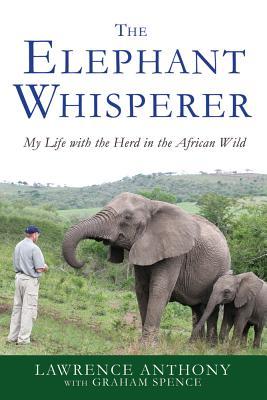
The Elephant Whisperer by Lawrence Anthony with Graham Spence

Paperback, 368 pgs, Pub May 22nd 2012 by St. Martin's Griffin (first published 2009), ISBN13:9781250007810, Lit Awards: Audie Award for Biography/Memoir (2014)

Anthony and Spence do a magnificent job of sharing Anthony's story of settling a herd of seven wild elephants on his 5,000 acres of bush in Zululand, South Africa. I respect his decision to try to extend the reserve to include the neighboring tribal land so that a greater number of wild animals might live comfortably without interference. The elephants get the credit they deserve for being remarkably intelligent and resilient, despite extremely harsh treatment and bad memories early on. It is a source of great happiness that there are such people working tirelessly to create an environment of inclusion in a world that increasingly seems focused on self-aggrandizement.

Nana becomes the troubled herd’s defacto matriarch after the herd’s real matriarch is shot and killed just prior to the herd’s transfer to Thula Thula, Anthony’s game reserve, in 1999. Nana had learned many tricks about escaping from electrified enclosures from her earlier mentor and the herd often worked in concert to outwit their captors. Happily, Anthony seemed to understand that a calming presence and personal connection with the lead elephant could make a difference to the herd’s peace of mind. Slowly, over a period of weeks, he managed to make Nana understand that their new home could be a place of comfort and peace. They stayed and thrived, becoming important members of the reserve’s wildlife bounty.

Anthony shares his experiences in words and photos, and tells of difficulties with poachers, local tribal courts, unruly bushrangers, and with the wild elephants themselves. When money gets tight, he is forced to open a tourist lodge to host foreign guests, but does it with customary goodwill and bonhomie.

Late in the book, Anthony tells us he and one of his rangers went to Baghdad during the early part of the Iraq War to help save the zoo animals, and wrote a book about the experience called Babylon's Ark: The Incredible Wartime Rescue of the Baghdad Zoo. His ranger then went on to Kabul, Afghanistan, to do the same thing there. The experience of living in the bush with these resourceful folks and animals over the period of time it takes to read the book is wonderfully energizing and one hates to leave their company at the end. One feels quite as though one is losing a friend. Anthony is not simply an elephant whisperer, but fortunately a man who spoke to us, too.

Lawrence Anthony died March 2, 2012 at the age of sixty-one. His obituary in The Telegraph of Britain is here. Graham Spence is a journalist and native Zimbabwean who co-wrote three books with Lawrence Anthony. He also writes fiction. A short bio is here.

Paperback, 384 pages, Published May 22nd 2012 by St. Martin's Griffin first published June 11th 2009); ISBN 125000781X (ISBN13: 9781250007810)


You can buy this book here: Shop Indie Bookstores

Sunday, January 26, 2014

Badluck Way by Bryce Andrews

It feels a privilege to read this acutely observed and deeply felt memoir by a thoughtful, literate, conservation-minded ranch hand in southwest Montana. He worked the Sun Ranch in the upper Madison River Valley of southwestern Montana only one year but did enough thinking for far more than that. In his early twenties, Andrews had experience working summers on a ranch outside of Billings, Montana, and was ready when he saw an advertisement for a six-month position as a Grazing Coordinator and Livestock Manager at the Sun Ranch.

Sun Ranch was centered in an important wildlife corridor in the Greater Yellowstone Ecosystem. Wolves had been reintroduced to the area, and there were large populations of elk as well as grizzlies, lynx, mountain lion, and wolverines. The idea was to integrate ranching into a functional natural ecosystem.

I have mixed feelings about cattle ranching in the west and Andrews does, too: “Often, I was tempted to construe ranching as nothing more than a protracted act of violence.” The fences needed to manage cattle are barriers to free-ranging wild herds, and cattle, managed properly or not, can cause enormous damage to a fragile landscape. But Andrews allows us to consider all this while he shares with us reminiscences that hallow our history in the west: he was a cowboy in the modern day.
“Day followed wild day, and over time amounted to a process of seasonal change. Immersion in that constant cycling was the ranch hand’s highest privilege.”

Wolves play an important part in this narrative. Since reintroduction, they had settled in the Madison River Valley, and one pack in particular, The Wedge Pack, lived above the ranch.
”The Wedge Pack, like most others, was a family unit centered on a single breeding pair. Aerial surveys had reported that two consecutive litters of pups had been successfully raised in the foothills and steep valleys behind the Sun…The ranch had been lucky last year. The wolves had stuck to killing elk, and the cattle had come home fat at the end of the summer.”

But the summer of 2006 was different, and the wolves changed up their diet to include Angus beef rather than just elk. Damage to the herd was responded to in the time-honored way: with a rifle. The revenge-killing of an alpha male wolf seemed to cut both ways for Andrews. Concerned with preservation of the wilderness and wildness of the area, he deplored the necessity of killing the predators in the ecosystem but recognized the necessity for it. “Like the Wedge Pack, we did our best to make a living from a hard place.”

Andrews is a wild thing also, like those wolves he talks about.
”Every night, at or after sunset, I ran the benches and hills of the Sun Ranch. I’ll admit I was looking for trouble. When I saw deer or elk from a long way off, I tried to sneak up on them. Using the features of the land—little dips and swales I had never noticed before—I did my best to get close.

It was wicked, feral fun. I drew near herds of deer, elk, and antelope, sometimes crawling on my hands and knees to stay hidden in the sage and grass. When the animals saw or smelled me, I sprinted toward them, scattering them to the horizon. They always left me in the dust, alone and smiling under a many-colored sky.

I chased everything I could—coyotes, jackrabbits, and a badger who unexpectedly turned to fight. Once, in a moment of extremely poor judgment, I ran a black bear up Moose Creek and then looked over my shoulder all the way back down. There was never any malice in it, only simple joy. I loved to feel the wind, lay claim to my landscape by crossing it, and watch the deer outpace me before disappearing in the rising night.”

Andrews managed to find a job that ordered the priorities in his life: he could be in places and do things he really enjoyed and that matter to him and the larger world. He stepped away from the noise of our everyday lives to observe, think, and write. “I am living at the center of my heart’s geography.” We are lucky he took the time to share his findings and remind us of cowboys and the wildlife corridors left in our hearts.

Marcie Stillman conducts a KUOW radio interview with Bryce Andrews that allows us to understand his motivations: “I was my best self when I was working out-of-doors.” “That landscape had beauty and brutality as its two defining qualities.”

The publisher's website has two short videos of Bryce Andrews talking about his work and his reading. I received a galley of this book from Netgalley in exchange for an honest review.


You can buy this book here: Shop Indie Bookstores

Friday, May 10, 2013

Foal's Bread by Gillian Mears

Paperback, 360 pgs, Pub Nov 2011 by Allen & Unwin (first published January 1st 2011), ISBN13: 9781742376295, Lit Awards: Miles Franklin Literary Award Nominee (2012), Prime Minister's Literary Awards for Fiction (2012), Victorian Premier's Literary Award for Vance Palmer Prize for Fiction (2012), Colin Roderick Award (2011), Barbara Jefferis Award Nominee (2012), ALS Gold Medal (2012), Nita B. Kibble Literary Award Nominee (2012)

Gillian Mears’ searing novel of Australia, Foal’s Bread, was sixteen years in the making. It was published in late 2011 with the publishers Allen & Unwin, and then proceeded to win the 2012 Australian Prime Minister’s Literary Award for Fiction and The Australian Literary Society’s 2012 Gold Medal while also winning or being shortlisted for eleven other Australian prizes. While apparently still not available in bookstores in the U.S., it is available new or used from mostly overseas sellers on Alibris, Amazon, or Barnes & Noble. It is worth seeking out. It is high on my list of “Best of” fiction reads for 2013.

This unforgettable saga of a horse woman and her family living in rural New South Wales begins in 1926 with motherless Noey on a pig drive with her pa, Cecil. Her father is proud of her: “wasn’t no horse too tricky that my daughter couldn’t git over a…ladies’ high jump.” So the two of them sign up for the Port Lake Show, one of many such country shows all around Australia in the late summer and fall. Noey is fourteen, and ”built small…she was like a pony come out of the scrub. The hair on it just like a sun-bleached flaxen mane.” At that show Noah meets her future husband, Roley, a consistent winner on the showjumping circuit.

Hard-hitting and psychologically complex, this fiction centers around a fully realized and unrepentantly sexual woman. She is both grasping and generous. She feels more than she expresses and bears as much as she is able. She is tender and terrible in jumping the hurdles in her life, bringing us the sense of a whole person. She is unable to keep her husband and all three children safe from harm, and this knowledge weighs on her.

There are several daring, disturbing, and thought-provoking themes running through this novel, one of which is sexual love for a much older partner. Mears has us wrestle with our feelings about this to some effect. We are unsure what to make of her characterization of the love between Noey and Uncle Nip, and this adds to the complicated feelings we experience while we read. It is quite thrilling to be once again unsure of oneself when presented with the power of her storytelling.

The story itself is rounded and full, holding all the complicated emotions, joys, and disappointments of real life. The language is strong and farm-style frank. We watch two generations on one family farm over a period of some eighty years. The baby George, born “special” and a little simple, makes his family’s lives more joyous than they might otherwise have been because he reflects their love back two-fold. Special, indeed. Roley, Noah’s showjumping husband, struggles with despair as a wasting disease hijacks his limbs. Noey charts his decay, and denied the comfort of her husband’s body, passes through every stage of grief. Suppression of her natural tenderness causes her personality to twist.

The passage of time is marked through the growth and seasonal change of a jacaranda tree, for under its spreading branches and purple blossoms major events are marked. The tree lives on through drought and flood, and just becomes more beautiful as it ages. I still wonder why Mears ended the book the way she did, for I didn’t think her ending was as inevitable as she made it feel, but I concede it does show once again the confusion and emotional distress tearing apart an older Noey.

After finishing this book, you are likely to be curious about the author, rural New South Wales, and the early days of showjumping when obstacles were stacked impossibly high and the country shows were exhilarating and extraordinary. Mears explains her research and her writing in this audio interview with the ABC Book Show host, Anita Barraud. Mears herself knows something about an unexplainable muscle-wasting disease, for she has struggled herself with Multiple Schlerosis for some years. The mystery and arbitrariness of that disease forces a furious frustration on all that come in contact with it.

And what is a foal’s bread? It is not exactly clear, but it appears to be a lump of tissue found within a foal’s placental birthing sac. Dark, hard, and heavy at the birth, it can be dried out, passing through stages until it is light colored and lightweight. It is a rare enough find to be considered a lucky event.


You can buy this book here: Shop Indie Bookstores

Monday, March 25, 2013

Ten White Geese by Gerbrand Bakker

Ten White Geese


It is no surprise that a book about a scholar deeply immersed in the work of Emily Dickinson is also about death. The titular ten geese, by the end of this book, number only four. But this book is about deception, too, and perception; love, and relationships; nature, and gardens. We pass two months in Wales but every season is accounted for. Gerbrand Bakker has created a knotty piece of fine art for us to contemplate.

We never learn how old she is, Agnes, or Emily as she liked to be called. We know she is probably at the end of child-bearing age, so desperately had she tried to conceive. She is an intellectual, writing a dissertation on the poems of Emily Dickinson, that poet she must have once admired but grew to resent. She is ill. We learn that early, along with her sense of being stuck, and unsure in which direction to go.

She arrives in Wales alone, escaping the failures of her past. She walks. One day a badger bites her foot as she lies sunbathing on a rock. Not long after, Bradwen, a boy, and Sam, his dog, stumble into her yard and stay. But statements about events are foreplay here, for there is undertone and atmosphere and references and indications which are more of the book than the story itself. Like poetry, perhaps?

After her encounter with the badger, Emily pulls out her copy of The Wind in the Willows, one of the main characters of which is a badger. The book is mentioned again when Bradwen takes it from the house on his departure. That The Wind in the Willows is mentioned more than once cannot be coincidence. But why that book?

Perhaps we are to draw light comparisons between Emily and Toad for she is at her happiest in the bath; makes a mash of her career; alienates and betrays those close to her; is “on the run.” Bradwen might be Rat, for he carried a backpack and simply takes what he needs for his journeys, offering friendship to Toad when he needs it most, and is locked up while Toad makes his escape.

Bradwen is a curious figure whom we can’t see as a reliable character. He lies by omission, as does “Emily.” He never tells Emily who his father is and how he came to stay in this place, but clearly he is at home in it. He is willing to make meals in exchange for a bed. He shares a comforting, unerotic coupling with Emily, filled more with silence than sound, and worries ever after that his generosity might add to her burdens.

Sam the dog might be Mole, who accompanies Rat and finds the badger. A badger is a solitary creature “who simply hates society”--perhaps the reclusive Ms. Dickinson herself?--clever, generous, and welcoming when another comes to visit, but must be sought out. Friendly but fearful and elusive, the badger and doesn’t ever seem to come when called. Dickinson was apparently better known as a gardener while she was living than for writing poetry. Does this draw a line from Bakker to Dickinson, and badgers?

Gerbrand Bakker writes with a clarity and a depth that borders on knowledge—about pain, confusion, hurt, alienation, even sickness unto death—and in the voice of a woman. “I’m a strange man, maybe, but I think there is no fundamental difference between men and women. A lot of people would say otherwise, perhaps.” (NPR interview, 2013) This point of view may come from his training as a gardener. Humans of either sex are the same species: one sex has basically the same wants, needs, desires as the other—our differences don’t define our essential character. That having been said, this was a woman apart and in exquisite pain. I recognize her, but I hope I never meet (am) her.

Ach. Gerbrand Bakker’s book refuses to leave me. In the same seven minute NPR interview mentioned above, Bakker says that the process of writing this novel precipitated in him a great depression. I am not surprised. But literature can make us think about what man is, and Bakker doesn't leave us bereft. We still have The Wind in the Willows.


You can buy this book here: Shop Indie Bookstores

Tuesday, January 29, 2013

Albert of Adelaide by Howard L. Anderson

Albert of Adelaide


This is a western, set in the bush of Australia, featuring some very unusual characters, among them a Tasmanian devil, a platypus, a wombat, some wallabies, dingoes, bandicoots, and memorably, a raccoon from California. Strange though it may seem, this is not a book for children, nor is it a story written by an Australian. Together, all these facts weave a wonderfully strange allegory of life’s circuitous journey to happiness and fulfillment and some measure of wisdom.

When a book appears outside of the usual genres, it must be difficult to market. But my favorite reader/writers have been raving about this book since its arrival on the scene in the summer of 2012. And so it goes by word of mouth, and I add my own to the paeans of praise.

Albert is a platypus. Naked and alone in his cage in the Adelaide zoo, he dreams of escape—to a life without incessant examination by “faces smeared with cotton candy and jaws that dribbled popcorn.” He has heard tell of “old Australia” which he conflates with “the Promised Land.” He jumps a freight train, heading north carrying a soft drink bottle filled with water…

Many bad things happen, but there are good things, too. “Old Australia” isn’t quite what Albert imagined, but he’s made some friends and sometimes he still dreams of finding a shady riverbank populated by friendly platypussies. Life is a journey, and in this, we travel along with a thoughtful, civilized life form, slow to anger but fierce in vengeance, who can tell a story that makes us see what we might have done better when we ourselves came upon a band of marauding wallaby, terrorizing dingoes, or facing down the brown snake in a cave or in our office.

We come to admire Albert, and wish him well. We’d like to know him, and sit about the campfire trading stories. What more can we ask of fiction?

A word about the author: he is American who has lived as a general roustabout, a perfect background for a writer. He is currently working in New Mexico as a public defender, where he represents people from Mexico charged with crimes north of the border. He is one of the living writers I’d most like to meet.

When an author tries something completely unusual, and succeeds, we need to take notice and support them in their endeavor. Buy this book. You can pass it on after you’ve had a chance to ramble the Outback.


You can buy this book here: Shop Indie Bookstores

Saturday, January 12, 2013

Doppler by Erlend Loe

Some books just hit a nerve, as this did in Scandinavia where it became a bestseller when it was first published in 2004. Just republished in English by Canada's The House of Anansi, this hilarious comic novel about a worthy man's mid-life crisis is destined to be a huge hit in North America. Just about everyone I know needs a copy of this--for its humor, insight, and recognition of our commonalities across national boundaries.

Our narrator is Doppler, a man confused and unmoored by his success. He rails against the Americans for having the temerity to begin a controversial invasion of Iraq while he, busy executive that he is and all, is having his bathroom redone. How on earth is he supposed to concentrate on tile choices? Trust someone to do something truly disturbing just as he is wishing to enjoy the spoils of his wealth.

Mad for cycling (“as a cyclist you’re forced to be an outlaw”), he falls off his bicycle in the woods one day and hits his head. He decides he doesn’t (and perhaps never had) like people. And he is much too nice. “Even when I’m alone and I’ve decided not to be nice, I’m nice. It’s a sickness.” He decides to straighten out his priorities and heads for the woods.

It is difficult to choose just one thing about Doppler that is so very intoxicating, for his adventures and his inherited attributes (“Chopper Doppler”) rival his philosophies for attention. We see the world from the cramped tent of a curmudgeon and we want to see more of him…as does everyone else he runs into. Having decided to be on his own, Doppler finds he has acolytes who follow him everywhere, starting with the moose…

I loved this short novel from its opening pages, mostly because Doppler is so very nice, and civilized. It laughs at the human condition while demonstrating that indeed we can’t really escape ourselves or each other. Perhaps this novel could only have been written by someone who’d experienced the angst and ennui of affluent society, and may only appeal to the same. I found it utterly refreshing and reassuring to find such high-minded humor in such a small package.

A word about the publisher: The House of Anansi Press is fast becoming my favorite press-to-watch for really fine, accessible selections of recent foreign-language literature translated into English.

You can buy this book here: Shop Indie Bookstores