Showing posts with label Graywolf. Show all posts

Thursday, February 1, 2018

So Much Blue by Percival Everett

Paperback, 236 pgs, Pub June 13th 2017 by Graywolf Press, ISBN13: 9781555977825

Percival Everett blows the doors off with this beautifully constructed novel that holds secrets and mysteries in each of its three stories centered about Kevin, an oil painter living in Rhode Island with his wife and two children. I do wonder about Everett, who so gradually has become one of America’s most reliably exciting and unique novelists that his anonymity lasted long enough for him to enjoy some walking-around time without celebrity recognition. That’s probably well over now, if this enormously assured work of fiction garners the attention it deserves.

The work is studded with recognizable truths in the way of great literature but the writing is plain enough that we spot these easily, following his trail eagerly. Describing the way his children looked at him when he was drinking regularly and too much:
“No, I never flew into rages or stumbled late and noisily into dance recitals or yelled a little too loud and made inappropriate comments at soccer games, but I became acutely aware that I wore a sickly-sweet late evening cologne and I noticed how my children looked at my eyes, holding them for too long and looking away too quickly.”
There is a paragraph less than fifty pages in which describes what happens in Paris when Kevin is visiting a museum on a day his wife is traveling. He happens upon a young woman, a watercolorist, who recognizes him and invites him somewhere they can talk comfortably.
“Very close of course was Victoire’s flat. She was, after all, a watercolorist and her apartment was full of them. Thankfully they were not portraits of cows, but there was a preponderance of empty parks and stark river scenes. There was a large window that overlooked a garden. In the middle of the garden was a broken birdbath and I felt a little guilty when I realized I was paying more attention to it than to the many works of art. I turned my attention to her work and found them well done, but ordinary.”
This paragraph with all its conflicted feelings describes a true thing; I know this because it happened to me. I can’t remember now if I was the young woman or the older man. Perhaps I was the younger woman with the eyes of an older man.

Everett does this to us regularly: holds up our experience, or maybe his own, for us to acknowledge. He is always surprising and exact yet comfortable and intimate with us. Sometimes his sentences remind me of the clipped noir of Raymond Chandler or the deeply funny seriocomic social commentary of Joe Lansdale. But Everett is unique. Not only that; each novel is unique.

Almost every novel by Everett is different than the one preceding it, making it seem as though he were reveling in the breadth of the form, trying out methods, working a style. One has the sense of an oeuvre not unlike a fiction chapbook which showcases many forms of popular fiction but which is infused with a self-conscious humor, even parody, always within the realm of literature. It is American literature at core, worthy of study for the pieces Everett chooses to highlight. That standing outside the form is almost missing in this novel, but Everett is sly.

The novel's three strands, each thread in a different country, are widely spaced in time yet carefully braided into one narrative so that no one strand seems dominant nor gets lost as the other stories unfold. The interleaving is so well done it is a model for writers. The only overlap in all the stories is the main character, Kevin Pace; married, living in New England, two children, a painter.

Blue, the color blue, cerulean, cobalt, “the color of trust, loyalty,” ultramarine, blue leaning to green, Guillet green, emerald green. Kevin saw one painting done by the young French watercolorist which was outside her usual style, all done in blues and green running into blue, with a splash of blood red in one corner. It made him cry. It should have been done in oils. Blue was a color he could not control, and it reminded him of something, a secret.

This novel is about secrets, and upheaval, and finding a safe place, and the how paint can reveal truths we cannot speak. Everett is a painter besides being an author, and in 2010 he collaborated with the novelist Chris Abani to produce a journal of Abani’s poetry and Everett’s paintings.

This novel, coming after thirty or more earlier works, seems to bring all that earlier experimentation to glorious fruition. It’s a beautiful novel, full of energy, movement, truth, and color. So much blue.


You can buy this book here: Shop Indie Bookstores

Tuesday, October 11, 2016

All That Man Is by David Szalay

I’ve just found my best book of the year…in a year filled with best books. Szalay (pronounced SOL-loy) writes nine stories about men, different men, each approximately seven years older than the man preceding him. The men are white Europeans, visiting or living in a country not their own. The youngest man is seventeen, the oldest is seventy-three. I laughed my way through this tragicomic look at what it means to be a man, for Szalay put in more than enough to qualify this as the best sort of literature.

Some critics have raised the point that a collection of stories about white heterosexual males isn’t rounded enough without a diverse population. While I crave the author’s take on the immigrant experience or that of a black male in London, the truth is I want his opinion on everything...with jokes, please. He has chosen to share this delicious, mordant look at what adherence to the masculine role has done to several generations of white males adrift in their culture, and that has produced an entirely sufficient and complete work of art. I look forward to what he comes up with next.

Women are the sun and stars about which the stories revolve. Their roles appear to be supporting ones, waitresses, prostitutes, mothers, wives, vacationing lushes, but any woman would recognize that there is ample going on behind their eyes. Their power is undeniable, if only they would seize it. A few of them do. Szalay “fleshes out” several of his female characters, but the most gorgeous one is never physically described, except by the double exclamation, “Wow. Wow.” That was a wise cop-out, sparing the author attacks for focusing on a woman’s physical charms, or for mistakenly forgetting to emphasize a reader’s most fantasized-about body part.

The whole collection of stories together are unforgettable in their descriptions of the haplessness of European white males, but the amusement we experience is tempered by the knowledge that men like these are responsible for fighting wars, closing borders, electing nitwits, denying climate change, and any number of other scourges plaguing our societies. Their lack of self-examination is our annoyance.

Murray Dundee on the “Croatia Riviera” had me screaming with laughter and weeping tears of hilarity. At the beginning of #7, Dundee returns to his mother’s memorial service in Scotland, sleeping overnight in his sister’s house, in his nephew’s bed. He doesn’t sleep well, though he claims he does. Too much thinking going on. Murray has hit a few speed-bumps settling in Croatia in his attempts to 1) make friends, 2) start a business, 3) bed a woman. A local man Murray can’t call a friend, “short, muscular, untalkative - the sort of man that Murray instinctively defers to,” suggests Murray might be cursed, and he does seem that. Murray goes to see a woman about it.
She’s in a dressing gown, A solid, surly woman…like someone who sells you a train ticket to Zagreb, frowning at you through the perforated glass as you try to explain what it is you want, while the queue lengthens. Short hair. Little buds of gold in her earlobes, Breath that smells of cigarette smoke, bacteria.

She says something to Murray in a sharp, imperative voice.

“She says you should relax,” is the translation…

...He has the weird fear that she’s going to ask him to strip.

The stories begin strong and just get deeper and richer as we progress though the novel. The glitz and glamour and misplaced attention in story #8 brought to mind the outsized ambition of Donald Trump (can I ever not see this man in the novels I read?) but I found myself slowing my reading as the stories went on. There is something about the accretion of sorrow and of despair, no matter how funny, that makes us feel these men. There is always the edge of the precipice in sight. Each new story presents the prospect of fulfillment: would you be happy if you…took a sun vacation in the Mediterranean? Had a luxe apartment in the Alps? Took your retirement on the Croatian Riviera? Owned a multi-storied yacht? Unexamined lives and denial bring them there…alone…and their fate, when they realize it is too late to change anything, describes our pain.

In a Paris Review interview Szalay tells us that he originally thought of calling these linked stories Europa. It does seem like a good title, but perhaps the current title with the word “man” in it is more appropriate. Certainly one gets the sense of Europe in this novel, in much of its diversity, but the subject is both broader and narrower than that.

All I can say is if you don’t read this one you are missing something very special indeed. I won’t expect Szalay will top this one immediately (isn’t that the problem with writing something so very good to begin with?), but whatever he comes up with next is going to be interesting. All my chips on the man with the x-ray vision.

This novel has just won the 2016 Gordon Burns Prize, and has been shortlisted for the 2016 Man Booker Prize.


You can buy this book here: Shop Indie Bookstores

Thursday, February 19, 2015

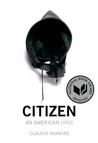
Citizen: An American Lyric by Claudia Rankine

Citizen: An American Lyric
Race is something we Americans still have not gotten right. Rankine’s small book of essays tells us the myriad ways we consistently misinterpret others’ motives, actions, skin color. She writes in second person: "you." It is agonizing to display our flayed skin to the salt of another day. You take to wearing sunglasses inside.

I call these essays while Holly Bass in the NYTimes calls them poems. They are fragments, scripts or screenplays for video or film, shards of thought, sharp and able to pierce one with remembered pain. Bass's review (12.24.14) explains the floating and disembodied hoodie on the cover, black against a field of white: an art installation made in 1993 by David Hammons, long before Trayvon Martin died; before he was even born. Rankine shares a line attributed to Zora Neale Hurston: "I feel most colored when I am thrown against a sharp white background."

Rankine talks of tennis, of Serena and Venus, of foot faults and bad calls. I didn’t know these things: I don’t watch tennis. But foot faults and bad calls are happening on our streets, not within the civilized constraints of a rule-bound tennis game. These I do watch. The agony of the small daily slights crescendo, collapse, avalanche when the police become involved. No wonder people run away from police, our ‘guardians’. We have all learned something these many years and it is not that police are guardians.

Overhead in the conference room: “being around black people is like watching a foreign film without translation.” Yes, it is a cultural difference. They got that right. But that’s all: Nothing more sinister or insoluble. And since we know that America is all about cultural differences, this should be something to celebrate. Or profit from.

My mind slides to Obama, and how I don’t think of him as black anymore. Have whites co-opted him? Or is it because black and white are not as different as we were expecting? That our differences really are only skin deep. I worry that we expected Obama to “fix the race problem.” How can he fix the thousand interactions we have every day between us? By denying any differences? Have we learned nothing, nor made any progress at all? Our divisions may have been exacerbated. Tell me it ain’t so.

Rankine’s essays reference the language of video, of film. My mind skims her short paragraphs and the indignities, the small and the large slights blossom. Together we imagine film, great films, films everyone watches and re-watches, praising the actorly restraint and real-life quality of the slurs...something European in slowness and length…that shows us, white and black and yellow and red…what we say, what we think, what we do…to each other. Catching those moments of misinterpretation, or interpretation, waking up to ourselves—this is what great film does.

There is so much work to be done, art to make, change to happen! The urgency weighs on me. "The purpose of art is to lay bare the questions hidden by the answers": James Baldwin and Fyodor Dostoyevsky agree on definition. The ingredients of art are all around us, fat and ripe and ready to be harvested. There is so much art to be made, so many lessons to learn. Hurry!

Citizen was a finalist for the 2014 National Book Award for Poetry. Claudia Rankine is a poet.


You can buy this book here: Shop Indie Bookstores