Showing posts with label graphic. Show all posts

Tuesday, August 14, 2018

Sabrina by Nick Drnaso

Hardcover, 204 pgs, Pub May 22nd 2018 by Drawn and Quarterly, ISBN13: 9781770463165, URL: https://www.drawnandquarterly.com/sabrina, Lit Awards: Man Booker Prize Nominee for Longlist (2018)

This is the first graphic novel in the history of the Man Booker to be considered for an award. To say it is worthwhile doesn’t capture the real slap these big-bodied, small-headed figures levy. Lives of quiet desperation indeed. There may be some features missing in the frames…don’t all our lives have features missing? This feels terribly urgent, and painful, as though we cannot go another day without talking about it.

Sabrina lives in Chicago and has a life that includes a live-in lover, a cat, a sister, and a mother. One day she doesn’t come back from a walk. Drnaso shares the aftermath, picturing what life was like for those who remained, particularly for her boyfriend Teddy.

What is this story about, besides the central mystery? It is about what we do when our lives are upended, how we act, how we carry on. There are people we will remember as kind, and helpful, and others we will remember as clueless, and poisonous. We have to live in the world despite the horror it can hold. We obviously can decide not to do that as well.

The drawings have a real momentum that ratchet up our stress and fear levels. We are not completely clear on exactly what has happened until some distant midway point. We are as in the dark as the characters. When we finally get the news, we are disinclined to believe it, given all the peripheral noise. And finally, the darn conversations with Florida, and the workmates ostensibly helping with job prospects…they are so real they do not seem fictional at all.

What about the creepy guy in the white pickup looking for the cat? Why was he there, and what did he want? Was he meant to be an ambiguous figure meant to toy with us when we were so suspicious of everything? Was it the suspicion in our own minds that made the experience of meeting him and accepting his help so uncomfortable? If the frames were lighter and the background noise of a woman’s disappearance not concurrent, would we feel such strain upon seeing him in the street?

The ennui we feel upon hearing of a preventable tragedy like a mass shooting by a disaffected youth is not inevitable. Whether or not this is Drnaso’s message, I think those who pick up this book will see that we must not succumb to despair, and that sometimes we have to rely on ourselves, so inner resources are critical. We need to store up those inner resources for rainy days, while working to be kinder, and changing the way we treat one another.

The drawings and captions are extremely effective in conveying mood, attitude, situation. For some reason when characters looked through the closed blinds, I always had a frisson of energy. This sense of one hiding away and being afraid to look at reality stays with me. Maybe we’re all a little like that: too wrapped in our insular worlds an not paying enough attention to people and things around us.

Wake up, Drnaso might be saying.
Regarding the conspiracy theorist Albert Douglas, his resemblance to Alex Jones cannot be overlooked. It occurs to me now that the real Alex Jones may have been trying to see what it would take for some rights to begin to be abridged. I find it difficult to imagine the man is as mad as he pretends: Has anyone camped outside his house to videotape his interactions with family and friends neighbors to see if he is a lunatic off-screen? (I assume he has no friends. Is this wrong?) He may indeed be so conservative he wishes to hoist liberals on their own petard. For many of us who don't listen to Jones, it can be useful to actually hear what he has been saying and how close he strays to the edge...of sanity, or legality.


Tuesday, February 13, 2018

Ghost World by Daniel Clowes

Paperback, 80 pgs, Pub April 2001 by Fantagraphics (first published March 1998, ISBN13: 9781560974277

In one of his interviews, the great graphic novelist Craig Thompson cites Daniel Clowes as a must-read graphic artist he admires. I admire Thompson’s work, so it makes sense I would seek out Clowes. This graphic novel was made into a movie in 2001 starring Thora Birch and Scarlett Johansson. I haven’t seen that yet, but it may well be the first sighting of Scarlett Johansson before big stardom.

A GR friend of mine wrote a deeply insightful meditation on the development of American cities in response to this work, going big in the face of adolescent alienation. As much as I enjoyed that piece, the book made a different impression on me. I’m going to go small: this is a novel of ideas that happen internally and out of sight. All we see is the petulance, the ripple on the surface of a psyche.

A young thin blond girl and a much edgier dark-haired friend who sports an aggressive haircut and heavy-framed glasses are nearing the end of high school. Contemplating their futures, the dark-haired girl wishes to become someone else. “I totally hate myself,” she cries late one night lying on the couch of a boy she’d just admitted she loved. Poor guy.

At that age we are both afraid of and jealous of the complexities adults wrestle every day; we want to try out our problem-handling skills to see if they can measure up. We want the next thing to happen so that we are not merely sitting ducks when it does. Desire for the world and fear of that same world mix unsteadily in our gut. We’re not ready, but when will we ever be?

The ideas shown in this graphic novel struck me as completely within the range of 'normal' adolescent angst, disaffection, confusion, and fear about the world and one’s role in it. We’re pretty obnoxious and self-absorbed at that age, as anyone with a teenager in the house will readily commiserate. Clowes actually plays it so low key we are as bored and unimpressed with their lives as the characters are.

My favorite frame comes near the end when the dark-haired girl is driving the hearse her father graciously bought for her to take to college. Despite having a vehicle and a direction, the girl says she is depressed: “Everything is all the same no matter where you go.” The Buddhists say it like this: “Wherever you go, there you are.”

The tricolor palette in this book works fine: black and white with a green wash. The pen drawings capture the sprawled-leg teenager-y postures, the trying-so-hard-to-be-cooler-than-thou clothing choices and the deliciously descriptive backgrounds absolutely fill in the picture. I thought Clowes was brave to take on the persona of a teenaged girl, but he caught that moment in the lifecycle of a female of the species perfectly.

This is another example, if we needed one, that the writing—including what isn’t said—is as important as the drawing in great graphic novels. So many things have to come together to make a great and lasting work. I admire the heck out of artists working in this medium and encourage anyone who hasn’t picked up a graphic novel lately to try one. It’s hard to read just one.


You can buy this book here: Shop Indie Bookstores

Monday, February 5, 2018

Habibi by Craig Thompson

Hardcover, 672 pgs, Pub Sept 20th 2011 by Pantheon, ISBN13: 9780375424144, Lit Awards: Harvey Awards Nominee for Best Graphic Album-Original, Best Artist (for Craig Thompson), Best Cartoonist (for Craig Thompson) (2012), Will Eisner Comic Industry Awards for Best Writer/Artist (for Craig Thompson) (2012), IGN Award for Best Original Graphic Novel (2011)

In an interview Craig Thompson told his audience that artists must become vulnerable if their work is to mean anything. This dark and agonized work has a great deal of nakedness in it, both literally and figuratively, and a lot of staring directly at human experience and trying to make sense of it. It also looks with a colder, more dispassionate and assessing eye at the overlap in the religious teachings of Christianity and Islam.

This is Thompson’s fourth published work, and one glance inside gives some idea why it took six years to complete. The graphic work is fantastically detailed and patterned, which over more than six hundred pages becomes claustrophobic and oppressive with patterns repeated again and again in different combinations. This is partly due to the size of the pattern, which seems to become more and more compressed as the story progresses, and the more-black-than-white palette.

The patterns are beautiful, and may represent mathematical principles that sustain the progress upon which the world is built, but by the end I got the distinct impression Thompson was asking us to question even that progress: is it good? Who is it good for and how can it be modified to suit a different world with better outcomes? One is not accustomed to such weighty questions in the work of graphic artists.

Thompson is unique in many ways, but certainly the source of his questioning may come from his fundamentalist Christian upbringing in rural Wisconsin, an upbringing he explores in his second graphic novel and the first large-scale project of his career, Blankets. Thompson freely admits he still believes in God, but he is less sure now how best to worship him.

That his father was a plumber Thompson credits with the understanding that water is precious. This book is plumbed through with references to the primacy and importance of water in our world, our lives. This aspect of the book was another piece that elevated the story-telling to something essential.

Some discussion among reviewers condemns the sex, violence, and numerous representations of the naked human form depicted in this work as gratuitous. I will argue that is not the case. There is no question that the storyteller in this case is frightened by and ashamed of his powerful sexual feelings, but his arousal is well within the bounds of normal male sexuality and should, in fact, educate readers about the conflicted emotional trauma that can accompany the physical manifestations of desire.

In the years Thompson worked on this book, he learned to appreciate and to write some Arabic script, but never learned to speak. His translators and friends in the endeavor to understand Islam—its culture, science, and art—reviewed the story he created to check for realism and racism. In the end, any understanding readers take away about the religion or culture of the region belong to Thompson alone, but I suspect he feels confident in his depiction.

Simply sketched, the story is as follows: a light-skinned girl and a dark-skinned boy find themselves orphaned in the desert. They make a life and grow up together for a period of years before they are violently separated. They spend a long period of time hoping to find one another again and then one day, they do. The story has an impetus and emotion even without the later personality-defining moments of coercion and despair depicted with the same pitiless camera-eye that captured their earlier life.

If I say that there are many complications and observations along the way, it will give you scant warning for the deluge that is to come. This work is huge, covering enormous ground, picking up and putting down again many topics worthy of examination and discussion. It is overwhelming, as it undoubtedly was to write. I have never determined how an editor deals with slimming the opus of an auteur. The only thing I can think of is that cut pages or threads could be sold separately once the work has been published to acclaim.

Thompson’s willingness to look closely at who we are evinces in me admiration and gratitude, not censure. I look eagerly forward to what he decides to do next, whether it be drawing, writing, or something else of his choice. He is extraordinary in every way.


You can buy this book here: Shop Indie Bookstores

Thursday, January 18, 2018

Blankets: A Graphic Novel by Craig Thompson

Paperback, 592 pgs, Pub Aug 18th 2003 by Top Shelf Productions (first published July 1st 2003), ISBN13: 9781891830433, Lit Awards: Harvey Awards for Best Graphic Album of Original Work, Best Artist (for Craig Thompson), & Best Cartoonist (for Craig Thompson) (2004), Salón Internacional del Cómic de Barcelona for Premio del público a la mejor obra extranjera (2005), Will Eisner Comic Industry Awards for Best Graphic Album–New (2004)

Wow. Every bit as earthshaking and meaningful as Marjane Satrapi’s Persepolis, this graphic novel by Craig Thompson published in 2003 by Top Shelf is one thoughtful Americans do not want to miss. Christian evangelical notions of life on earth and what comes after are a huge part of the narrative of our nation. Even today when our population is more diverse than ever, the history of these core beliefs within our citizenry continue to affect the direction of our politics.

Teenagers instilled with these notions rarely have the intellectual wherewithal to question those received ideas. Paradoxically, perhaps because of those early teachings and the constraints of his upbringing, the author--the main character in this memoir--has the discipline and strength to look squarely at his life, the beliefs of his parents, and think again.

This graphic novel won two Eisner Awards, three Harvey Awards, and two Ignatz Awards in 2004 and a Prix de la critique for the French edition a year later. A strict Christian evangelical family raises two sons in rural Wisconsin; we watch the boys grow up from sleeping together in the same room/same bed they move to their own rooms, go to summer camp, get harassed at school, romance a girl.

Sometimes graphic novels get a few things right, like the artwork, or the pacing. In this case, Thompson seemed to get everything right. The growing up story is poignant and real and revealing about farm life in Wisconsin in a close-knit religious family. Craig goes to visit his girlfriend Raina who lives in the snowiest city in the contiguous United States, in the Upper Peninsula of far north Michigan....in winter. We are treated to Raina's home life as well, another Christian family who struggles under enormous pressures.

Graphic novels are especially impressive because they must portray characters from an endless array of angles, and in this case, we recognize a character as he grows over a period of years. Moreover, we are feeling that character struggle with the promises and constraints of his religion and the actual manifestation of those teachings that he can see. When Craig’s pastor suggests he consider a religious calling, Craig seriously contemplates the idea.

The graphic novel drops into lower gear here and we see the quality of the intellect behind the work. Craig’s thinking and research into the Bible is Jesuitical, deep and challenging, and he is left with too many unanswered questions and lingering doubts. Different mentorship probably would have produced a different result. This portion of the book is careful, allowing Craig to slip away, leaving the door to his family open, and conflict at bay.

Thompson’s drawing skill is exceptional and smart, unmistakably capturing movement from life. The group scenes are especially exciting; for example, he might draw a high school cafeteria with many tables of students doing all manner of shenanigans. It is Bruegel, in ink. Thompson didn’t hold back on this book: it is 582 pages, not including the credits. He took the time to draw out his religious questioning and didn’t rush us through his moments of insight and revelation.

I especially appreciated the belly laughs he led us to near the end of the memoir when some of the church elders in his hometown warned Craig not to consider going to art school, lest it lead him to sin. Our hearts nearly break with what the teen will miss if he doesn’t follow his passion, but again he manages to avoid confrontation while following his dreams.

Thompson has continued his remarkable success, and in 2011 Pantheon Books published Habibi, a book Thompson had begun working on in 2004 after traveling in Europe for a time. Influenced by Arabic calligraphy and Islamic mythology, Thompson tells us  "I'm playing with Islam in the same way I was playing with Christianity in Blankets.” [Wiki].

Below I have posted two videos of Thompson demonstrating and discussing his work. The first is short and covers his childhood and all books. The second is a 56 minute interview, with slides, of Thompson discussing Habibi. This man completely knocks me out; I am wowed by his work, and the depth and scope of his intellect. Highly recommended.


You can buy this book here: Shop Indie Bookstores

Thursday, August 17, 2017

The Art of Charlie Chan Hock Chye by Sonny Liew

Hardcover, 320 pgs Pub March 2016 by Pantheon (first pub May 2015) ISBN13: 9781101870693 Edition Language English URL http://www.artofcharliechan.com Literary Awards Singapore Literature Prize for English Fiction (2016), Will Eisner Comic Industry Awards for Best U.S. Edition of International Material—Asia, Best Publication Design, and Best Writer/Artist (for Sonny Liew) AND nominated for Best Graphic Album—New, Best Coloring (for Sonny Liew), and Best Lettering (for Sonny Liew) (2017), Singapore Book Award for Book of the Year and Best Book Cover Design (2016)

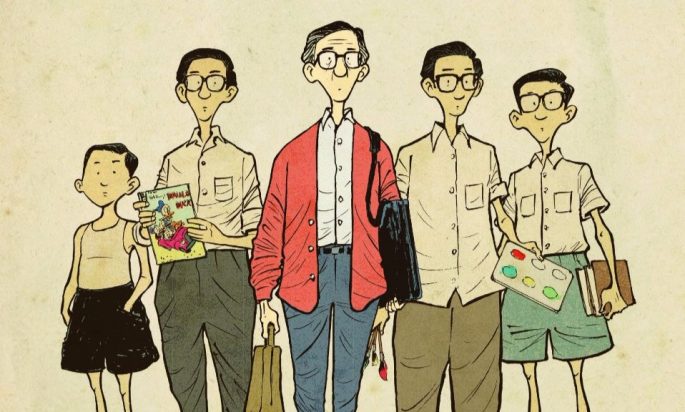
For graphic artists, there are must-reads of the genre that direct the eye to advances in the art, and Sonny Liew’s contribution may well be one of those. Liew shows us many types of comic book art, discusses their genesis and early creators, but also seamlessly melds the story of an artist, Charlie Chan Hock Chye, with the story of the political and economic development of Singapore. It is a masterful work of enormous depth and sensitivity that answers questions I’d had when contemplating the entwined histories of Singapore and Malaya.

I really went down the rabbit hole with this work because it has so many layers and levels of reality and history that I immediately wanted to talk to someone about it or hear an interview. I had been constantly walking way from the piece, trying to realign my thinking about who was telling the story. Sometimes it seemed like it was written from the point of view of this artist and comic-book writer, Charlie Chan Hock Chye, born in Singapore in 1939, and all his life aspiring to be Singapore’s own greatest graphic artist and political commentator.


Sonny Liew was merely republishing, or publishing for the first time, Charlie’s work, including a graphic autobiography begun late in his fifth decade of life and left unfinished until his seventh decade. But occasionally Liew would pop in and add commentary since he was showing us only representative pieces and scraps of Charlie’s body of work. Charlie took the writing of episodic and serialized comic novels to the pinnacle of political commentary, making such astute analysis that he was having trouble getting his work published in the conservative political environment of a colonial city-state and its aftermath.

A high point for me was the RoachMan comic series which imagined a man in 1950s Singapore whose back-breaking job it was to collect honey pots of night soil from houses in traditional neighborhoods. One day on his rounds he is daydreaming about the resilience of cockroaches when—suddenly— he is bitten! Over the next days and nights he feels delirious and tingling sensations only to discover when he is nearly mowed down by a car at night that he has acquired new physical abilities…

Of course, it did occur to me to wonder about the choice of a cockroach as a hero, but Liew tells us that Charlie’s idea was picked up and changed slightly for the Spiderman comics that were popularized in the English-speaking western world the following decade. What looks like formerly scotch-taped examples of his pages are reproduced for us to judge, the artwork changing and so amazingly similar to famous Marvel works that we wonder which came first.

All the while, we are experiencing Charlie’s day-to-day reality finding a publisher, and creating characters that reflect the city’s struggle for political leadership. This is no ordinary comic. It is dense with history, drama, commentary, humor, and art. When Liew pops up again to provide commentary—we can tell it is Liew who sometimes writes captions—we need to slow down and ask ourselves which person is talking because it matters to the interpretation—one is concurrent with events and one is long afterward.

Spoilers won’t ruin this piece for you, but I just want to say that the ending is terribly poignant and meaningful; we feel as though Liew has given us a great gift to have introduced us to this unknown cartoonist, who finally finished his autobiography. He’d travelled to Comic Con in San Diego in 1988 after an entire career in comics, bringing with him representative samples of his work. That episode is included in the final pages. I won’t tell you how it turned out—what Charlie saw or who saw him—but suffice it to say it provided grist for mill.

Charlie Chan Hock Chye’s story feels like it has burst onto the scene with the power of a neutron bomb, laying all other artists flat because of its virtuosity and depth. We are intensely curious about how Charlie could escape attention for so long, but also wonder about the connection between Sonny Liew and Charlie. The book won three 2017 Eisner Awards at this year’s Comic Con, for Best Writer/Artist, Best US Edition of International Material—Asia, and Best Publication Design Winner.

Read the book first, and then get a taste of how it has been received in the U.S. by checking out the Comics Syllabus 008 podcast produced by Paul Lai who interviews Sonny Liew about the book. Also, below I have posted a short Epigram Books clip of Liew talking about the book’s conception and execution. But read the book first. Get the whole experience.


You can buy this book here: Shop Indie Bookstores

Saturday, June 3, 2017

Hostage by Guy Delisle

Hardcover, 436 pages Pub April 25th 2017 by Drawn & Quarterly (first published September 16th 2016) Orig Title S'enfuir. Récit d'un otage. ISBN13: 9781770462793

With this new book released in the U.S. in the spring of this year, French Canadian graphic artist and animator Guy Delisle takes a departure from his more usual graphic novels about his life as the spouse of a Médecins Sans Frontières physician to tell the story of a real innocent abroad, Christophe André, on his first assignment for MSF in Ingushetia, in the North Caucasus in 1997.

Christophe was taken hostage, driven across the border into Chechnya, and outside of Grozny he was held for ransom for three months. He had been in his post for three months when they came for him. He spent the bulk of his captivity chained to a radiator in a small room with a mattress stuffed with straw. He was fed watery soup and allowed bathroom breaks, but otherwise had no opportunity to speak, see the sky, move freely.

Ransom negotiations were slow: when he escaped, finally, the translator assigned to his office in Ingushetia told him other foreigners had been kidnapped in the time he was being held. The 400+ pages of this book are not a struggle; readers spend the time thinking about what they might do in similar circumstances, and interrogate themselves about the scene and their own strengths. André himself passed the more terrible stretches by recalling in great detail the military commanders, battles, and outcomes he had studied when he was younger, including Russian, French, and American battles.

The escape at the end is harrowing, and stomach-dropping. André simply did not know whom to trust. Eventually he made it back to his home in Paris, and six months after that went back to MSF and asked for a new assignment. He worked twenty years for MSF after that experience.

Here is a Public Radio International The World radio interview with the artist Delisle about this new book, Hostage, the kind of story that lingers in one's memory:


You can buy this book here: Shop Indie Bookstores

Monday, May 22, 2017

Jerusalem: Chronicles from the Holy City by Guy Delisle

Hardcover, 336 pages Pub April 24th 2012 by Drawn and Quarterly (first published November 16th 2011) Orig Title Chroniques de Jérusalem ISBN13: 9781770460713 Edition Literary Awards Prix du Festival d'Angoulême for Fauve d’or du meilleur album (2012)

This is an appropriate time to take another look at Jerusalem, and Guy Delisle’s book can explain to you the in and outs of what U.S. President Trump is seeing while he is visiting.

Guy Delisle is a graphic artist who accompanies his wife, a Médecins Sans Frontières physician, to hotspots around the world. While in the past he has been able to work as an artist while overseas on assignment, every posting is different, and the one in Jerusalem did not lend itself as easily to sketching outside, teaching in universities, giving shows on his work, and concentrating on finishing his drawings in a systematic way.

The very thing that makes Delisle effective in his role as graphic artist and stay-at-home husband and dad also makes him a frustrating on-the-ground observer. He is almost resolutely non-partisan and non-political. When bombs start to fly in Operation Cast Lead over the holiday period Dec 27, 2008-January 16, 2009 he tells what he heard from his position at home, but he wasn’t interested in being an observer. He also wasn’t interested in interviewing settlers in Hebron when he was asked to do graphic reportage there.

By the end, however, I could see the value in his distanced, uninvolved view. He drew what he observed, without much editorializing. He drew the extreme care some security guards took in checkpoint and airport security work, the difficulties Palestinians had in getting around, working, living, and planning for the future, he drew the wall, and the pushing Palestinians out of their homes by settlers in the West Bank.

Delisle saw the sights Jerusalem had to offer, always on the lookout for interesting or peaceful places to bring his wife and children, or somewhere he could work uninterrupted. Eight months into a twelve-month tour, the pastor of the Lutheran church Augusta Victoria, on the Mount of Olives, offered Delisle a room in which to work. It was quiet and the only distractions were Delisle’s own thoughts, and a large organ which sent vibrations through his space. He found that he’d accustomed himself to grabbing the in-between moments in his hectic daily life, and the peacefulness of the church was made it more difficult for him to complete his projects, paradoxically.

Delisle spent many frames drawing the wall: “It’s graphically interesting,” he would explain. The wall through Jerusalem cut Palestinians off, in some cases, from their school, from their work, from their own land. What I particularly liked was his dividing the chapters by months of the year. Some months had considerable drama, but others reflected his dawning understanding about the situation and his learning to make up his own mind about what might be excusable behavior and what seemed like taking advantage.

Throughout the mostly black-and-white book, a map of Israel with the West Bank and Gaza drawn in chartreuse served to remind Delisle and readers that the amount of space allocated to Palestinians in Israel is very small, and Israeli settlers are pushing them away even still. The violent tactics and language the settlers use, the virulent criticism heaped upon the government and activists by the press, can be shocking to those of us who are not used to such extreme positions. “The vast majority of Israelis vigorously disapprove of the extreme behavior of the Hebron settlers.” It is hard not to respond with derision to statements like these, and it is hard to see that restraint is working to underline the urgency of the situation for Palestinians.

The currents of daily life are portrayed effectively by the end of this thick graphic novel (336 pages), and Delisle’s tone and lack of interest serve his purposes well. Despite his occasional missteps (when discussing Hasidic Jews, for instance), his intentional ignorance gives us and him the opportunity to look at the situation anew.

I ended up ordering Delisle’s Pyongyang: A Journey in North Korea and also his book Burma Chronicles. He has another, called Hostage, which debuted in English in 2017, translated from the French. Hostage tells the story of MSF employee Christophe André, who was captured in Russia’s North Caucasus in 1997 until he managed to escape months later. Public Radio International has a description here. From that link, we learn
”And the truly surprising end of the story is this: Just six months after he escaped, André showed up at Doctors Without Borders and asked for a new assignment. He stayed on with them for another 20 years.”


You can buy this book here: Shop Indie Bookstores

Wednesday, April 26, 2017

Waltz with Bashir: A Lebanon War Story by Ari Folman & David Polonsky

Paperback, 128 pages Pub February 17th 2009 by Metropolitan Books (first published 2008) ISBN13: 9780805088922

The 2008 animated documentary of the same name by Ari Folman and David Polonsky took four years to complete. The frames of this graphic novel may have come from the film itself, and the sense of the film is uncannily captured without the sound or movement. Both book and film are so powerful I could not make it through in one sitting. A tremendous sense of anxiety and foreboding is generated by white/brown/black monochrome washed with an acid, chemical yellow, the slavering wild dogs, and the dissociative reality of war on a beach.

For anyone who hasn’t seen this film or read the graphic novel, I urge you to put aside anything else you have on your plates the minute you obtain a copy of either. It probably won’t take more than an evening to read/watch this remarkable act of witnessing, and you will remember it for the rest of your lives. Folman was a nineteen-year old recruit in the Israeli army when he was sent to Lebanon in 1982 to stop PLO rocket attacks and to retaliate for an assassination attempt on the life of Israeli ambassador to the United Kingdom.

At the time, many displaced Palestinians were living in refugee camps in southern Lebanon in permanent structures like houses. Their lives did not look temporary, but there was always agitation because their refugee status did not change. In Lebanon, the sectarian Christian leader Bashir Gemayel aggressively challenged (some might say crushed) the rights of Palestinians and Muslims, and shortly after he became president-elect in the 1982 presidential election in Lebanon, he was assassinated.

Gemayel’s party, the Christian Phalangists, took their revenge on two refugee camps, Sabra and Shatila. Israeli forces were slow to recognize and respond to an unfolding massacre. It appears they simply did not recognize the evil for what it was--it was too monstrous. The scars of those days left many men unable to understand what had actually happened in September 1982 and their role in it. Forman and Polonsky managed to show us that paralysis that comes over someone, even a group, when something bad is happening. The men protested up to their leaders, but not loudly, confidently, definitively enough. This phenomenon is not unknown. It may even have happened to us.

Much of the story is about the elusive nature of memory, and what scars the trauma of war leaves. The authors decided not to try and give voice to the other participants in this extraordinary event, but to just focus on the point of view of someone who was there but not directly implicated in the killing and who retained no memory of the time. We can forget these times of trauma, which is why the Holocaust is constantly referred to and memorialized. One must remember in order to forestall similar atrocities in the future.

The art in the film and the book is exceptional for its originality. The drawings are a certain kind of primitive and for that reason are all that we can project onto them. It may be the horror is something we bring because objectively speaking, until real photographs appear at the very end, events are only hinted at: we have the blank stares of the affected soldiers and the bizarrely horrible sudden deaths of soldiers playing on a beach—and this all from the point of view of what might be called the Israeli bystanders.

They were part of the army, and they had ordnance, but they had little passion for battle, the Israeli participants. The Phalangists were the actors in this case. I am reminded of Montaigne: "There is no hostility that exceeds Christian hostility." The whole record of the movie and the book should go down with oral histories of ancient battles not at all heroic but horrible and instructive and something forever to be avoided.

After making this film, Ari Folman said he no longer has interest in traditional filmmaking. There was something even more exciting to him about the art of David Polonsky, who tried using his non-dominant hand to draw so that the smoothness of caricatures did not distract from the roughness of the subject matter. Animation was a relatively new industry in Israel when they began, and since they had no infrastructure, they made decisions that more practiced and wealthier studios may not have made.

Both the film and the graphic novel are for grown-ups, or for people who want to be grown-ups.


You can buy this book here: Shop Indie Bookstores

Wednesday, December 7, 2016

March (Books 1,2,& 3) by John Lewis, Andrew Aydin, and Nate Powell

The third book in the graphic novel series March won the National Book Award for Young People's Literature in 2016, prompting a look at the trilogy. John Lewis’s extraordinary life growing up on a farm in Alabama is told in flashbacks, linking to the opening frames of Book 1 which depicts Lewis’ office in Cannon House Office Building in Washington, D.C. in January 2009.

Our perception of the fifty-odd years between Lewis’ childhood and Obama’s inauguration changes as we read, sometimes thinking fifty years sounds like a long time, and then realizing it’s only fifty years. How radically different living conditions were then, outside of cities. Blacks were still being blatantly discriminated against in every way, and the first civil rights legislation was just being proposed, passed, and enacted. This is the story of the resistance.

Lewis’ early work began with protesting segregation at lunch counters in Nashville, Tennessee, and then moving on to protesting segregated movie theaters, swimming pools, and universities. He wrote to organizers of the Freedom Ride, a planned action on Greyhound buses from D.C. to Louisiana. The Freedom Riders sought to challenge bus companies ignoring the recently-passed Supreme Court ruling on Boynton v Virginia which disallowed discrimination on buses or in bus stations. Lewis was allowed to participate in that dangerous but ultimately successful protest action before moving on to protesting lack of access to the vote for blacks in Mississippi.

The continued pressure of constant insistence on political rights for people of color across the southern states provoked violent push-back, but the disciplined, nonviolent tactics of Lewis’ group were surprisingly effective. It is valuable for us now to know how difficult it was for the nonviolent arm of civil rights groups to negotiate not only with the folks opposing their rights, but with their own colleagues. The stress of repeated beatings, killings, jailings, and threats was pushing attitudes toward a more robust form of protest. The authors describe differing voices, alternative views.

Lewis and the man whose delivery of nonviolent “social gospel” which influenced his own speeches, Dr. Martin Luther King, Jr., helped to hold back the swelling tide of violent resistance long enough to celebrate national recognition for their efforts culminating in the Civil Rights legislation of 1964 and the Voting Rights Act of 1965.

Lewis had a front-row seat to all that was going on in the south and in Washington. He was head of Student NonViolent Coordinating Committee and as the youngest of the “Big Six,” representatives of the most impactful civil rights organizations, he met with Presidents Kennedy and Johnson and Attorney General Robert Kennedy. Lewis has a story to tell, and in this collaboration with two younger men, show us how momentous his contribution.

The whole trilogy is a focused and detailed look at the Civil Rights movement from the point of view of John Lewis for approximately a ten-year period 1955-1965. The encapsulation of a real life into a series of picture frames and dialog boxes is a difficult thing to pull off, but Andrew Aydin and Nate Powell do it beautifully, never talking down to the reader, nor reaching so high that the concepts can’t be grasped immediately, viscerally even. This is life and death stuff, and they leave a little of the horror in for us to contemplate, but the steady focus and preparation necessary to challenge political power comes across as well. As does the bravery of those who dared to resist.

Get this trilogy if you have teens. This is worthy.


You can buy this book here: Shop Indie Bookstores

Sunday, October 23, 2016

The Arab of the Future, Part 2 by Riad Sattouf, translated by Sam Taylor

Volume II is a continuation of the adventures of Riad as a young French-Arab in Homs in the mid-1980s. Riad is still a child, blond-haired and six years old. He is ready to go to school for the first time, and is terrified. With good reason, it turns out.

Sattouf positively outdoes himself drawing scenes from the classroom. The headscarf-wearing teacher has a skirt so short and legs so large that our eyes widen in fear. Riad takes a frame to zero in on the impossible narrowness of her high heels, her calves looming dense and heavy above, like a boulder snagged over a walkway. She looks dangerous. That is to say nothing of the smile she holds a second before she strikes the boys on the palms with a wooden rod. Nothing so thin as a ruler, her tool is a rod that looks very solid and hard in her hand.
"Ha, ha, [Riad’s father chortles that evening] you’re funny. You’re just like me at your age. Scared of everything…Don’t worry, nothing will happen."
More false words were never spoken. Lots happens, and much of it is life-threatening. But perhaps most importantly we see the utter cruelty with which people treat one another. If there was ever a time to be grateful for political correctness in our daily interactions, after reading this you will breathe a sigh of relief for those tedious niceties. You will remember the menace of schoolyard bullies, and realize Arab society, in Syria at least, is taught this is normal human behavior: to be admired if you win, killed if you do not.

Sattouf takes his time with this installment of the story of young Riad. We spend a couple of days sampling the coursework in first grade: patriotic songs, basic characters for writing, reading skills without comprehension, and inventive slurs and punishments. We meet the neighbors: a police-chief-cousin whose stash of gold jewelry could finance a bank, and whose home is a huge unfinished concrete pile cratered with moisture-seeping cracks. We go on a day trip to Palmyra with a general while Riad’s father spends his time trying to wrangle the general into “putting in a word” for his advancement at the university where he works. Palmyra is littered with ancient-looking pottery shards which Riad’s father disdains.
"In the third century after Jesus Christ [Riad’s father says dully, lighting a cigarette] Zenobia turned the nomad’s city of Palmyra into an influential artistic center."
Riad returns to France and enjoys it at the same time he begins to realize he is changing…has changed. He is a desert child now, confused with the plenty that surrounds him in France. It is a poignant section we all recognize for its dislocation. He does not read or speak French particularly well. The French language is difficult, and complicated. Where does Riad fit in? Where does he belong? Where will he be accepted?

The scenes of RIad with the men in his community when he returns to Homs are memorable. Very little is said; the drawings do the work here. I did not understand all that was implied, but someone will. Perhaps the punchline will be revealed in another installation of the life of Riad in Syria. Riad’s father is becoming more and more unbearable as a husband, as a father, as a man. He is hopelessly out of his league wherever he is, and always aspirational, never in control. His wife is losing patience, and he himself is recognizing a few hard truths that have him sitting by himself in some frames, smoking and silent.

Sattouf leaves us feeling unsettled and unsure. Do we want Riad in this place with these people? I think his mother is feeling similarly unsure. The father…one gets the sense that however much the father thinks he is the man, there is precious little he does control.

This installment just cements my sense that this kind of graphic novel may be the easiest, most immediate, most fun way to learn about a culture. When it is done well, a boatload of information can be transmitted in a couple of frames. Sattouf appears to be completely frank about life in Homs as he sees it, and it is remarkable for its insights as well as its humor.

I love this series and will insist upon reading everything about Riad growing up. The Tintin series was the first set of books Riad had access to, the series being only one of two books his academic father had in his personal library. The other book was the Quran. Will look to see if I can see the influences from Tintin in Sattouf’s marvelous story of growing up Arab before his third book hits the stands.

The terrific translation of this work is done by Sam Taylor, and the U.S. publisher is Metropolitan Books, a division of Henry Holt.

Paperback, 160 pages. Published September 20th 2016 by Metropolitan Books (first published June 11th 2015) Original TitleL'Arabe du futur 2 : Une jeunesse au Moyen-Orient (1984-1985) ISBN 1627793518 (ISBN13: 9781627793513)


You can buy this book here: Shop Indie Bookstores

Friday, November 6, 2015

The Arab of the Future: A Graphic Memoir by Riad Sattouf

This memoir in the form of a graphic novel by Riad Sattouf is positively terrifying. It only takes an evening to read, and I can guarantee you will not want to put it down.

A cartoonist and former contributor to Charlie Hebdo, Sattouf now has a weekly column in France’s L’Obs. This graphic memoir is translated from the French by Sam Taylor and published in 2015 by Metropolitan Books, and tells of Sattouf’s early childhood in France, Libya, and Syria.

The memoir is terrifying for what it tells us of the consciousness of a Sunni Arab man and his extended family, as well as the conditions in the late 1970s-early 80's in the cities of Tripoli and Homs. Sattouf engages our sympathies immediately by starting out his descriptions from the eyes of a blond two-year-old, who we might expect to be perplexed wherever he was, being new to the world. But this turns out to be the perfect vehicle for presenting the things he sees, hears, smells, and experiences with a disingenuous honesty, though, I must admit, the consciousness of a child. It is as disarming as it is damning. We laugh and cringe at the same time.

Sattouf is choosing what to tell us about his upbringing with the consciousness of an adult. He shows the peculiarities of early education in France, and Syria. Both have failures, as a system. It’s a wonder we survive at all, but less surprising that we exhibit the flaws we do. He has a finely honed skill for cutting away the extraneous, and revealing the kernel of his experience. He makes it laughable, but at heart, it is also terrifying.

Riad’s Syrian father, Abdul-Razak, is the first of his family to read and is (therefore?) considered a great scholar in Syria. He is sent to study history at the Sorbonne and manages to wed an unworldly French student, Clementine, who is studying in Paris. Clementine is from a small village in Brittany and when they both graduate, Abdul-Razak accepts a position teaching in Tripoli, Libya. You have got to read this to enjoy it. I don’t want to spoil your fun. It sounds just about what you might expect with Qaddafi in charge, only even worse than you could imagine.

The family returns briefly to France, and then pack themselves off to Abdul-Razak’s home village outside of Homs, Syria. By this time Riad has a new dark-haired brother, but his own hair is still blond. He is teased (and beaten up) mercilessly in Homs, where the children harass him with expletives while calling him “Jew.” Conditions of everyday life in late 70's Syria sound positively crushing in this period Hafez al-Assad, Bashar al-Assad’s father, was in charge. Riad’s family was Sunni; Assad was Alawhite. Segregation by religion, by sect shouldn’t surprise me, but the extent and result of it is stomach-roiling. Riad’s dear father, Abdul-Razak doesn’t sound more enlightened, for all his education.

I am reminded of Richard Dawkins’ The God Delusion in which he writes that early childhood inculcation into any religion is one of the most damaging things that can happen to the impressionable mind. One cannot help but agree when one sees what it has done in cultures all over the world. In this part of the world hatreds last for millennia, perhaps due largely to childhood inculcation of religious ideology. Riad’s father buys him a plastic revolver as a toy. “All boys like weapons,” he says. Does it follow, I wonder, that all who like weapons are still boys?

What Riad captures in this work is the deeply ingrained and insufficiently informed nature of the racism and sectarianism in each of the countries in which he has lived. He also captures realistically grim pictures of living conditions in each country, as well as the good bits: in France, we see an education system that seems to work well for enrollees; in Libya, we see ancient ruins by the sea that evoke history better than many other ruins; in Syria, we see the memories of a school-aged Abdul-Razak bring him back to a simple life. But each is a comfortable deception that people feel comfortable telling themselves. Family ties were more important than whether your relatives were good people or not, and obligation takes the place of generosity.

Riad’s drawing skill is such that one can envision the environment quite clearly. It is better than a photograph since Riad can add the elements he wishes to emphasize. In the New York Times review of this title, as well as The New Yorker 10/19/15 review, called "Drawing Blood, we learn that Riad has a few more installments planned for this series, and I look forward eagerly to other adventures as he grows older. He has a viewpoint that is not all sarcasm. He so far has spared his mother, who comes across as a bewildered alien in a hostile environment.

Riad’s work has the sting of criticism, but since he presents it through the eyes of a child, adult readers are meant to add their own gloss, knowing what we do about the perceptions of a child. Let’s see what he comes up with next, enjoying this and making up our minds later about whether he oversteps the mark.


You can buy this book here: Shop Indie Bookstores

Tuesday, March 3, 2015

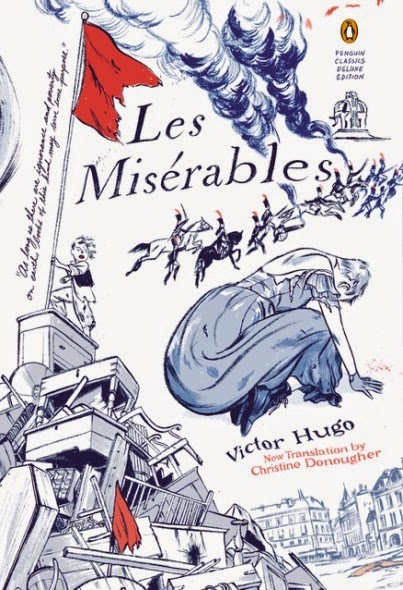
Giveaway for Penguin Classics Deluxe Edition of LES MISÉRABLES


This is a completely new translation of Victor Hugo's classic tale--the first in forty years for Penguin Classics. It is being widely hailed as an exquisite and contemporary translation by Christine Donougher of Hugo's sometimes chatty/sometimes outraged voice so that it seems like a commentary on the state of today's "Occupy" nation of haves and have-nots. I can't wait to have a look at it. Though the size of translations of Hugo's work are daunting to contemplate, this edition should lead you into the riches of this classic tale.

The cover art shown above is by the widely admired illustrator Jillian Tamaki, whose work you may have seen in the NYT Book Review. If you would like to share in the exciting experience of (re)discovering Victor Hugo's classic, Penguin has agreed to send a Deluxe Edition of this book to one U.S. resident. Please sign up on the secure form below. And in the meantime, take a look at some of the buzz about this book that has just hit bookstores.

(Penguin Classics; On Sale: February 24, 2015; $23.00; ISBN: 978-0-14-310756-9)
--------------------------------------------------------------------------------------------

Hugo’s epic tale of injustice, heroism and love follows the fortunes of Jean Valjean, an escaped convict determined to put his criminal past behind him. But his attempts to become a respected member of the community are constantly threatened—by the relentless investigations of the dogged policeman Javert and by his own conscience. The stakes are high for Valjean, who has promised to protect the daughter of Fantine, driven to prostitution by poverty. And as his freedom is threatened, revolution breaks out in Paris, with far-reaching consequences for Valjean, his loved ones, and Hugo’s expansive cast of misérables.

In his introduction to LES MISÉRABLES, Robert Tombs praises the “literary power, intellectual sophistication, and subtlety of observation” of Hugo’s revolutionary masterpiece. Featuring a beautiful cover by acclaimed illustrator Jillian Tamaki and clear, illuminating notes by Donougher, this new edition invites readers to discover—or rediscover—the timeless narrative force and startling relevance of one of the world’s great novels.

About the Author

Victor Hugo was born in Besançon, France in 1802. In 1822, he published his first collection of poetry, and in 1831 he published his most famous youthful novel, Notre-Dame de Paris. A royalist and conservative as a young man, Hugo later became a committed social democrat and was exiled from Paris as a result of his political activities. After his death in 1885, his body lay in state under the Arc de Triomphe before being buried in the Panthéon.

Christine Donougher is a freelance translator and editor. She has translated numerous books from French and Italian, and won the 1992 Scott Moncrieff Translation Prize for her translation of Sylvie Germain’s The Book of Nights.

Robert Tombs is Professor of History at St. John’s College, Cambridge. His most recent book is That Sweet Enemy: The French and British from the Sun King to the Present, co-written with Isabelle Tombs.

Jillian Tamaki is an illustrator and cartoonist. She currently teaches in the illustration Department of the School of Visual Arts, and is the co-creator of the graphic novels Skim and This One Summer, with Mariko Tamaki.

----------------------------------------------------------------------------------

“No adaptation can convey the addictive pleasure afforded by Victor Hugo’s narrative voice: by turns chatty, crotchety, buoyant and savagely ironical, it’s made to seem so contemporary and fresh in Donougher’s rendering that the book has all the resonance of the most topical state-of-the-nation novel.” — Telegraph

“Donougher’s translation is a magnificent achievement. It reads easily, sometimes racily, and Hugo’s narrative power is never let down...[an] almost flawless translation, which brings the full flavour of one of the greatest novels of the nineteenth century to new readers in the twenty-first.”— Times Literary Supplement

“Christine Donougher’s seamless and very modern translation of Les Misérables has an astonishing effect in that it reminds readers that Hugo was going further than any Dickensian lament about social conditions ... [Les Mis] touches the soul.”—Herald Scotland


Winner chosen 3/10/15. Thanks everyone!


You can buy this book here: Shop Indie Bookstores

Saturday, February 21, 2015

Smoke Gets in Your Eyes by Caitlin Doughty

Caitlin Doughty helped me. At first, I don’t mind saying, she repulsed me with her (what I thought initially) childish and macabre sense of humor. What happened over the course of reading this book is that I became informed--reminded and informed--about the "responsible exposure to decomposition" which we as a culture are so good at hiding, denying, refusing. If I never completely relaxed, I think that is quite normal. But she really earned her $24.95 for the price of the book. That’s a lot of teaching going on.

I don’t want to be responsible for the shock readers might feel who stumbled onto this review by accident. This book is about the crematory industry and death. It is useful, but if that is not what you came for, don’t read this book nor this review.

(view spoiler)[-----------------------------------
Caitlin Doughty reminds me of the little minx Lauren Ambrose that played in the TV serial Six Feet Under. They look nothing alike. It is a personality thing…and the subject matter, of course. I thought I would just skim this because I was having difficulty entering into the humor of this book, but I found myself learning things…slowing down…nodding my head…reading aloud to family…and laughing, against my will, at some of the scenes Doughty conjured in my head.

Doughty makes an awful lot of sense. She is a licensed mortician, youngish. She worked in a crematory at the beginning of her career, after obtaining a degree in Medieval Studies. She’d done her thesis on medieval witches accused of roasting dead infants and grinding their bones. "A year later I found myself literally roasting dead infants and grinding their bones….[those witches] were burned alive at the stake. I, on the other hand, …was thanked by the poor parents for my care and concern. Things change." See what I mean about her sense of humor?

Anyway, what I learned was extremely useful. She relates the story of a woman who said that her mother died "unexpectedly" after hospice care for six months. Doughty didn’t buy it:
"When a young person dies unexpectedly, the family will likely face what [Jessica] Mitford called the "necessity of buying a product of which they are totally ignorant." The sudden death of a young person is a horrible tragedy. In their sorrow the family should not have to worry that a funeral home would take advantage and upsell them to a more expensive casket or funeral-service package. But anyone who works in the death industry can readily tell you that a slim minority of cases involves the sudden death of a young person. Most deaths come after long, significant diseases or very lengthy lives…why [someone would] not look up the best funeral homes in the area, compare prices, ask friends and family, figure out what’s legal, or most important, talk to her mother about what she herself wanted when she died? …Refusing to talk about it and then calling it "unexpected" is not an acceptable excuse."

Doughty does the work of sharing the history of the business of funeral homes with us: How it developed into a huge industry in the United States as opposed to cremation, and how Jessica Mitford—yes, that Jessica Mitford—almost single-handedly turned public opinion around with her book, The American Way of Death, published in 1963, the same year Pope Pius VI overturned the ban on cremation for Catholics.

Cremation is still the lesser-used option, but there is a movement afoot now to take back the business of dying with home wakes and 'natural burials' in bucolic settings. Doughty addresses the latter option, saying that she’s decided on a natural burial for herself. "Not only is a natural burial by far the most ecologically sound way to perish, it doubles down on the fear of fragmentation and loss of control. Making the choice to be naturally buried says, 'Not only am I aware that I’m a helpless, fragmented mass of organic matter, I celebrate it. Vive la decay!'"

A website she doesn’t mention gives a range of options for those who want that modicum of control, including home wakes and natural burials: WBUR Radio piece with links. After hearing Doughty’s stories and watching some of her YouTube video series, and knowing that she hints at times to prefer being torn apart by buzzards on a hilltop in Tibet rather than be cremated, one just has to think…about death: what it is and how it affects us.


Doughty may be irreverent, but she’s earned it. She earns our forgiveness with her admission:
"Everything I was learning at Westwind I wanted to shout from the rooftops. The daily reminders of death cast each day in more vivid tones…my work at Westwind had given me access to emotions I didn’t know I was capable of. I would start laughing or crying at the drop of a damn hat…[my] emotional range was blasted apart, allowing for ecstasy and despair like I had never experienced…I went from thinking it was strange that we don’t see any dead bodies anymore to believe their absence was the root cause of major problems in the modern world. Corpses keep the living tethered to reality."

Doughty quotes the social critic Camille Paglia: "Human beings are not nature’s favorites. We are merely one of a multitude of species upon which nature indiscriminately exerts its force."

Irresistibly, Doughty shares the original Hans Christian Anderson story of "The Little Mermaid," to go with her vignette about growing up in Hawai’i. Kids’ story "The Little Mermaid" is not, despite Disney’s re-creation of the fable in film, and adults reading it in 1836 when it was published would learn not to complain about their lot in life because things could be a whole lot worse.

She tells us about the wide menacing smile of a skull. "It was unnerving to think this same deranged grin lurks just beneath the flesh of everyone’s face, the frowning, the crying, even the dying." And she tells us that "Buddhist monks hoping to detach themselves from lust and curb their desire for permanence would meditate on the form of a rotting corpse."

Yes, she can be gruesome, but what she managed to do is keep my skittering mind focused on the issue of death for a couple hours, for a day. Who wants to think about this? Nobody. But it is a truth, and frankly, like Doughty, I would always have preferred to have been initiated into the secrets of reality than told as a child that there really is “a happy ending.” It keeps things real, and it keeps us focused, and it keeps us striving. Because, darn it, the scythe is at the door. (hide spoiler)]


You can buy this book here: Shop Indie Bookstores

Monday, January 12, 2015

Can't We Talk About Something More Pleasant? by Roz Chast

Can't We Talk about Something More Pleasant? One imagines the word “cartoonist” should be paired with “funny,” and certainly I am accustomed to think “funny” when hearing the name Roz Chast. But not any more. The only thing I thought was funny enough to laugh at in this book-length cartoon about the decline of her parents was the part she did not draw out: the photographs of her parents’ apartment after they left it one day for a ‘trial run’ at an assisted living facility. For some reason, the 1950’s vintage ammonia inhalants placed prominently in the small bathroom medicine cabinet struck me as very funny.

But for the first time I felt Roz Chast and I could be friends in some alternate universe where our circles intersected. We are nothing alike, but she opened up her world and her thinking and her motivations in this piece and made herself very vulnerable. And I cannot help but find her experience and explanations interesting and worthy of respect. It is so different from my own way of thinking that I feel sure I could learn something—a new way to look at the world, perhaps. I have never understood the distance that adult children have toward their parents’ needs though I honestly think that is the norm, and this book went some way to giving me one person’s explanation.

In an interview with Terry Tazioli for the TV segment Well Read, Chast said she used her parents’ decline and death as a subject and she would encourage her own kids to do the same when her time comes because “it is all material.” She spent a couple of years agonizing over this stuff, and it is the agonizing stuff that makes the best material, for cartoons, for literature, for music or film. That this book made so many of the “Best Of” lists shows how it resonated with the public at large.

But it wasn’t funny, really. What kept me reading was not “wondering how it would turn out,” since I already had an idea about that, but how Roz was managing it. When Elizabeth Chast, Roz’s mother, was diagnosed with a digestive-tract fistula at 96, her sister, a retired R.N., recommended she “have the operation” to remove it. In my experience, this devil-may-care attitude towards the actual hands-on nursing care required in such a situation (even if it goes well!) is typical of the R.N.s I have known…it’s almost as though they have no idea, or so devalued is the day-in and day-out effort of recovery and of care in their eyes that they don’t even see it. How can that be?

Anyway, Chast's description of the assisted-living facility caught many of the weirdnesses therein very well. I always thought the door art was helpful for those folks who were looking for their rooms, though I suppose if you’ve forgotten your room number and floor, you’ve probably also forgotten what was decorating your door. But Chast caught the dinner-table cliquishness, the empty game rooms, the choking and falling over very well. That is not so funny for me. It is more awful than anything. I am not sure how things will go for my loved ones and me, but I’m not looking forward to that.

I admire Chast for putting together this book. She spent a few years with this problem and was able to digest it enough to share her experience. It wasn’t the “waste of time” so many of us fear. I argue that it is the point. Birth, love, death...these are the things that matter to all humans. Certainly when death comes there is opportunity for breakthrough moments of understanding and intimacy.

No one can want a lingering death, but that may be what we face. It is infinitely preferable to know what death can look like, so that we can make modifications to that outcome that if we can. My great aunt wanted to live to 102, and darn it, she did. But I know now I’m not going to set a goal like that. I’m sure it gives some folks the impetus to carry on, but I am not sure that carrying on is the point, exactly.

Chast provokes strong feelings in this book, and many of us that face these issues may very well handle them differently. The book began to resonate when Roz talked about her mother’s emotional distance, denial, and lack of empathy. It is important to remember that when we get to that place: the mental strength and indomitable will that keeps us independent may not be the same skill we need when we can no longer cope on our own. We need to start thinking again about others—what they are experiencing, and how best we can fit in a changed world. If you want others to care, you must care also, and show it.


You can buy this book here: Shop Indie Bookstores

Tuesday, October 28, 2014

The Secret History of Wonder Women by Jill Lepore

Hardcover, 410 pgs, Pub Oct 28th 2014 by Knopf Publishing Group, ISBN13: 9780385354042, Lit Awards: Andrew Carnegie Medal Nominee for Nonfiction (2015), New-York Historical Society American History Book Prize (2015)

Jill Lepore is a bit of a wonder woman herself, certainly a wonder of a historian. She uncovers, unclothes, and satisfactorily binds with ropes and chains (the better to dispose of it) the myth that Wonder Woman was a feature of woman’s liberation rather than one of male dominance. Sadly, the scantily clad Wonder Woman was modeled on the real-life live-in girlfriend of the psychologist who created her, and who himself exhibited the dominant male model all too well.

Lepore not only gives us the background of William Moulton Marston, Harvard-trained psychologist and developer of the systolic blood-pressure polygraph, but also of his wife, Sadie Elizabeth Holloway, herself an almost-PhD (All But Dissertation) who studied psychology and law. Olive Richard Byrne is the younger woman, a former student of Marston’s, who shares their homes, their children, and their beds. Marston and his smart and admiring women lovers lived unconventional family lives in the 1920s, 30s, and 40s in New England, with Marston fathering the children of at least two women in their large and ramshackle house to which they moved near the coast in Rye, New York.

Although Marston had lots of experience with strong women and claimed to like, admire, even love them, he (and the women themselves) never really progressed beyond the idea of equality between the sexes to the thing itself. Feminists in name only, I’d have to say, but one might argue that Marston was simply a failure as a wage-earner rather than a dependent louche. His wife Elizabeth earned wages for family upkeep, Olive took care of the children, and Marston…must have…hopefully…kept them happy sexually, though they probably could have done without him there, also.

Lepore probably knows more about W.M.M. (in my mind I call him Willie) than any single person alive and she was frank about his delusions. He began his comic Wonder Woman as an answer to male superheroes and debuted Wonder Woman in hot pants and a tiara in December 1941. Maybe he wasn’t such a talented guy, though his women were pretty admirable and talented. No wonder Wonder Woman. But there was not to be a straight line from 1920s feminism and the right to vote to Wonder Women and equality for women. Marston died in 1947, someone else took over the writing of the comic, and all advances made with a woman forging a new path during the war years were rolled back.

Somehow Wonder Woman never really made the leap from helping out to helping herself. Marston may have been enlightened for his time (god bless his little willie) but he would have been sacrificed at the altar of equality long before this at the hand of Amazons living today in America. Lepore does a good job of reminding us of our past, present, and future --if we don’t manage to prove her wrong. She would like that. Wonder Women Live!

I listened to the Random House Audio production of this title, read by Lepore herself. Lepore has an energetic style and a young-sounding squeaky voice: I appreciate having her add the emphases where she intended, as well as wringing the humor from her writing. I can’t say I found the history of the self-important Marston and his often bound-and-chained Wonder Woman as interesting as Lepore did, but she fortunately puts Marston’s self-promotion in the perspective of the times, and he and his ladies tried for something different with their educations and their lives.


You can buy this book here: Shop Indie Bookstores

Tuesday, August 19, 2014

Lena Finkle's Magic Barrel by Anya Ulinich

Ulinich does something extraordinary here by combining her storytelling and drawing skills to create an absorbing graphic novel featuring the drama of an adult woman searching for love. This is not ordinary entertainment, but instead a realistic and riveting examination of the vicissitudes of finding love and keeping it.

Lena Finkle is the twice-divorced mother of two who is about to get herself involved in an inter-continental relationship with a married man. When a friend wisely suggests Lena get more experience with men before she jumps into another unsuitable relationship, Lena forays into the world of online dating. Lena’s trenchant observations about her stumbling first steps in this direction are cringe-worthy best friend talk, admitting confusion, bad choices, and failure. To top it off, Lena has a homunculus on her shoulder making snide asides and expressing the observations Lena’s less rational side needs to hear.

There is an energy in this novel that derives from the combination of cartoonish drawings and the wrenching real-life agony of misplaced and unrequited love. References to the online dating site OkCupid lower the tone; comparisons of Lena’s work as a novelist with Philip Roth, Bernard Malamud, Anton Chekov heighten the tension. It is an absurdist romp with heartbreaking consequences, and yes, this is indeed a sort of classic literature filled with naked vulnerability and deep intelligence. There is movement, introspection, growth, and understanding.

The central character, a Russian, a Jew, and a mother, has all the strengths and weaknesses of those categories we use for shorthand. Lena denies her Jewish background (“I fail the faith test in God”) at the same time she pulls out her angst for us to contemplate. “Oh my God, I’m turning into a Russian wife!” she exclaims when she instinctively over-cares for her sick lover. In the next line she denies being slotted into that category: “I will never, ever be a Russian wife!” She is practical and loving as a mother, and also claims to be “impersonating a mother” when her love affair goes sideways. She tosses her homunculus into the gutter: “Your knee-jerk skepticism, your materialist rationality, and your stupid irony—what use are they to me now?”

Buying a pair of shoes might set off a flood of introspection, self-criticism, and a peering into the larger society: “buying a pair of red shoes wouldn’t constitute a punishable offense, but would certainly invite questions…which would load the shoes with too much significance to ever actually wear…which is why married people in Brooklyn are stuck in horrible moccasins and fleece sweaters they buy online…” The Scottish philosopher-lawyer-author Alexander McCall Smith couldn’t have said it better.

The man she chose to learn from was not the perfect man: he was a device for making her more self-aware and accepting. Lena wanted to ignore her homunculus and friend Yvonne who told her not to close her eyes to the bright yellow caution tape in his conversation. Lena needed to be able to see, to listen to her homunculus even when she didn’t want to. Finally, understanding dawns.
“No one ever really arrives. We just nudge each other along muddy ruts of suffering, occasionally peeking over the edges of our ruts in search of a better way.”

The name of Ulinich’s central character, Lena Finkle, is derived from two references that situate the character in the absurdist canon. Lena Dunham’s droll movie, Tiny Furniture, about a college graduate moving back into her mother’s apartment in the City, has an unforgettable scene about the struggle for intimacy—in a street-side construction pipe. This same hilarious and breathtakingly painful description of the nakedness of one’s need is keenly described in drawings and thought bubbles by Ulinich.

The second reference is derived from Bernard Malamud’s story, “Magic Barrel,” in which a man, Leo Finkle, asks for help from a matchmaker in finding a mate. Leo Finkle is a rabbinical student doing what was expected of him until one day he realized he had no faith! This set off a depression which led him to a “panicked grasping” of a young woman which he called “love.”

I can’t recommend this novel more highly. Its dark humor and anguished understanding ties into some of the great literature of the 19th and 20th centuries but in a format that is finally coming into its own in the 21st century. The graphic novel format is uniquely suited to Ulinich’s skills. As always when an author manages a breathtaking high-wire act, I wonder if it can be replicated. But no matter, enjoy this one for what it is—an astonishing and absorbing example of high-intensity literature for our time. Many thanks to Ulinich for reminding us of Malamud's delicious little story once again.


You can buy this book here: Shop Indie Bookstores

Friday, May 30, 2014

Days of Destruction Days of Revolt by Chris Hedges and Joe Sacco

Days of Destruction, Days of Revolt This book left me feeling depressed and bereft for a number of days. I wonder if anyone has ever been so bald before in revealing America’s most heinous errors of judgment and fairness. In the Introduction, Hedges writes that Sacco and he started out to look closely at the “sacrifice zones” in parts of America that have been areas of exploitation and neglect. It is horrifying, but necessary information.

This book is a collaboration between two highly talented individuals who separately have achieved international reputations for looking at how we live, how we resolve conflict, and how the system seems to develop “forgotten areas” where human rights are not as they were promised, and are not what many of us enjoy.

They start with the Indians, American Indians. Just saying the name already develops in us a sense of wariness. We’ve heard…but these men stare. They investigate. They conclude. The conditions of their survival are completely heartbreaking. We do more for bison than we do for native Americans, and I am not talking about government “handouts.” I have long thought that these folks should be dukes and duchesses in the supposedly classless American society instead of reviled and degraded, and reading the report of these two men makes me even more sure that we can hardly right the wrongs without changing something fundamental in our thinking.

The book has five parts. In four of those parts, Hedges and Sacco look at different areas of the country, but also areas of our discriminatory behaviors…places like Camden, New Jersey “left for dead” while others areas of the country carry on with growth and abundance. It is disgusting to read about, and even more disgusting to realize no one can really talk this away by blaming it on the folks that are suffering. These are national problems.

Sacco’s work as a graphic artist is brilliant and unforgettable. You may remember his work from several books on the Middle East (Palestine, Footnotes in Gaza) or his work on Yugoslavia (Safe Area Goražde: The War in Eastern Bosnia, 1992-1995, or War's End: Profiles from Bosnia, 1995-1996). He literally illustrates the lives people lead in these crisis areas and dares us to turn away. What he chooses to draw in these chapters is clearly clipped from reality. If a picture is worth a thousand words, he has written an opus.

This book is an unusual collaboration that reads like a gut-punch. The last chapter talks about Occupy Wall Street, how it began, how it spread, what it means. The occupation in Zuccotti Park began during the last months of the writing of this book, and in Hedges’ words, “permitted us to end our work with the capacity for hope.” Perhaps so. For weeks I could not see or hear of indignities in our daily life without thinking of this book. It is instructive, and truly horrifying. Should definitely go on high school reading lists, but really we should all read this.


You can buy this book here: Shop Indie Bookstores