Showing posts with label funny. Show all posts

Sunday, November 27, 2022

Bonfire of the Vanities by Tom Wolfe


Paperback, 690 pages, Pub October 30th 2001 by Dial Press Trade Paperback (first published November 1st 1987), Literary Awards: Ambassador Book Award for Fiction (1988), National Book Critics Circle Award Nominee for Fiction (1987)

This novel doesn’t read now the way it did to me as a younger reader. Deeply explicatory of the ways people arrange their brains to suit the facts that show them in the best light, it is a cynical book but not a cruel one. This is the way people act, moral or not, so we’d best take that feature into account when facing criminal charges.

First published on a fortnightly basis as a 27-part serialization in Rolling Stone magazine in 1984, this first novel of Tom Wolfe was later published, with revisions, by Farrar Straus & Giroux in 1987. With the book publication, Mr. Wolfe became a cause célèbre. He’d been disappointed with the reaction of the public to the magazine serialization and that earlier effort seems to have been almost lost to history:

From The Independent :
It felt all the more ironic given the book’s title. The first vanities bonfire happened in Florence, Italy in 1497 when supporters of friar Girolamo Savonarola publicly burned what they considered vain objects – books, art, music, anything deemed immoral. It’s easy to see Wolfe playing the part of Savonarola, eradicating all evidence of his early attempts at fiction.


A beautiful obituary of Wolfe in Rolling Stone magazine reminds us of Wolfe’s other work, highlighting the 2007 novel entitled, I Am Charlotte Simmons .

Considering Bonfire was Wolfe’s first novel, it was a marvel of description, capturing the technicolor of the Wall Street bond market, the holding pen in the Bronx Criminal Courts Building, as well as the well-padded offices of Reverend Bacon, the profitable nonprofit savant.

The language is the thing to enjoy here. Plot is not this book’s strong suit. I read with real admiration Wolfe’s description of a crime victim, shot dead in the back of a Cadillac: “The victim was a fat man with his hands on his legs, just above his knees, as if he were about to hitch up his pants to keep them from being stretched by his kneecaps.”

Somehow that description blew me away. The next sentence, how the rear window of the Cadillac looked like someone had thrown a pizza against it, confirmed that the victim himself had, in fact, been blown away.

Wolfe claimed in a couple places that there was truth in the saying that “A liberal is a conservative who has been arrested.” That’s his own ‘saying’ and the first time I read it I laughed. When I read it again, I wondered…I don’t think that is true anymore, fifty years later.

So, I am still scratching my head over the title. I am inclined to agree with another reader who has pointed out this is probably less of a bonfire of the vanities than a celebration of them, but perhaps the title refers to the main character, Sherman (Shuhmun) McCoy.

Sherman McCoy, whose name recalls the ‘real thing,’ is in fact, ‘the real McCoy’ insofar as he is a man untouched by human drama to this point in his life. Raised in wealth and working in bonds, he has hardly had occasion to consider what a ‘bump in the road’ might mean to the ordinary man on the street.

In the beginning, McCoy is fearful and respectful, still, of law enforcement and legal matters in general though gradually one can perceive his discernment increasing as time—and his opportunities for incarceration—go on. Perhaps the title is not meant as anything other than the notion that the innocence of man, in the larger and smaller senses, is set alight every day in urban America, were we only aware.


Tuesday, March 26, 2019

Dreyer's English by Benjamin Dreyer

Hardcover, 291 pgs, Pub Jan 29th 2019 by Random House, ISBN13: 9780812995701

I just love this book. When I first heard Terry Gross interviewing Dreyer on NPR’s Fresh Air, I thought he was trying too hard to make amusing something that can be utterly stultifying. However, when I had the chance to listen to Dreyer reading the book, published by Penguin Random House Audio, I was entranced and delighted. How can this be, you ask. It is counterintuitive that reading a style book on writing would be amusing.

Dreyer’s delivery is dry, dry as a bone, so-o-o dry that I would be laughing aloud, missing his next entry, as he lined up all the stupid stuff we write—the adverbs, extra adjectives, and the ‘very unique’ emphasizers. I was amazed Dreyer could read this text aloud and make sense, filled as it is with examples he needs to capitalize or spell a certain way. I could follow it! And it was interesting. He rarely read from his footnotes, which are copious and useful and also funny, one good reason to get both the book and the audio.

One can even make the case that audio is an excellent format for this material, as rules run into one another and it is complicated and time-consuming to both separate the rules and look them up. Dreyer just gives it to us conversationally, in context, without taking out the ruler.

Practically all of us are writers—indeed, publishers—now, whether we write blogs, notes to friends, or posts for social media. We need to take care our words communicate what we want them to say and not what we did not wish to say. We all must be copy editors as well, and we need Dreyer to tell us what we really mean.

Benjamin Dreyer has worn a lot of hats, all at the same company. He began as a freelance proofreader, moved to Copy Editor, then Production Editor, and finally Copy Chief at Random House, now one of the largest book publishers in the United States. In this B&N podcast interview, Dreyer describes the distinction between those jobs and how, after he moved into management, he had an opportunity to circle back and spend time highlighting discrepancies between good and bad writing. He’s awfully good at it, he’s funny, and he’s seen it all in his nearly thirty years in the business. I kept thinking how much there is to know about using language, even for native speakers, and how useful this material is to all of us. So I went and bought the hardcopy.

Dreyer admits to hating grammar, that is, he hates grammar jargon. Which is just fine because I usually just skip those parts. What the heck, I figure. If I haven’t learned it yet, what good will it do me? I am not a completist. I tried to follow his rules in this review so far as I recall them, having laughed through half of them and listened with half an ear when he hit on something I'd worried over in the past…my memories probing that sore place like a tongue in the socket of a lost tooth. How reassuring it is to me to know that the past tense of wreak is wreaked, something with which I have struggled.

There was a point on a long drive when I started laughing uncontrollably at the sometimes stupid stuff he says. In this case it was
GRISLY/GRISTLY/GRIZZLY/GRIZZLED
Gory crimes are grisly.
Tough meat is gristly.
Some bears are grizzly.
Mistaken references to “grizzly crimes” (unless committed by actual bears, in which case OK) are extremely popular, although good for a chuckle, and to be avoided strenuously.
“Grizzled” refers to hair streaked with gray—and by extension, it does make a decent synonym for “old.” It does not mean, as many people seem to think it does, either unkempt or rugged.
It’s okay if you didn’t laugh at that. I’m telling you, Dreyer’s wit is cumulative. If you have ever seen those old books by Richard Lederer, I recall one was called Anguished English, you’ll know exactly what I mean. Three generations of my family sat shouting and crying with laughter at the difficulty of writing well.

People who write for a living won’t want to miss this. Journalists, novelists, public speakers, politicians, business people who write reports, social media junkies: When he actually points out our common errors, we admit with chagrin it looks, and sounds, silly.

Below is a sample of Dreyer reading from the book. You can listen to this on a commute, can't you?


Thursday, February 21, 2019

Lake Success by Gary Shteyngart

Hardcover, 339 pgs, Pub Sept 4th 2018 by Random House, ISBN13: 9780812997415

I listened to this novel months ago—just about the time it came out. I haven’t been able to adequately put into words how I felt about it. This was the first time I’ve partaken of a Shteyngart novel, and it is more in every way than I was expecting. There is a shadow of Pynchon’s frank absurdity there, and some bungee-cord despair—the kind that bounces back, irrepressible.

Shteyngart’s novel is overstuffed with funny, sad, true, caustic, simplistic, derogatory observations about life in America that somehow capture us in all our glory. He is not dismissive; I think he likes us. The main character in this novel, Barry Cohen, is nothing if not representative of what we have taught ourselves to be: money-mad and self-pitying, educated enough to capture our own market but too stupid to see the big picture. What introspection we have is wasted on divining the motivations of others rather than our own triggers.

Barry is a man America loves to hate. He is a successful hedge fund manager who emerged from the economic crisis in fine shape—it was only his clients who suffered. And his clients suffered because the government finally caught on to some irregularities in Barry’s operations that allowed him to win so much. While the SEC investigated, Barry left Seema, his wife and an attorney, with his son Shiva to see if he could find an old flame. Last he’d heard she was living in the South.

Right there Barry made a big mistake. One doesn’t leave an attorney for another woman. I mean, how stupid do you have to be? Barry and Seema had been doing okay marriage-wise, though it turns out Shiva is autistic. Unable to speak and often looking as though he does not even comprehend what words and comments are directed to him, Shiva is unknowable.

Barry wants to love him, but maybe wants Shiva to love Barry himself more. Seema handles most of Shiva's care which means she cannot work. More and more absorbed with nurturing her son’s growth, she recognizes and relishes small victories in understanding Shiva's internal world while her husband languishes.

Barry Cohen’s odyssey from New York by bus to various destinations in the south features a man with a skill set that serves him surprisingly well when traveling by bus on limited cash, no credit, and a roller-board of fancy watches. He can’t be shamed because he’s a bigger crook than anyone. Dragging around his collection of fancy watches turns out not to be very lucrative—who recognizes their value? But they do get him food occasionally, and a little tradable currency.

Barry spends relatively little psychic energy pondering the sources of his Wall Street wealth, but somehow recognizes it’s probably not worth as much as he was getting paid to do it. His long-story-short gives us cameos of American ‘types’: street-wise salesmen, long-suffering nannies, practical mothers, and money managers who believe their work confers some kind of godliness on their financial outcomes. Because we win, we are meant to win. Yes, this all takes place in the first year of the Trump administration.

Barry Cohen is hard to take. “See, this is the thing about America,” he tells his former employee in Atlanta, a man named Park that Barry keeps referring to as Chinese, “You can never guess who’s going to turn out to be a nice person.” 


Well. Barry is not a very nice person, really. He simply is not reflective enough. We can feel twinges at his angst, but ultimately we make our own beds, don’t we? Barry is tiresome, that’s the problem. His adventures are quite something, but we grow weary of his blind spots and slow recognition that he does, in fact, love his imperfect family. It’s all he’s got, the silly doofus, and they are worthy of his love. We’d rather spend time with them.

In an enlightening interview with The Guardian, Shteyngart acknowledges the story is about racism:
"I think racism undergirds all of this, no question. It’s a huge part of it. When we were immigrants and couldn’t speak the language, the one thing this country told us was: ‘You’re white, there’s always somebody lower than you.’"
Shteyngart thought he might add a gender dimension to the story, and was going to make his main character a woman, but the few female hedge fund managers he found were rational and didn’t take such big crazy risks that they end up blowing up the world. Right, I think. Exactly right.


Wednesday, September 5, 2018

The Country Life by Rachel Cusk


Audiobook, Pub Oct 1st 2014 by Recorded Books, Inc.; Hardcover, 341 pgs, Pub Jan 1st 1999 by Picador USA (first published June 20th 1997) ISBN13: 9780312198480, Lit Awards: Somerset Maugham Award (1998)

This novel is a fantastically successful parody of a Eighteenth Century novel in which a young woman encounters all sorts of terrors in her first solo foray into the wilds of the country in Sussex. I had the advantage of listening to this novel, brilliantly read by Jenny Sterlin, produced by Recorded Books, but I like to think I would have picked up on the melodrama even if I’d read it.

As an undergraduate reading 18thC literature, I was tasked in one demanding class to “write an paper in the style” of one of the authors we studied that term. This novel by Cusk would be a brilliant fulfillment of that requirement. One would swear one were reading a modern Gothic romance in the style of our very earliest novels like Weiland; or The Transformation by Charles Brockton Brown, written in 1798 or Mary Wollstonecraft Shelley’s 1818 Frankenstein.

All the intrigue, drama, and fear of a young woman’s fancy are amply on display: creaking floorboards, the dangers of walking in the country on public footpaths, leering oversexed male acquaintances, dwarfish figures whose intent, whether good or bad, is undetermined. Stella is simply overtaken with every possible obstacle to living well in Sussex at Franchise Farm, a large, ancient, impressive farming estate owned in perpetuity by the Maddens. Stella has been engaged to be a companion to the Matthew Madden, a teenaged handicapped scion of the family.


Cusk works over our sympathies in this novel so that every couple pages we are changing allegiances with the characters. The story has a darker heart than we’re prepared for by all the ridiculous drama of Stella’s first days at Franchise Farm, but this is meant to be discovered after several hours with the characters, so i won’t reveal it here. Suffice it to say that the overblown prose and extraordinary dilemmas faced by our narrator contrast in a comic way with the utter ordinariness of the rest of the characters, all of whom find themselves watching Stella with some degree of alarm and surprise as she settles in.

I can’t remember when I’ve enjoyed a novel as much, it being so completely unexpected, truly hilarious and absurd, with our heroine, through no intent of her own, ending up several days completely blotto on stolen vodka. The teenaged charge Matthew bears some responsibility for taking advantage of his much-older companion, never having seen someone with as little control or suitability for her position as the lovely Stella. As his mother says volubly, “He’s not retarded, Stella, he’s just disabled.” And very clever and interested he is, too, in all that goes on around him. For once he sees someone nearly as helpless as he is, and he rises to the challenge.

The finish is heartfelt and warm, and we discover that Stella is indeed suited to her position, and in fact we want more of her stumbling ways since she manages to bring out the best in everyone. We have been aghast at the blunt language and contentious attitudes of many of the folks we meet. But they can recognize vulnerability when they see it and do not crush those suffering from it.

I am particularly thrilled to read a novel that describes—and asks us to imagine—what life might actually be like for someone disabled. The group meetings Matthew must attend outside of his school hours are truly horrifying—all authoritarian control and insistence on talking about one’s feelings. Matthew is often overlooked and not appreciated for what he can do well.

Every novel I have read by Cusk is very different from its predecessors but equally funny. Her work is not losing its charm, no matter that I have read nearly all her oeuvre at once. I am even more convinced of my earlier assessment—certainly that Cusk is my favorite living author, but also that she is one of the greats working today. She is especially relevant in a world in which sexual relations have entered the stage of “let’s put it all on the table, dear.”

-----------------
My reviews of Cusk's other books:
Saving Agnes, 1993
The Temporary, 1995 (not reviewed yet)
The Country Life, 1997
A Life's Work: On Becoming a Mother, 2002
The Lucky Ones, 2003
In the Fold, 2005
Arlington Park, 2006
The Bradshaw Variations, 2009
The Last Supper: A Summer in Italy, 2009
Aftermath: On Marriage & Separation, 2012
Outline, 2014
Medea, 2015
Transit, 2016
Kudos, 2018
Coventry: Essays, 2019


Saturday, September 1, 2018

In the Fold by Rachel Cusk

Hardcover, 262 pgs, Pub Oct 1st 2005 by Little Brown and Company (first published September 2005), ISBN13: 9780316058278, Lit Awards: Man Booker Prize Nominee for Longlist (2005)

This book, like so many of those by Cusk, interrogates the nature of ‘artist’ and ‘art,’ but also the nature of marriage and personal fulfillment, of love and desire. Unlike any of Cusk’s novels, the main character is a man, which complicates the interpretation for so many who draw a straight line from narrator to author. This work, which might seem a puff piece by anyone else, is difficult, thorny, a nervous system of connections that raises questions about how we should live.

What does the title mean? Does it mean in the arms [fold] of the family, in the fold of female genitalia as in birth, or in the fold of a letter, opened, to discover something dreadful has come to pass? For each of these suggestions there is some support in the book.

Our narrator, Michael, and Adam Hanbury lived next door to one another at school. Adam’s sister Caris invites Michael to her eighteenth birthday party at the family pile—a farm overlooking the sea—called Egypt. The family is large and constantly in motion. Someone is always saying or doing something to provoke another.

Michael is accepted and admired by the family, drawing him in. The moment catches in his imagination as though in a photograph, illuminating the potential in family relationships. He is experiencing a stumble in his own marriage some years later, but when he once again visits the Hanburys in Egypt, he does not feel the love.

I love watching Cusk navigate the male imagination. She is restrained: she tries not to step outside the lines into “that definitely wouldn’t be so” territory. But perhaps even more fascinating is her look at the female imagination. Michael’s wife Rebecca recently had a child. She is struggling with her ‘art’…she is a painter who paints very little indeed. She instead takes a job in an art gallery and seems to find her niche. She is confident, smooth, successful. Except that she is unhappy with her faithful husband, new child, lovely home, fulfilling job.

Throughout the novel are seeded mentions of gruesome murders of one spouse by another that happened in history. The houses of Rebecca’s parents are a factor in how Michael perceived them…he has an allergic reaction to their moral ambivalence: not only did they have no interest in being virtuous, “they concerned themselves with domineering feats of patronage and ostentatious magnanimity.”

Rebecca is trying to escape her parents’ life but is their daughter, after all. She wanted a child, but that child Hamish would become Michael’s responsibility
“like the pets people buy their tender, clamorous children; children who then harden, as though the giving, the giving in, were proof in itself that in order to survive and succeed in the world, you must be more callous and changeable than those who were so easily talked into accessing to your desires.”
This novel, as a novel, has some difficulties, but Cusk’s perceptions and humor are intriguing enough to carry us over any rough spots. In fact, it may be her very perceptions that make this ride bumpy. We spend lots of time reconciling her vision of who these people are and almost miss the car crash of a marriage breakup unfolding in slow motion before our eyes.

So what is this book about? It involves what people do to one another, even while professing love. We have to make sure to “ask questions” of our partners, of ourselves, to get to the heart of our feelings. The book is about family, how damaging it can be while appearing to provide succor, and how difficult, if not impossible, to break free. Always, the self-examination, the questions we ask ourselves, are key to some degree of autonomy.

For those familiar with the story, I wonder why we only got a glimpse of Beverly, the one figure in the book who appeared autonomous.
“Beverly was the healthiest human I had ever laid eyes on. She was twenty-five or so, and she looked as I imagined people were meant to look. Her broad brown body was distinctly female and yet there was nothing slender or shiny about her. She was like a piece of oak. Her hair was light matte brown and curly and her eyes were bright, friendly lozenges of green. I didn’t think she was married, I imagined her associating with a menagerie of animals, like a girl in a children’s story.”
We cannot call Beverly a goddess, unless she is one type of goddess while the youthful Caris is another. Beverly might be the goddess of fertility while Caris is the goddess of desire. The older Caris has become disillusioned and vengeful, quite like Greek goddesses of old, and the shifting nature of the Hanbury family has something tragic in its outlines.

The dogs that terrorize Vivian in her own home might be the multi-headed dog Cerebus, who guarded the Gates of Hell to keep the dead [Vivian] from leaving. In the end, she kills the dogs and escapes.

This novel feels more a tragedy than other Cusk novels I have read. Those other novels, by some lightness of attitude, made us feel a kind of camaraderie with the human condition. We do not want camaraderie with these people. We do not want to be them. It is more a warning Cusk is giving us. Question everything.

Reviews of Cusk's other books:
Saving Agnes, 1993
The Temporary, 1995 (not reviewed yet)
The Country Life, 1997
A Life's Work: On Becoming a Mother, 2002
The Lucky Ones, 2003
In the Fold, 2005
Arlington Park, 2006
The Bradshaw Variations, 2009
The Last Supper: A Summer in Italy, 2009
Aftermath: On Marriage & Separation, 2012
Outline, 2014
Medea, 2015
Transit, 2016
Kudos, 2018
Coventry: Essays, 2019


Wednesday, August 29, 2018

A Life's Work: On Becoming a Mother by Rachel Cusk

Paperback, 224 pgs, Pub Mar 1st 2003 by St. Martins Press-3pl (first published 2002), ISBN13: 9780312311308

This work was initially published in 2002, and fifteen years later we learn that it had a rocky reception. Womenkind may indeed be split into two irreconcilable halves because I have no idea what could incense people about this book: I laughed through it, and when I wasn’t laughing, I was marking her passages to relate later, so clearly did they capture the ambiguity we feel between love and distress at being so loved and/or needed ourselves.

This memoir of the circumstance surrounding the conception, birth, and first years of a child’s life is really a tight series of essays. Cusk manages to capture moments that illuminate the despair mothers can feel when they discover the true disorientation that comes with bringing the baby home—feelings like cotton wool has supplanted one’s brain and that one cannot find the wherewithal to make a plan—the whole exhaustion of it.

No one really prepared her for the sense of having one’s life hijacked—she admits she’d jumped right over references to children or infants in the writing of those she’d enjoyed before. The children part wasn’t relevant and didn’t matter—a little like me when as a teen I skipped the foreign names in any book I read. I would note the first letter of the name and gauge the length of the word by blurring my eyes. I could distinguish individuals by something distinctive the author had shared about them, so why even bother to learn to pronounce their names?

Cusk’s own story is different than everyone else’s: her daughter “sucks well,” sucking for hours at a time, giving her a short break before starting up again. The nurses she consulted all considered this to be good news, generously praising mother and child for being able to move onto the next phase, bottle-feeding, whenever she had spare hours to sterilize the equipment and make up the formula—or pump and freeze her own milk to put in sterilized bottles.

With motherhood, Cusk has discovered her presence “has accrued a material value, as if I had been fitted with a taxi meter.” There was never any slack, no “lubricant empty hours” in which nothing is planned or paid for. When interviewing babysitters, sometimes she might find herself giving overly-detailed instructions about every aspect of her daughter’s care, as though the caregiver could in some way understand “what it was like to be me.”

A very funny but telling paragraph or two is given over to describing a scene she happened upon one night on a television documentary in which a pampered American housewife admits she would prefer her child get less attention from her South American nanny rather than have the nanny care for the American children as though they were her own: “I’m like, you know, put her down, she knows how to sit in the hot tub!” A hot tub. A baby.

Towards the end of this memoir is a chapter entitled “Don’t Forget to Scream!” about the family’s move to a university town. Mother appears to miss her London life in the way she had missed it when she had the baby. The baby is a toddler now, and when invited to the local play group housed in a church hall, she is manhandled by the other children. Mother could see that successful mothering ventures contained a measure of military organization:
“…conscription to the world of orthodox parenthood demands all the self-abnegation, the surrender to conformity, the relish for the institutional, that the term implies…Here the restaurants had high chairs and changing facilities, the buses wide doors and recesses for prams.”
The chaos of living among those outside the …hood cannot be found here in the privileged, patriarchal enclave of the university town where everyone asks, “What does your husband do?”

Cusk is out of step, gloriously, and can tell us what we look like, those of us who haven’t stepped back long enough to think about it. The mothers in the university town are older than she is—far older, some grey-haired and pregnant-bellied. This societal change she notes casually but is an observation that should make us sit up and think. Practically everything she says makes me think, which is why I think any one of these chapters would work well as essays—a short sharp strike across the noggin.

The language she employs to describe a year of sleeplessness recalls young men on the front lines in war.
“The muddled nights began to attain an insomniac clarity. My insides grew gritty, my nerves sharp…I no longer slept in the intervals, but merely rested silently like some legendary figure, itinerant, doughty and far from home. The reservoir of sleep I had accumulated through my life had run dry. I was living off air and adrenalin. Mercury ran through my veins."

What can I say? She makes me laugh, she makes me think. Her writing electrifies me. Reading Cusk novels and memoirs back to back is pure indulgence. Below please find reviews of Cusk's other work in order:

Saving Agnes, 1993
The Temporary, 1995 (not reviewed yet)
The Country Life, 1997
A Life's Work: On Becoming a Mother, 2002
The Lucky Ones, 2003
In the Fold, 2005
Arlington Park, 2006
The Bradshaw Variations, 2009
The Last Supper: A Summer in Italy, 2009
Aftermath: On Marriage & Separation, 2012
Outline, 2014
Medea, 2015
Transit, 2016
Kudos, 2018
Coventry: Essays, 2019


Tuesday, August 28, 2018

Jackrabbit Smile & Edge of Dark Water by Joe Lansdale

Hardcover, 256 pgs, Pub March 27th 2018 by Mulholland Books, ISBN13: 9780316311588, Series: Hap and Leonard #12

The Hal & Leonard series is full up with crazy male bravado and vulnerability, pressing hard on our moral, sexual, and racial understanding until we squeeze out a guffaw and decide to fall for these guys sitting on our faces. These two take on challenges others would let fall into a fast-flowing river, and now that the series has become a regular gig on Sundance Channel as an Original Series, starring America’s own brilliant, tough-seeming, and comedic Michael Kenneth Williams and British star James Purefoy, hopefully Joe Lansdale will get more airtime .

Lansdale barrels ahead riding roughshod over anyone who hasn’t updated their hard drive with new information about the lives of gays, trans, and people of color. No more excuses will be made for those faltering on the road to total acceptance of these folks living in America. Lansdale doesn’t make any bones about it, just assumes the bad guys are the unreformed who ‘haven’t quite gotten there yet.’ There is damage being done daily to the psyches of ordinary folk with extraordinary skills who have to put up with crippling prejudice.

This fast-paced addition to the series addresses white supremacy head on: WHITE IS RIGHT is emblazoned on the T-shirt of a young man seeking the investigative services of Hap & Leonard, not knowing Leonard can be rattlesnake mean to those who disparage him for his color...or any old thing he might take it in his mind to do. This is the book #12 in the series so Lansdale doesn’t spend much time explaining the two main characters. The chapters are short and speedy, racing to a gruesome dénouement that features a hog farm, some mean twins, and a jackrabbit smile.

This is the kind of book one can read in a day, relaxedly, since it is mainly composed of dialogue and a few hard whacks of a rifle butt. But it will put you in a good mood since the bad guys get theirs and the good guys, well, they may not ever get paid, but think of what they’re doing for the planet! I ❤️ Joe Lansdale.

------------------
-
Hardcover, 292 pgs, Pub Mar 27th 2012 by Mulholland Books, ISBN13: 9780316188432

Is there a more prolific writer of Westerns than Joe Lansdale? Endlessly inventive, Lansdale has both a series featuring Hap & Leonard, and a slew of standalones in which he shares the way even good people can get themselves in a bad way in a world with evil in it.

In this standalone novel, published in 2012 by Mulholland Books, 16-year-old Sue Ellen is narrating. She lives in a small southern town and has two friends her age: a white gay boy named Terry who is reluctant to let anyone know his inclinations, and Jinx, a black girl friend since childhood. Lansdale is so natural in his use of skin color that he can teach us things we never knew we needed to know.

Sue Ellen, Terry, and Jinx discover the town’s beauty, May Lynn, killed and submerged in the river, tied by the ankle with wire attached to a sewing machine. None of the grown men in the town seem to want to pursue the matter, but merely shove the body in a casket and cover up the evidence. We get a bad feeling, but mostly we sense any sixteen-year-olds ought to pack up & leave that place, so when the kids decide that’s what they’re going to do, we’re onboard.

They’re floating, by the way, on a wooden raft, and along the way they pick up more than one who decides to go with them. Seems like practically everyone who knows their plans—to go to Hollywood—wants to go with them, if not the whole way, at least far enough to get out of town. There’s a posse of folks, more than one, following behind, looking for them, so it gets hectic and dangerous and the hangers-on fall off, one by one.

Lansdale always seems to get the tone right, however, and when there is a chance for evil to thrive he makes us question whether or not that’s the way we want things to play out. After all this is kind of a crime novel, kind of a police procedural, kind of a mystery, but it’s got heart…more heart than we’ve come to expect of the genre. I like the way people think and make choices that seem fair and right and good.

Lansdale himself is really kind of a standalone guy. As far as I know there isn’t anyone else doing this kind of crossover writing with lessons on race, human nature, and on right and wrong. It is never sappy, often funny, and always deeply thoughtful. He is not religious: “I got misery enough in my life without adding religion to it,” says a character in one of his later novels. The language he uses is country, and can be extremely descriptive, if not entirely proper: “Expectations is a little like fat birds—it’s better to kill them in case they flew away” or “certain feelings rose to the surface like dead carp.”

The Hap & Leonard series has been made into a TV series starring Michael Kenneth Williams and James Purefoy. It is a rich stew of southern storytelling, darkened by reality but leavened with laughter. I don’t think I need to state how difficult it is to create new characters, new language, and new situations every year (sometimes more than once a year? is it possible?) and hit the bell each time. I’m a fan.


Saturday, August 25, 2018

The Last Supper: A Summer in Italy by Rachel Cusk

Hardcover, 256 pgs, Pub May 26th 2009 by Farrar, Straus and Giroux, ISBN13: 9780374184032

One has to ask oneself why we read memoirs of travels. Wouldn’t it be better to just take off on our own, not knowing of other people’s troubles or joys in case we are fearful or disappointed? But Rachel Cusk reminds us why we read other people’s tales: she is observant, and terribly funny. Tales of her trips make ours resonant with laughter, too. How did we first manage when confronted with grocery stores without anything we would consider food in them?

Oh yes, training one’s palate until we recognize what is so special about food, in this case, in Italy. The simplicity of it. We meet the brusque-seeming, loud and insistent butcher, the tennis-playing hotelier who smokes incessantly, and the “four Englishwomen [on the train] their own laps full of purchases from Florence boutiques…returning to their rental villa in the hills….They seem to have outlived the world of men, of marriage and motherhood and children. They laugh hilariously at anything any one of them says. They are a third sex, these happy materialists.”

One of the best afternoon’s amusements is listening to Cusk detail the paintings she comes upon in her travels; endless pictures of Madonna and any number of versions of the Child. She gives the backstory of Raphael, his adoration of the work of Michelangelo, and his death at the early age of thirty-seven. The observations she makes about the “congested alleyway toward the Piazza della Signoria, where a riot of of café terraces and horse-drawn tourist carriages and pavement hawkers selling African jewelry is underway.” How much has this scene changed in millennia of Italian history? Or has it always been just like this, where people
“push and shove rudely, trying to get what they want…I have seen a fifteenth-century painting of the Piazza della Signoria, where children play and the burghers of Florence stroll and chat in its spacious spaces, while the monk Savonarola is burned at the stake in the background outside the Palazzo Vecchio. Here and there peasants carry bundles of twigs, to put on the fire.”
So few are the antiquities that people from the world over wait in long, snaking lines, “an overgrown humanity trying to fit into the narrow, beautiful past, like a person in corpulent middle age trying to squeeze in to a slender garment from their youth.” It takes one’s breath away, the clarity with which Cusk writes, reminding us of what we may have once observed but could not convey.

The Catholics have a large presence in Italy, the Basilica di San Francesco lending credence to “the giantism of Catholic architecture…which harmonize unexpectedly with the iconography of late capitalism…the airport terminal…and the shopping mall.” Cusk takes the stuffing out of adults who use “Christianity as a tool, a moralizing weapon they had fashioned in their own subconscious…the strange, dark chasm of repression and subjectivity…judgment lay down there…flowing like a black river.” Do I need to say Catholic school growing up in England was a less than satisfactory experience?

This is the book I would give a friend to explain why I love the work of Cusk so. How can one not appreciate the quiet way she inserts her family into an unfamiliar world and does not spare herself nor anyone else the sharpness of her observations. The family moves over a period of months, down the Italian coast, just south of Naples.

The last day of their southern journey, the ‘bottom’ of their vacation, they are denied a trip to Capri by boatman strike. Instead they boat to Positano where father, mother, and two children paid fifteen Euros each to lie on the beach. Beside them were young American newlyweds in white bathers, ‘groomed as gods” but timid and self-conscious. Cusk wishes she had a Raphael to paint them for her, and I do, too.

Cusk has a warmth in her writing for the magnificent, the ‘theatrical and sincere,’ the elaborate, the splendid Italians, and she tells us her children will always remember Italy as a place they want to live. Her husband gets no notice, and if we did not know she travelled in a family of four, we would not know he was there at all. This book was published in 2009, and three short years later her marriage lay in ruins. We see the beginning of that split here, methinks.

One feels quite as though one had done this journey, too, traveling along with sunburnt girls in the back of a car with the windows wide. The final week in a faded blue tent strike us as real as real can be—even with the call from the publisher saying the rights to publish her last book in South Korea allowed them the possibility of a glorious, comfortable night in a seaside resort with gold bathroom fixtures but an unused swimming pool and a beautifully-appointed restaurant in which no one ate.

‘Rewarding’ hardly seems adequate praise. I savor her work like Peruginas. Her writing is for me like one of those moments she describes whose effects will last forever…visually stunning, thought-provoking, delicious to remember. The summer feels lived.

Below please find reviews of Cusk's other works, in order:
Saving Agnes, 1993
The Temporary, 1995 (not reviewed yet)
The Country Life, 1997
A Life's Work: On Becoming a Mother, 2002
The Lucky Ones, 2003
In the Fold, 2005
Arlington Park, 2006
The Bradshaw Variations, 2009
The Last Supper: A Summer in Italy, 2009
Aftermath: On Marriage & Separation, 2012
Outline, 2014
Medea, 2015
Transit, 2016
Kudos, 2018
Coventry: Essays, 2019


Wednesday, May 23, 2018

We Are Never Meeting in Real Life. by Samantha Irby

Paperback, 288 pgs, Pub May 30th 2017 by Vintage, ISBN13: 9781101912195, Lit Awards: Goodreads Choice Award Nominee for Humor (2017)


She's funny, there's no doubt about it. However...you know how some comedians appear to have no 'off' button, or in some cases, no understanding of 'too much'? Yeah. This book makes you ask yourself if Irby is just too much. Open to ANY page and begin reading. You're absorbed immediately. It's a book with only dirty bits left in, none of the boring or predictable bits. Who can live like this?

It's exhausting. But in small doses, it can be just the ticket.

To say Irby has potty mouth is understating, but her instincts for what is funny are undeniable. I tried to find out if she was writing for the stage comedians--she'd be a goldmine considering she comes out with a non-stop new book every year lately--but it looks like she was discovered writing a blog, called "bitchesgottaeat".

We get inklings of what she was like as a youngster: I dare say she was an innocent once...she just wised up faster than all of us. She can write like a dream, and shines a bright light on serious topics. She pokes fun at herself, so you can bet she's not gonna spare you. Weight, race, sexual orientation, class, part of the country...all come under her gaze, and she catches us out.

--------

I just want to register the notion that Irby has my permission to actually relax a little, not fake-relax as in writing jokes. She doesn't have to be 'on' all the time, though it looks from these popular books that she feels an obligation to keep it up. Nah. Unnecessary. Look, no one else in the world is doing it. Because they can't. Because it may not be that healthy. I'd like to see under the mask ... now, I SAY that, but maybe I don't... really...NO!

-------

P.S. I am tired of adding 'race' to every book written by a person of color even if they touch on race in their commentary. Like Zadie Smith says in her book of essays, Feel Free: Essays, there was a moment in the history of American literature when the work of Philip Roth and Saul Bellow were so spectacular and spoke to so many of us that Great Jewish-American Writer was turned into Great American Writer. I want that for us again. I acknowledge race, but it's not all there is, as this woman shows us. We're all Americans. Are we ready for that? I feel ready, but I am usually in advance of the pack. (That's not always usually a good thing.)


Tuesday, May 22, 2018

The Gentle Art of Swedish Death Cleaning by Margareta Magnusson

Hardcover, 128 pgs, Pub Jan 2nd 2018 by Scribner (first published October 6th 2017), Orig TitleDöstädning. Ingen sorglig historia, ISBN13: 9781501173240

I read about this in the New York Times awhile ago and it sounded like it might be the right thing for members of my family. Margareta is a friendly guide but she can be refreshingly tart. She’s completed death cleaning three times in her life, twice for other people. She is matter-of-fact about the most predictable thing about our life--our own death. She allows us to see how this death cleaning can concentrate the experience of life, and can often increase our pleasure by its recognition that all is fleeting.

Margareta acknowledges how difficult it can be to downsize for oneself. In the example she shares with us, her husband of many years passed after a long illness. The house in which they’d lived so long together was bringing her down, and it had many things she no longer needed, could no longer use. Her husband had a meticulous collection of tools which he kept in pristine condition. He would never have been able to get rid of them, but Margareta herself had no personal connection to the items, so could save a hammer, screw driver and a few hooks and give the rest to grateful kids and their friends.

Most of us haven’t moved as many times as Margareta has—seventeen times in all— throughout her husband’s career and raising five children. She is somewhere between eighty and a hundred years old and can no longer take care of her garden, or care for a houseful of things. She talks naturally about what is important, and how take joy in the things that will work well in smaller living accommodations. She even suggests a way to estimate what will work in a smaller apartment.

I’ve read a few of these books, and all of them have been helpful. One useful idea makes the entire experience less fraught, and one really does grow more accustomed to the idea as one proceeds. We also develop questions, which this book helps to answer. We can commiserate. This is a new stage! We're developing insights, and wisdom...though we may forget it all tomorrow. All the more reason to start today to pare down and simplify. One retains some control if one does it oneself, and also because one gets to remember while looking ahead. Margareta recommends doing it young, age sixty-five or so, when one is still fit enough to do the work and resilient enough to enjoy the freedom that comes.

Don’t start with photos and letters, or you’ll never get done. Margareta is so Scandinavian, and very appealing for that. She has wonderful memories and stories of her family and her pets. She shares a couple of the recipes she found that she didn't want to lose in the shuffle. I really enjoyed reading this book.


Wednesday, May 9, 2018

God Save Texas by Lawrence Wright

Hardcover, 352 pgs, Pub Apr 17th 2018 by Knopf Publishing Group, ISBN13: 9780525520108

This is a fast and fabulous, smart and funny read…the kind that reads so effortlessly because the author has a lifetime of writing experience. There is a big-hearted generosity in Wright’s view of Texas, though he doesn’t hesitate to point out personalities or policies that diminish what he believes the state could be. Wright lived many years in Austin, the big blue liberal heart of Texas, a city that attracted so many people to what the city once was that it no longer resembles that attractive mixed-race, mixed-income diversity so rich with possibility.

Having read Wright’s big books on Carter’s peace talks at Camp David, and his exhaustive study of Christian Science, I was unprepared for the deep vein of “will you look at that” humor that richly marbles this piece. It is an utter delight to have Wright use his insider status as a resident to call out especially egregious instances of Texas bullshit.

The book is a memoir, really—the memoir of a natural raconteur from a state where cracking jokes about serious issues is an art form. But before page ten Wright makes clear his assessment of the state:
"Texas has nurtured an immature political culture that has some terrible damage to the state and to the nation. Because Texas is a part of almost everything in modern America—the South, the West. the Plains, Hispanic and immigrant communities, the border, the divide between rural areas and the cities—what happens here tends to disproportionately affect the rest of the nation. Illinois and New Jersey may be more corrupt, Kansas and Louisiana more dysfunctional, but they don’t bear the responsibility of being the future."
Wright is so skilled now at writing big books that he manages to give us lots of detail and information even in this more relaxed telling, all the while being really funny. He is clear-eyed about why Texas can be a big fail and yet he clearly loves the place.
"To strike it rich is still the Texas dream...Texans are always talking about how much they loved the state, but I wondered where was the evidence of that love."
Wright admits he considered leaving during the oil boom/bust in the 1980s when the state never seemed to live up to its obligations. He dreamed sometimes of decamping to liberal California, where he could flog his screenwriting skills...and make more money. He thinks that a country that can hold together two such immensely powerful and opposing forces as California and Texas has got to be something worthwhile and important. I used to think so, too, but feel less confident now. Sometimes I want to saw off those pieces of the country that claim to want so much freedom, and seal the borders. No trade. We’ll see then who comes out on top.

Music and art are sprinkled throughout this biography, obviously an important part of Wright’s attraction to the state. Each chapter sports woodcuts by David Dantz describing the chapter’s subject and Dantz’s endpapers illustrate the arc of the book. The art, like the prose, is rich with humor and attitude. Music is a part of Wright’s own biography and so he writes particularly well about the scene and historical influences. It’s rounded, this book, and interesting and fun and full of reasons to like Texas, despite its particularly awful politicians.

Texas was a reliably blue state until the 1990s. Houston is the only major city in America without zoning laws. AM Texas radio hosts Alex Jones. Ted Cruz makes jokes about Machine Gun Bacon on Youtube but as usual when Cruz is trying to be funny, it’s an epic fail. Dallas had been a city fostering extremism until Kennedy died there. After that humiliation, Dallas became more open and tolerant, more progressive…and developed more churches per capita than any city in the nation. Wright thinks Dallas has the ability to transform suffering into social change. I say we shouldn’t be blamed for being a little suspicious of all that supposed holiness. Evangelicals have shown what they are thinking where they are standing.

In the last chapters, Wright is open about searching for his final resting place. He is only seventy years old, but he is calling it for Texas. I really like that about him. He can conceive of life and death, Democrat and Republican, north and south in one sentence. He can love Texas and laugh at it, too. He has written a truly wonderful, un-put-down-able book about the biggest second-biggest state in the union.

I'm from Texas.


Tuesday, February 20, 2018

Winter by Ali Smith (Seasonal #2)

Hardcover, 336 pgs, Pub Jan 9th 2018 by Pantheon Books (first published November 2nd 2017), ISBN13: 9781101870754, Series: Seasonal #2


Ali Smith wrote this book fast, and I think that is how she intends us to read it, at least at first. We slow down when her images and meanings start to coalesce on the page and we suspect there is much more to this than the twitter-like, depthless sentences that don’t seem like they are adding up to anything. Afterwards, an image emerges. What is more suited to tweeting than a Canada warbler?

The story, as such, is that a young man breaks up with his girlfriend Charlotte right before a Christmas he’d wanted to bring her to his mum’s house to introduce her to his mother. He finds a substitute girl, who happens to be waiting at a bus stop, rather than go through the humiliation of saying he no longer had a girlfriend. He pays her—Lux she is called, though he’d never asked—to stay the three days of the holiday.

Art grew in the course of this book into a grander vision of himself. He writes about nature, the churn of seasons, in a blog he calls Art in Nature. Though he rarely writes anything political, he is thinking about making his work a little more political, like the “natural unity in seeming disunity” of snow and wind, “the give and take of water molecules,” and “the communal nature of the snowflake.” He, Art, is not dead at all, though he is being crushed by his ex-girlfriend Charlotte on Twitter.

Charlotte is pretty clear-eyed:
The people in this country are in furious rages at each other after the last vote, she said, and the government we’ve got has done nothing to assuage it and instead is using people’s rage for its own political expediency. Which is a grand old fascist trick if ever I saw one…the people in power were self-servers who’d no idea about and felt no responsibility towards history…like plastic carrier bags…damaging to the environment for years and years after they’ve outgrown their use. Damage for generations.
Plastic carrier bags? This is where Smith shines, making her argument so clear and relatable and yet so absurd. She’s funny. She’s right and wrong at the same time, like most of us. Like Art. Smith draws environmental degradation, suggesting chemical (nuclear?) drift in the air can settle like snow, like ash, like slow poison on our lives. She compares the influx of refugees fleeing for their lives in the Mediterranean to exhausted holidaymakers using their friends’ recommendations on the ‘best places to stay.’

Many images float around this book, inviting us to make connections: Iris-eye, art-Art, stone with a hole in it-eye, stone with the weight and curvature of a breast-Mother Nature…once we begin, we start looking for these parallels everywhere. Lux— she had some kind of luxurious brain, a luxurious education studying what she wanted (like Shakespeare, violin, human nature), and the luxury of floating through the world unencumbered and unafraid.

Lux is an out-of-body experience, an angel who appears and disappears, a Canada warbler blown off course. Lux is grace. Lux brings the two sisters together and reminds them of their shared history, of love, of the importance of struggling to create bonds. Lux tries to convince Art to stay after the three-day Christmas holiday to talk, late at night, to his mother. At first he refuses, but when Lux says she will help, he looks forward to it.

Soph, Art’s mother, is not crazy but prescient, depressed, and old. The word Sophia in ancient Greek and early Christian times meant wisdom, and clever, able, intelligent. Iris, the sister from whom Soph was estranged, is not a religious do-gooder but is targeting critical needs to save what’s best of the human race. She is named for Iris, the Wind-Footed Messenger of the Gods. Her presence signifies hope.

Smith is also concerned with truth, and at some point Lux points to the notion that the truth of a thing may be confused with what we believe to be true. Is there objective truth? This question has been argued since time immemorial. It is back with a vengeance, and must be adjudicated daily, moment-by-moment within each of us.

Art in Nature continues to exhibit itself throughout the novel: a female British MP is barked at by the grandson of Winston Churchill, who is also an MP. He says it was meant as a friendly greeting, she accepts the non-apology. Smith interprets this incident as snow melting on one side of furrowed ground in slanted winter sun. It turns out the stuff Art writes in his blog material is invented. Lies, one could say, but close enough to real to sound remembered. This novel has a lot to do with art and politics and what the difference is between them.

Iris writes
& th diff dear Neph is more betwn artist and politician—endlss enemies coz they both knw THE HUMAN will alwys srface in art no mtter its politics, & THE HUMAN wll hv t be absent or repressed in mst politics no mtter its art x Ire
Ali Smith—and this is only the second novel of hers I have read—is a skilled interpreter of our lives. She is involved in the struggle with us, and has enough understanding to recognize #MeToo began with the Access Hollywood tape; the rest, on both sides of the Atlantic and around the globe, is fallout. She doesn’t want us to lose hope, but recognizes the route to betterment is long and arduous, which is why she occasionally blows a Canada warbler off course in the middle of winter to thrill us with what is possible.

I note Recorded Books and narrator Melody Grove won Audiofile Magazine's coveted Earphones Award for "conveying every nuance in the second movement of Ali Smith's Seasonal Quartet." Sounds like it would be a wonderful experience, to listen to this marvelous book speaking of a very dark time in all our lives.


You can buy this book here: Shop Indie Bookstores

Tuesday, February 13, 2018

Ghost World by Daniel Clowes

Paperback, 80 pgs, Pub April 2001 by Fantagraphics (first published March 1998, ISBN13: 9781560974277

In one of his interviews, the great graphic novelist Craig Thompson cites Daniel Clowes as a must-read graphic artist he admires. I admire Thompson’s work, so it makes sense I would seek out Clowes. This graphic novel was made into a movie in 2001 starring Thora Birch and Scarlett Johansson. I haven’t seen that yet, but it may well be the first sighting of Scarlett Johansson before big stardom.

A GR friend of mine wrote a deeply insightful meditation on the development of American cities in response to this work, going big in the face of adolescent alienation. As much as I enjoyed that piece, the book made a different impression on me. I’m going to go small: this is a novel of ideas that happen internally and out of sight. All we see is the petulance, the ripple on the surface of a psyche.

A young thin blond girl and a much edgier dark-haired friend who sports an aggressive haircut and heavy-framed glasses are nearing the end of high school. Contemplating their futures, the dark-haired girl wishes to become someone else. “I totally hate myself,” she cries late one night lying on the couch of a boy she’d just admitted she loved. Poor guy.

At that age we are both afraid of and jealous of the complexities adults wrestle every day; we want to try out our problem-handling skills to see if they can measure up. We want the next thing to happen so that we are not merely sitting ducks when it does. Desire for the world and fear of that same world mix unsteadily in our gut. We’re not ready, but when will we ever be?

The ideas shown in this graphic novel struck me as completely within the range of 'normal' adolescent angst, disaffection, confusion, and fear about the world and one’s role in it. We’re pretty obnoxious and self-absorbed at that age, as anyone with a teenager in the house will readily commiserate. Clowes actually plays it so low key we are as bored and unimpressed with their lives as the characters are.

My favorite frame comes near the end when the dark-haired girl is driving the hearse her father graciously bought for her to take to college. Despite having a vehicle and a direction, the girl says she is depressed: “Everything is all the same no matter where you go.” The Buddhists say it like this: “Wherever you go, there you are.”

The tricolor palette in this book works fine: black and white with a green wash. The pen drawings capture the sprawled-leg teenager-y postures, the trying-so-hard-to-be-cooler-than-thou clothing choices and the deliciously descriptive backgrounds absolutely fill in the picture. I thought Clowes was brave to take on the persona of a teenaged girl, but he caught that moment in the lifecycle of a female of the species perfectly.

This is another example, if we needed one, that the writing—including what isn’t said—is as important as the drawing in great graphic novels. So many things have to come together to make a great and lasting work. I admire the heck out of artists working in this medium and encourage anyone who hasn’t picked up a graphic novel lately to try one. It’s hard to read just one.


You can buy this book here: Shop Indie Bookstores

Monday, February 12, 2018

Tell Me More by Kelly Corrigan

Hardcover, 240 pgs, Pub Jan 9th 2018 by Random House, ISBN13: 9780399588372

The subtitle of this book is “Stories about the 12 Hardest Things I’m Learning to Say” and her chapter headings are those twelve phrases. Corrigan’s grandmother always reassured her that she was “good enough,” and would be able to withstand the vicissitudes of life because when she failed, she just got right back up again and did something else. That resilience is a quality more important than beauty or intellectual horsepower when it comes to success in life, though nobody believes that when you’re young.

Some of these stories are sad, like when Corrigan loses her dad, and at little later, her best friend Liz. Corrigan can be eloquent when describing how important her best friend was to her, and what a horrifying shock it was to discover she would die. But she leavens her memories with the funny bits…the bits where both their families travelled together with the kids and shared laughs and more.

She is irreverent about her own accomplishments, a career writing, two daughters and a loving husband, but we can tell how much it means to her to be with them. It’s all she wanted: “Four by Forty,” is how she put it. Well, she did not have four kids because breast cancer intervened, but there were still four of them when she turned forty, two kids and two parents, so she satisfied herself with that. Corrigan volunteers to hold newborns at a local hospital once a week, getting her baby fix while giving relief to the corona of families and staff that surround a baby at risk.

One thing Corrigan had learned to say was “tell me more,” which works when someone is upset or when they are angry. The very fact of listening draws people out and clarifies their anxieties so that those stressors can be dealt with or dismissed. One doesn’t have to have any special expertise for this listening and yet people often find it most consoling.

The lesson I liked best was her learning to say ‘No.’
“Sexually, professionally, personally…saying ‘No’ takes balls. One friend told me her one big take away from three years and $11,000 of therapy was ‘Learn to say no and when you do, don’t complain and don’t explain. Every excuse you make is like an invitation to ask you again in a different way.’”
I learned this lesson early and all my life it has been my super power. Corrigan tells us her mother was a ‘No Pro’ who had no desire to curb another’s activities. “She had her own mind and she used it.” If she didn’t want to go somewhere everyone else wanted to go, she’d wave them off and settle happily to spend her evening alone.

“It must be possible to say ‘No’ nicely and still be loved,” Corrigan opines. Her mother must have managed it, since Corrigan loves her now. She may not have at the time, however, and we know this because of Corrigan’s earlier book Glitter and Glue in which Corrigan settles into recognition and love for how she was as a mother.
“Very few people I’ve known are able to set themselves free the way my mother has, liberated by the simple act of saying “no,” which I submit is impressive for any woman and downright radical for one raised in the “nice and easy” generation. My Mom had always been able to find outs where others could not. Looking back I think it came down to her impressive willingness to be disliked and her utterly unromantic position that people should take serious, if not total responsibility, for their own happiness.”
Corrigan has lots of personality—that used to be a way for men to say women are loud—but she actually says stuff rather than just blow air, and she can be really funny. It you listened to her describe using her daughter's round-tipped scissors to cut off a shirt she’d bought on sale but couldn’t manage to take off past her boobs once on, you know what I mean. She may actually be a little bit loud, but she is definitely the one you’d aim for at a party or for a long walk—she’d never be without some observation worth developing into something bigger and deeper. I am nothing like her, but I appreciate that mother nature of hers to the end. I have always admired mothers for their stop-gap practicality and their attention to the things that matter.

The end of this memoir reads like a long eulogy for Liz, and what her friendship meant. It is the best darn eulogy I have ever heard…in a way it sounds like a wedding toast, it is so full of life and love and gratefulness and remembrance. It would be a wonderful model for someone wishing to find a way to say what is in their hearts for their own friends or relatives. We’ll all have to face it one day and judging from Corrigan’s experience, we are never ready.

Corrigan reads the audio of this book herself, and it is a good way to enjoy the Penguin Random House production. The book would be good as well because the eulogy passages you may want to read again.

Attached please find Corrigan in a very short NYT video discussing Glitter & Glue, and below that, a 5 minute audio clip of Tell Me More:


You can buy this book here: Shop Indie Bookstores

Saturday, February 3, 2018

War Music by Christopher Logue, Homer

Paperback, 240 pgs, Pub Oct 12th 2003 by University Of Chicago Press (first pub 1981), Orig Title: War Music: An Account of Books 1-4 and 16-19 of Homer's Iliad, ISBN13: 9780226491905

Christopher Logue was a poet. Irreverent and utterly original, he was asked to “contribute to a new version” of Homer’s Iliad. Despite protestations that he knew no Greek, he looked over the earliest attempts to translate the work and came up with something…irreverent and utterly original.

Logue offers “an account” of Homer’s Iliad, just as a later poet, Alice Oswald in Memorial, would offer an interpretation…not a translation. Lovers of the Iliad, those who know well the story and joyfully encounter each new translation, will just as eagerly sink into the off-beat nature of this poet’s unique and modern take.

We know Achilles hated Agamemnön, but Achilles’ shouted challenges to the older man in the voice of earlier translators did not have the modernistic sensibility of Logue’s:
‘Mouth! King mouth!’
Then stopped. Then from the middle of the common sand said:
“Heroes, behold your King—
Slow as an arrow fired feathers first
To puff another’s worth,
But watchful as a cockroach of his own.”
Ah, I love that. May I say I can think of another leader who fits the ‘watchful cockroach’ image, who sports a hair mantle not unlike that of the cockroach's carapace. Damn hard to eradicate him, too.

The sport of the gods is evident throughout, despite the bloody gore of a war among equals.
“But they just smile. They are the gods.
They have all the time in the world.
And Lord Apollo orchestrates their dance.
And Leto smiles to see her son, the son of God,
Playing his lyre among them, stepping high,
Hearing his Nine sing how the gods have everlasting joy,
Feasting together, sleeping together,
Kind, color, calendar no bar, time out of mind,
And how we humans suffer at their hands,
Childish believers, fooled by science and art,
Bound for Oblivion—
And Aphrodite, Queen of Love, “her breasts alert and laden with desire…” addresses Helen:
“Do stop this nonsense, Helen, dear…
...Try not to play the thankless bitch:
‘Such a mistake to leave my land, my kiddywink…’
What stuff. Millions would give that lot
For half the looks that I have given you…
...Be proud. You have brought harm. Tremendous boys
Of every age have slaughtered one another
Just for you!
… Bear this in mind:
Without my love, somewhere between the Greek and Trojan lines
A cloud of stones would turn your face to froth.
So, when they lift the curtains, and he looks—you hesitate.
And then you say: Take me, and I shall please you.”
Pause.
What do you say?
‘Take me, and I shall please you.’
“Good. Now in you go.”
Christopher Logue died in 2011, so his account of Books 1-4 and 16-19--this fragment that ends with the death of Petroclus--is what we have left. His similes remain: "Spears like nettles stirred by the wind," “Dust like red mist,” Pain like chalk on slate,” Arrows that drift like bees,” “Tearing its belly like a silk balloon…” And so it goes on.

One is never finished with the Iliad when one has read it. It lingers, and while it does, Christopher Logue’s version gives some joy.

Jeffrey Brown, Arts Correspondent for PBS’ Newshour, reviews War Music in the NYT and gives some background about the work.


You can buy this book here: Shop Indie Bookstores

Tuesday, January 30, 2018

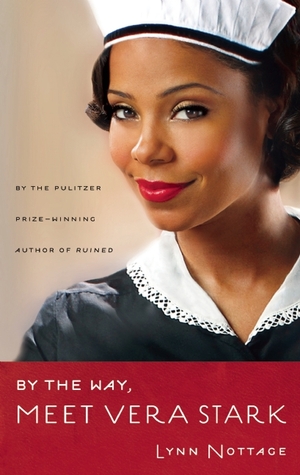
By the Way, Meet Vera Stark: A Play by Lynn Nottage

Paperback, 112 pgs, Pub Oct 15th 2013 by Theatre Communications Group (first pub Jan 1st 2011), ISBN13: 9781559364423

Lynn Nottage plays are uncluttered and make an immediate point; they are funny but also point to race and the way it plays out for actors and their audience. This one has a big surprise at the end and overall leaves an impression of light-heartedness and humor...as much as one can be when one is dead serious about painful truths. The roles for black actresses in Hollywood in the 1930s were ridiculously few: one had be a slave or a maid, there was nothing else. White directors wanted the black roles to be filled with "real" country folk descended from slaves, as though acting weren't the point after all. Actors would scheme for these parts nonetheless.

This two-act play addresses three time periods, all set in Hollywood: 1933, 1973, and 2003. At least half the cast is black, and half is white.

Act One opens in 1933 on the bedroom of a white actress who is having some trouble learning her lines. Her black maid Vera is prompting her, not without a little throw-away sarcasm. The two seem especially intimate in conversation but there is no love lost, particularly. One gathers that the white woman relies on the black maid to keep her organized and producing, and the black maid is a tiny bit resentful that her assistance is not rewarded with bit parts in the actress' films. That is why they are all in Hollywood, after all.

It's a terrific short play, packed with great language and situational pranks. At the same time, it conveys a real truth that has everything to do with what is being discussed, finally, in Hollywood under the aegis #OscarsSoWhite. The black actress Gabrielle Union wrote in her recently published memoir, We're Going to Need More Wine, that black actresses need to be given more and better roles in order to be recognized. The talent is there, it just needs to be showcased. Same story, nearly a century later.

In Act Two the time has jumped to 2003 when a group of people are discussing Vera's brilliant acting in an underwritten bit part that raises the movie to the level "Art." They reference Vera's last known TV interview in 1973, forty years after the film was made, when she met again with the lead of the film, the white woman of Act One, Scene One.

So enamored am I of Nottage's plays, I hesitate to chose a favorite from among them, but this one, with it's layered time, great comic roles, and deliberate pointing to the lack of substantive change across a century, is among my favorites. Vera's personality changes in the forty years since the film was made, but she remains a consummate actress to the end.

This play satirizes the Hollywood and all the well-intentioned but unmistakably dull audience that takes what it is fed by delusional directors and does not demand more and better writing, casting, acting, directing. I love it.

Other Nottage plays recently reviewed:
※ Sweat
※ Ruined
※ Intimate Apparel

A special treat for Nottage fans: a short play, "Poof," by Nottage posted as a Playing on Air podcast. At the very end is an interview with the author. Enjoy!


You can buy this book here: Shop Indie Bookstores

Saturday, December 30, 2017

Sag Harbor by Colson Whitehead

Hardcover, 273 pages Published April 28th 2009 by Doubleday, ISBN13: 9780385527651, Lit Awards: PEN/Faulkner Award for Fiction Nominee (2010), Hurston/Wright Legacy Award Nominee for Fiction (2010)

The first time I read this book shortly after publication in 2009 I didn’t like anything about it. I didn’t understand Whitehead’s air of casual privilege. I reread it at the end of 2017 because a review by Brandon Harris in the New York Review of Books (Dec 7, 2017) about James McBride’s new collection of short stories, Five-Carat Soul, mentions Sag Harbor as “ravishing.” What did I miss?

The short answer is that I missed everything. But without going back to interrogate that 9-year-ago self, I can’t be sure I didn’t just miss, but dismiss this gorgeously-written growing-up summer reminiscent of Bradbury’s Dandelion Wine. Whitehead surely didn’t have a white girl in mind as his target audience: he spoke to other young boys in a dangerous world who are uncertain, black, and soon-to-be men. This white girl gets to listen in.

This second time I listened to Mirron Willis read the novel and he gave it the voice I needed for comprehension. And yes, I do get it now. That mid-1980’s summer on Long Island gave a look into a boy’s mind, how he thought, what concerned him most, the dangers that lurked at the edges of his testosterone-soaked consciousness. Even his obliviousness to moves made by the few age-appropriate girls in his cohort rang true. Often boys look poleaxed at that age—fifteen—they are thinking of other things while their body is reacting.

What jerked me aware of my whiteness this time was the jokey nature of the not-quite-ready-for-the-world half-man Benji talking about the radio spot his father listened to about the shootings happening regularly and constantly, the shootings of black men, or women, dropped into the news like yesterday’s weather. All of a sudden I was willing to concede that his reality had real, unreasonable, and unexpected death in it, not mine, and I should shut my mouth and listen up.

Once I gave him the reins, I could see and hear the way language was being used, see how capable that boy was of capturing a mood or the attitudes of his friends, his family. When BB guns crop up in the story, they immediately register as danger, despite the innocence all parties have exhibited to now. A group of teen boys testing the puncture power of BB shot from close range…it sets the blood pulsing and the mind reeling. A sense of danger is here to stay.

A short section near the end telling of Benji’s exciting and mysterious older sister Elena is filled with a barely acknowledged yearning for connection so poignant our hearts break asunder. Benji’s discussion of his parents’ marriage, and the father’s oppressive attitudes towards his wife and children, explains an avoidance in the family dynamic with an authenticity that can’t be faked. Benji’s mother “disappeared, word by word” when his father became verbally abusive, and the sense of propriety Benji had developed somewhere led him to close all the windows in the warm house in an attempt to keep the parents' raised voices hidden from the neighborhood. That sense of shame is a just a shuttercock instant in a boy's life: a few years earlier, the youngster would not feel he had the agency, a few years later, he would realize this happens in every marriage.

Some set scenes may challenge our credulousness, though anyone who has lived with a teenaged male may well be taken in: the pot of writhing maggots, the killing of houseflies with a rubber band, the first open-eyed open-mouthed kiss of a girl—all these elements of a parentless summer by the beach ring so true we feel the grit of wind-blown sand between our teeth. The beginning of the last chapter has some of the most beautiful writing I have seen anywhere, about the passage of time and reaching the end… of summer, of youth, of innocence, and somehow more than all that.

This wonderful fiction deserves all the accolades it got at the time, and it makes me curious to try another of Whitehead’s novels, especially the science fiction. I will look at Underground… again, for my own benefit, but I may owe him an apology for a review that did not acknowledge that however he wants to write about his understanding of slavery is a perspective that I have nothing to say about.


You can buy this book here: Shop Indie Bookstores