Showing posts with label art. Show all posts

Saturday, August 25, 2018

The Last Supper: A Summer in Italy by Rachel Cusk

Hardcover, 256 pgs, Pub May 26th 2009 by Farrar, Straus and Giroux, ISBN13: 9780374184032

One has to ask oneself why we read memoirs of travels. Wouldn’t it be better to just take off on our own, not knowing of other people’s troubles or joys in case we are fearful or disappointed? But Rachel Cusk reminds us why we read other people’s tales: she is observant, and terribly funny. Tales of her trips make ours resonant with laughter, too. How did we first manage when confronted with grocery stores without anything we would consider food in them?

Oh yes, training one’s palate until we recognize what is so special about food, in this case, in Italy. The simplicity of it. We meet the brusque-seeming, loud and insistent butcher, the tennis-playing hotelier who smokes incessantly, and the “four Englishwomen [on the train] their own laps full of purchases from Florence boutiques…returning to their rental villa in the hills….They seem to have outlived the world of men, of marriage and motherhood and children. They laugh hilariously at anything any one of them says. They are a third sex, these happy materialists.”

One of the best afternoon’s amusements is listening to Cusk detail the paintings she comes upon in her travels; endless pictures of Madonna and any number of versions of the Child. She gives the backstory of Raphael, his adoration of the work of Michelangelo, and his death at the early age of thirty-seven. The observations she makes about the “congested alleyway toward the Piazza della Signoria, where a riot of of cafĂ© terraces and horse-drawn tourist carriages and pavement hawkers selling African jewelry is underway.” How much has this scene changed in millennia of Italian history? Or has it always been just like this, where people
“push and shove rudely, trying to get what they want…I have seen a fifteenth-century painting of the Piazza della Signoria, where children play and the burghers of Florence stroll and chat in its spacious spaces, while the monk Savonarola is burned at the stake in the background outside the Palazzo Vecchio. Here and there peasants carry bundles of twigs, to put on the fire.”
So few are the antiquities that people from the world over wait in long, snaking lines, “an overgrown humanity trying to fit into the narrow, beautiful past, like a person in corpulent middle age trying to squeeze in to a slender garment from their youth.” It takes one’s breath away, the clarity with which Cusk writes, reminding us of what we may have once observed but could not convey.

The Catholics have a large presence in Italy, the Basilica di San Francesco lending credence to “the giantism of Catholic architecture…which harmonize unexpectedly with the iconography of late capitalism…the airport terminal…and the shopping mall.” Cusk takes the stuffing out of adults who use “Christianity as a tool, a moralizing weapon they had fashioned in their own subconscious…the strange, dark chasm of repression and subjectivity…judgment lay down there…flowing like a black river.” Do I need to say Catholic school growing up in England was a less than satisfactory experience?

This is the book I would give a friend to explain why I love the work of Cusk so. How can one not appreciate the quiet way she inserts her family into an unfamiliar world and does not spare herself nor anyone else the sharpness of her observations. The family moves over a period of months, down the Italian coast, just south of Naples.

The last day of their southern journey, the ‘bottom’ of their vacation, they are denied a trip to Capri by boatman strike. Instead they boat to Positano where father, mother, and two children paid fifteen Euros each to lie on the beach. Beside them were young American newlyweds in white bathers, ‘groomed as gods” but timid and self-conscious. Cusk wishes she had a Raphael to paint them for her, and I do, too.

Cusk has a warmth in her writing for the magnificent, the ‘theatrical and sincere,’ the elaborate, the splendid Italians, and she tells us her children will always remember Italy as a place they want to live. Her husband gets no notice, and if we did not know she travelled in a family of four, we would not know he was there at all. This book was published in 2009, and three short years later her marriage lay in ruins. We see the beginning of that split here, methinks.

One feels quite as though one had done this journey, too, traveling along with sunburnt girls in the back of a car with the windows wide. The final week in a faded blue tent strike us as real as real can be—even with the call from the publisher saying the rights to publish her last book in South Korea allowed them the possibility of a glorious, comfortable night in a seaside resort with gold bathroom fixtures but an unused swimming pool and a beautifully-appointed restaurant in which no one ate.

‘Rewarding’ hardly seems adequate praise. I savor her work like Peruginas. Her writing is for me like one of those moments she describes whose effects will last forever…visually stunning, thought-provoking, delicious to remember. The summer feels lived.

Below please find reviews of Cusk's other works, in order:
Saving Agnes, 1993
The Temporary, 1995 (not reviewed yet)
The Country Life, 1997
A Life's Work: On Becoming a Mother, 2002
The Lucky Ones, 2003
In the Fold, 2005
Arlington Park, 2006
The Bradshaw Variations, 2009
The Last Supper: A Summer in Italy, 2009
Aftermath: On Marriage & Separation, 2012
Outline, 2014
Medea, 2015
Transit, 2016
Kudos, 2018
Coventry: Essays, 2019


Wednesday, May 9, 2018

God Save Texas by Lawrence Wright

Hardcover, 352 pgs, Pub Apr 17th 2018 by Knopf Publishing Group, ISBN13: 9780525520108

This is a fast and fabulous, smart and funny read…the kind that reads so effortlessly because the author has a lifetime of writing experience. There is a big-hearted generosity in Wright’s view of Texas, though he doesn’t hesitate to point out personalities or policies that diminish what he believes the state could be. Wright lived many years in Austin, the big blue liberal heart of Texas, a city that attracted so many people to what the city once was that it no longer resembles that attractive mixed-race, mixed-income diversity so rich with possibility.

Having read Wright’s big books on Carter’s peace talks at Camp David, and his exhaustive study of Christian Science, I was unprepared for the deep vein of “will you look at that” humor that richly marbles this piece. It is an utter delight to have Wright use his insider status as a resident to call out especially egregious instances of Texas bullshit.

The book is a memoir, really—the memoir of a natural raconteur from a state where cracking jokes about serious issues is an art form. But before page ten Wright makes clear his assessment of the state:
"Texas has nurtured an immature political culture that has some terrible damage to the state and to the nation. Because Texas is a part of almost everything in modern America—the South, the West. the Plains, Hispanic and immigrant communities, the border, the divide between rural areas and the cities—what happens here tends to disproportionately affect the rest of the nation. Illinois and New Jersey may be more corrupt, Kansas and Louisiana more dysfunctional, but they don’t bear the responsibility of being the future."
Wright is so skilled now at writing big books that he manages to give us lots of detail and information even in this more relaxed telling, all the while being really funny. He is clear-eyed about why Texas can be a big fail and yet he clearly loves the place.
"To strike it rich is still the Texas dream...Texans are always talking about how much they loved the state, but I wondered where was the evidence of that love."
Wright admits he considered leaving during the oil boom/bust in the 1980s when the state never seemed to live up to its obligations. He dreamed sometimes of decamping to liberal California, where he could flog his screenwriting skills...and make more money. He thinks that a country that can hold together two such immensely powerful and opposing forces as California and Texas has got to be something worthwhile and important. I used to think so, too, but feel less confident now. Sometimes I want to saw off those pieces of the country that claim to want so much freedom, and seal the borders. No trade. We’ll see then who comes out on top.

Music and art are sprinkled throughout this biography, obviously an important part of Wright’s attraction to the state. Each chapter sports woodcuts by David Dantz describing the chapter’s subject and Dantz’s endpapers illustrate the arc of the book. The art, like the prose, is rich with humor and attitude. Music is a part of Wright’s own biography and so he writes particularly well about the scene and historical influences. It’s rounded, this book, and interesting and fun and full of reasons to like Texas, despite its particularly awful politicians.

Texas was a reliably blue state until the 1990s. Houston is the only major city in America without zoning laws. AM Texas radio hosts Alex Jones. Ted Cruz makes jokes about Machine Gun Bacon on Youtube but as usual when Cruz is trying to be funny, it’s an epic fail. Dallas had been a city fostering extremism until Kennedy died there. After that humiliation, Dallas became more open and tolerant, more progressive…and developed more churches per capita than any city in the nation. Wright thinks Dallas has the ability to transform suffering into social change. I say we shouldn’t be blamed for being a little suspicious of all that supposed holiness. Evangelicals have shown what they are thinking where they are standing.

In the last chapters, Wright is open about searching for his final resting place. He is only seventy years old, but he is calling it for Texas. I really like that about him. He can conceive of life and death, Democrat and Republican, north and south in one sentence. He can love Texas and laugh at it, too. He has written a truly wonderful, un-put-down-able book about the biggest second-biggest state in the union.

I'm from Texas.


Friday, March 16, 2018

Creekfinding: A True Story by by Jacqueline Briggs Martin, Illustrated by Claudia McGehee

Hardcover, 36 pgs, Pub Mar 7th 2017 by Univ Of Minnesota Press, ISBN13: 9780816698028

This inspirational child's storybook for ages 5-9 features the beauty of the natural world plus animals and big earth-moving equipment! Even parents are guaranteed to enjoy this one. The story is true, of a scientist who had heard the land upon which he lived once had a creek but had been bulldozed flat to make larger corn fields. The mind boggles at the necessity for this travesty.

He found photographs of the land in the time before and when an old man told him he'd fished the stream for brook trout, the scientist decided to try to find the creek. If it had been there since time immemorial, perhaps it was just waiting to be found.

The gorgeous full-color woodcuts by Claudia McGehee add immeasurably to the exciting story of discovery created by Caldecott winner Jacqueline Briggs Martin. The scientist dug the field, found the creek, built a bed, planted the sides, repopulated the waters that flowed from the head of the spring.

The actual events in this story take place in northeast Iowa. Thanks to the University of Minnesota Press for putting so much effort into making this the most beautiful and inspirational storybook published in 2017, surely. Brilliant job, everyone!


Saturday, March 3, 2018

The Lonely City by Olivia Laing

Hardcover, 336 pgs, Pub March 1st 2016 by Picador, ISBN13: 9781250039576, Lit Awards: National Book Critics Circle Award Nominee for Criticism (2016), Goodreads Choice Award Nominee for Nonfiction (2016)

Ali Smith pointed me to Olivia Laing—I think she was planning to introduce her at a conference in Edinburgh. I knew nothing about Laing when I opened this book to the essay about Henry Darger,
“the Chicago janitor who posthumously achieved fame as one of the world’s most celebrated outsider artists, a term coined to describe people on the margins of society, who make work without the benefit of an education in art or art history.”
It is very creepy and disturbing, the whole story of the three hundred paintings and thousands of pages of writing Darger left behind at his death, about sex and children and abuse and neglect. Laing’s description of it, and her close research into his life, reminded me of the work of New Yorker writer Ariel Levy: one doesn’t really want to read it, but once begun, it is hard to tear oneself away.

This book itself is about lonely people, lonely artists, herself as a lonely person. Such a repellant topic; Laing notes the psychoanalyst Fromm-Reichmann, a contemporary of Freud, writes
“Loneliness seems to be such a painful, frightening experience that people do practically everything to avoid it….Loneliness, in its quintessential form, is of a nature that is incommunicable by the one who suffers it.”
Exactly, exactly, exactly, I want to say as I turn my attention away. It makes me uncomfortable, suffering from it or not. So why, then, does Laing want to write a book about loneliness?

The truth is, if one can suffer through the sensation of skin-being-sanded while Laing chooses Edward Hopper to discuss during her own period of estrangement, alone in New York City, irreparably separated from her fiancĂ©, her discussion of Hopper’s paintings and his life leave an indelible impression. Hopper met his wife in art school, and they each were forty-one-year-old virgins when they married. The chapter becomes a queerly voyeuristic biography of Hopper, his art, and his journal-writing wife whose painting was so derided by Hopper that she stopped painting and became his model.

When Laing moved from Brooklyn to the Village—she can’t have been so lonely, by the way, that she didn’t just return to England unless she likes a little bit that sensation of sandpaper-on-skin—she turned her gaze on Andy Warhol. At first Laing detested his work but after seeing him struggling to speak in a biopic once, she realized his Pop Art, the repeating images in different colors, was the attempt of a lonely boy to fit in.
"Sameness, especially for the immigrant, the shy boy agonisingly aware of his failures to fit in, is a profoundly desirable state; an antidote against the pain of being singular, alone, all one, the medieval root from which the work lonely emerges. Difference opens the possibility of wounding; alikeness protects against the smarts and slights of rejection and dismissal."
Laing does not neglect Valerie Solanas, the shooter who nearly ended Warhol’s life, who was also “drawn to the excessive and neglected.” Solanas’s work on the SCUM Manifesto puts her smack dab in the middle of a resurgent feminist movement, and yet decidedly outside the mainstream headed by Betty Friedan.

Laing provides context to and critiques of the work of Warhol contemporaries, photographer/artists Nan Goldin, David Wojnarowicz, Peter Hujar, and demonstrates how their work fits in with the alienation developed through loneliness. Laing’s searing chapter on the AIDS epidemic reminds us how the scourge played out in New York, and how it enveloped Warhol and his milieu.

The discussion of “Strange Fruit (for David)”, an art installation created by Zoe Leonard for Wojnarowicz in 1998, is somehow eye-opening, and mind-changing. The creepiness of that avant garde art scene melts to reveal the humanity and real pain in the expression of this art.

So Laing’s own journey through loneliness becomes a meditation on loneliness expressed through the art of others.
"It was the rawness and vulnerability of [Wojnarowicz’s] expression that proved so healing to my own feelings of isolation: the willingness to admit to failure or grief, to let himself be touched, to acknowledge desire, anger, pain, to be emotionally alive. His self-exposure was in itself a cure for loneliness, dissolving the sense of difference that comes when one believes one’s feelings or desires to be uniquely shameful."
Laing’s skill on this difficult subject of outsider art keeps us curious and bearing our discomfort as she leads us to a deeper understanding of our human condition.
"Loneliness is personal, and it is also political. Loneliness is collective; it is a city…the pursuit of individual happiness does not trump or excuse our obligations to each other. We are in this together…What matters is kindness; what matters is solidarity. What matters is staying alert, staying open…"


You can buy this book here: Shop Indie Bookstores

Friday, February 23, 2018

Good Night Stories about Rebel Girls by Elena Favilli and Francesca Cavallo

Hardcover, 212 pgs, Pub Dec 1st 2016 by Timbuktu Labs, Orig Title: Storie della buonanotte per bambine ribelli: 100 vite di donne straordinarie, ISBN13: 9780997895810, Series: Storie della buonanotte per bambine ribelli #1, Lit AwardsWaterstones Book of the Year Nominee (2017)

The subtitle of this collection is 100 Tales of Extraordinary Women, and it is beautifully done. The short passages cover every continent and every race, religion, and sexuality…that is, the stories are about girls and women with lesbians and transgender individuals identifying as female included. It is ravishingly interesting.

Each short passage is a tightly written biography suitable for 9-14 year-olds, informative, and inspiring. Many unusual job descriptions and lifelong purpose are described, expanding our horizons about the scope of what is possible. As an adult, I didn’t expect to learn as much as I did nor enjoy it as much.

This book is about rebels. It challenges us to think again about what we admire and what we don't...and why. It is a fantastic teaching tool. I can imagine a mother reading an entry alongside her preteen (of either sex, by the way) and discussing it for a short while so that the implications of each success sink in: "Why would that person be considered a rebel?" "What do you think about what that person did?" "Do you know anyone who has done things like this?" The mother is going to recognize some of the names and so can add whatever backstory is not in the book.

A few examples from the stories are
✦ Inventor Ann Makosinski, a fifteen year-old Canadian who won first prize in Google Science Fair for inventing a flashlight that doesn’t need batteries, wind, or sun--just body heat.
✦ Amna Al Haddad, weight lifter from the United Arab Emirates. She was a journalist and discovered she really enjoyed exercising! She began to work out in a gym with weights for the first time in her life as an adult. She was good at it and began training for the Olympics.
✦ Anna Politkovskaya, the Russian journalist who was murdered for reporting on the truth of what she saw in the brutal civil war in Chechnya.
✦ Jane Goodall is among the women to emulate for having her own mind and studying a subject so deeply that she became the expert.
✦ Hayshepsut was an Egyptian pharaoh who ruled Egypt long before Cleopatra became Queen. Records of her were destroyed after her death, but archeologists were able to piece together a record of her successful rule, the first (and only?) female pharaoh.
Included with each biography is a full page color representation of the subject, and a quote of something they said or wrote. Next to the short bio of Misty Copeland, for instance, is a drawing of her in flight during a ballet performance with a quote that reads, “Dance found me.”

The authors, Elena Favilli and Francesca Cavallo, studied in Italy and the United States where they founded Timbuktu Labs, a children’s media innovation lab. What’s that? you may well ask. The authors define the mission of Timbuktu as committed to “redefining the boundaries of children’s media through a combination of thought-provoking content, stellar design, and cutting-edge technology.” They designed the first iPad magazine for children. The start-up has created mobile apps and creative content for users in more than 70 countries.

It’s more than just new. It’s exciting. The first edition of this book was published in 2016. Since then it has gone through multiple reprintings, and in 2017 Good Night Stories for Rebel Girls 2 was published. There are apparently also coloring books, temporary tattoos, and posters that go along with the books and can be purchased separately. It’s become an industry, with good reason. If you have a girl in the family in the target age range, check it out. Just when you thought your girls were too old for bedtime stories, this may bring it all back.


You can buy this book here: Shop Indie Bookstores

Tuesday, February 20, 2018

Winter by Ali Smith (Seasonal #2)

Hardcover, 336 pgs, Pub Jan 9th 2018 by Pantheon Books (first published November 2nd 2017), ISBN13: 9781101870754, Series: Seasonal #2


Ali Smith wrote this book fast, and I think that is how she intends us to read it, at least at first. We slow down when her images and meanings start to coalesce on the page and we suspect there is much more to this than the twitter-like, depthless sentences that don’t seem like they are adding up to anything. Afterwards, an image emerges. What is more suited to tweeting than a Canada warbler?

The story, as such, is that a young man breaks up with his girlfriend Charlotte right before a Christmas he’d wanted to bring her to his mum’s house to introduce her to his mother. He finds a substitute girl, who happens to be waiting at a bus stop, rather than go through the humiliation of saying he no longer had a girlfriend. He pays her—Lux she is called, though he’d never asked—to stay the three days of the holiday.

Art grew in the course of this book into a grander vision of himself. He writes about nature, the churn of seasons, in a blog he calls Art in Nature. Though he rarely writes anything political, he is thinking about making his work a little more political, like the “natural unity in seeming disunity” of snow and wind, “the give and take of water molecules,” and “the communal nature of the snowflake.” He, Art, is not dead at all, though he is being crushed by his ex-girlfriend Charlotte on Twitter.

Charlotte is pretty clear-eyed:
The people in this country are in furious rages at each other after the last vote, she said, and the government we’ve got has done nothing to assuage it and instead is using people’s rage for its own political expediency. Which is a grand old fascist trick if ever I saw one…the people in power were self-servers who’d no idea about and felt no responsibility towards history…like plastic carrier bags…damaging to the environment for years and years after they’ve outgrown their use. Damage for generations.
Plastic carrier bags? This is where Smith shines, making her argument so clear and relatable and yet so absurd. She’s funny. She’s right and wrong at the same time, like most of us. Like Art. Smith draws environmental degradation, suggesting chemical (nuclear?) drift in the air can settle like snow, like ash, like slow poison on our lives. She compares the influx of refugees fleeing for their lives in the Mediterranean to exhausted holidaymakers using their friends’ recommendations on the ‘best places to stay.’

Many images float around this book, inviting us to make connections: Iris-eye, art-Art, stone with a hole in it-eye, stone with the weight and curvature of a breast-Mother Nature…once we begin, we start looking for these parallels everywhere. Lux— she had some kind of luxurious brain, a luxurious education studying what she wanted (like Shakespeare, violin, human nature), and the luxury of floating through the world unencumbered and unafraid.

Lux is an out-of-body experience, an angel who appears and disappears, a Canada warbler blown off course. Lux is grace. Lux brings the two sisters together and reminds them of their shared history, of love, of the importance of struggling to create bonds. Lux tries to convince Art to stay after the three-day Christmas holiday to talk, late at night, to his mother. At first he refuses, but when Lux says she will help, he looks forward to it.

Soph, Art’s mother, is not crazy but prescient, depressed, and old. The word Sophia in ancient Greek and early Christian times meant wisdom, and clever, able, intelligent. Iris, the sister from whom Soph was estranged, is not a religious do-gooder but is targeting critical needs to save what’s best of the human race. She is named for Iris, the Wind-Footed Messenger of the Gods. Her presence signifies hope.

Smith is also concerned with truth, and at some point Lux points to the notion that the truth of a thing may be confused with what we believe to be true. Is there objective truth? This question has been argued since time immemorial. It is back with a vengeance, and must be adjudicated daily, moment-by-moment within each of us.

Art in Nature continues to exhibit itself throughout the novel: a female British MP is barked at by the grandson of Winston Churchill, who is also an MP. He says it was meant as a friendly greeting, she accepts the non-apology. Smith interprets this incident as snow melting on one side of furrowed ground in slanted winter sun. It turns out the stuff Art writes in his blog material is invented. Lies, one could say, but close enough to real to sound remembered. This novel has a lot to do with art and politics and what the difference is between them.

Iris writes
& th diff dear Neph is more betwn artist and politician—endlss enemies coz they both knw THE HUMAN will alwys srface in art no mtter its politics, & THE HUMAN wll hv t be absent or repressed in mst politics no mtter its art x Ire
Ali Smith—and this is only the second novel of hers I have read—is a skilled interpreter of our lives. She is involved in the struggle with us, and has enough understanding to recognize #MeToo began with the Access Hollywood tape; the rest, on both sides of the Atlantic and around the globe, is fallout. She doesn’t want us to lose hope, but recognizes the route to betterment is long and arduous, which is why she occasionally blows a Canada warbler off course in the middle of winter to thrill us with what is possible.

I note Recorded Books and narrator Melody Grove won Audiofile Magazine's coveted Earphones Award for "conveying every nuance in the second movement of Ali Smith's Seasonal Quartet." Sounds like it would be a wonderful experience, to listen to this marvelous book speaking of a very dark time in all our lives.


You can buy this book here: Shop Indie Bookstores

Tuesday, February 13, 2018

Ghost World by Daniel Clowes

Paperback, 80 pgs, Pub April 2001 by Fantagraphics (first published March 1998, ISBN13: 9781560974277

In one of his interviews, the great graphic novelist Craig Thompson cites Daniel Clowes as a must-read graphic artist he admires. I admire Thompson’s work, so it makes sense I would seek out Clowes. This graphic novel was made into a movie in 2001 starring Thora Birch and Scarlett Johansson. I haven’t seen that yet, but it may well be the first sighting of Scarlett Johansson before big stardom.

A GR friend of mine wrote a deeply insightful meditation on the development of American cities in response to this work, going big in the face of adolescent alienation. As much as I enjoyed that piece, the book made a different impression on me. I’m going to go small: this is a novel of ideas that happen internally and out of sight. All we see is the petulance, the ripple on the surface of a psyche.

A young thin blond girl and a much edgier dark-haired friend who sports an aggressive haircut and heavy-framed glasses are nearing the end of high school. Contemplating their futures, the dark-haired girl wishes to become someone else. “I totally hate myself,” she cries late one night lying on the couch of a boy she’d just admitted she loved. Poor guy.

At that age we are both afraid of and jealous of the complexities adults wrestle every day; we want to try out our problem-handling skills to see if they can measure up. We want the next thing to happen so that we are not merely sitting ducks when it does. Desire for the world and fear of that same world mix unsteadily in our gut. We’re not ready, but when will we ever be?

The ideas shown in this graphic novel struck me as completely within the range of 'normal' adolescent angst, disaffection, confusion, and fear about the world and one’s role in it. We’re pretty obnoxious and self-absorbed at that age, as anyone with a teenager in the house will readily commiserate. Clowes actually plays it so low key we are as bored and unimpressed with their lives as the characters are.

My favorite frame comes near the end when the dark-haired girl is driving the hearse her father graciously bought for her to take to college. Despite having a vehicle and a direction, the girl says she is depressed: “Everything is all the same no matter where you go.” The Buddhists say it like this: “Wherever you go, there you are.”

The tricolor palette in this book works fine: black and white with a green wash. The pen drawings capture the sprawled-leg teenager-y postures, the trying-so-hard-to-be-cooler-than-thou clothing choices and the deliciously descriptive backgrounds absolutely fill in the picture. I thought Clowes was brave to take on the persona of a teenaged girl, but he caught that moment in the lifecycle of a female of the species perfectly.

This is another example, if we needed one, that the writing—including what isn’t said—is as important as the drawing in great graphic novels. So many things have to come together to make a great and lasting work. I admire the heck out of artists working in this medium and encourage anyone who hasn’t picked up a graphic novel lately to try one. It’s hard to read just one.


You can buy this book here: Shop Indie Bookstores

Monday, February 5, 2018

Habibi by Craig Thompson

Hardcover, 672 pgs, Pub Sept 20th 2011 by Pantheon, ISBN13: 9780375424144, Lit Awards: Harvey Awards Nominee for Best Graphic Album-Original, Best Artist (for Craig Thompson), Best Cartoonist (for Craig Thompson) (2012), Will Eisner Comic Industry Awards for Best Writer/Artist (for Craig Thompson) (2012), IGN Award for Best Original Graphic Novel (2011)

In an interview Craig Thompson told his audience that artists must become vulnerable if their work is to mean anything. This dark and agonized work has a great deal of nakedness in it, both literally and figuratively, and a lot of staring directly at human experience and trying to make sense of it. It also looks with a colder, more dispassionate and assessing eye at the overlap in the religious teachings of Christianity and Islam.

This is Thompson’s fourth published work, and one glance inside gives some idea why it took six years to complete. The graphic work is fantastically detailed and patterned, which over more than six hundred pages becomes claustrophobic and oppressive with patterns repeated again and again in different combinations. This is partly due to the size of the pattern, which seems to become more and more compressed as the story progresses, and the more-black-than-white palette.

The patterns are beautiful, and may represent mathematical principles that sustain the progress upon which the world is built, but by the end I got the distinct impression Thompson was asking us to question even that progress: is it good? Who is it good for and how can it be modified to suit a different world with better outcomes? One is not accustomed to such weighty questions in the work of graphic artists.

Thompson is unique in many ways, but certainly the source of his questioning may come from his fundamentalist Christian upbringing in rural Wisconsin, an upbringing he explores in his second graphic novel and the first large-scale project of his career, Blankets. Thompson freely admits he still believes in God, but he is less sure now how best to worship him.

That his father was a plumber Thompson credits with the understanding that water is precious. This book is plumbed through with references to the primacy and importance of water in our world, our lives. This aspect of the book was another piece that elevated the story-telling to something essential.

Some discussion among reviewers condemns the sex, violence, and numerous representations of the naked human form depicted in this work as gratuitous. I will argue that is not the case. There is no question that the storyteller in this case is frightened by and ashamed of his powerful sexual feelings, but his arousal is well within the bounds of normal male sexuality and should, in fact, educate readers about the conflicted emotional trauma that can accompany the physical manifestations of desire.

In the years Thompson worked on this book, he learned to appreciate and to write some Arabic script, but never learned to speak. His translators and friends in the endeavor to understand Islam—its culture, science, and art—reviewed the story he created to check for realism and racism. In the end, any understanding readers take away about the religion or culture of the region belong to Thompson alone, but I suspect he feels confident in his depiction.

Simply sketched, the story is as follows: a light-skinned girl and a dark-skinned boy find themselves orphaned in the desert. They make a life and grow up together for a period of years before they are violently separated. They spend a long period of time hoping to find one another again and then one day, they do. The story has an impetus and emotion even without the later personality-defining moments of coercion and despair depicted with the same pitiless camera-eye that captured their earlier life.

If I say that there are many complications and observations along the way, it will give you scant warning for the deluge that is to come. This work is huge, covering enormous ground, picking up and putting down again many topics worthy of examination and discussion. It is overwhelming, as it undoubtedly was to write. I have never determined how an editor deals with slimming the opus of an auteur. The only thing I can think of is that cut pages or threads could be sold separately once the work has been published to acclaim.

Thompson’s willingness to look closely at who we are evinces in me admiration and gratitude, not censure. I look eagerly forward to what he decides to do next, whether it be drawing, writing, or something else of his choice. He is extraordinary in every way.


You can buy this book here: Shop Indie Bookstores

Thursday, February 1, 2018

So Much Blue by Percival Everett

Paperback, 236 pgs, Pub June 13th 2017 by Graywolf Press, ISBN13: 9781555977825

Percival Everett blows the doors off with this beautifully constructed novel that holds secrets and mysteries in each of its three stories centered about Kevin, an oil painter living in Rhode Island with his wife and two children. I do wonder about Everett, who so gradually has become one of America’s most reliably exciting and unique novelists that his anonymity lasted long enough for him to enjoy some walking-around time without celebrity recognition. That’s probably well over now, if this enormously assured work of fiction garners the attention it deserves.

The work is studded with recognizable truths in the way of great literature but the writing is plain enough that we spot these easily, following his trail eagerly. Describing the way his children looked at him when he was drinking regularly and too much:
“No, I never flew into rages or stumbled late and noisily into dance recitals or yelled a little too loud and made inappropriate comments at soccer games, but I became acutely aware that I wore a sickly-sweet late evening cologne and I noticed how my children looked at my eyes, holding them for too long and looking away too quickly.”
There is a paragraph less than fifty pages in which describes what happens in Paris when Kevin is visiting a museum on a day his wife is traveling. He happens upon a young woman, a watercolorist, who recognizes him and invites him somewhere they can talk comfortably.
“Very close of course was Victoire’s flat. She was, after all, a watercolorist and her apartment was full of them. Thankfully they were not portraits of cows, but there was a preponderance of empty parks and stark river scenes. There was a large window that overlooked a garden. In the middle of the garden was a broken birdbath and I felt a little guilty when I realized I was paying more attention to it than to the many works of art. I turned my attention to her work and found them well done, but ordinary.”
This paragraph with all its conflicted feelings describes a true thing; I know this because it happened to me. I can’t remember now if I was the young woman or the older man. Perhaps I was the younger woman with the eyes of an older man.

Everett does this to us regularly: holds up our experience, or maybe his own, for us to acknowledge. He is always surprising and exact yet comfortable and intimate with us. Sometimes his sentences remind me of the clipped noir of Raymond Chandler or the deeply funny seriocomic social commentary of Joe Lansdale. But Everett is unique. Not only that; each novel is unique.

Almost every novel by Everett is different than the one preceding it, making it seem as though he were reveling in the breadth of the form, trying out methods, working a style. One has the sense of an oeuvre not unlike a fiction chapbook which showcases many forms of popular fiction but which is infused with a self-conscious humor, even parody, always within the realm of literature. It is American literature at core, worthy of study for the pieces Everett chooses to highlight. That standing outside the form is almost missing in this novel, but Everett is sly.

The novel's three strands, each thread in a different country, are widely spaced in time yet carefully braided into one narrative so that no one strand seems dominant nor gets lost as the other stories unfold. The interleaving is so well done it is a model for writers. The only overlap in all the stories is the main character, Kevin Pace; married, living in New England, two children, a painter.

Blue, the color blue, cerulean, cobalt, “the color of trust, loyalty,” ultramarine, blue leaning to green, Guillet green, emerald green. Kevin saw one painting done by the young French watercolorist which was outside her usual style, all done in blues and green running into blue, with a splash of blood red in one corner. It made him cry. It should have been done in oils. Blue was a color he could not control, and it reminded him of something, a secret.

This novel is about secrets, and upheaval, and finding a safe place, and the how paint can reveal truths we cannot speak. Everett is a painter besides being an author, and in 2010 he collaborated with the novelist Chris Abani to produce a journal of Abani’s poetry and Everett’s paintings.

This novel, coming after thirty or more earlier works, seems to bring all that earlier experimentation to glorious fruition. It’s a beautiful novel, full of energy, movement, truth, and color. So much blue.


You can buy this book here: Shop Indie Bookstores

Thursday, January 18, 2018

Blankets: A Graphic Novel by Craig Thompson

Paperback, 592 pgs, Pub Aug 18th 2003 by Top Shelf Productions (first published July 1st 2003), ISBN13: 9781891830433, Lit Awards: Harvey Awards for Best Graphic Album of Original Work, Best Artist (for Craig Thompson), & Best Cartoonist (for Craig Thompson) (2004), SalĂłn Internacional del CĂłmic de Barcelona for Premio del pĂşblico a la mejor obra extranjera (2005), Will Eisner Comic Industry Awards for Best Graphic Album–New (2004)

Wow. Every bit as earthshaking and meaningful as Marjane Satrapi’s Persepolis, this graphic novel by Craig Thompson published in 2003 by Top Shelf is one thoughtful Americans do not want to miss. Christian evangelical notions of life on earth and what comes after are a huge part of the narrative of our nation. Even today when our population is more diverse than ever, the history of these core beliefs within our citizenry continue to affect the direction of our politics.

Teenagers instilled with these notions rarely have the intellectual wherewithal to question those received ideas. Paradoxically, perhaps because of those early teachings and the constraints of his upbringing, the author--the main character in this memoir--has the discipline and strength to look squarely at his life, the beliefs of his parents, and think again.

This graphic novel won two Eisner Awards, three Harvey Awards, and two Ignatz Awards in 2004 and a Prix de la critique for the French edition a year later. A strict Christian evangelical family raises two sons in rural Wisconsin; we watch the boys grow up from sleeping together in the same room/same bed they move to their own rooms, go to summer camp, get harassed at school, romance a girl.

Sometimes graphic novels get a few things right, like the artwork, or the pacing. In this case, Thompson seemed to get everything right. The growing up story is poignant and real and revealing about farm life in Wisconsin in a close-knit religious family. Craig goes to visit his girlfriend Raina who lives in the snowiest city in the contiguous United States, in the Upper Peninsula of far north Michigan....in winter. We are treated to Raina's home life as well, another Christian family who struggles under enormous pressures.

Graphic novels are especially impressive because they must portray characters from an endless array of angles, and in this case, we recognize a character as he grows over a period of years. Moreover, we are feeling that character struggle with the promises and constraints of his religion and the actual manifestation of those teachings that he can see. When Craig’s pastor suggests he consider a religious calling, Craig seriously contemplates the idea.

The graphic novel drops into lower gear here and we see the quality of the intellect behind the work. Craig’s thinking and research into the Bible is Jesuitical, deep and challenging, and he is left with too many unanswered questions and lingering doubts. Different mentorship probably would have produced a different result. This portion of the book is careful, allowing Craig to slip away, leaving the door to his family open, and conflict at bay.

Thompson’s drawing skill is exceptional and smart, unmistakably capturing movement from life. The group scenes are especially exciting; for example, he might draw a high school cafeteria with many tables of students doing all manner of shenanigans. It is Bruegel, in ink. Thompson didn’t hold back on this book: it is 582 pages, not including the credits. He took the time to draw out his religious questioning and didn’t rush us through his moments of insight and revelation.

I especially appreciated the belly laughs he led us to near the end of the memoir when some of the church elders in his hometown warned Craig not to consider going to art school, lest it lead him to sin. Our hearts nearly break with what the teen will miss if he doesn’t follow his passion, but again he manages to avoid confrontation while following his dreams.

Thompson has continued his remarkable success, and in 2011 Pantheon Books published Habibi, a book Thompson had begun working on in 2004 after traveling in Europe for a time. Influenced by Arabic calligraphy and Islamic mythology, Thompson tells us  "I'm playing with Islam in the same way I was playing with Christianity in Blankets.” [Wiki].

Below I have posted two videos of Thompson demonstrating and discussing his work. The first is short and covers his childhood and all books. The second is a 56 minute interview, with slides, of Thompson discussing Habibi. This man completely knocks me out; I am wowed by his work, and the depth and scope of his intellect. Highly recommended.


You can buy this book here: Shop Indie Bookstores

Thursday, December 21, 2017

The Descent of Man by Grayson Perry

Paperback, 150 pgs, Pub May 30th 2017 by Penguin Books (first pub Oct 20th 2016) ISBN13: 9780143131656

Until a friend recently pointed him out, I’d never heard of Grayson Perry. I have since looked at his artwork online and am as impressed over his painting and his clothing choices as anyone would be. They are quite…wildly spectacular and suggestive…of a world where sexuality is a choice.

Somehow, despite Perry telling us that he experienced and acted out of a deep well of rage in his youth, we feel comfortable with him telling us what he thinks we’re misunderstanding about sexuality and gender disparity. Perry calls himself a transvestite, and I guess we’ll have to accept his definition of that. He doesn’t go into detail (thank goodness) but he does mention his wife in this work and she is female, so far as I can tell.

Whatever. This book is an amusing and non-judgmental look at masculinity and the effect it has had on the female sex psychologically and every other way. Perry makes some really funny and caustic observations on his way to telling men they can let down their compulsion to carry the world on their shoulders. Half the world is ready to take up their share of the burden, and, oh by the way, you can get yourselves some better clothes while you’re at it. Something pastel, perhaps?
“Actors, when they are preparing for a role, often talk of the clothes as key…So, in the great gender debate, maybe clothes are one of the key drivers of change…If we want to transform what men can be, maybe central to their performance will be a costume change.”
Much of what Perry writes in this book is what women have been saying for some time, so I never felt uncomfortable or surprised by his ideas. However, Perry had a unique set of questions I’d never seen raised before, like
“I asked a men’s group what women may not know about men. What came up was just how attracted to risk men are. These were middle-aged, middle-class men in therapy, yet they all had tales to tell of reckless driving, drug taking, sex and violence, and they told them with relish. In all-male company, risk is a shared enthusiasm.”
Perry goes on to say that if the popular notion of masculinity is in need of an update, who better to figure it out than concerned groups of men? But ‘the men’s movement’ tends to lay the blame at the feet of women, whereas if traditional working-class men feel left on the rust heap, they would be better served to look at the sexist patriarchy—the very thing feminists are attacking—rather than women and feminism.
“…Men are their own worst enemy.”
In a chapter entitled “The Shell of Masculinity,” Perry explains that in childhood men aren’t given the tools they need to be expressive of their needs and feelings, and this can hamper their development later in life and in relationships. I think this is pretty much received knowledge, and knowing it means we need to have mothers and fathers prepare their sons for a world that is fundamentally changed, more rewarding of introspection and insight into one’s own behavior rather than the dog-eat-dog, first-man-to-the-top-of-the-heap-no-matter-the-human-cost attitudes we had been rewarding.

Another thing Perry tells us is that for many men,
“sex boils and ferments below a crust of civility. The comedian Phill Jupitus describes masturbation as the ‘male screen saver.’ If a man is not concentrating on something, his brain goes into sleep mode and sex swims into his awareness. [I particularly like this analogy.] Instead of a view of Yosemite Valley or a swirling universe, a back catalog of diary porn shuffles across his mind screen, and the desire to jerk off takes over.”
My sympathies entirely, gentlemen. What effort you must expend to keep from reaching over and putting your hand up the skirt of the nearest babe. I’d no idea what you were wrestling with, and yet…friends of mine do not report such overwhelming urges that they cannot keep themselves well under control.


Perry moves from this discussion to “a strong component of masculinity is nostalgia.” This piques my interest because I have noticed that definitely among the men I have known. Mothers are so practical and utilitarian and not so backward-looking, in my experience. Perry suggests our sex drive is always on the hunt…for the past, for our childhoods. The emotions we attach to our sex lives,
“the power plays and dramatic roles we act out in our sex lives, we learn as children…The scripts of our sexual fantasies are usually roughed out by our experiences as children. [Including fetishes.]”
Perry has spent so long in therapy he has really talked out among men many of the things people discuss when they talk about gender equality. And yet, he says, gender “difference and an imbalance of power are big components of what turns us all on, not just the kinky ones.” From here Perry notes fetishes often have a distinctly nostalgic flavor, and sexual nostalgia may be the reason men are hanging on to old stereotypes. What turns them on is sexually and politically out of date.

This is something I’ve never heard articulated in quite this way before, though I have seen it manifest often. It seems a worthwhile avenue of exploration.

In his final chapter, Perry reminds men that they can lay down the burden of holding up the world, and they are allowed to declare a few things; for instance, men have “The Right to be Wrong,” and “The Right Not to Know,” and maybe most important, “The Right to be Weak.” Yes, this is the part where we can all enjoy the power imbalance for a little while at least, pulling out those sexual fantasies for something entirely novel…


You can buy this book here: Shop Indie Bookstores

Monday, December 18, 2017

Something for Christmas by Palmer Brown

Hardcover, 40 pgs, Pub Sept 20th 2011 by NYR Children's Collection (first pub 1958) ISBN13: 9781590174623

The New York Review of Books has republished the Palmer Brown books that many people say they have never forgotten, having read them in childhood, 45 long years ago. The reprints are child-sized, about 4" x 6" and have lovely reproductions of the artwork that makes this collection so special.

In this story, a baby mouse wonders aloud over what she should get for Christmas for someone special (her mother) who seems to have everything. All kinds of things are considered until the mother helps her decide that to give one's love is the most precious gift of all.


You can buy this book here: Shop Indie Bookstores

Monday, September 25, 2017

Forty-One False Starts: Essays on Artists & Writers by Janet Malcolm

Hardcover, 320 pages, Pub May 7th 2013 by FSG ISBN13: 9780374157692 Literary Awards: PEN/Diamonstein-Spielvogel Award for the Art of the Essay Nominee for Shortlist (2014), National Book Critics Circle Award Nominee for Criticism (2013)

Now this is a different kettle of fish. I just wrote a non-review for Malcolm’s The Purloined Clinic: Selected Writings in which I said I didn’t understand a word of her dense essays, all psychoanalysis and people I’d never heard of. This collection of Malcolm’s work, by contrast, has some kind of entrĂ©e. For one thing, she writes about famously reclusive artists like Salinger (“Salinger’s Cigarettes”) and Arbus (“Good Pictures”), and although she may go on a bit long (IMHO), her unique point of view and piercing intelligence makes us see something anew.

Even the Introduction by fellow New Yorker writer Ian Frazier has insights that tweak our imaginations: when discussing her interview and subsequent piece about Thomas Struth [photographer of the Queen], Frazier tells us Ms. Malcolm stood by her decision to include a minor exchange which made Struth look slightly ridiculous and seemed unfair because “at the level of fabulousness where Struth operates there’s a risk of everything becoming so wonderful and nice that meaninglessness sets in.”

This, perhaps, is where I did not give her enough credit in her earlier book. There is something to be said for people who can operate at the level of “the best we have” and retain their balance. Perhaps psychoanalysis is an absolute prerequisite at that level. When I proclaimed archly that her then-audience “aren’t educated that way anymore,” I meant “the best we have” now have to run the gantlet of not-particularly-well-educated public opinion rather than the considered opinion of an educated few. In the end, perhaps “the best we have” is now judged by different criterion, overlapping only partially with that category circa 1990 and earlier.

That having been said, were one conversant with some of the figures she speaks of, this would be a delicious, gossipy, and yes, insightful read. “Girl of the Zeitgeist” outlines Rosalind Krauss, formerly (at the time this piece came out in 1986) of the Artforum board.
“Rosalind Krauss’s loft, on Greene Street, is one of the most beautiful living places in New York. Its beauty has a dark, forceful, willful character. Each piece of furniture and every object of use for decoration has evidently had to pass a severe test before being admitted into this disdainfully interesting room…No one can leave this loft without feeling a little rebuked…Similarly, Rosalind Krauss’s personality—she is quick, sharp, cross, tense, bracingly derisive, fearlessly uncharitable—makes one’s own ‘niceness’ seem somehow dreary and anachronistic.”
It is possible to endlessly quote Janet Malcolm’s incisive views of her subjects. So, yes, okay, I get Janet Malcolm’s special skill. At her peak production, it must have been something…to know her and/or to enjoy her pieces.

But I think the world has changed now. No point in being sad about that. And Helen Garner has nothing to be embarrassed about in her own writing. She is as clear as fast-flowing ice melt, and is bridging this changing world.


You can buy this book here: Shop Indie Bookstores

Thursday, August 17, 2017

The Art of Charlie Chan Hock Chye by Sonny Liew

Hardcover, 320 pgs Pub March 2016 by Pantheon (first pub May 2015) ISBN13: 9781101870693 Edition Language English URL http://www.artofcharliechan.com Literary Awards Singapore Literature Prize for English Fiction (2016), Will Eisner Comic Industry Awards for Best U.S. Edition of International Material—Asia, Best Publication Design, and Best Writer/Artist (for Sonny Liew) AND nominated for Best Graphic Album—New, Best Coloring (for Sonny Liew), and Best Lettering (for Sonny Liew) (2017), Singapore Book Award for Book of the Year and Best Book Cover Design (2016)

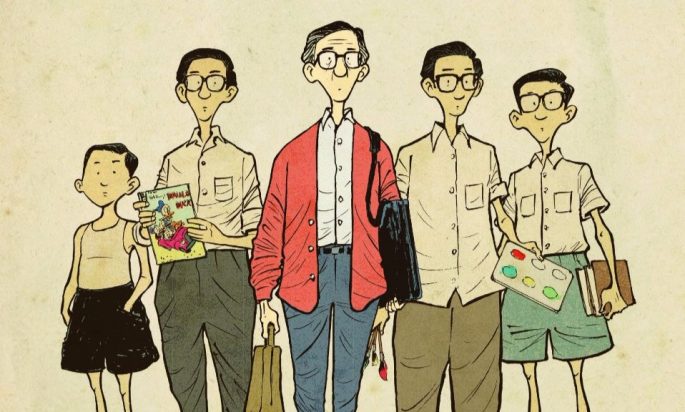
For graphic artists, there are must-reads of the genre that direct the eye to advances in the art, and Sonny Liew’s contribution may well be one of those. Liew shows us many types of comic book art, discusses their genesis and early creators, but also seamlessly melds the story of an artist, Charlie Chan Hock Chye, with the story of the political and economic development of Singapore. It is a masterful work of enormous depth and sensitivity that answers questions I’d had when contemplating the entwined histories of Singapore and Malaya.

I really went down the rabbit hole with this work because it has so many layers and levels of reality and history that I immediately wanted to talk to someone about it or hear an interview. I had been constantly walking way from the piece, trying to realign my thinking about who was telling the story. Sometimes it seemed like it was written from the point of view of this artist and comic-book writer, Charlie Chan Hock Chye, born in Singapore in 1939, and all his life aspiring to be Singapore’s own greatest graphic artist and political commentator.


Sonny Liew was merely republishing, or publishing for the first time, Charlie’s work, including a graphic autobiography begun late in his fifth decade of life and left unfinished until his seventh decade. But occasionally Liew would pop in and add commentary since he was showing us only representative pieces and scraps of Charlie’s body of work. Charlie took the writing of episodic and serialized comic novels to the pinnacle of political commentary, making such astute analysis that he was having trouble getting his work published in the conservative political environment of a colonial city-state and its aftermath.

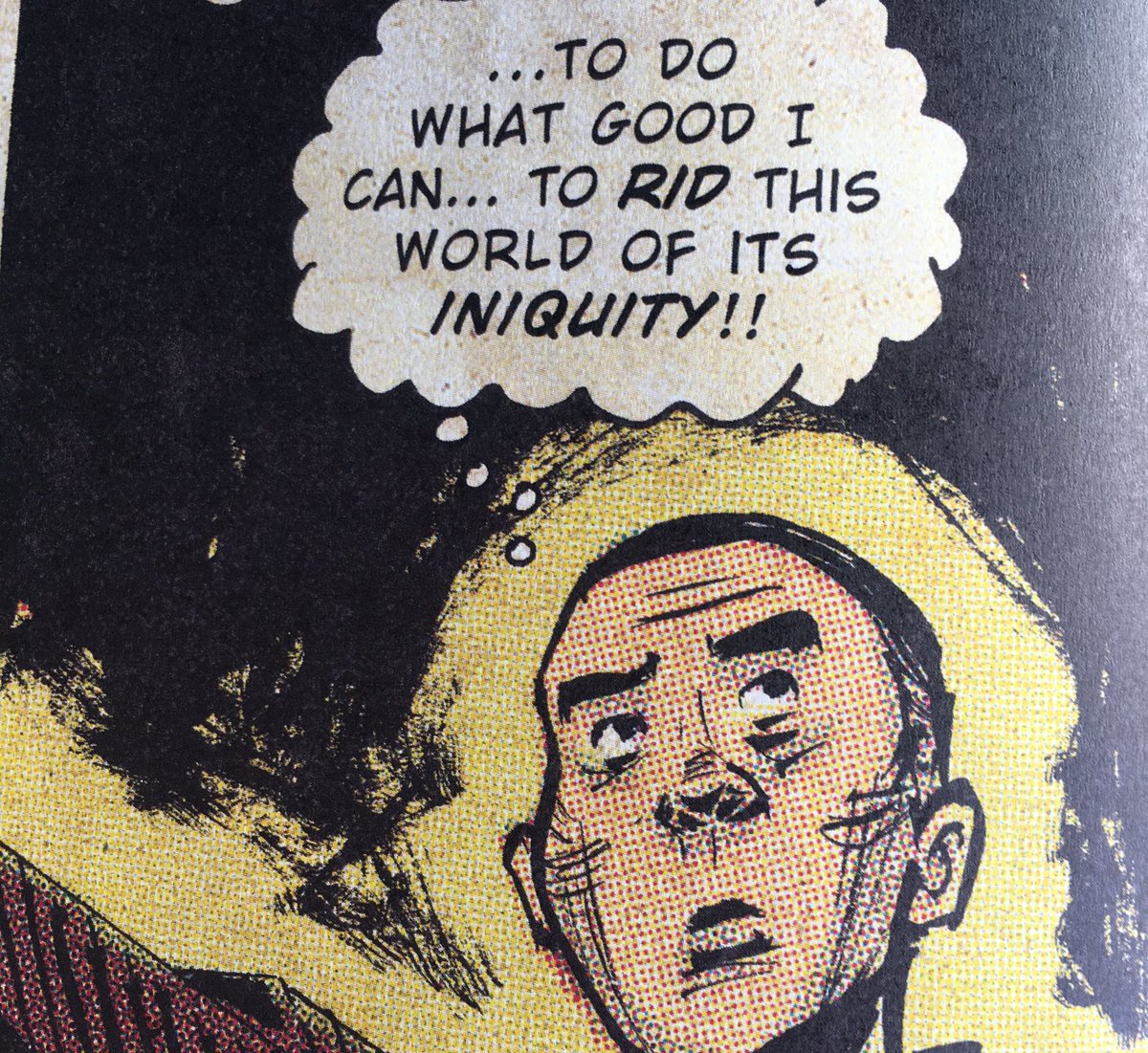
A high point for me was the RoachMan comic series which imagined a man in 1950s Singapore whose back-breaking job it was to collect honey pots of night soil from houses in traditional neighborhoods. One day on his rounds he is daydreaming about the resilience of cockroaches when—suddenly— he is bitten! Over the next days and nights he feels delirious and tingling sensations only to discover when he is nearly mowed down by a car at night that he has acquired new physical abilities…

Of course, it did occur to me to wonder about the choice of a cockroach as a hero, but Liew tells us that Charlie’s idea was picked up and changed slightly for the Spiderman comics that were popularized in the English-speaking western world the following decade. What looks like formerly scotch-taped examples of his pages are reproduced for us to judge, the artwork changing and so amazingly similar to famous Marvel works that we wonder which came first.

All the while, we are experiencing Charlie’s day-to-day reality finding a publisher, and creating characters that reflect the city’s struggle for political leadership. This is no ordinary comic. It is dense with history, drama, commentary, humor, and art. When Liew pops up again to provide commentary—we can tell it is Liew who sometimes writes captions—we need to slow down and ask ourselves which person is talking because it matters to the interpretation—one is concurrent with events and one is long afterward.

Spoilers won’t ruin this piece for you, but I just want to say that the ending is terribly poignant and meaningful; we feel as though Liew has given us a great gift to have introduced us to this unknown cartoonist, who finally finished his autobiography. He’d travelled to Comic Con in San Diego in 1988 after an entire career in comics, bringing with him representative samples of his work. That episode is included in the final pages. I won’t tell you how it turned out—what Charlie saw or who saw him—but suffice it to say it provided grist for mill.

Charlie Chan Hock Chye’s story feels like it has burst onto the scene with the power of a neutron bomb, laying all other artists flat because of its virtuosity and depth. We are intensely curious about how Charlie could escape attention for so long, but also wonder about the connection between Sonny Liew and Charlie. The book won three 2017 Eisner Awards at this year’s Comic Con, for Best Writer/Artist, Best US Edition of International Material—Asia, and Best Publication Design Winner.

Read the book first, and then get a taste of how it has been received in the U.S. by checking out the Comics Syllabus 008 podcast produced by Paul Lai who interviews Sonny Liew about the book. Also, below I have posted a short Epigram Books clip of Liew talking about the book’s conception and execution. But read the book first. Get the whole experience.


You can buy this book here: Shop Indie Bookstores

Thursday, June 22, 2017

Burma Chronicles & Pyongyang by Guy Delisle

Hardcover, 272 pages Pub April 1st 2009 by Jonathan Cape (first pub 2007) Orig Title Chroniques birmanes ISBN13: 9780224087711

Delisle manages to capture for us what a non-working foreigner not proficient in the local languages would perceive during his/her time in Rangoon. The heat. I'd always wondered about it. Delisle said his level of tolerance improved over the year he stayed there, so that he could stand up to 90degF before turning on the air conditioner, while when he'd arrived, 80degF was his limit.

Delisle's wife works as a physician for Médecins Sans Frontières (MSF) International as a physician, and this time we learn a little about how the process of country-siting is chosen, what kind of conditions employees endure as condition of their employment, and a little about the different roles sister organizations have within the same country. One can actually use this as a window into the work of the organization as well as into the country.

All of Delisle's graphic memoirs are interesting. This one made me laugh when he showed a picture of a pen and ink drawn made during 'the wet,' or the rainy season. The lines were all running and blurred, as though it had been dunked in a barrel of water or as if one had spilled water onto it. The rest of the year is 'the hot.' What else is striking is at that time (2006-07), permits were required for foreigners to travel around the country, due to a great deal of internal unrest.

Some of the physicians are stationed at remote outposts, and even though the organization is permitted to operate, getting permission to travel to and from those outposts is difficult and can be dangerous. But here the usefulness of having an artist making the trip is apparent. We envision the enormous ancient teak house in Mudan that is rented by MSF, and the local translation of a British village complete with fenced front gardens. You will remember Orwell was stationed in Burma between the world wars.

Anyway, Delisle is not a political writer, nor a journalist, but he adds a heck of a lot to our understanding nonetheless. I'm now officially a big fan.

-----------------------

Hardcover, 184 pages Pub September 1st 2005 by Drawn and Quarterly (first pub October 2003) Orig Title Pyongyang ISBN13: 9781896597898 Literary Awards Urhunden Prize for Foreign Album (2014)

Delisle's Pyongyang experience is a little different from his other books because in the case of North Korea, Delisle is here to work on animation studies for a film. Apparently most major animation studios find animation devilishly expensive to produce in the home country and so go to lower-wage countries to do the in-between frames in a storyline so that the work is smooth and not herky-jerky.

Foreigners are asked to come for short periods of time to keep an eye on the project and get the work done on time and with the proper standards. While he was there, Delisle came across a not-insignificant number of people living in Pyongyang or passing through, on their way to remote outposts for different reasons. I'd always wondered about that, but wasn't sure if it actually happened. Must be pretty grim work, considering Delisle's experience ensconced in a big, empty, cold & impersonal hotel in the city...surely as comfortable a place as can be found.

Anyway, one gets a very good sense of what his days were like, what the city looked like, how fun was to be had, if it was to be had at all, but very little of the inner lives of residents, which is to be expected. Delisle's work again adds to the richness of our understanding of the world.


You can buy this book here: Shop Indie Bookstores

Friday, May 26, 2017

Blind Spot by Teju Cole

Hardcover, 352 pages Expected publication: June 13th 2017 by Random House ISBN13: 9780399591075

This book of photographs paired with short essays is due out in the next two weeks. I want to give you ample time to order one for delivery on publication. Teju Cole’s art is exceptional at the same time it is accessible. In my experience, the confluence of these two things happens only rarely, which is how Cole has come to occupy an exalted place in my pantheon of artists. If I say his photography can stop us in our tracks, it says nothing of his writing, which always adds something to my understanding. Today I discovered his website has soundtracks which open doors. And there it is, his specialness: Cole’s observations enlarge our conversation.

This may be the most excellent travel book I have read in recent years, the result of years of near-constant travel by the author. Scrolling through the Table of Contents is a tease, each destination intriguing, irresistible, stoking our curiosity. Each entry is accompanied by a photograph, or is it the other way around?
“I want to make the kinds of pictures editors of the travel section will dislike or find unusable. I want to see the things the people who live there see, or at least what they would see after all the performance of tourism has been stripped away.”
Yes, this is my favored way of travel, for “the shock of familiarity, the impossibility of exact repetition.” It is the reason most photographs of locales seemed unable to capture even a piece of my experience. But Cole manages it. In the entry for “Palm Beach,” his picture is of a construction site, a pile of substratum—in this case, sand—piled high before an elaborate pinkish villa. His written entry is one of his shortest, only three sentences, one of them the Latin phrase Et in Arcadia ego, washing the scene with knowledge of what we are viewing, and what is to come.

Cole calls this work a lyric essay, a “singing line” connecting the places. There is some of that. What connects all these places for me are Cole’s eyes…and his teacherly quality of showing us what he is thinking. It is remarkable, and totally engrossing.
“Human experience varies greatly in its externals, but on the emotional and psychological level, we have a great deal of similarity with one another.”
Yes, this insight, so obvious written down, is something I have been struggling with for such a long time, going back and forth over the idea that we are the same, we are different. Cole tells us that this book stands alone, or can be seen as fourth in a quartet addressing his “concern with the limits of vision.” I want to sink into that thought, in the context of what he has given us, because outside the frame of a photograph, outside of our observation, outside of us, is everything else.

My favorite among the essays, if we can call them such, filled as much with what Cole did not say as with what he did, is the piece called “Black River.” Cole evokes the open sea, Derek Walcott, crocodiles, and white egrets. A tropical coastal swamp filled with crocodiles also had white egrets decorating the bushy green of overhanging mangroves, the large white splashes almost equidistant from one another, the closest they can be for maximum happiness, I like to think, t hough it could also be minimum happiness, I guess. Any closer and there will be discord, like the rest of us live.

The arrival in bookstores of a book by Teju Cole is an event. His pictures makes us look, and his words are like the egrets, spaced for maximum pleasure. Whether or not you read this as a series or alone, make sure you pick it up, just to gaze. You need have no agenda. His magic does not make much of itself. He takes us along for the ride. Bravo!


You can buy this book here: Shop Indie Bookstores

Sunday, April 2, 2017

Love-Lies-Bleeding by Don DeLillo

Paperback, 112 pages Published January 10th 2006 by Scribner (first published January 2002) ISBN13: 9780743273060

I believe this is the first time I have been able to read something by Don DeLillo. I’ve tried in the past, not recently. This is a play, his third, with four characters. Staging is minimal, consisting of chairs on the stage. Set changes are made by lighting, by who is on stage, by clothing changes for one character who is in a wheelchair.

He touches, in practically so many words, the big themes: life, death, familial and sexual love, time, compassion, generosity, jealousy, resentment, desire, beauty. A man, a painter, suffers one, then two, massive strokes. His family, such as it is, gathers.

They discuss him. But mostly they discuss themselves, their needs, wants, desires. He has a second wife, much younger. She focuses on the painter, but it is her love, in the end, that she wants to preserve. They discuss what is fair treatment, what is right and what is good, now, about his life. How long should it be preserved? He dies.

The spare dry air of the southwestern desert plains is clear in a few short sentences:
ALEX
I’m just here. In winter the sharp-shinned hawk comes down to the scrub. I can sit and watch a hawk in a tree for unnumbered hours. I’m on his time. He don’t move, I don’t move. I drive to the site and stay four five days at a time. Work and sweat. Talk Spanish to my crew.
That was before, before the strokes. Time grows short, and it is almost always time for bed. What is the good, the right, the fair thing to do?

Masterly in its control, this short play condenses a lot of experience into an hour or so, without giving us any sense that the answer given here finishes the debate. It is a moment, in a wide open plain, when the sun slowly sinks into the west and the Love-Lies-Bleeding evokes color, suffering, mystery. “That’s what being in the world means. At times we suffer.”

You can buy this book here: Shop Indie Bookstores

Saturday, April 1, 2017

Is It Evil Not To Be Sure? by Lena Dunham

Kindle Edition, 54 pages Pub May 12th 2016 by Lenny ASIN B01FMWFG9A

Lena Dunham is still the woman you met in the first season of Girls. These journal entries were made in 2006 when she was in college at Oberlin in Ohio. Many times the entries are not even complete sentences; they are mostly markers for absurd situations or behaviors. All that Lena Dunham is now is evident in those sentence fragments: her lacerating humor, her lack of modesty, her clear intelligence, and her fierce refusal to put makeup on the human condition.

She is offering these fragments to the world in order to show other young women and men that from which inspiration flows. They are fragments that capture a zeitgeist, a moment in the life of a college student…the time the unsexy boy wrapped his arm around you in the car, or the lover with the meaty thighs, or the time your girlfriend carried you over the snowy field on her back. Dunham is the same person…never sure how she is going to get all the people out of her apartment, sleeping everyday from 4 p.m. to 7 p.m., so inventive in her imagination one is ever off-balance in her company.

2006 was the year Dunham began making short videos around the theme of sexual enlightenment, extracurricular to her school work. One could say none, or all, of the ideas recorded in her journal that year surfaced in her art. She records awkward moments, moments of pleasure and of pain, moments of humiliation. Moments she can use to see a situation, a person, a scene. Theoretically, one could use these scraps to spark an idea, or to remember a character you’d like to describe more fully.

It’s interesting, but it is probably not for the lay person. It’s really for creatives. The audio for this is read by the author, produced by Penguin Random House. It worked well for me. I understand the written journal is available as an ebook only.

You can buy this book here: Shop Indie Bookstores

Tuesday, December 27, 2016

Mincemeat by Leonardo Lucarelli

Hardcover, 352 pages Published December 6th 2016 by Other Press ISBN 1590517911 (ISBN13: 9781590517918)

Storytelling and cooking may have something in common—imagination—but they also have a similar way of feeding people, and doing it well can be positively inspiring. Leonardo Lucarelli reminds us that good chefs use very, very sharp knives in the mastery of their craft, and good writers learn the same skill. Lucarelli says repeatedly he did it all “for the money,” while we laugh uproariously as he waxes eloquent about that meal he prepared--alone--for 250 capoeira enthusiasts in the hull of a rusty old ship with no kitchen docked beside Rome in the Tiber…

There is some special delight in listening to a man at the top of his career as a chef in a country known for spectacular cuisine and flamboyant male displays tell us how, by bravado, native (naĂŻve?) talent—but no training—he goes from zero to one thousand in a matter of years. And he continued to manage it, learning on the job, telescoping years of trial-and-error into moments of insight literally seared into his memory...and his hands.

He is arrogant, abrasive, acerbic…and that is just the A’s. Lucarelli began cooking as a teen, when meals his mother left at home for his brother and himself needed a little massaging to be exciting. He cooked for friends, and the first gift to his first real girlfriend was bread, wrapped in a napkin, four corners tied together. (It had been his fourth try, and was the only loaf not obviously wrong on the outside.) Taste and presentation: he knew it might have something to do with winning hearts. Though that early attempt failed, his gradual emergence as a rock-star in the kitchen gave him plenty of opportunities to bedazzle the ladies.

Drugs go along with sex & rock & roll, and there are hair-raising moments in this memoir when we are not entirely sure Lucarelli is going to escape with his faculties intact. The momentum he achieves in his writing contrasts with the stumbling advancement of his career as he tangles with the law, makes poor choices in work and in life, wrecks his motorbike…everything revolving about an important friendship with Matteo, the grounded center of who he really was. Matteo was an ‘on again-off again’ roommate in Rome, Lucarelli’s alter-ego. A reprinted email from Matteo late in the book shows us Matteo’s talent seeing, feeling, and speaking truth, and how important he was to Lucarelli’s sense of himself.

It always interests me when “bad boys” discover their inner homebodies. Lucarelli was no exception, and truthfully, the portion of the memoir devoted to his life after rockstar status was some of the most interesting and affecting of what he chose to share. Lucarelli shows us that everything we learn can be used in the next gig, and how teaching cooking skills may have rewards that equal or exceed chef-dom when the pros and cons of each are laid side-by-side.

It is not just food or cooking that is so interesting about this memoir, however. Lucarelli reveals insights into the economics of modern Italy from his earliest mention of anti-globalization demonstrations in Genoa in 2001, reminding us that discussions revolving around these issues are not new and have been viewed as critical for many years in countries other than the United States.

More striking even were his revelations about the fluid nature of restaurant employment: under-the-table payments to all restaurant staff, even chefs, to avoid tax; direct wage payments from the night’s take; lack of contracts or protections for staff; the precarious position of most owners when it comes to loan sharks or bank loans. It seems there is no safety. What a remarkably poor investment, one might conclude, unless owners know something investors do not.

Taxes. It is hard to discover from just one memoir how widespread the practice must be, but one cannot but note how commonplace avoidance appears to be for those making even small incomes in Italy. In the United States, poor and middle-class wage earners generally pay taxes while the wealthy exploit investment loopholes that result in little or no tax payments. Tax avoidance may, in the end, be most responsible for both the exuberant display of, and the eventual destruction of, western ‘values.’

The other discussion, worthy in Italy just as it is in the United States, is the importance of immigrant labor, even illegal immigrant labor, in keeping restaurants afloat. Lucarelli even gives a somewhat impassioned defense of the illegals he has known that is well worth reading and considering. What art would not have been produced but for the 'slave' labor of illegals? These very issues we must consider when addressing our own problem of illegals in America.

Economic issues were not discussed in the Wall Street Journal review of this title by food critic Moira Hodgson, but Hodgson does give you an exciting look at Lucarelli’s anecdotes. Take a look for yourselves.

P.S. One last thing that warmed my heart: When Lucarelli began working in restaurants and clubs in the early 2000's, it seems every menu contained several vegetarian options, and at least one vegan option. Mediterranean food is especially easy to 'veganize,' but more importantly, it wasn't odd, but obvious. Nearly twenty years later, American restaurants are limping half-heartedly (heart-attackedly?) into enlightenment.


You can buy this book here: Shop Indie Bookstores