Showing posts with label Penguin. Show all posts

Tuesday, July 27, 2021

Rhode Island Red by Charlotte Carter

Paperback, 192 pages
Published July 27th 2021 by
Vintage Crime/Black Lizard (first published 1997)
Original Title: Rhode Island Red,
ISBN13: 9780593314104,
Series: Nanette Hayes Mysteries #1

Charlotte Carter. We are lucky to be alive in this time when publishers are doing the right thing for themselves AND for us by republishing terrific, under-read authors. Charlotte Carter is new to me but she is one of the best writers for a kind of hard-boiled mystery reminiscent of Raymond Chandler and the kind of glamour and won’t-look-away savvy of Nina Simone and James Baldwin.

Nanette Hayes is the series. Described as “a Grace Jones lookalike in terms of coloring and body type (she has the better waist, I win for tits)”, Nan is, when we meet her, busking on NYC streets with a saxophone, supplementing part-time work as a translator, French to English.

As far as I can tell, the series is only three novels long, but Carter has such a delicious and particular voice, you’re going to want to read all of this in a rush of indulgence. The first book in the series, Rhode Island Red, comes out July 27, just in time for long hot days in the hammock. August and September bring the last two, Coq Au Vin and Drumsticks. It’s like eating bonbons—very hard to resist.

First published in 1997, Rhode Island Red is written from a Black woman’s perspective and set in New York City just after stop-and-frisk was added to our lexicon. Cops were hated then, maybe even more than now? Even the title is a mystery; we don’t even know what the title means until close to the end but if you were to guess…

Nanette longs for France but grew up in the States as a child prodigy in maths, languages and spelling, of all things. One day another sax street player—a White man a little older than she—shows up needing a place to stay…and who ends up dead within hours.

It’s a complicated story, as it always must be when a stranger gets killed inside one’s own apartment. Nan calls the cops, only to have them question her motivation in bringing him home to her apartment. It’s a good question, one that Nanette will spend the rest of the story asking herself.

Carter wasn’t ahead of her time. She was playing old tunes in the 90s, but they were the anthem of the century. In a sense, she was closing the joint. We as a country are just catching up with her now. Radical. Real. Rhode Island Red.

Saturday, October 19, 2019

The Testaments by Margaret Atwood

Hardcover, 422 pgs, Pub Sept 10th 2019 by Nan A. Talese, ISBN13: 9780385543781, Series: The Handmaid's Tale #2 Lit Awards: Booker Prize (2019), Scotiabank Giller Prize Nominee (2019)

As this sequel to Atwood’s worldwide bestseller and Hulu serialized drama, The Handmaid’s Tale was coming to a close I grew anxious. ‘There are’t enough pages left to wrap this up,’ I thought, but I wasn’t giving Atwood and her editors enough credit.

The story is Atwood’s conversational response to readers who wanted to know what happened to characters left in extremis at the end of A Handmaid’s Tale. Atwood’s wonderful sense of humor brings the sharp-eyed, lumpy woman adorned in brown burlap and known as Aunt Lydia to life. Her diary is being composed as we read:
“Two roads diverged in a yellow wood, and I took the one most travelled by. It was littered with corpses, as such roads are. But as you will have noticed, my own corpse is not among them.”
This turns out to be one page in Aunt Lydia’s apologia for misdeeds first forced upon her and then undertaken as a means to an end. Whose end we learn at the finish.

Two more points of view are given in short, discontinuous and not always parallel histories. A young girl growing up privileged in Gilead discovers at thirteen that she is considered marriageable. The horror of that notion stirs rebellion within her. An orphaned teen in Canada learns her guardians have been car bombed. She apparently has some debts to pay.

Atwood braids these three stories, giving each voice real distinction and character. Our mind’s eye has each firmly in sight as they gradually find themselves within arm’s reach of one another. One of the girls tells the other that Aunt Lydia is the “scariest of all the Aunts…You get the feeling she wants you to be better than you are…She looks at you as if she really sees you.” Hmm, yes.

What was most interesting to me as I blazed through this big book—it is very easy to read, a straight-line adventure story—is how Atwood could see so clearly certain social and political trends that are evidenced in our society now. Her clarity and comprehensiveness of view reveals so much about her own personality. She’d be a wonderful friend.

Vermont and Maine get top billing as states on Gilead’s border where residents are known to be willing to transport ‘grey market’ goods like lemons or escaping girls. A New Englander myself, I was disappointed New Hampshire was not similarly viewed until I considered the White Mountains would pose a significant barrier to anyone expecting to travel past them to the north.

In the end, I was gratified to discover Portsmouth, NH was chosen as a key location for by-sea person-smuggling from Gilead, just as it had been historically for black slaves of old seeking freedom in the north.

It is difficult to avoid Atwood’s premise that literature must be destroyed in a repressive state because new, creative notions about how to live are subversive. Atwood picked out for especial notice books that would be have an enormous impact on impressionable minds, like Jane Eyre, Anna Karenina, Tess of the D’Ubervilles, Paradise Lost, and Lives of Girls and Women.

I haven’t read the last but would like to, now. I might take issue with Paradise Lost. I read that again a couple years ago to compare it to Jamaica’s Kincaid’s memoir See Now Then and I can honestly say that book is too dense, particularly for young girls who are just learning to read. But Atwood probably knows better. When one’s library is limited, sometimes one’s understanding becomes sharpened.

When the girls in Gilead were finally able to read, it came as a shock to them that the Aunts had lied to them about the Bible. The Aunts had told the girls that the dismemberment story of the concubine, while horrific, was an act of sacrifice, a noble and charitable act. Reading the words themselves the girls discovered there was only degradation and hatred in the killing of an innocent.
“I feared I might lose my faith. If you’ve never had a faith, you will not understand what that means. You feel as if your best friend is dying, that everything that defined you is being burned away; that you’ll be left all alone.”
We have to have some empathy, then, for those who will lose their faith, however weak it has become over the years, in a political party now called Republican. It is sad, this death of belief.

Very very glad to hear from Margaret Atwood again. I miss her already.


View all my reviews

Sunday, August 18, 2019

This Poison Will Remain by Fred Vargas, translated by Siân Reynolds

Paperback, 416 pgs, Pub: August 20th 2019 by Penguin Books (first published May 10th 2017) Orig Title: Quand sort la recluse, ISBN13: 9780143133667, Series: Commissaire Adamsberg #11

Vargas doesn’t spare us the grisly details of outrageous crimes committed against defenseless girls and women, but never have I ever wanted to be in a mystery novel before. The characterizations of police officers and villagers are so full of personality, intelligence, and humor that one cannot help but wish these folks were by one’s side—or at least televised.

According to Wikipedia, four of the Vargas mystery series have been serialized for television. I saw one, once, years ago. It was painful, considering the renown of French cinema and the intrigue of the novels. it is definitely time for a new rendition.

Any new film series of the novels must be filmed in France and in French because the charm of the series is the utter French-ness of the interactions, the local dishes like the cabbage soup with onions and ham the officers eat nearly every night of the investigation, and endless bottles of Madiran.

Vargas has given us a convoluted mystery so dense with criminality that we scarcely know which way to turn. Just today I was listening to Vox's Today Explained podcast discussing the many thousands of rape kits in American cities which were never run for DNA: when the kits were finally examined, the entire body of knowledge around rape and serial rape has been turned on its head. It turns out that there were many, many more rapists than one ever thought possible, and one out of every five rapes is caused by a serial rapist.

There has been, as can be seen in the history revealed in this novel and in the untested rape kits languishing on shelves in police stations all over America, a dismissive attitude towards crimes against women. In this mystery, some truly horrifying crimes are described (thankfully in a matter-of-fact, non-inflammatory way) and some male attitudes are examined for bias. At one point Chief Inspector Adamsberg realizes describing his favorite female lieutenant as worth “ten men” would be better changed to “one woman.” Those of us who have worked with colleagues of both sexes are pleased Vargas made a point of chastising Adamsberg for old attitudes.

Vargas is known for the depth of her knowledge about medieval subjects and archeology and gradually she incorporates some of her encyclopedic knowledge in this more modern mystery. There is an archeological dig, and we learn how to find the site and what it takes to manage it. There is a medieval tie-in, but the shocking part is that it sounds medieval when in fact some of the events happened within recent history.

Chief Inspector Jean Baptiste Adamsberg always puts me in mind of Simenon’s Jules Maigret, though the two police chiefs are quite different in many ways. One difference is that Maigret, unless my memory is faulty, wasn't necessarily a masterful team leader. Adamsberg is far from alone. We are intimately familiar with his entire team and grow to rely on them to keep their chief operating in maximum intuition. Adamsberg's “tiny bubbles of gas in [his] brain” jiggle when he walks, stimulating thought. Not so far, then, from Poirot’s “little grey cells.”

This novel, originally published in May of 2017 by Flammarion of France, has been translated by Siân Reynolds, winner of many awards, including a coveted Dagger from Crime Writers’ Association. Reynolds is a professor emerita of French at the University of Stirling, Scotland. In her words,
”… Fred’s books are quirky and often fantastical, sometimes with historical elements, and much appreciated in France. They are about French characters usually in a recognizably French environment, and will necessarily seem a bit foreign to anglophone readers, so the aim is to make them enjoyable on their own terms – but in English.”
This Reynolds does in spades. The novels are a remarkable glimpse of French culture and altogether are a marvelous series. Highly recommended.

More reviews of Vargas works:
The Chalk Circle Man
This Night's Foul Work


Sunday, January 27, 2019

The Truths We Hold by Kamala Harris

Audible Audio, Pub Jan 8th 2019 by Penguin Audio. Hardcover, 336 pgs, Jan 8 2019, Penguin Press, ISBN13: 9780525560715

It is difficult to critique political memoirs without seeming to be critical the high-minded ideals these writers espouse. Kamala Harris appears outside the norm for the kind of Washington politician we’ve put up with these past twenty years. Formerly Attorney General of California, she had to find solutions to big thorny problems that plagued governance of that state. If she didn’t “solve” the problems for all time, she always came down fighting for the side of individuals against corporate entities, big business, or thoughtless, inadequate government.

Early on in this memoir Senator Harris speaks with some awe of the work of Maura Healy, current Attorney General of Massachusetts, who has been firm in defending statewide consumer protections in that state unlike any other. She mentions the work now-Senator and presidential-hopeful Elizabeth Warren has done to protect consumers from predatory lending practices and investment scams of big banks, or the greed of big pharma.

Harris’ own work is strictly in this vein: criminal justice reform, racial justice, environmental protections, wage equality, regulation of banks and corporation, fair practices for consumers. For a woman who has never served in the military, no one could ever argue this woman doesn’t know what war looks like. She has investigated the heart of drug smuggling from Mexico, immigration, sex trafficking, and other rough criminal ventures that make our hair curl. She knows what government power means and when and how to use it. She’s tough. And disciplined. And principled.

After seeing how the country suffers when the presidency is filled by someone inadequate to the demands of the job, we should ever be grateful that someone of Harris’ gifts stands up to take on the brutality we’ve witnessed in Washington. Harris is winged Nemesis wielding a sword; she is implacable justice, avenger of crime. It will be bloody but it will be over when she’s done.

Until Donald Trump (and more and more I am convinced the 2016 election was not a fair demonstration of the national will), we’ve never elected someone with as little support from the major parties. Democrats now have very little patience left for what is the husk of a Republican Party, and Republicans detest what Democrats stand for. Harris will not be a cross-over candidate. She will be vengeance.

This book is an introduction to Harris and is very good for that. Kamala was born in Oakland in the sixties of a Jamaican-economist father and a Tamil Indian-endocrinologist mother who’d met at Berkeley during the civil rights movement. She and a sister, Maya, who is two years younger, were brought up by her single-parent mother after the breakup of her parents while Kamala was still a child. She married Douglas Emhoff, a lawyer, in 2014. Emhoff had two children during a previous marriage.

Harris begins her book talking about her youth and the importance of recognizing that our nation has been enriched by immigration. She is proud of her black heritage and chose Howard University for her undergraduate degree and graduated University of CA Hastings College of Law in 1989. She admits to terrible embarrassment at failing the CA bar the first time, but her employers supported her next, successful attempt.

Harris began as Deputy District Attorney in San Francisco, then won the race for District Attorney in San Francisco in 2003. By 2004 she’d begun a program called Back on Track, to help youthful nonviolent offenders to get back into the community through work. The program was considered a success though it had a low graduation rate. It was instituted in several other counties and eventually became state law.

When Harris won the election for CA State Attorney General in 2010, the race tally was so close the election results were not announced for three weeks. One of her first successes was against banks liable after the sub-prime mortgage crisis, winning $26 billion from the banks, including $12 million for homeowners. As AG, Harris initiated investigations into sex and drug trafficking, hate crimes, environmental degradation, predatory lending, school truancy and foster care, as well as prison conditions and sentencing reform.

Barbara Boxer announced she was going to retire as Senator to CA in 2016, and Harris was one of the first to announce her candidacy for Boxer’s seat. Harris is generally well-regarded at home in CA and among those who search for and vet candidates for high national office like Supreme Court and Attorney General of the U.S. There has been some grumbling that Harris defends misconduct by law enforcement, but overall these complaints have not hurt her popularity in the state. Harris won the 2016 congressional election against Loretta Sanchez with 62% of the vote, winning in all but four counties.

Since being in Washington, Senator Harris has been a hard-hitting and outspoken critic of Trump’s policies and the Democratic Party now considers her a front-runner for president. We learn that her name Kamala (COMMA-la) means lotus, a flower that blooms above the water while its roots are planted in mud. That’s quite a visual for a successful presidency.

I listened to the audio of this read by the author and produced by Penguin Audio. It is a successful sprint through the high points of a career not yet over. We get a sense of her personality, her drive, her family and friends. She is quite an opponent.


Thursday, June 14, 2018

Facts & Fears: Hard Truths from a Life in Intelligence by James Clapper

Hardcover, 432 pgs, Pub May 22nd 2018 by Viking, ISBN13: 9780525558644

James Clapper has had a very long career in intelligence collection and he goes through it all for us here. He’s had practically every job out there in leadership in this field, capping his career as Director of National Intelligence. The DNI serves as head of the now seventeen U.S. intelligence collection agencies, and advises the National Security Council which advises the president. Listening to Mark Bramhall narrate the audio of this autobiography, it is easy to see why Clapper had such a long and successful career in government. He gets along well with others.

Most others. Clapper freely disagrees with Congressional Republicans who used government policy or intelligence outcomes to lash out politically at their opponents (Democrats in office), and he spares no pity for Snowden, Poitras, and Greenwald in their pursuit of borderless-ness in secrets uncovered during surveillance.

Which led me to a queer insight: Greenwald as a journalist does as much spying on government as it does on him. Both want the other side’s secrets uncovered and their own preserved…(“only I can preserve individual liberty…”) Snowden was most outspoken about individual rights, and therefore on the far right of America’s political spectrum, and yet he chose a far-left journalist to reveal his secrets to. Strange bedfellows. I was never completely onboard with Snowden or Greenwald but I think Clapper does himself and his agency a disservice by not acknowledging that these folks provided a corrective to potentially invasive intelligence collection, a fact he does in fact concede near the end of this very long book.

I picked up this book because I read a couple of interesting conclusions he’d come to in his nearly sixty years in office. An intelligence chief is an unlikely one to write a tell-all. By the end of his career Clapper acknowledges that the secret aspect of intelligence doesn't have as much cache as it used to, and agrees that it is probably for the best that their activities are out in the open. If you don't mind my saying, this is a result of those men and women who forced this information to be revealed, and yes, it probably is for the better in some ways. Clapper doesn’t seem to hold back on describing the reporting responsibilities and personalities in the agencies he headed, which should save foreign governments time trying to work it all out.

Clapper claims one reason he wrote this book is to want to encourage interested young people to join the intelligence community. The other reason would undoubtedly be countering the criticism he has gotten for major intelligence successes and failures of the past forty years. His last posting as Director of the Office of National Intelligence sounds kind of a bum job: no power but lots of responsibility to make sure all intelligence departments are singing off the same sheet of music. That’s the kind of job they give you if you last long enough in a sea of sharks. Big enough to blame, old enough to bury.

There is no doubt that Clapper had a congenial personality and was able to hold his own among those who did not self-destruct over the years. Anyone’s career that lasted sixty years is worth listening to, I reckon. In my opinion, he gave himself more credit than he should have for allowing gay and trans individuals to serve in the military and intelligence services--after all, this was a very long time coming and too late anyhow. It was a real shock to most Americans not directly attached to the military to discover how many individuals had been undergoing sex-change treatment before Chelsea Manning put a spotlight on the fact.

This book is necessary for anyone interested in intelligence as a career, or anyone who wants to know how we got from there to here. I listened to the audio, read by Mark Bramhall and produced by Penguin Audio. Viking produced the hardcover.


Friday, June 8, 2018

Frankenstein in Baghdad by Ahmed Saadawi

Paperback, 288 pgs, Pub Jan 23rd 2018 by Penguin Books (first published March 2013, ISBN13: 9780143128793, Lit Awards: الجائزة العالمية للرواية العربية (أي باف) / International Prize for Arabic Fiction (IPAF) (2014), Man Booker International Prize Nominee for Shortlist (2018)

It won’t come as any surprise to anyone that this novel is about the war in Baghdad, the one which has gone on relentlessly since 2003. Saadawi won the 2014 International Prize for Arabic Fiction for this work about the people trying to—literally—piece their lives together amidst endless bombings and heavy doses of despair.

The diversity of Iraqi culture is one highlight in this novel, the first people we see in any depth being one of the large numbers of Christians, not Shi’ite, Sunni, Yazidis, Ahl-e Haqq, Mandeans, Shabak, and Bahá’í, or any other of the many religions that were commonly found in Baghdad before the war.
"I’ll tell you something. I don’t think my family were originally Arabs…I think [we] were Sabean who converted to Islam,” said Mahmoud.
Mahmoud is a journalist in a struggling newspaper. The owner doesn’t seem to care enough about news and is instead, like the rest of the city, looking for opportunities to make money. The city’s population has a large contingent of people who no longer trust in their god but have revived an interest in the astrology of their forbears.

Mahmoud gets a scoop, a digital audio archive of the man thought to be terrorizing the city’s citizens. The man, called Whatsitsname, had been created by a grieving junk man, Hadi, from the bits of people left after bombings. Whatsitsname was meant to be memorial to all the people who died but who have no bodies to bury. Hadi had meant no disrespect, and certainly never anticipated Whatsisname would come to life in the midst of a terrible electrical storm…

Lightly told, the story’s humor saves it from a reality too terrible to contemplate. Originally composed of body parts from ‘innocents,’ Whatsitsname gradually found himself replacing bits and pieces of those people he’d already avenged, eventually using parts from terrorists themselves, or criminals and crooks. This made his psychic paybacks much more fraught and complicated.
“…who’s to say how criminal someone is? That’s a question the Magician raised one day. ‘Each of us has a measure of criminality…’”
More importantly, we begin to question what it means to share destinies with others, some we do not like or do not trust, and even some people we barely know. If the coarse and criminal ‘get the girls,’ what does it mean to be chaste? As for the Frankenstein, Whatsitsname, “they have turned me into a criminal and a monster, equating me with those I seek to exact revenge on.” But he continues to exist, changing features and nature, reflecting those whose parts he attaches.

As an examination of the fragmentation that has taken place in a diverse but harmonious society when death is sown recklessly and nonsensically, this novel is a window. As a novel in the Western tradition, it manages to convey a complex psychological portrait of a city, not merely of individuals. Were it a painting, it would feature a lot of red and black. It is definitely an indication that life has not been extinguished yet, that confusion sowed is being digested, and the city may rise again.


Sunday, May 27, 2018

Feel Free: Essays by Zadie Smith

Hardcover, 452 pgs, Pub Feb 6th 2018 by Penguin Press, ISBN13: 9781594206252

The essays in this book have been published before, mostly in the New York Review of Books and The New Yorker, but it is quite something to see and read them all together. One has the impression of a very talkative, precocious teenager who notices ceaselessly, has opinions on everything, and is curious what you think but wants to get her view out there first, in case you change her mind. The flexibility of her mind and her fluency is the remarkable thing.

Reviewers and other novelists will find this collection important for how Smith structures her arguments, what she chooses to focus on, what she says about point of view and novelistic structure. When one desires particularly bright conversation but doesn’t have it to hand on an ordinary day, this collection is just the thing to provide food for thought. I listened to the audio, produced by Penguin Audio and read oh-so-brilliantly by Nikki Amuka-Bird. This is a wonderful way to digest Smith’s ideas, the essay form particularly good for a commute.

It took long time to finish the collection, so some of my favorites come from the end simply because I remember them better. But I do remember one near the front called “Dance Lessons for Writers,” which had particularly beautiful descriptions of the dance moves of Michael Jackson and Prince, Baryshnikov & Nureyev. Here’s Baryshnikov on Fred Astaire:
“I was very star-struck, I hardly spoke. But I watched his hands all the time, they were like a lesson in themselves,—so elegant.”
Smith discusses the comedy marriage of Key & Peele in “Brother from Another Mother,” the comedy duo who grew their audience during the Obama presidency. “…Subject to all the normal pressures of a marriage,” their routine has reached its natural end, but while it was going on it poked fun at attitudes of whites while raising issues faced by blacks. It led us into a more mature understanding and way of interacting by highlighting the ways “blacks” are often not black at all, but mixed and even mostly white. Time to drag one’s consciousness into the 21st Century, America.

There is a whole section called “In The Gallery,” in which Smith discusses art, including the first time she noticed art at her mother’s apartment and later, going to museums or to other parts of Europe in search of art. Her father, she points out, was always a natural viewer of art, not intimidated by the notion that an ordinary working man should not be able to comprehend art. He stood in front of a painting or sculpture and could say what he saw or how it affected him. He taught his daughter with her fancy education something about naturalness. She attributes some of that naturalness to her father’s love of John Berger and his 1972 TV show Ways of Seeing.

In “Love in the Gardens” Smith’s tells of inviting her father to Italy with money from her first book. He’d wanted to spend more time in France, she found out later, but she was young and insistent on Italy. They visited gardens and cities positively overrun with tourists. He hardly took a picture, and he was an amateur photographer. Later, after her father had died, Smith went to live in Rome and found a place he would have loved. Why hadn’t we spent more time in Rome she wondered, as she took in the beauty of the statutes and the women. He would have loved it here.

One of the best reasons to pick up the hardcopy of this book are the photographs reproduced. When Smith is discussing a particular piece of art, she may include a reproduction, or perhaps a photograph both she and her brother picked out of her father’s collection independently of one another, a photograph of a newspaper-carrying father kissing his toddler upon his return home from work, while the mother, wearing a skirt and pumps and a chignon, watches television expressionlessly. It is titled "The Family is a Violent Event."

One of the last essays is about Justin Bieber, the pop music star, and Martin Buber, long-dead Jewish philosopher. Smith imagines a meeting between the two and discusses both in the context of Buber’s 1923 I-Thou and I-It essay. Not being familiar with Buber’s essay, I listened kind of clueless and the very next day came across another reference to Buber’s essay, of which I could say quite a little bit, gratis Smith’s introduction.

And a real meeting of minds when, in “Getting In and Out,” Smith talks about how "black is now cool," and how "white people want to get inside & walk around in black skin." But she elegantly demolishes the notion of how one might “appropriate” experience by noticing it, by speaking of it, by writing about it. I had withheld my judgment on arguments about appropriation, all the time wondering how one can possibly NOT want people to understand, empathize, and yes, write about another’s experience as though it were their own. Smith makes the logical argument that a mixed person then cannot speak about the experience of someone with darker skin, though both have been labelled black, and what about someone who looks white but is, in fact, mixed? Will they have to pull out their credentials for all to make a decision whether or not she will have the right to speak of or even imagine the black experience?

I loved this book of essays and think England has got themselves a national treasure who can both write and think.


Thursday, March 1, 2018

Here and Now: Letters (2008-2011) by Paul Auster & J.M. Coetzee

Hardcover, 256 pgs, Pub Mar 7th 2013 by Viking (first published 2012), ISBN13: 9780670026661

There was always the chance that the letters between two literary friends wouldn’t be as interesting as their novels. That hasn’t happened, at least to me. On the contrary, I find their thoughts on the current state of Israel, the work of Philip Roth and Franz Kafka, and their own method of imagining their fiction completely absorbing. Thoughtful men on subjects about which we may disagree…

Their letters reflect their novels; that is, Auster is so concrete, sports-minded, explicitly organizing the rooms (cities, countries) in which his characters move, sending articles, being an instigator while Coetzee—sometimes we have difficulty figuring out which place on earth he is speaking of. And yet, his ideas are bigger, deeper, more honed. He appears to be at home on every continent, except perhaps Asia. But as he says, he sleeps better in Europe, in the time zone of his natal South Africa.

The two men are not equally intelligent, nor equal writers, but how would that work, to speak of it among friends? The joy I get at reading what Coetzee is thinking is entirely what this collection of letters is about. Though these ideas and scraps of writing are not curated, his succinctness allows me to see the care with which he marshals his thoughts, and what he worries about as he ages.

There is too much here, in this short book, to point to all that moved me, but within a page, in his first letter addressing the subject of male friendship, Coetzee has reminded us
"...of a remark by the character Christopher Tietjens in Ford Madox Ford’s Parade’s End: that one goes to bed with a woman in order to be able to talk to her. Implication: that turning a women into a mistress is only a first step; the second step, turning her into a friend, is the one that matters, but being friends with a woman you haven’t slept with is in practice impossible because there is too much unspoken in the air."
In a letter about male friendship, this tiny mention addresses a question I have pondered forever, it seems. Coetzee says further than unlike “love or politics, which are never what they seem to be, friendship is what it seems to be. Friendship is transparent.” Yes, this clarifying definition places this relationship where it belongs: in the light, unashamed, unembarrassed, unrehearsed. Further,
"...the most interesting reflections on friendship come from the ancient world…because in ancient times people did not regard the philosophical stance as an inherently skeptical one, therefore did not take it as given that friendship must be other than it seems to be, or conversely concluded that if friendship is what it seems to be, then it cannot be a fit subject for philosophy."
On this subject and in his first letter, Auster doesn’t mesh well with Coetzee’s lead. He writes at much greater length but says less—that men and women can be friends so long as no physical attraction enters the equation. His mind turned instead to “friendship is a component of marriage” and “marriage is above all a conversation, and if husband and wife do not figure out a way to become friends, the marriage has little chance of surviving.” All true, but perhaps not the direction indicated. He does accurately, I think, point out that “the best and most lasting friendships are based on admiration.”

Anyway, Auster proposes a topic—sport—which shows up in a lackadaisical way throughout the series of letters. One gets the sense that it is Coetzee now that will engage but has little real interest in the topic. We learn that Coetzee is an avid bicyclist who travels pretty frequently in Europe by this method, but he worries that he rarely has much to say about his trips afterward, that he is the worst travel writer and reporter ever. Auster points out that Coetzee is not a reporter, after all, but something far more creative.

But I think I understand that worry of Coetzee’s. It is endearing, that he worries. It is why we like him. Towards the end of this book of letters, nearly four years into the experiment of letter-writing, Coetzee came back from his first trip to India with two observations, nothing about color, heat, food, or filth. First, that animals in India, the ones he saw, like pigs, cows, dogs, monkeys, were not treated cruelly but were accepted and tolerated for their habits and characteristics, even for behaviors that intrude upon the sphere of men. He contrasted that to Africa, where animals are treated with contempt and an unthinking cruelty as for a lower form of life.

The second observation he came back with was that some people in India are perilously poor, very close to subsistence living, and yet the reservoir of practical skills, sheer industriousness, and the “intelligent hands” that in any other culture would make them respected artisans, demonstrate the vast potential of only very partially tapped human resources. He says no more about it, but one does get a sense of…is it hope? I may be making his thoughts sound banal, but in their context they are anything but and are more like opening a window to a scene you never expected to see.

Coetzee is older than Auster by seven years, and both men are happily married to long-time spouses. The four seem to get along with one another and every year they would run into one another at a conference or plan to meet up when in the same country. This correspondence covers things they think about while apart.

One final remark of Coetzee’s about the writing of Philip Roth which so closely parallels something I have written about Updike and Irving that I laugh to include it here:
"I don’t find Exit Ghost a particularly notable addition to the Roth canon. I know that Roth relishes the challenge of wringing something fresh out of stock situations, but there is only so much mileage one can get out of the aging male struggle against decay to prove his virility one last time."


You can buy this book here: Shop Indie Bookstores

Thursday, January 18, 2018

The Iliad by Homer, translated by Various

Foolish me. I thought I was going to look at the different editions of The Iliad and choose the one most readable but did not reckon with the overwhelming beauty of the language and story. The truth is, it does not matter which edition you choose, so long as you read at least one. It is inevitable that you will find yourself drawn to the question of the most beautiful and complete rendition but you may (wisely) concede defeat at the beauty of each.

The Homeric epics are said to be the greatest martial stories ever sung or written of all time, so if for some reason they did not resonate for you in high school, you may want to revisit what your teachers were talking about. When they describe the death of a man in the full bloom of his strength looking like an flower in a rainstorm, head and neck aslant, unable to withstand the beating rain, we understand. I listened to the audio of Stephen Mitchell’s streamlined translation, and it was utterly ravishing and compelling.

The Iliad is one episode among many in Homer’s epics, and it may have been assumed that listeners of the original spoken performance would be familiar with all the players in this war. It is argued by some, including British scholar M.L. West, that The Iliad has had pieces added to it over the years. Stephen Mitchell follows West’s scholarship and strips out the extra passages, a notion expanded upon in a review of Mitchell’s translation by classicist Daniel Mendelsohn in The New Yorker (2011). Mitchell’s translation may be the most readable, the most listenable one in English. It is also the shortest. Mitchell also shortens the lines in English so that they have speed and momentum for an impressive delivery.

The recent (2017) Peter Green translation, begun when Green was nearly 90 years old, is similarly easy to read; Green tells us that he began in a relaxed attitude for diversion and completed the whole within a year. Colin Burrow reviewed Green's translation in the June 18th 2015 edition of the London Review of Books. Neither the writing or the reading of this version is anguished or tortured, and Burrow points out that Green was a historian but didn't allow that to obfuscate or weigh down the poetry.

The Green & Mitchell versions both retain a long recitation of those who prepared their ships to sail with Agamemnōn to Troy to bring back Helen, the wife of Menelaös. One imagines ancient listeners shouting when their region is named, much along the lines of the cheering section of a field game, when each player’s name is called. And later, as the blow-by-blow of the battle proceeded, one imagines each region cheering when mention of their leader is declaimed, though some died horrible deaths.


This is another reason to read this ancient work: We live and die not unlike one another, we who lived so far apart in time, and perhaps the ardor young men of today have for the sword and for fame will be doused by the utterly desolate manner of death recounted here, one in particular that I cannot forget: a spear through the buttock and into the bladder meant a painful and ugly death. However, it is true that Achilles chose fame over life, knowing that his exploits in Troy would mean his physical death but his fame amongst men would be sung for “thousands of years.”

One wonders how the ballad was delivered—in pieces or over a period of days—perhaps in sections by different singers? Caroline Alexander, after a lifetime of her own research into the Homeric epics argues in The War That Killed Achilles: The True Story of Homer's Iliad and the Trojan War that the work certainly required days to recite, and may have been performed in episodes. The length of the piece now suggests the work was once short enough to be memorized, with a few repeated lines leaving headspace for the singer's invention and modification as befits the oral tradition.

I wonder now which European language has the most translations, and do they sometimes dare to attempt translations from ancient Greek to, say, French, and then to English? It seems we have enough scholars understanding ancient Greek to give us satisfactory versions without resorting to piggybacked translations. An attempt was made by John Farrell in the Oct 30, 2012 edition of the Los Angeles Review of Books to untangle the English translations and sort them for clarity and poetry. Those of us who love this work will read all the versions, especially the fascinating introductions to each in which the translators themselves wax eloquent about what they loved about it. Mitchell's introduction is especially accessible and impelling: I couldn't wait to get to the story.

I have read reviews of people who prefer Lattimore, Fagles, Fitzgerald, or Lombardo translations and all I can say is I’m not the one to quibble about great works. Daniel Mendelsohn "graded" four translations in the article discussing Mitchell's translation. It must be a curse and a blessing both (for one's self and one’s family both) to understand ancient Greek and to feel the desire to translate Homer. All the questions any editor/translator must address, e.g., spelling, which edition is ‘original,’ more poetry or prose, whether to render the translation literally or by sense…how exhausting the decisions, but how fantastically exciting, too.
In the end, whichever edition gives you the greatest access for your first attempt to breach the ramparts of this ancient work is the one to choose for a first read. The other editions will naturally come later, once you have the sense of the story, a few names nailed down, and have that deepening curiosity about the poetry and the beauty.

One last observation is that the men in this epic were mere playthings of the gods, gods that could be cruel, petty, jealous, and vengeful. These gods were helpful to individual men or women insofar as it helped their cause vis à vis other gods. There was striving among men, but most of the time human successes or failures had less to do with who they were than with who they knew. Was it ever thus.


※ Mitchell: Paperback, 560 pgs, Pub Aug 14th 2012 by Atria Books (first published -750), Orig Title Ἰλιάς, ISBN13: 9781439163382; Audio Pub: Simon & Schuster Audio, 10/11/2011, Unabridged, ISBN-13:9781442347311

※ Green: Paperback, 544 pgs, Pub May 14 2015 by University of California Press, ISBN13: 9780520281431

※ Alexander: Paperback, 608 pgs, Pub Sept 13 2016 by Ecco, ISBN13: 9780062046284

※ Fagles: Paperback, Deluxe Edition, 683 pgs, Pub Apr 29 1999 by Penguin Books, ISBN13: 9780140275360

※ Fitzgerald: Paperback, 588 pgs, Pub Jan 2 2004 by Farrar, Straus & Giroux, ISBN13: 9780374529055

※ Lombardo: Paperback, 574 pgs, Pub Mar 12th 1997 by Hackett Pub Co, Inc., ISBN13: 9780872203525

※ Lattimore: Paperback, 599 pgs, Pub Nov 15th 2011 by University Of Chicago Press, ISBN13: 9780226470498


You can buy this book here: Shop Indie Bookstores

Thursday, December 21, 2017

The Descent of Man by Grayson Perry

Paperback, 150 pgs, Pub May 30th 2017 by Penguin Books (first pub Oct 20th 2016) ISBN13: 9780143131656

Until a friend recently pointed him out, I’d never heard of Grayson Perry. I have since looked at his artwork online and am as impressed over his painting and his clothing choices as anyone would be. They are quite…wildly spectacular and suggestive…of a world where sexuality is a choice.

Somehow, despite Perry telling us that he experienced and acted out of a deep well of rage in his youth, we feel comfortable with him telling us what he thinks we’re misunderstanding about sexuality and gender disparity. Perry calls himself a transvestite, and I guess we’ll have to accept his definition of that. He doesn’t go into detail (thank goodness) but he does mention his wife in this work and she is female, so far as I can tell.

Whatever. This book is an amusing and non-judgmental look at masculinity and the effect it has had on the female sex psychologically and every other way. Perry makes some really funny and caustic observations on his way to telling men they can let down their compulsion to carry the world on their shoulders. Half the world is ready to take up their share of the burden, and, oh by the way, you can get yourselves some better clothes while you’re at it. Something pastel, perhaps?
“Actors, when they are preparing for a role, often talk of the clothes as key…So, in the great gender debate, maybe clothes are one of the key drivers of change…If we want to transform what men can be, maybe central to their performance will be a costume change.”
Much of what Perry writes in this book is what women have been saying for some time, so I never felt uncomfortable or surprised by his ideas. However, Perry had a unique set of questions I’d never seen raised before, like
“I asked a men’s group what women may not know about men. What came up was just how attracted to risk men are. These were middle-aged, middle-class men in therapy, yet they all had tales to tell of reckless driving, drug taking, sex and violence, and they told them with relish. In all-male company, risk is a shared enthusiasm.”
Perry goes on to say that if the popular notion of masculinity is in need of an update, who better to figure it out than concerned groups of men? But ‘the men’s movement’ tends to lay the blame at the feet of women, whereas if traditional working-class men feel left on the rust heap, they would be better served to look at the sexist patriarchy—the very thing feminists are attacking—rather than women and feminism.
“…Men are their own worst enemy.”
In a chapter entitled “The Shell of Masculinity,” Perry explains that in childhood men aren’t given the tools they need to be expressive of their needs and feelings, and this can hamper their development later in life and in relationships. I think this is pretty much received knowledge, and knowing it means we need to have mothers and fathers prepare their sons for a world that is fundamentally changed, more rewarding of introspection and insight into one’s own behavior rather than the dog-eat-dog, first-man-to-the-top-of-the-heap-no-matter-the-human-cost attitudes we had been rewarding.

Another thing Perry tells us is that for many men,
“sex boils and ferments below a crust of civility. The comedian Phill Jupitus describes masturbation as the ‘male screen saver.’ If a man is not concentrating on something, his brain goes into sleep mode and sex swims into his awareness. [I particularly like this analogy.] Instead of a view of Yosemite Valley or a swirling universe, a back catalog of diary porn shuffles across his mind screen, and the desire to jerk off takes over.”
My sympathies entirely, gentlemen. What effort you must expend to keep from reaching over and putting your hand up the skirt of the nearest babe. I’d no idea what you were wrestling with, and yet…friends of mine do not report such overwhelming urges that they cannot keep themselves well under control.


Perry moves from this discussion to “a strong component of masculinity is nostalgia.” This piques my interest because I have noticed that definitely among the men I have known. Mothers are so practical and utilitarian and not so backward-looking, in my experience. Perry suggests our sex drive is always on the hunt…for the past, for our childhoods. The emotions we attach to our sex lives,
“the power plays and dramatic roles we act out in our sex lives, we learn as children…The scripts of our sexual fantasies are usually roughed out by our experiences as children. [Including fetishes.]”
Perry has spent so long in therapy he has really talked out among men many of the things people discuss when they talk about gender equality. And yet, he says, gender “difference and an imbalance of power are big components of what turns us all on, not just the kinky ones.” From here Perry notes fetishes often have a distinctly nostalgic flavor, and sexual nostalgia may be the reason men are hanging on to old stereotypes. What turns them on is sexually and politically out of date.

This is something I’ve never heard articulated in quite this way before, though I have seen it manifest often. It seems a worthwhile avenue of exploration.

In his final chapter, Perry reminds men that they can lay down the burden of holding up the world, and they are allowed to declare a few things; for instance, men have “The Right to be Wrong,” and “The Right Not to Know,” and maybe most important, “The Right to be Weak.” Yes, this is the part where we can all enjoy the power imbalance for a little while at least, pulling out those sexual fantasies for something entirely novel…


You can buy this book here: Shop Indie Bookstores

Monday, November 27, 2017

You Can't Spell America Without Me by Alec Baldwin & Kurt Andersen

Hardcover, 288 pgs, Pub Nov 7th 2017 by Penguin Press, ISBN13: 9780525521990

I have a hard time listening to DJT at the best of times, and listening to him at all now is a drain, nearly a year into the most bizarre presidency ever. Therefore I almost didn’t bother with Alex Baldwin’s parody which would have been a pity. I later learned (via NYT Book Review editor Pamela Paul interviews Kurt Andersen) this book was written in collaboration with novelist Kurt Andersen, who knew Trump back in the day. Andersen and Baldwin manage to channel DJT to an extraordinary extent, using DJT's actual words, sentence constructions, and speech idiosyncrasies for reconstructions and deep dives into his psyche.

This is deeply funny and unsettling stuff. Racist, sexist, religionist attitudes leach into his writing ("talking is the new writing"), surely not intentionally—he seems so completely ignorant of it. He makes juvenile jokes about Japanese names and the extent of Japanese disquiet over the cancellation of T.P.P., and expresses a kind of shocked surprise at how much the African American security people earn to protect him, especially after that discrimination suit they won…He blissfully mispronounces Philippine proverbs throughout the work, rendering them in his version of Tagalog, and mangling the translations.

Actual DJT tweets and quotes run into plausible extensions which elaborate his thinking gut feelings. Constantly finding ways to plug his golf courses and properties, branded steaks, wine, and ties, Trump finds his new job is awash in business opportunities: one could use military jets, perhaps, to bring same-day Nebraska grass-fed beef direct to the tables of his hotels. Andersen and Baldwin pick out current themes in American masculinity, politics, art, and critical thought and introduce the rogue element that is DJT.
“The chapter you just read was written personally by me, Donald Trump…this entire book, the words and sentences and the larger sections…the paragraphs, the chapters, all mine…and it's the best...”
By the end of the book, DJT is willing to ship Melania back to Yugoslavia ("I didn’t realize she’d come in illegally…" and "she's 50 years old this year") and he poses himself in front of a camera waving at the departing plane carrying his third wife while, written into the script, a single tear falls silently in the closeup. Sad.
"The president has unlimited Presidential Pardon Power (PPP), which means I could even pardon myself…PPP…"
DJT seems only to love his now 11-year-old son, Barron. He’s "so smart,""he’s like an adult now." One of the riffs I enjoyed most was about Paul Ryan, who looks
"like a smiling vampire…always glances at himself in windows and mirrors…it’s kinda gay…that afternoon Paul Ryan definitely looked untrustworthy. When I have strong instincts, they always mean something."
When you get to the part on North Korea, you will understand the depth of his delusions.
"I’ve never been to North Korea, I never took a course…but discussing it strongly for ten minutes, not with some CIA analyst or some State Department know-it-all, I now totally, completely, absolutely understand…that’s how CEO’s do it."
And his conflation of vote tallies:
"I won sixty percent of the electoral vote which is the same as Reagan and FDR…won of the popular vote."
Arghh.

These two men take the time to make us see the absurdity in DJT’s utterances…they go through all of it…right through his hiring family for jobs hardened professionals have trouble handling, to our foreign relations, the collusion, the shallowness of businessmen’s understanding of cultural relations, the voting…”It Finally Felt Real Like a Movie” is a chapter title, but it does tend to put the whole thing in perspective.

I suggest we take every opportunity to laugh while we can, all the while building up energy to take this clown down. Even if you think you are tired of all things Trump, these men have done a brilliant job of it, so have a listen, or a peruse. Laugh with friends at enemies. The audio is produced by Penguin Audio, and this book has a Whispersync option, a good choice for this title. Published by Penguin Random House.


You can buy this book here: Shop Indie Bookstores

Tuesday, November 7, 2017

Grant by Ron Chernow

Hardcover, 1104 pages, Pub October 17th 2017 by Penguin Press ISBN13: 9781594204876, Lit Awards: Andrew Carnegie Medal Nominee for Nonfiction (2018)

This book requires a serious time commitment. Grant lived 132 years ago, not so long in the course of things. Much had been written about him at the time, and much after. He himself wrote memoirs that are highly regarded and that showed his intelligence and shrewdness. His mother-in-law Dent, defender of southern slave holdings, noticed that although he had failings (alcohol) and could sometimes get off-track career-wise (an inability to make money as an independent entrepreneur), he had a fine political mind. That his mother-in-law had such good things to say about his instincts speaks to his political successes.

The cover copy says Grant was unappreciated for much of his career. This should give succor to individuals who struggle through various jobs, unable to find something in which they can excel. Grant went to West Point almost by accident, disliking the jobs assigned him by his father, a tanner. He apparently hated the smell of the tannery and warm blood, and found himself unable to eat meat unless it was charred beyond recognition. His horsemanship was legendary, even from a young age, and the skill served him well throughout his military career. His career stalled after a stint in the Mexican War, and revived during the Civil War when he could showcase his particular skills in strategy and logistics.

The book cannot adequately be recapitulated in short form, so I resort to impressions hammered home by Chernow in a thousand examples: that Grant decided to trust certain people whether they were knaves or not. He tended to hold onto his initial impressions even when he had reason to abandon support for individuals who’d done him wrong. It strikes me that this failing of his, a failing of accuracy in judgment, could be a reason he as so well liked as a leader. He was loyal, generous, kind, and willing to forgive as well as extraordinarily skilled himself in being able to read a battlefield, the condition of his men, and the heart of the opposition.

Grant was not as skilled at the diplomacy he would later be asked to perform in his role as president, though he gave more positions to people of color than any previous government, and he was instrumental in reforming the civil service. I would like to read more about a diplomat that Chernow seems to praise above all others, Hamilton Fish, Secretary of State for the entire of Grant’s presidency.

More than anything, Chernow makes clear that Grant’s life, despite the lofty heights of public regard during certain periods, was a real struggle all the way through. Never has a presidency seemed like such a bum job: after having fought a terrible, bloody war on one’s own soil for so many years, Grant had to face the unrepentant vanquished again as leader of a divided nation. The racism and bitterness we see and hear now is a mere echo of what was going on during Reconstruction, when every attempt to raise the quality of life of black people was fought every step of the way. Makes one want to force those who refuse to accept their defeat to their knees now—no more talk, no more accommodation. I wish it were as simple as bringing out the big guns (the law) and ending this. But we see now how deep the sense of entitlement still is.

Any portion of this book is worthwhile to read even if you can’t get to the whole thing. It's so important to recall the details of the Civil War and its aftermath now, in this time of division in our own country. If I had my druthers, this book would be shorter. My brain’s ROM has been gummed up with this work for months now and it nearly crashed my hard drive. I feel I am cheating in some way by not being able to express more moments of revelation, but there were so many. I’m sure there is something to be said for putting in every detail of a man and his country, and perhaps it is reasonable to repeat oneself occasionally. Readers may select portions of the whole, or spread out the reading over a long period. However, it is difficult to digest a book of this size.

I listened to the audio of this book and looked over the hard copy. The audio was very well read by veteran actor Mark Bramhall, produced by Penguin Audio. Below please find an excerpt of the reading of Chernow’s work by Bramhall.


You can buy this book here: Shop Indie Bookstores

Tuesday, August 15, 2017

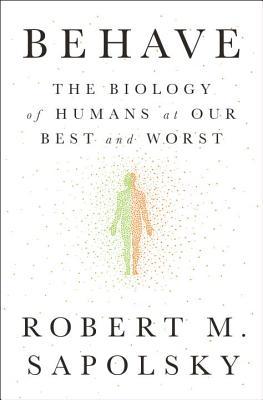
Behave: The Biology of Humans at Our Best and Worst by Robert M. Sapolsky

Hardcover, 790 pages Pub May 2nd 2017 by Penguin Press ISBN13: 9781594205071

Whatever your discipline of study, this book has some degree of relevance, considering as it does human biology. I wish to convey that this book is aspirational for everyone, even the author himself. He readily admits to gaps in his/our knowledge about human biology, but he tries to give us, in this mighty interdisciplinary work synthesizing a lifetime of observation and thought, the current state of knowledge and points to areas for further study.

Don’t be intimidated by its size or erudition. The author is amazing but he has always been approachable. Just flip through, stopping where something catches your eye. You will find yourself absorbed, amazed, provoked. Notice the chapter headings: the last several chapters are about humans doing the right thing…or not. The first several chapters reference those later chapters, showing how what he is telling us is related.

What we do and how we act is related to our biology..all of it…like neurobiology, endocrinology, genetics, the relevance of which he attempts to be very careful and specific about explaining. He goes back in time, bringing in examples from our ancient history to show how things have changed and how culturally conditioned our reactions and responses are to stimuli. Each chapter ends with a summary, and the book ends with insights he has developed over years of study.

Skim these to see if there is something more you wish to pursue. The studies he discusses in each section are referenced by authors focusing on different aspects of human knowledge and you may already be familiar with them. The concepts explored underpin much of what we understand about human behavior and morality. The work of Steven Pinker, cognitive scientist and currently professor of psychology at Harvard, is described by Sapolsky as “monumental” and is given its own critique late in this book.

Sapolsky is not arrogant. He writes this book not to show off his knowledge, but to share his knowledge, which is why he tries to make it as readable as possible without dumbing it down. It is a work to be grateful for. One of the more moving moments in the work comes near the end, after over 600 pages of science and Sapolsky is talking about doing the right thing. He introduces us to Anglican cleric John Newton, born in 1725.

Newton composed the hymn “Amazing Grace” but that is not what Sapolsky wants to tell us. Newton is remembered as an abolitionist, mentor to William Wilberforce who worked through parliament to outlaw slavery in the British Isles. But he didn’t start out that way. Read the story for yourself--plan to read the whole back-end of the book because you won’t be able to stop with Newton—about individuals, ordinary individuals making a difference and doing the right thing.

Sapolsky may be a great scientist, but he is great writer and a great teacher. He makes us think and challenge our own assumptions. He tries to answer questions as they arise and he does not intentionally obfuscate. He does not dodge and only occasionally dismisses, and only then when an argument falls of its own weight.

If you wish you had the background to soak up everything he says but do not, go for one of his earlier books which he wrote as a younger man, less burdened by all he has studied. They display his trademark intelligence and humor and are as much fun as a barrel of monkeys book on baboons.


You can buy this book here: Shop Indie Bookstores

Wednesday, March 1, 2017

There Once Lived a Mother Who Loved Her Children, Until They Moved Back In by Ludmilla Patrushevskaya

Paperback, 181 pages Pub October 28th 2014 by Penguin Books (first published 2002) ISBN13: 9780143121664

Not long ago I reviewed a short memoir published by Petrushevskaya, The Girl from the Metropol Hotel: Growing Up in Communist Russia, in which I mused about rumors of her talent, never having read any of her poetry, stories, or novelettes. Petrushevskaya has a savage humor borne of long deprivation. Her work bears signs of torture of the spirit; she recognizes how to cannily exploit human weakness to stay alive. But she also has a huge umbrella of compassion which she holds over those she loves. Reading her work is a breathtaking experience.

This collection is comprised of a novelette, "The Time is Night," and two shorter stories. The work altogether expresses every feeling of love, desperation, hope, and bitter despair that a mother can feel about her children in any country in any time. It is an epic, deeply funny, excoriating look at how the deprivations in Russian social, political, and economic life have worked loose the traditional bonds of family. It is compulsive reading. The work was published in Germany before it could be published in Russia, having been banned there.
"It all seems like yesterday. I look back on my life—men are like roadsigns, children mark chronology. Not very attractive, I know, but what is, if you look closely?"
A proud poet finds herself destitute in late middle age. Her son is in prison for theft (and maybe murder) and her daughter keeps showing up pregnant and wanting more than the poet has to spare. The poet takes her daughter’s first child to care for and continues to suffer ungrateful visits from her children whenever they need something. Anna Summers, translator for this series of stories, tells us in the Introduction that
"…her heroines are tired, scared, impoverished women who have been devastated by domestic tragedies and who see little beyond the question, How to raise a child? How to feed it, clothe it, educate it when there is no strength left and no resources?"
When "The Time is Night" was finally published in Russia, it came out at the same time as the third piece, "Among Friends.” "Time…" is a novelette, its length over one hundred pages; "…Friends" is less than thirty pages, outlining a grotesque collection of viperish friends and former spouses, all calculating how and what they can score from knowing someone but paying no attention to the larger world outside their immediate purview. The incestuous theft and jealousy rife within the group is ghetto poverty: no one can break free of the poisonous atmosphere because they need each other. The story is a short quick shard that cleaves the heart, and leaves the reader gasping: it speaks directly to what some feel they must resort to “protect” their children.

The second story, "Chocolates with Liqueur," is the one written the most recently (2002). Summers tells us it was written as a tribute to Edgar Allen Poe. The story itself is broken into five parts; I thought the story was complete after the first part which contains the most horrendous and coruscating engagement scene I have ever encountered, without us knowing it is just a continuation of the theme of how difficult it is to find a place to live. The atmosphere gets thicker, darker, and heavy with motive as befits a Poe tribute, and finishes pointing to "The Cask of Amontillado," thought to be Poe’s best short story. In that story Poe created a family motto suggesting that the family history is filled with acts of revenge: "Nemo me impune lacessit" (No one attacks me with impunity). Find Petrushevskaya's story somewhere and read it. It feels positively ancient, as though this were a story written at the dawn of time.

The twist in the nature of marriage and family comes from the search for a safe place in a society where food, lodging, dignity are in short supply. Petrushevskaya is controlled She has seen it all and still gives us art. I don’t know which of these stories I like the best. She deserves all the awards and all the adulation. She is extraordinary.


You can buy this book here: Shop Indie Bookstores

Monday, February 13, 2017

The Girl from the Metropol Hotel: Growing Up in Communist Russia by Ludmilla Petrushevskaya, translated by Anna Summers

Paperback, 176 pages Pub February 7th 2017 by Penguin Books ISBN13: 9780143129974

Ludmilla Petrushevskaya was born in Moscow in 1938. The Girl from the Metropol Hotel is a short memoir of the time after her twenty-seven-year-old mother finished university and returned to her grandparents' house after four years away to bring Ludmilla back to Moscow. Ludmilla was on the streets by then, having ‘escaped’ the poverty of her grandparents’ upbringing in Kuybyshev.

On the street in Kuybyshev, Petrushevskaya took cold-eyed account of what she could sell to earn enough money to eat. She sang, and recited poetry. After one particularly moving rendition of one of Gogol’s short stories, a weeping woman in a large empty apartment offered her a green cardigan, which she took, a little perplexed, and not especially grateful. She wore it every day.

Petrushevskaya is said by some to be one of Russia’s greatest living writers. I had never heard of her. I always have some confusion in my own head about a repressive regime and the awards it grants: do the things a regime praises have the same currency out of country? In this case, I believe so, as she has been living outside of Russia for decades. It is said that in Russia Petrushevskaya was blacklisted in the 70s, was published in the 80s, and awarded in the 90s.

I think the citizenry must make their decision, and whomever is read and praised among the citizenry is a good choice for longevity of reputation, particularly in Russia. Russians have a brilliant literary tradition, including important satiric writers who were long-suppressed. Russians know all about the importance of language and how it can move one.

The same way Petrushevskaya looked upon her chances as a child on the streets is the kind of voice she uses in this memoir. She is matter-of-fact and does not at all curry our sympathies for a cold and hungry childhood. Everyone she knew was the same. There was no feeling sorry, just being more clever, more lucky, more resilient. To live by one’s wits requires keen attention, which must be how her writer’s eye developed. Whatever had value in a certain scene is something worth remembering.

Petrushevskaya is also known as a playwright, and there is a bit of a playwright’s multiplicity of voice in her memoir as well. She is able to see points of view and where they diverge, defining conflict. She has been writing from Eastern Europe and America since the 1990’s, though she recently began composing new lyrics for songs she likes and is singing on a cabaret circuit, that sometimes includes major venues like Moscow House of Music, around Russia.

Three books of stories have received wide acclaim, and The New Yorker published three. Her stories are said to be known for a fairytale quality, urban legend, or perhaps dark reports from a mystical, allegorical fantasy world. The books titles might give readers some idea of her grim realism: There Once Lived a Girl Who Seduced Her Sister’s Husband, and He Killed Himself: Love Stories, and There Once Lived a Woman Who Tried to Kill Her Neighbor’s Baby , and her latest to be translated, There Once Lived a Mother Who Loved Her Children, Until They Moved Back In.

Moments of real pathos in this memoir are written (and spoken in the audio version) with no pathos. Like anyone who has experienced the trauma of revolution or war, if one manages to survive, one often just gets on with it—with the business of living. Not another second will be spent wasted by looking back and stemming one’s forward progress with regret.

The audio was narrated by Kate Mulgrew, produced by Penguin Random House. Anna Summers did the translation and has written an Introduction which gives readers some background, in case, like me, you’d never heard of Petrushevskaya.

Below please find a short excerpt of Kate Mulgrew's reading of the memoir:


You can buy this book here: Shop Indie Bookstores

Friday, January 13, 2017

You Can't Touch My Hair by Phoebe Robinson

Paperback, 320 pages Published October 4th 2016 by Plume Books Original TitleYou Can't Touch My Hair: And Other Things I Still Have to Explain ISBN13: 9780143129202

We may not be in a post racial society but I tell you what: when funky, funny Phoebe can tell us what white people do that makes her crazy, and why she doesn’t want to be anybody’s token black friend, I think we’ve moved the needle since the last century. I remember the first time an African man told me that the only pictures he’d had taken in his years of graduate school were those taken by a Singaporean man who knew how to get the camera to register his skin color and expression. Robinson says something similar here: maybe it’s best if we first acknowledge a color difference before we declare it doesn’t matter.

Robinson does plenty of things in this “breakout book deal” but the thing that drew me in was the chance to learn, unfiltered, how black women had such dope-fantastic hair while white folk have to make do with boring thin stuff that flies away and looks pretty much the same everyday, no matter what we do to it. I first learned a little about the time and energy and money serious black hair coiffeurs require in Chimamanda Ngozi Adichie’s novel Americanah, but now I think I get it. And no, I don’t think anyone should have to do this so that other folks will love them more. It is, however, an art form, another art form that black folk have created, perfected, and strutted.

Shonda Rhimes, in her book Year of Yes, tells us as a teen she tried to get her hair looking like Diana Ross every morning before classes. I did the same thing with some magazine model or other whose look was so far from mine that a million years of evolution wouldn’t have changed that difference between us. It is definitely not worth the effort. And the “creamy crack” or “crack cream” sounds positively dangerous. Forget it immediately. Get a wig if you want to toss straight hair so much and definitely don’t subject yourself to chemical burns. Come on. If that is what’s required, f- them. I wouldn’t do it. Who the heck is calling the shots here?

When Robinson describes a bedroom scene where the woman is wearing an elastic do-rag to protect her afro and she insists that a real man would still get a boner regardless, I laughed all right. But then it occurred to me that is the definition of drop-dead sexy: strong and sexy, when black womanhood doesn’t even need to fling her hair around to get to home base. She commands the stage. I’m impressed. Personally, I’d kill for the simplicity of a close crop and call it quits. But I ain’t no Phoebe Robinson.

Jessica Williams, Phoebe’s “work wife,” writes the introduction to this book. Williams was a writer/correspondent on The Daily Show and now the two perform standup at various locations in Brooklyn and work a podcast (WYNC) called 2 Dope Queens. Robinson had a vision of where she wanted to go and to that end began a blog called Blaria in 2014. When the Robinson and Williams standup routine started to take off, a new piece in the NYT tried to keep track. Robinson also has a talk-show style podcast she started last year called Sooo Many White Guys. She's angling for Oprah's job, and I think she's becoming a worthy successor. She certainly has drive.

If the material is sometimes juvenile, well, juvenile can be funny. There is one thing that may eventually limit the range of the women, though: all their references for jokes relate to TV or movies. When it works, it’s very good indeed, but not everyone is so deep into popular culture, or have looked at it with such seriousness and depth of understanding. It is fascinating to watch Robinson deconstruct an old movie like a college professor does a piece of literature, but then our mind starts thinking…what else can this woman do that would be—less fun, maybe—but more important?

Then I remember what she is doing, desensitizing race relations, telling white folk what bothers black folk, sharing some intimacies and some vulnerabilities, and I realize she is doing exactly what she needs to be doing right now, and she is doing it funny, she is doing it sexy, she is doing it in braids, in long soft curls, in dreads, and in a bust-'em afro. She’s strong, she’s sexy, she’s outspoken, and she’s unstoppable now. I’m a fan.

2 Dope Queens 2016 holiday podcast on YouTube:


You can buy this book here: Shop Indie Bookstores