Showing posts with label Henry Holt. Show all posts

Monday, April 20, 2015

Columbia University's 2015 Pultizer Prize Announcement

Twenty-two winners in twenty-one categories are announced today. My reviews of some of the finalists and winners are attached below the announcement.


Nonfiction
The Sixth Extinction: An Unnatural History by Elizabeth Kolbert
No Good Men Among the Living by Anand Gopal
TheAge of Ambition by Evan Osnos

Fiction
All the Light We Cannot See by Anthony Doerr

Links to all the prizes and mentions are here.


You can buy this book here: Shop Indie Bookstores


Thursday, January 15, 2015

The Sixth Extinction by Elizabeth Kolbert

The Sixth Extinction: An Unnatural History Kolbert’s premise, that we are likely in the midst of the Sixth Period of great extinction in the world’s history, is “a most awful yet interesting” idea, to quote Darwin out of context. Kolbert shares recent (in the past forty years) scientific discoveries, theories, and test results which many of us may not have had a chance to follow with the diligence of a scientist. She is not a scientist but a journalist who has interviewed scientists, and her wonderful easy style makes the science simple for us to understand.

What Kolbert has done here is to overlay a timeline transparency of extinctions over the more commonly known history of the earth’s geologic record and mankind’s progress. Kolbert is merely reporting in this book, not advocating, though the reader comes away with an awakened sense of attention and sense of the irony that man himself may be the instrument of his own destruction.

Kolbert is what could be called a “neocatastrophist.” She believes that the scientific record shows that conditions on earth change only very slowly, except when they don’t---“long periods of boredom interrupted by occasionally by panic. Though rare, these moments of panic are disproportionately important.” Her reportage brings her to the conclusion that we are in the midst of a great extinction and that in the future--far into the future--the geologic record will clearly show something extraordinary happened in the hundreds of thousands of years of human habitation. But it may be visible only to giant rats, the one species she concludes may be likely to survive and thrive.

While at first Kolbert shares current examples of species extinction happening right now, gradually she comes to zero in on probable cause: habitat modification caused by humans. She takes us through a riveting series of investigations scientists around the world are conducting to test how species adapt to changes in environment like carbon dioxide levels, for instance. Since continents are so well-travelled now, there are fewer areas uncontaminated by introduced species which may be invasive or destructive to native species. Kolbert argues that man’s unparalleled and insatiable need to discover, innovate, and change his environment was like “bringing a gun to a knife fight.”
”To argue that the current extinction event could be averted if people just cared more and were willing to make more sacrifices is not wrong, exactly; still, it misses the point. It doesn’t much matter whether people care or don’t care. What matters is that people change the world.”
That is not to say that we couldn’t slow the event down a little, at least for humans, if we began to pay attention at this point. “As soon as humans started using signs and symbols to represent the natural world, they pushed beyond the limits of that world.” We are just witnessing and documenting the outcomes now.

Kolbert writes “Though it may be nice to imagine there once was a time when man lived in harmony with nature, it’s not clear that he ever really did.” Perhaps American Indians with their roaming, nomadic habits, no fixed abode, and principles including commune with nature and not taking more than they needed to survive, may have been the last great environmentalists. They had a light footprint, didn’t they? Or am I completely wrong about that?

In the last couple of paragraphs, Kolbert points out that some scientists are seriously considering reengineering the atmosphere by scattering sulfates in the stratosphere to reflect sunlight back to space, or alternatively, to decamp to other planets. That, so far, is their best work. Perhaps if we just cut back on consumption, and left fossil fuels in the ground, we’d live long enough to figure out a better option.

Kolbert’s thesis ought to spark discussion, if nothing else. But we may be also witnessing the real-time devolution of our own species…no talk, no compromise. Get my gun.


You can buy this book here: Shop Indie Bookstores

Sunday, November 23, 2014

No Good Men Among the Living by Anand Gopal

Finally we have a journalistic nonfiction big and detailed enough to show the humanity behind the war in Afghanistan. I knew it could be done, had been done in fact, beginning with Rory Stewart’s chronicle of his walk though Afghanistan in 2002 just as the Taliban government fell. That book, The Places in Between, stands as the clearest, most in-depth view of the people and places with whom America has been involved for a decade. This book by Anand Gopal goes in that class. I am eternally grateful to both men for finally exposing for us the beating heart of Afghanistan.

Gopal’s exceptional journalism didn’t take hold of me at first. At first I was cringing at what I know to be true: that our military, acting on orders from above, landed in Afghanistan like creatures from outer space. They were good people, all, but their mission was undoable. They had no idea what was going on, who to trust, and how best to fulfill their mission, i.e., to kill or capture Osama bin Laden. The people shifted. The mission shifted. Our soldiers struggled, and we got reports of raids gone wrong. No wonder. Gopal tells us now how any American mission could never have worked in an Afghanistan as torn and bloodied as it was in 2001.

This is the absolutely indispensable companion book to other books recounting American involvement in Afghanistan. The confusion on the ground was experienced by everyone, not just soldiers: no one knew whom to trust, who to follow, who to support. If you ever wondered who, in fact, is in Guantanamo, you have to read Gopal’s chapter “Black Holes.” By the time you have finished this chapter, you must see the absurdity and madness in the fog of war. “You survived one way and one way only: through the ruthless exploitation of everyone around you.” Men under fire just act like men after all.
"Dr. Hafizullah, Zurmat’s first governor, had ended up in Guantanamo because he’d crossed Police Chief Mujahed. Mujahed would up in Guantanamo because he’d crossed the Americans. Security chief Naim found himself in Guantanamo because of an old rivalry with Mullah Qassim. Qassim eluded capture, but an unfortunate soul with the same name ended up in Guantanamo in his place. And a subsequent feud left Samoud Khan, another pro-American commander, in Bagram prison, while the boy his men had sexually abused was shipped to Guantanamo. No one in this group had been a member of the Taliban or al-Qaeda."

The most affecting portrait Gopal shares is that of Heela, the Kabul University-educated wife of a UN worker in a farming village in Uruzgan. Her story illustrates the confusion and prejudice suffered by provincial residents though the period of the first election in 2004. A changing series of governors, and officials, each murdered by the one before, left in place one of the most ill-tempered and combative.
“this whole land is filled with thieves and liars…”--Hajji Zaman.

It takes one to know one.

Gopal gives us in-depth views from a Taliban leader, warlords, militiamen, fathers, husbands, wives, collaborators, militants, prisoners, and tribal leaders, but three portraits in particular: "Akbar Gul, a Taliban commander who quit after 2001, only to rejoin the movement and become an insurgent commander fighting against the U.S.; Jan Muhammad, who rose from humble origins to become a major warlord who worked closely with American forces; and Heela, a housewife from Kabul who fled to the countryside to escape the civil war."

These people we understand. Gopal allows us to see their motivations, their striving, their joys, their defeats. The dangers involved in the reporting is only mentioned in passing, but in a country where seismic shifts in alliances is everyday, it is a gift to have a journalist curious and capable enough to have done this work. An interview of Gopal with TurkeyAgenda gives his thinking about the book.

This book was a Finalist for the 2014 National Book Award for Nonfiction and a Finalist for the 2015 Pulitzer Prize for General Nonfiction.


You can buy this book here: Shop Indie Bookstores

Saturday, November 8, 2014

No Place to Hide by Glenn Greenwald

No Place to Hide: Edward Snowden, the NSA, and the U.S. Surveillance State Snowden and Greenwald were afraid the information they’d risked everything to expose would be ignored or shrugged off by the public, so inured are we to the pervasiveness of “threats” and its counterbalance “surveillance.” In one of the later chapters, Greenwald addresses the idea of privacy, and why we need it:
“Only when we believe that nobody else is watching us do we feel free—safe—to truly experiment, to test boundaries, to explore new ways of thinking and being, to explore what it means to be ourselves…it is in the realm of privacy where creativity, dissent, and challenges to orthodoxy germinate.”
This statement contains both the reasons for and reasons against the massive state surveillance program executed under the aegis of the National Security Agency.
“We shouldn’t have to be faithful loyalists of the powerful to feel safe from state surveillance. Nor should the price of immunity be refraining from controversial or provocative dissent. We wouldn’t want a society where the message is conveyed that you will be left alone only if you mimic the accommodating behavior and conventional wisdom of an establishment columnist.”

The last two chapters of this book are extraordinarily thought-provoking: Greenwald shares his thinking on privacy and the purpose of journalism, or "the fourth estate." He is clearly angry, but his anger serves a purpose. Greenwald won several awards for his reporting on Snowden, including being named one of 2013's Top 100 Global Thinkers by Foreign Policy magazine (along with Snowden). The last two chapters of this book tell us why.

Elsewhere in the book Greenwald discusses meeting Snowden and introducing him to the world and he shares some actual screenshots of the material provided to him by Snowden. Undoubtedly some of this material and the accompanying discussion of it will help bad actors realize the extent of U.S. oversight of their activities, and allow them to think of ways to evade detection. In that sense, this has undone some of what our security agencies have put in place.

But neither Greenwald nor Snowden are traitors in the absolute sense. Mass surveillance itself makes detecting and stopping terror more difficult. There is too much information. These two shined a light on that important caveat. Greenwald and Snowden also reveal how the machinery of protection can and is being used alternatively…to obtain economic, financial, and political advantages, e.g., trade data, negotiation talking points, private correspondences between a foreign leader and her advisors…and how it can be used to monitor us, should the need arise.

We may not feel the danger now, said the frog in the warming pot. But the danger is clear, all completely beside the fact that individuals within the surveilling organizations have access to the data, anytime, anywhere. “People are willing to dismiss fear of government overreach when they believe that those who happen to be in control are benevolent and trustworthy.” How many of us can say this for successive political administrations that change party affiliation?

But what is monstrously clear to me is large numbers of people involved in instituting and executing the series of programs revealed by Greenwald and Snowden believe they are “protecting the state,” when in fact they may be doing the opposite. In the past I recall wondering how mass delusion was possible. Isn’t this another case of the phenomenon? The convincing arguments about fixing security failures have given way to clever folks believing “collect it all” is in the public interest. How they can believe it day after day, year in year out must be that their education and their economic livelihood are tied up in it: all high tech entities are involved. The system becomes inescapable. And they can’t talk to anyone about it.

I think Greenwald makes an eminently reasonable argument when he says that we have made the threat of terrorism an argument for dismantling the very protections that make our system of government so unique and so exceptional and so universally admired. We go to the dark side on that path. We have other examples of countries that have made such choices, some still operating today. I do not think that should be our goal.

Greenwald defines the concept of the “fourth estate” thusly: “those who exercise the greatest power need to be challenged by adversarial pushback and an insistence on transparency; the job of the press is to disprove the falsehoods that power invariably disseminates to protect itself. Without that type of journalism, abuse is inevitable.”

Regarding journalistic objectivity, Greenwald is blunt: “The relevant distinction is not between journalists who have opinions and those who have none, a category that does not exist. It is between journalists who candidly reveal their opinions and those who conceal them, pretending they have none.” I admit that has been an issue that has bothered me for years, having discovered a remarkable lack of objectivity in newspapers even in choosing which stories to run and which to withhold.

The final chapter in this book is a mighty indictment of the powerfully connected U.S. media establishment and celebrity reporters and finally tells me why Snowden went to Greenwald with his information, as opposed to any other news organization. It also relaxes to a certain extent the tension I experienced at the beginning of the book upon learning of Greenwald’s adversarial and aggressive stance, though I can’t help but worry that I am now being managed by Greenwald.

I think everyone can agree that Snowden, Poitras, and Greenwald are brave folks. Whatever else folks have been calling them, that, at least, is the truth.


You can buy this book here: Shop Indie Bookstores

Tuesday, October 21, 2014

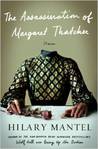
The Assassination of Margaret Thatcher by Hilary Mantel

The Assassination of Margaret Thatcher Mantel, eerily observant and wickedly funny, is a strange combination of self-conscious fear and lashing wit. Faced with her precision, I am reduced to the inarticulate: a laugh, a sigh, a whispered outbreath, G’ol. Sometimes she uses just a word, an adjective or a verb, that brings a smile, a wince, a world to life: “At six, the steeple-headed Saleem had lost his baby fat, and his movements were tentative, as if his limbs were snappable.”

The story “How Shall I Know You?” speaks directly to my fears. An author is persuaded to speak to a book group outside of London and it is a loathsome destination: her lodging “was not precisely as the photograph had suggested. Set back from the road, it seemed to grow out of a parking lot, a jumble of vehicles double-parked and crowding to the edge of the sidewalk.” The place had a “travelers’ stench…tar of ten thousand cigarettes, fat of ten thousand breakfasts, the leaking metal seep of a thousand saving cuts” recalling her struggle with a biography about a man who accidentally cut his throat while shaving. The author recalls an earlier, presumably more luxurious accommodation:
”In Madrid, by contrast, my publishers had put me in a hotel suite that consisted of four small dark paneled rooms. They had sent me an opulent, unwieldy, scented bouquet, great wheels of flowers with woody stems. The concierge brought me heavy vases of a grayish glass, slippery in my hands, and I edged them freighted with blooms onto every polished surface; I stumbled from room to room, coffinned against the brown paneling, forlorn, strange, under a pall of pollen, like a person trying to break out of her own funeral.”
The story speaks to my fears because I am struck with terror when someone suggests actually meeting an author, or asking them a question. What on earth could I possibly ask? Haven't they already told us what they wanted to say? Good lord, and what, have those x-ray eyes turn in my direction, to withstand that funny, devastating, vampiric wit?

This is a slim collection, beautifully printed with vast spacing and acres of white. There is room for your mind to wander to what she might have said but did not. Mantel uses words in a way that have no precedent. Her vision is unique. Mantel doesn’t need as many words as others often do to convey her devilish vision. You would have thought, if you’d tried to read her award-winning novels about Thomas Cromwell, that she could not write only a little, but you’d be wrong. She can, and she does, here. These are perfect little gems that speak to her (and our) deepest fears, the deepest held secrets of the heart.


You can buy this book here: Shop Indie Bookstores