This delicately-sized debut thriller packs a punch well above its weight. Exquisitely observed, the story focuses on a young boy in a depressed moor town and a serial killer who preys on the same. The language and the sentiments feel real, and one's attachment to the main character grows in direct proportion to our disquiet as the story unfolds. A first-class debut from a talented author.
Friday, December 17, 2010
Blacklands by Belinda Bauer
This delicately-sized debut thriller packs a punch well above its weight. Exquisitely observed, the story focuses on a young boy in a depressed moor town and a serial killer who preys on the same. The language and the sentiments feel real, and one's attachment to the main character grows in direct proportion to our disquiet as the story unfolds. A first-class debut from a talented author.
Tuesday, November 23, 2010
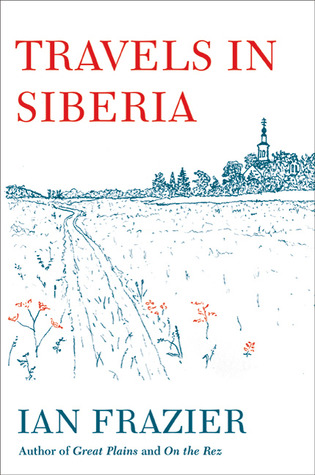
Travels in Siberia by Ian Frazier
Travels in Siberia is BIG, and I thought the vast expanse of white cover particularly appropriate, too--just like the place. It seems peculiar to describe a trip (several trips, actually) across Siberia and say honestly at the end: "nothing much happened," but that about sums it up. For a traveller, nothing (unexpected) happening can be a very good thing, and readers can take heart that we had such a pleasant and wryly funny guide to the biggest country on earth ("too big, really"). I, for one, was very glad Frazier did this trip for me. While I am curious about Siberia post-USSR, I really cannot see myself hiring a van and a translator...Later in the book we read about Dervla Murphy who shows up in Severobaikalsk on a BICYCLE. I made a note to look up that trip report.
By we time we get to the last chapter (Chapter 30) in Travels, we have been steeped in Russian lore for so many pages that the litany of bald facts regarding Russia selling off its enormous resources of natural gas, oil, rare earth minerals, and rare animal parts is sickening and disheartening. We have come to care for Siberia, mistreated and remote as it is, and respect it's plucky population. The exploitation of it's riches seems imprudent, careless, and short-sighted--perhaps even grotesque. We would hope that such an outsized country would have outsized leadership, but this is earth, not heaven. God bless us, every one.
Wednesday, November 10, 2010
Even Silence has an End by Ingrid Betancourt
As an example of its type, the hostage memoir, this book will go down as one of the best. It is a towering achievement to have conceived and written a book like this after one's release, for as fellow captive Clara Rojas wrote in her memoir Captive, "going back isn't easy", even in one's mind, to remember and relive the period of captivity. However, the level of detail about one's daily life in the Amazon jungle is patently fascinating, even to those of us who have no intention of spending any time there. For an explorer, scientist, or government operative, this is required reading.
That a public figure,Ingrid Betancourt, long-shot presidential candidate, could write a book of such power and clarity and filled with personal observations and motivations, reminded me of the only other memoir of similar power in recent memory written by another long-shot presidential candidate, Barak Obama Dreams from my Father. Equally riveting, though entirely of a different character, Even Silence has an End tells us much about the nature of the individual who could observe dispassionately (and sometimes passionately) in the face of complications difficult to imagine: terror, sickness, pain, and boredom.
As I read I became aware of the sometimes poisonous relationships that developed among the hostages and between the hostages and their FARC captors. An earlier memoir I'd tried to read, Out of Captivity became immediately relevant, as each book references the authors of the other. As a result, I subsequently read Rojas' Captive, which reminded me of the mind-numbing boredom of my earlier attempt with Out of Captivity. The fight in Colombia between government forces and FARC rebels has always felt out of my realm, and those two books did not make make our worlds intersect in any significant way. Betancourt's book, however, brought that whole world right up close and personal, and I am there: involved, interested, engaged. Clearly Betancourt arouses strong emotions, both support and opposition, even as she did as a captive. But until the opposition can speak with such a clearly rational and obviously humane and--this is critical--a truly interesting voice, Betancourt's version of events is the one I will choose to remember.
That a public figure,Ingrid Betancourt, long-shot presidential candidate, could write a book of such power and clarity and filled with personal observations and motivations, reminded me of the only other memoir of similar power in recent memory written by another long-shot presidential candidate, Barak Obama Dreams from my Father. Equally riveting, though entirely of a different character, Even Silence has an End tells us much about the nature of the individual who could observe dispassionately (and sometimes passionately) in the face of complications difficult to imagine: terror, sickness, pain, and boredom.
As I read I became aware of the sometimes poisonous relationships that developed among the hostages and between the hostages and their FARC captors. An earlier memoir I'd tried to read, Out of Captivity became immediately relevant, as each book references the authors of the other. As a result, I subsequently read Rojas' Captive, which reminded me of the mind-numbing boredom of my earlier attempt with Out of Captivity. The fight in Colombia between government forces and FARC rebels has always felt out of my realm, and those two books did not make make our worlds intersect in any significant way. Betancourt's book, however, brought that whole world right up close and personal, and I am there: involved, interested, engaged. Clearly Betancourt arouses strong emotions, both support and opposition, even as she did as a captive. But until the opposition can speak with such a clearly rational and obviously humane and--this is critical--a truly interesting voice, Betancourt's version of events is the one I will choose to remember.
Friday, November 5, 2010
Every Man in This Village is a Liar by Megan Stack
Stack uses language like a paintbrush in this memoir of her time covering the Middle East and South Asia as a reporter for the L.A. Times. In fact, she became a foreign correspondent by accident: being in Europe when the Twin Towers fell, she stumbled into Afghanistan. Throughout the book I have highlighted passages that capture light:
The final chapter of Stack's mideast tour introduces us to a young man in Baghdad in 2006, and if her description of his wasted life doesn't make you grind your teeth in frustration and fury, you have already passed to the netherworld.
"I left Afghanistan--the light that falls like powder on the poppy fields, the mortars stacked like firewood in broken-down sheds at the abandoned terror compounds, the throaty green of the mineral rivers. In the back of the car, I stared into a scrubbed sky as empty plains slipped past."And then this:
"And then I was at my mother's house in Connecticut, walking known floorboards, the same naked trees in the windows, blocked by familiar walls. The silence of the house screamed in my ears, and my bones and skin hung like shed snakeskin that wouldn't fall away."But Stack also captures the sense (or the nonsense) of the Middle East, and in a gut-wrenching final analysis makes the divisions between countrymen in Lebanon sound so much like the deadlock in the current U.S. political situation one wants to wail in sorrow. Instead of transforming the Middle East in our image (George W. Bush's raison d’ĂȘtre), we are becoming more like them.
The final chapter of Stack's mideast tour introduces us to a young man in Baghdad in 2006, and if her description of his wasted life doesn't make you grind your teeth in frustration and fury, you have already passed to the netherworld.
Labels:
adventure,
Asia,
biography,
journalism,
Middle East,
nonfiction,
NYTimes,
publishing,
travel,
war
Friday, October 15, 2010
A Thousand Cuts by Simon Lelic
A Thousand Cuts by Simon Lelic is an outstanding piece of work. It is as direct and in-your-face as an edgy Broadway show, and as searing and unforgettable. In the aftermath of a school shooting, we learn about the basic goodness and humanity of the main character through her actions and by hearing townspeople answer questions she must have posed. At times I found myself imagining the staging--the author gave chapters to different voices, leaving out the questions and presenting only the answers. Though we are not explicitly told who is speaking in each chapter, we are drawn in until there is no doubt who the speaker can be. It is the marvelous lack of words, of explanations, that I like best in this novel. It felt like a completely new, fresh take on our favorite mystery series.
This is an especially timely novel, because it raises the problem of bullying--among kids in schools and among adults in their work environment. Life in a corporation was never so baldly drawn, and one can believe life in a public corporation like the police force would reflect some of the insanity it deals with daily. A lone voice speaks truth to power and we want to stand and cheer, nay, scream that we support her. The author increases the tension inexorably, even painfully, and we want to believe we would do the right thing. But the incivility--we know it is there--is all around us. How did we become so mean to one another? Wasn't education meant to lead to understanding?
The author chose a woman detective in an otherwise all-male police department to parallel the incidents being investigated in a school. Familiar elements of a police procedural remain, but they are so stripped down that they feel suggestions alone and we imagine rest, much like a modernistic Broadway stage. The effect is powerful and chilling in this author's hands, leaving us little comfort and much to fear. Echoes of Vernon God Little by DBC Pierre and Columbine by Dave Cullen came to mind as I read, but this book stands on its own as a marvelous achievement.
Monday, September 27, 2010
Sunset Park by Paul Auster
In Sunset Park the characters are drawn with the swift, sure strokes of a master and are immediately accessible, and likeable. As it happens, I began reading this shortly after I'd begun Franzen's Freedom, on which I was struggling to concentrate. I was struck by the similarities and differences between the beginning of this book and Franzen's. Franzen's novel seemed an overstuffed suitcase, the contents of which we pick up in wonder and put back, curious how these vignettes will become relevant in the long course of the story. Auster's story is more like a briefcase of a story, each item within it immediately obvious in its usefulness to us, the readers. The writing is spare, elegant, propulsive.
The novels are similar in that they tell us of an American family, and a young person becomes an adult as we read. The descriptors echo, one book with another, but I had trouble grabbing hold of Franzen's, while Auster's grabbed ME and kept me up late into the night. Books on fiction writing often say we should "show" and not "tell," but strangely, I felt Franzen was showing and Auster was telling, which is one reason why Franzen's was longer, and more digressive. There seemed nothing extra in Auster's. Franzen's is simply a different style, and yields similar truths about the human condition.
If I had one regret with Sunset Park, it is that we did not see more of Pilar, who, while the youngest person in the story, in the end was the most adult. She seemed extraordinary, and we wanted to see more of the woman who could make grown men laugh, cry, sigh, and lie.
Freedom by Jonathan Franzen
A big book, in every sense. The whole of America is wrapped in its pages--a close, funny, irreverent look at "the way we live now." Funny and tragic at the same time, Freedom is a comedy of manners that can enter the literary canon as a marker for America early in the 21st century, just as the novels of Henry James and Edith Wharton gave us the motivations and beliefs of Americans in the early 20th. What I understood the author was saying is that we have so much freedom to create our own lives and make our choices, but sometimes that freedom is as much of a burden as not having freedom. And that perhaps with all our freedom, our choices are less than laudable, and feel more like mistakes. Maybe we're not doing such a bang-up job of making good citizens despite our unprecedented learning and wealth. We may have an inkling of what we ought to do, but we never seem to choose that particular option. Franzen has the young ones of the Berglund family, Jessica and Joey, looking with dismay at the choices their parents have made, but it is just a matter of time—they have had less time to make their own choices—and mistakes. No one political party comes off looking attractive after Franzen lays waste to their point of view, showing the absurdity of the rhetoric spewing from all sides. But the author clearly believes we have a responsibility to do the moral thing--a thing we already know but "choose" not to do. It is a human failing, but in this book, it has a particularly American flavor.
The book was frustrating and irritating to begin, for I felt much impatience with the long discussion of Patty's college years. I can attest to the kind of naiveté Patty exhibited in high school with her neighbor boy and in college with her stalker girl, but as an adult, the painful examination of old mistakes and errors in judgment felt like a reliving old wounds. The narrative and my sense of involvement changed, however, when Richard was introduced. The scene where Patty changes her interest from Walter to Richard felt all too real. Which one of us has not experienced the pain and humiliation of a potential lover lusting after our best friend? From whichever angle--the foolish luster, the cool lusted-after, or the poorly-done-by loser, it is an oft-played, excruciatingly painful memory, and when Franzen brought us there, he got my attention. From that point on, we regularly and ruefully see ourselves, our friends, our enemies, our families struggling to gain control of our lives, make decisions, and then overcome the results of poor decisions. With all the freedom we have to choose any direction, we often choose a wrong direction, the author seems to be saying. Judging from the recognition with which I read the novel, I've been there more times than I care to admit.
Subscribe to:
Posts (Atom)